Abstract
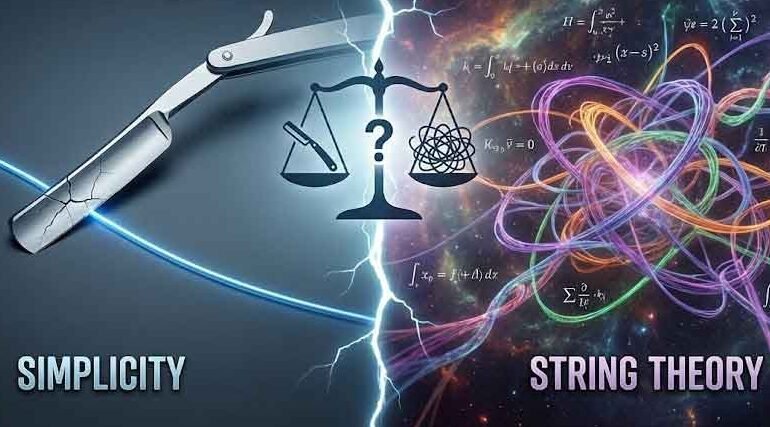
Occam’s Razor — the principle that entities should not be multiplied beyond necessity — has functioned as one of the foundational heuristics of Western science since the medieval period. Its utility in guiding theory construction, pruning speculative excess, and adjudicating between competing explanations of equivalent explanatory power is well established. Yet the extraordinary complexity of contemporary theoretical physics, and string theory in particular, raises pressing philosophical and methodological questions about whether parsimony remains a viable guide at the frontier of fundamental physics. This paper examines the historical origins and epistemological status of Occam’s Razor, traces its role in classical and quantum physics, and then interrogates its collapse — or at minimum its radical transformation — when confronted with the technical and ontological demands of string theory, the landscape of 10⁵⁰⁰ vacua, M-theory, and multiverse cosmology. Drawing on the critiques of Lee Smolin, Peter Woit, Sabine Hossenfelder, and Marco Masi, as well as responses from the string theory community, this paper argues that the failure of parsimony in theoretical physics is not merely a technical inconvenience but a profound symptom of a deeper epistemological crisis — one that demands a reconceived philosophy of science adequate to theories that may forever exceed the reach of direct empirical verification.
I. The Razor and Its Origins: Entia Non Sunt Multiplicanda
The principle we now call Occam’s Razor has a genealogy considerably more complex than its popular formulation suggests. William of Ockham (c. 1287–1347), the English Franciscan friar and scholastic philosopher from Surrey, did not write the exact phrase most frequently attributed to him. The celebrated Latin formulation — Entia non sunt multiplicanda praeter necessitatem (“Entities must not be multiplied beyond necessity”) — appears not in Ockham’s surviving texts, but in a 1639 commentary by the Irish Franciscan philosopher John Punch (Johannes Poncius) on the works of Duns Scotus (Stanford Encyclopedia of Philosophy, 2020). Ockham did, however, write variants that convey the same spirit, such as Numquam ponenda est pluralitas sine necessitate (“Plurality must never be posited without necessity”), found in his theological work on the Sentences of Peter Lombard (Wikipedia, “Occam’s razor”).
What Ockham expressed was a deep commitment to ontological parsimony rooted in his broader nominalist program. His nominalism held that universals — abstract entities like “humanity” or “justice” — possess no independent existence outside the mind; only particulars are real. From this metaphysical stance, Ockham developed an epistemological discipline: refrain from positing entities unless there is compelling empirical or scriptural reason to do so. As the Stanford Encyclopedia of Philosophy notes, “Ockham’s Razor, in the senses in which it can be found in Ockham himself, never allows us to deny putative entities; at best it allows us to refrain from positing them in the absence of known compelling reasons for doing so” (SEP, 2020).
This distinction matters enormously for what follows. Ockham’s razor was not a decree against complexity; it was a prohibition against unnecessary complexity — against the kind of speculative proliferation that Ockham witnessed in the over-refined scholasticism of his era, where “formalities” multiplied without constraint. The razor was a disciplinary tool, not a metaphysical axiom. It presupposes that we can judge what is necessary, which, as this paper will argue, becomes deeply problematic in the context of modern theoretical physics.
Isaac Newton restated the principle in the Principia Mathematica (1687/1713) in terms that have shaped scientific practice ever since: “We are to admit no more causes of natural things than such as are both true and sufficient to explain their appearances” (Masi, The Dangers of Occam’s Razor, PhilArchive). Einstein, in formulating Special Relativity, similarly invoked parsimony — removing the unnecessary ether — and quantum mechanics, in its early development by Planck, Heisenberg, and de Broglie, also reflected Occam’s principle: reduce assumptions, eliminate redundant frameworks, seek the minimal formal structure that accounts for the observed phenomena (Wikipedia, “Occam’s razor”).
For the first three centuries of modern science, this strategy worked triumphantly.
II. Occam’s Razor in Classical and Early Quantum Physics: A History of Success
The track record of parsimony in classical and early modern physics is impressive enough to explain why the principle achieved near-axiomatic status. Copernicus replaced the Ptolemaic system’s epicycles — ad hoc additions to an increasingly unwieldy geocentric model — with a heliocentric framework that required fewer assumptions to account for the same planetary motions. Newton unified celestial and terrestrial mechanics under a single gravitational law, eliminating the need for Aristotle’s separate physics of the heavens and the earth. Maxwell consolidated electricity, magnetism, and light into four equations. Each of these revolutions was a triumph of parsimony: fewer entities, fewer assumptions, greater explanatory power.
The pattern continued into the twentieth century. Einstein’s Special and General Theories of Relativity arose partly from the recognition that the luminiferous ether — a complex entity introduced to explain the propagation of light through a vacuum — was unnecessary. By eliminating it and treating the constancy of the speed of light as a fundamental postulate, Einstein derived consequences of breathtaking scope from a minimal set of premises. His famous dictum — “Everything should be made as simple as possible, but no simpler” — captures the spirit of calibrated parsimony: simplicity in service of truth, not as a substitute for it.
In quantum mechanics, the development of the Standard Model of particle physics represents perhaps the most successful application of parsimony in the history of science. The Standard Model accounts for three of the four fundamental forces (electromagnetic, weak nuclear, and strong nuclear), describes the properties of all known fundamental particles, and has been confirmed with extraordinary precision by decades of experimental work. Its crowning validation came in 2012, when the Large Hadron Collider at CERN confirmed the existence of the Higgs boson — a particle predicted by the model decades earlier (CERN, 2012).
Yet this success planted the seeds of the crisis that followed. The Standard Model, for all its power, is widely regarded as incomplete. It does not incorporate gravity. It contains roughly nineteen free parameters whose values must be determined experimentally, not derived from first principles. It offers no explanation for the matter-antimatter asymmetry of the universe, the nature of dark matter or dark energy, or the observed value of the cosmological constant. These gaps made it natural — indeed, felt necessary to many physicists — to seek a deeper, more unified theory.
The search for that deeper theory brought physics to string theory. And there, the principle of parsimony encountered something for which it was entirely unprepared.
III. String Theory and the Assault on Parsimony
String theory arose in the late 1960s and early 1970s as an attempt to model the behavior of strongly interacting particles. By the 1984 “Superstring Revolution,” it had been reconceived as a candidate for a unified theory of all fundamental forces, including gravity. Its core insight is radical and elegant in its way: the fundamental constituents of reality are not point particles but one-dimensional vibrating strings, and the different modes of vibration correspond to different particles. A single type of object — the string — could in principle account for the entire zoo of particles and forces, including the elusive graviton. The initial promise was a theory of breathtaking parsimony: everything from one thing.
The complications began almost immediately.
First, string theory requires extra spatial dimensions — either ten (in superstring theory) or eleven (in M-theory) — that are not directly observable. These extra dimensions are compactified, meaning they are curled up at scales too small to detect with current technology. The geometry of this compactification is described by mathematical objects called Calabi-Yau manifolds. Here the first serious problem for Occam’s Razor emerged: there is not one Calabi-Yau manifold consistent with the theory, but an enormous number of them — and each gives rise to a different set of physical laws, different particle masses, different fundamental constants.
The number of theoretically permitted configurations — the so-called “string theory landscape” — is now estimated to have a lower bound of 10⁵⁰⁰, with some research suggesting the true number may be vastly higher (Scientific American, “The String Theory Landscape”; ScienceDirect, “String cosmology and the landscape,” 2017). To appreciate the scale of this number: the total quantum information the entire observable universe can register is approximately 10¹²⁰ (Not Even Wrong, “10,500 Vacua,” 2005). The landscape of string theory vacua exceeds the universe’s informational capacity by a factor so large that the metaphor of a “landscape” is itself misleading — it is an abyss.
Each of these 10⁵⁰⁰ vacua represents a distinct universe with its own physical laws. The immediate consequence is devastating for parsimony. William of Ockham’s razor demanded that we not multiply entities beyond necessity. String theory, in attempting to unify all of physics, has multiplied the number of possible universes beyond anything the medieval friar could have conceived or feared.
The crisis deepened further with the development of the anthropic landscape. Since no theoretical mechanism exists to select which of the 10⁵⁰⁰ vacua corresponds to our universe, some physicists — notably Leonard Susskind, Andrei Linde, and Steven Weinberg — argued that the selection must be made anthropically: we observe the universe we observe because it is the one compatible with the existence of observers. As Susskind’s The Cosmic Landscape (2005) argued, the fine-tuning of the cosmological constant, long one of the deepest puzzles in physics, could be explained statistically if there are enough universes with different constants; we simply find ourselves in one where life is possible. The Academia.edu analysis of the anthropic landscape scenario notes that this move “reinterprets the role and function of scientific knowledge in a quite radical way,” essentially subordinating physics to a form of selection effect reasoning (Academia.edu, “Occam’s Razor: A Problem-Solving Principle in String Theory,” 2016).
Lee Smolin captured the philosophical stakes with characteristic bluntness in The Trouble with Physics (2006): “The scenario of many unobserved universes plays the same logical role as the scenario of an intelligent designer. Each provides an untestable hypothesis that, if true, makes something improbable seem quite probable” (Wikipedia, “The Trouble with Physics”). The comparison is deliberately provocative, but the logical structure it identifies is real: both moves invoke entities beyond the observable universe to explain observed facts. Neither can be tested.
IV. The Falsifiability Crisis: “Not Even Wrong”
Karl Popper’s criterion of falsifiability — the principle that a genuinely scientific theory must make predictions that could, in principle, be shown to be wrong by empirical observation — stands as one of the most influential contributions to the philosophy of science in the twentieth century (Popper, The Logic of Scientific Discovery, 1934). It is a criterion in deep tension with string theory as currently formulated.
The critique from Columbia University mathematician Peter Woit, developed in Not Even Wrong: The Failure of String Theory and the Search for Unity in Physical Law (2006), focuses precisely on this tension. The book’s title draws on a phrase attributed to the physicist Wolfgang Pauli, who applied it to theories so incomplete they could not even be used to make predictions that could be checked against observation. Woit argues that “what many physicists call superstring ‘theory’ is not a theory at all. It makes no predictions, even wrong ones, and this very lack of falsifiability is what has allowed the subject to survive and flourish” (Woit, Not Even Wrong, Basic Books, 2006).
The landscape problem is the technical root of this unfalsifiability. With 10⁵⁰⁰ possible vacuum states, string theory is consistent with essentially any observation. If a particle is found, there exists a string vacuum where that particle should exist. If it is not found, there exists a string vacuum where it should not. The theory cannot be cornered into predicting anything specific about our universe without first solving the vacuum selection problem — and no solution to that problem is in sight. As the Contested Boundaries study in Perspectives on Science (MIT Press, 2015) documents, Peter Woit articulated the concern bluntly: “String theory not only makes no predictions about physical phenomena at experimentally accessible energies, it makes no predictions whatsoever.”
Gerard ‘t Hooft, a Nobel laureate and no enemy of theoretical ambition, acknowledged that while string theory “has not led to genuine explanations of well-known features of the Standard Model,” nor made any “definitely testable predictions,” this is not inherently disqualifying — “such explanations and predictions are still way out of reach for respectable theories.” But the important qualifier is that a respectable theory, even when far from experimental confirmation, should at minimum be structured such that confirmation or falsification is conceivable. Many prominent string theorists and critics agree that this minimal bar is not clearly met by the landscape.
The Large Hadron Collider, which began operations at CERN in 2008, provided the first major empirical test of many string-theory-adjacent proposals. The Higgs boson, predicted by the Standard Model, was confirmed in 2012. But the theoretically motivated extensions of the Standard Model that string theory proponents had championed — particularly supersymmetry (SUSY), which posits a fermionic partner particle for every boson and vice versa — found no experimental support. As Sabine Hossenfelder writes in Lost in Math: How Beauty Leads Physics Astray (Basic Books, 2018): “The LHC hasn’t seen anything that would support our newly invented laws of nature.” The most generous reading of the LHC results is that they confirm the Standard Model and nothing beyond it.
Hossenfelder’s critique cuts deeper than mere disappointment about missing particles. She argues that the theoretical physics community has replaced the discipline of empirical constraint with the discipline of aesthetic preference — with “naturalness,” “elegance,” and “beauty” functioning as substitutes for experimental falsification. The belief in beauty has become, in her words, “so dogmatic that it now conflicts with scientific objectivity” (Lost in Math, Basic Books, 2018). This is, in a precise sense, the inverse of Occam’s Razor: instead of pruning unnecessary entities, beauty has been used to proliferate them — to add supersymmetric partners, extra dimensions, and landscape vacua because the resulting mathematical structures are deemed compelling or necessary on aesthetic grounds.
V. The Inverse Razor: How Complexity Became Its Own Justification
Marco Masi, an independent scholar whose work on the pathologies of parsimony in theoretical physics has appeared in PhilArchive, identifies what he calls an “inverse Occam’s Razor” operating in contemporary theoretical physics — a “worrying trend to favor complex interpretations because they are perceived as more impactful” (Masi, When Occam’s Razor Cuts Too Deep, PhilArchive, citing Mazin, 2022). This inverse operation is not mere carelessness; it reflects structural incentives in academic physics that systematically reward speculative complexity over parsimonious restraint.
The sociology of the problem was diagnosed extensively by Lee Smolin in The Trouble with Physics (2006). Smolin argued that string theory’s near-monopoly over fundamental physics hiring, funding, and publication in the United States created an environment where young physicists felt compelled to work on string theory “whether or not they believe in it — because it is perceived as the ticket to a career” in theoretical physics (Smolin, quoted in comparative review at Science Shelf). The intellectual culture of the field had been captured by a paradigm that was producing elegant mathematics but no empirical predictions — and the sociological machinery of academic physics was reproducing that paradigm generation after generation.
Masi raises a philosophical point that cuts to the heart of the matter: “The delimiting criterion identifying an explanatory construct as ‘parsimonious,’ ‘simple,’ having the ‘fewest assumptions’ and ‘necessary’ or ‘unnecessary entities’ is in the eye of the beholder, not an objective definable requirement, no more and no less than criteria of ‘beauty’ or ‘elegance'” (Masi, When Occam’s Razor Cuts Too Deep, PhilArchive). This observation strips away the false confidence with which parsimony is often invoked. Simplicity is not an objective, theory-independent property; it is relative to a framework, a set of background assumptions, and a community’s sense of what counts as a natural starting point.
String theory provides a striking illustration. From one perspective, it is the most parsimonious theory imaginable: a single type of entity (strings) gives rise to all particles and forces. From another perspective, it is grotesquely baroque: it requires ten or eleven dimensions, an enormous mathematical apparatus, and a landscape of 10⁵⁰⁰ possible universes. The question of whether string theory is simple or complex depends entirely on which features you count and which you discount — and that choice is not determined by the physics itself.
This is what might be called the relativity of parsimony: what counts as the simplest theory depends on which ontological primitives you take as given. Newtonian mechanics seemed simple because point particles and forces were intuitive; string theory seems complex partly because vibrating objects in ten dimensions are not. But the 14th-century scholastics might have found a world of four Aristotelian elements and celestial spheres far simpler than either.
A 2023 paper by philosophers at UC Santa Barbara and UC Irvine, published in Synthese, attempted to operationalize complexity comparisons by using mathematical symmetry as a measure of theoretical structure. After extensive analysis, the authors concluded that while symmetry provides an excellent guide for understanding structure, they ultimately doubted “that symmetry will provide the framework they need” to deliver an objective complexity measure (Barrett et al., On automorphism criteria for comparing amounts of mathematical structure, Synthese, 2023; reported in Phys.org, June 2023). The project of making parsimony rigorous in the context of abstract theoretical physics thus remains unresolved even by its most sophisticated contemporary advocates.
VI. The Landscape Problem and the Anthropic Turn: A Philosophical Reckoning
The resort to anthropic reasoning as a response to the landscape problem deserves careful philosophical examination, because it represents not merely a scientific strategy but a potential redefinition of what science is.
The traditional scientific method, as inherited from Galileo, Newton, and the empiricist tradition, operates within a structure of constraint: theories make specific predictions, experiments test those predictions, and theories that fail the test are discarded. Parsimony functions within this framework as an efficiency heuristic — it guides the selection of theories to test by recommending against unnecessary assumptions. But the framework’s integrity depends on the possibility of falsification. The anthropic principle, as deployed in the string landscape context, disrupts this structure in a fundamental way.
If there are 10⁵⁰⁰ universes, each with different physical laws, and we observe a universe with the particular constants we observe because only those constants permit our existence, then the observed constants are explained — but in a way that makes no predictions about anything else. We cannot observe the other universes. We cannot derive specific numerical values for the fundamental constants from the anthropic argument alone; we can only note that the observed values are within the anthropic window. As the Academia.edu analysis of the landscape scenario notes, this approach essentially “transcends the framework defined by the epistemological and methodological rules which conventionally form the basis of physics as an empirical science” (Academia.edu, 2016).
Physicists and philosophers of science disagree sharply about whether this transcendence is progress or abandonment. Leonard Susskind and Andrei Linde see it as intellectual maturity — a recognition that the universe did not have to be fine-tuned for us, and that the apparent fine-tuning is a selection effect, no more mysterious than the fact that we find ourselves on a planet capable of supporting life rather than one that cannot. Steven Weinberg’s 1987 prediction of a small positive cosmological constant using anthropic reasoning — a prediction later confirmed by the discovery of accelerating cosmic expansion in 1998 — is often cited as evidence that the anthropic principle can make genuine, checkable predictions (Wikipedia, “String theory landscape”).
Critics, however, note that the anthropic prediction of the cosmological constant remains a special case, and that the general anthropic framework is too flexible — it can rationalize almost any observed value, making it nearly immune to falsification. Tom Banks, whose work is cited in the nLab treatment of the landscape, has argued from within the string theory community that the landscape is essentially a dead end: “Skutistic” reasoning about the landscape is unlikely to produce genuine physical predictions because the landscape itself may not have a well-defined probability measure (Banks, Landskepticism, arXiv:hep-th/0412129).
What is at stake, philosophically, is the very definition of scientific explanation. The Popperian tradition holds that an explanation must, at minimum, be structured so that it could be wrong. The anthropic landscape, at its most expansive, appears to be structured so that it cannot be wrong — which is not a virtue but a flaw. As Peter Woit summarized the deepest concern: “At the moment [string theory] is a theory which cannot be falsified by any conceivable experimental result” (Woit, 2001, quoted in Perspectives on Science, MIT Press, 2015).
This is not merely a dispute within physics. It is a crisis in the philosophy of science — a confrontation with the limits of the empiricist tradition and an urgent demand for a more sophisticated account of what it means to explain something when the explanation lies, by construction, beyond the reach of any possible experiment.
VII. Defenders of the Complexity: What the Razor Cannot See
The critique of string theory on parsimony grounds is powerful, but it is not without serious responses. A number of prominent physicists have argued that the critics are applying the razor incorrectly — that they are demanding a kind of simplicity that nature is not obligated to provide, and that they are dismissing a research program that has already produced genuine intellectual dividends.
Sean Carroll, a physicist at the Johns Hopkins University, reviewed Smolin’s The Trouble with Physics with a mixture of appreciation and skepticism. He noted that many key results in string theory — including the finiteness of quantum gravitational scattering and the celebrated AdS/CFT correspondence, Juan Maldacena’s 1997 conjecture that a string theory on anti-de Sitter space is equivalent to a conformal field theory on its boundary — are “supported by extremely compelling evidence, to the point where it has become extremely hard to see how they could fail to be true” (Carroll, Preposterous Universe blog, 2006). The AdS/CFT correspondence has proven extraordinarily fruitful in condensed matter physics and quantum information theory, providing insights into black hole thermodynamics, the holographic principle, and the nature of entanglement — applications entirely unrelated to its original motivations.
This point is important. A research program can be deeply problematic as a theory of fundamental physics while simultaneously generating important mathematical structures with applications elsewhere. The Bogdanov affair notwithstanding, string theory has produced genuine mathematics — mirror symmetry, topological field theory, advances in algebraic geometry — that would not have emerged without it. These mathematical results do not validate string theory as a physical theory, but they suggest that the enterprise is not intellectually barren.
The defense of string theory also raises a point about the time scale of scientific progress. Nobel laureate David Gross, in his closing address at the 23rd Solvay Conference in 2005, compared the current predicament to the state of physics in 1896, after the discovery of radioactivity and before quantum mechanics. Physicists at that time were “missing something absolutely fundamental,” Gross noted — something that took another three decades to find (Science Shelf review of The Trouble with Physics). The absence of experimental confirmation after forty years of effort may reflect the extraordinary difficulty of probing Planck-scale physics — the scale at which string theory operates is 10¹⁵ times smaller than the scale the LHC can probe — rather than the theory’s fundamental untenability.
This is a legitimate argument, and it deserves to be taken seriously. The history of science includes long periods of theoretical development without experimental confirmation. General Relativity was published in 1915 and not definitively confirmed until the 1919 solar eclipse. The theoretical foundations of quantum chromodynamics (the theory of the strong nuclear force) were established in the 1970s, but confinement — the theoretical prediction that quarks cannot be isolated — has never been rigorously proven from first principles and may never be, yet QCD is universally accepted as correct.
But there is a disanalogy that the defenders of string theory must confront. General Relativity, before its experimental confirmation, made specific, falsifiable predictions: the bending of light by gravity, the perihelion precession of Mercury, the gravitational redshift of light. These predictions were derived from the theory, and the theory would have been abandoned if they had failed. String theory has produced no analogous predictions at testable energy scales. The landscape, if it corresponds to physical reality, appears to guarantee that no such predictions can be made — because for any possible experimental result, there exists a string vacuum that would produce it.
The asymmetry between General Relativity and string theory on the landscape view is therefore profound. One was a highly constrained theory with specific, novel, risky predictions. The other is, in the landscape formulation, a framework so flexible it is compatible with essentially any observation. Occam’s Razor cannot adjudicate between them, because the problem is not one of complexity versus simplicity, but of constrained versus unconstrained explanation.
VIII. Beyond the Razor: Toward a Post-Positivist Philosophy of Fundamental Physics
The crisis of parsimony in theoretical physics demands more than a diagnosis; it demands a response. What should scientists and philosophers of science do when the most promising candidate for a unified theory is, in its current form, empirically untestable?
Several responses have been proposed, none entirely satisfying.
One response, advocated by the philosopher of physics Richard Dawid in his book String Theory and the Scientific Method (Cambridge University Press, 2013), is what he calls “non-empirical theory assessment.” Dawid argues that when direct empirical testing is impossible, physicists can still rationally assess theories based on indirect indicators: the theory’s internal mathematical consistency, its unexpected connections to other areas of physics and mathematics, and the historical track record of theories with similar structural properties. In essence, Dawid proposes a Bayesian framework in which non-empirical evidence updates our credence in a theory’s truth. Hossenfelder finds this proposal deeply unsatisfying — it threatens to formalize the very aesthetic criteria she regards as the disease rather than the cure (Lost in Math, 2018).
A second response, proposed by Smolin and others, is methodological pluralism: the physics community should invest more resources in alternative approaches to quantum gravity, including loop quantum gravity, causal set theory, and other background-independent formulations that do not require extra dimensions or a landscape of vacua (The Trouble with Physics, 2006). The near-monopoly of string theory in theoretical physics hiring and funding, Smolin argues, has suppressed potentially fruitful alternatives in ways that may have set back fundamental physics by decades.
A third response, more epistemically austere, is to take seriously the possibility that some questions about the fundamental structure of reality may be permanently beyond the reach of science as currently conceived — not because the answers do not exist, but because the energies required to probe them exceed what can ever be achieved by any conceivable technology. This is not defeatism; it is intellectual honesty. The Planck scale, at 10⁻³⁵ meters, is not merely far from current experimental reach — it may be forever inaccessible to direct probing. If so, the project of testing string theory by particle physics experiments may be permanently out of reach, and the discipline will need to grapple with what kind of knowledge remains possible under these constraints.
The 2023 paper from UC Santa Barbara and UC Irvine in Synthese, which attempted to use symmetry to operationalize Occam’s Razor for abstract theories, reflects a broader philosophical project: to extend the tools of scientific rationality into the regime where empirical testing is difficult or impossible. The paper’s honest conclusion — that symmetry is an excellent guide but may not suffice — suggests that this project remains genuinely open (Barrett et al., Synthese, 2023). The razor must be sharpened, not abandoned; but it may need to be a different kind of instrument than the one William of Ockham forged in the 14th century.
What seems clear is that the encounter between Occam’s Razor and string theory has exposed the razor’s hidden assumptions: that there is a fact about which entities are “necessary,” that simplicity has an objective measure, and that empirical access to the relevant scales is in principle achievable. Each of these assumptions fails at the frontier of fundamental physics. The razor remains a useful heuristic in the middle distance — in chemistry, in evolutionary biology, in cognitive science — where those assumptions approximately hold. At the Planck scale, where the ontological furniture of reality may be vibrating strings in ten dimensions navigating a landscape of possibilities vaster than the universe itself, the medieval instrument may simply be the wrong tool.
Conclusion: The Limits of the Instrument
William of Ockham’s insight was not that nature is simple. It was that explanations should not invoke more structure than the phenomena require. This is a procedural discipline, not a metaphysical claim. It assumes that we can assess what the phenomena require — that they constrain the theoretical options sufficiently to identify some as redundant. In the domain of accessible, testable physics, this assumption has been enormously fruitful. The history of physics from Copernicus to the Standard Model is largely a history of successful parsimony.
String theory, as currently formulated, appears to be a theory in which the phenomena — the entire observable universe — are consistent with 10⁵⁰⁰ different underlying structures. In such a framework, the concept of a “required” entity loses its grip. The razor cannot cut when the space it must cut through is effectively infinite.
This does not mean that theoretical physics has failed. It means that physics has reached a frontier where its traditional epistemological tools require examination and possibly replacement. The failure of parsimony in the string landscape is not primarily a failure of physicists’ imagination or discipline; it is a failure of a philosophical framework that was not designed for the regime it has been asked to operate in.
The deepest response to this crisis is neither to abandon string theory nor to defend it uncritically, but to take seriously the philosophical questions it raises. What does it mean to explain something? What constitutes evidence in the absence of direct empirical testing? What are the limits of human knowledge about the fundamental structure of reality? These are questions that Ockham asked, in a different key, in a different century. They remain unanswered. Their urgency, at the frontier of theoretical physics, has never been greater.
Sources
- Stanford Encyclopedia of Philosophy. (2020). William of Ockham. https://plato.stanford.edu/entries/ockham/
- Wikipedia. (2025). Occam’s razor. https://en.wikipedia.org/wiki/Occam’s_razor
- Wikipedia. (2025). String theory landscape. https://en.wikipedia.org/wiki/String_theory_landscape
- Wikipedia. (2025). The Trouble with Physics. https://en.wikipedia.org/wiki/The_Trouble_with_Physics
- Wikipedia. (2025). Lee Smolin. https://en.wikipedia.org/wiki/Lee_Smolin
- Masi, M. The Dangers of Occam’s Razor / When Occam’s Razor Cuts Too Deep. PhilArchive. https://philarchive.org/archive/MASTOW-2
- Woit, P. (2006). Not Even Wrong: The Failure of String Theory and the Search for Unity in Physical Law. Basic Books. https://www.amazon.com/Not-Even-Wrong-Failure-Physical/dp/0465092764
- Smolin, L. (2006). The Trouble with Physics: The Rise of String Theory, the Fall of a Science, and What Comes Next. Houghton Mifflin.
- Hossenfelder, S. (2018). Lost in Math: How Beauty Leads Physics Astray. Basic Books. https://www.amazon.com/Lost-Math-Beauty-Physics-Astray/dp/1541646762
- Bousso, R., & Polchinski, J. (2004). The String Theory Landscape. Scientific American. https://www.scientificamerican.com/article/the-string-theory-landscape/
- Kachru, S., Kallosh, R., Linde, A., & Trivedi, S. (2003). De Sitter Vacua in String Theory. Physical Review D, 68(4), 046005. arXiv:hep-th/0301240.
- Susskind, L. (2005). The Cosmic Landscape: String Theory and the Illusion of Intelligent Design. Little, Brown.
- Woit, P. (2006). Not Even Wrong blog: The Trouble With Physics review. Columbia University. https://www.math.columbia.edu/~woit/wordpress/?p=451
- Woit, P. (2005). 10,500 Vacua! Not Even Wrong. https://www.math.columbia.edu/~woit/wordpress/?p=210
- Contested Boundaries: The String Theory Debates and Ideologies of Science. (2015). Perspectives on Science, 23(2), 192. MIT Press. https://direct.mit.edu/posc/article/23/2/192/15504
- Carroll, S. (2006). The Trouble With Physics. Preposterous Universe. https://www.preposterousuniverse.com/blog/2006/10/03/the-trouble-with-physics/
- Banks, T. (2004). Landskepticism: or Why Effective Potentials Don’t Count String Models. arXiv:hep-th/0412129. https://arxiv.org/abs/hep-th/0412129
- Krizek, G. C. (2017). Ockham’s razor and the interpretations of quantum mechanics. arXiv:1701.06564. https://arxiv.org/abs/1701.06564
- Barrett, T. W., et al. (2023). On automorphism criteria for comparing amounts of mathematical structure. Synthese. DOI: 10.1007/s11229-023-04186-3. Reported at https://phys.org/news/2023-06-sharpening-occam-razor-perspective-complexity.html
- McFadden, J. (2023). Razor sharp: The role of Occam’s razor in science. Annals of the New York Academy of Sciences. https://nyaspubs.onlinelibrary.wiley.com/doi/am-pdf/10.1111/nyas.15086
- Dawid, R. (2013). String Theory and the Scientific Method. Cambridge University Press.
- Hossenfelder, S. (2018). The trouble with beauty. Physics World. https://physicsworld.com/a/the-trouble-with-beauty/
- ScienceDirect. (2017). String cosmology and the landscape. https://www.sciencedirect.com/science/article/pii/S1631070517300324
- nLab. Landscape of string theory vacua. https://ncatlab.org/nlab/show/landscape+of+string+theory+vacua
- New World Encyclopedia. Ockham’s razor. https://www.newworldencyclopedia.org/entry/Ockham’s_razor