Duck breast is one of those dishes that separates the competent cook from the truly skilled one. On the surface, it looks deceptively simple — a single protein, a classic French sauce, a handful of ingredients that have been paired together for centuries. But there is no hiding behind the technique. Either the skin shatters when you bite into it, or it doesn’t. Either the meat holds a blush of rose at its center, or it doesn’t. Either the gastrique cuts through the fat with surgical precision, or it collapses into something sweet and muddy. The margin for error is narrow, and the result is honest.
Long Island has its own chapter in this story — a long and deeply local one. Starting in 1873 when a New York merchant named Ed McGrath returned from China with Pekin duck eggs, the breed found its ideal home along Long Island’s sandy shorelines, temperate climate, and freshwater streams. By the mid-20th century, Long Island farms were producing roughly two-thirds of all duck consumed in the United States. At its peak, approximately 90 farms operated across Suffolk County, and “Long Island Duckling” appeared on white-tablecloth menus from New York City to Europe. Today, only Crescent Duck Farm in Aquebogue carries that legacy forward — the last remaining Long Island duck farm, still breeding the meatiest, most succulent Pekin ducks on the market after more than a century of operation.
When you source a Crescent Duck breast or a quality Magret from a trusted supplier like D’Artagnan, you’re holding something with genuine provenance. That matters — not as sentimentality, but because the quality of the raw material defines the ceiling of the finished dish. From there, everything comes down to what happens in the pan.
Why Duck Is Not Chicken: Understanding the Fat
Before touching a knife to the skin, it’s worth understanding what makes duck breast anatomically different from every other domestic bird you’ve cooked. A duck is a semi-aquatic animal. That thick layer of subcutaneous fat beneath the skin isn’t excess — it’s insulation, engineered by nature to keep the bird warm in cold water and buoyant during flight. That fat layer is typically three to four times thicker than what you’d find on a chicken breast, and it is the defining challenge of the entire cooking process.
The objective is not to cook the fat — it is to render it out completely, transforming a thick, rubbery layer into a paper-thin, lacquered skin that shatters under pressure. If you rush this phase by cranking the heat, the skin browns on the surface while the fat underneath remains thick and unctuous. The outside burns, the inside stays soft. You end up with something that looks cooked and eats like a mistake.
The science here is straightforward: fat renders through a process of melting, which requires sustained low-to-medium heat and time. When that fat melts and pools in the pan, it creates its own cooking medium — essentially a shallow fry — that gradually crisps the skin from the outside in. This is why the scoring step matters so much. A sharp knife drawn through the fat in a crosshatch pattern, spaced roughly half an inch apart and cutting only through fat and never into the red muscle below, creates pathways for the fat to escape more quickly. More surface area released means more efficient rendering. More efficient rendering means crispier skin.
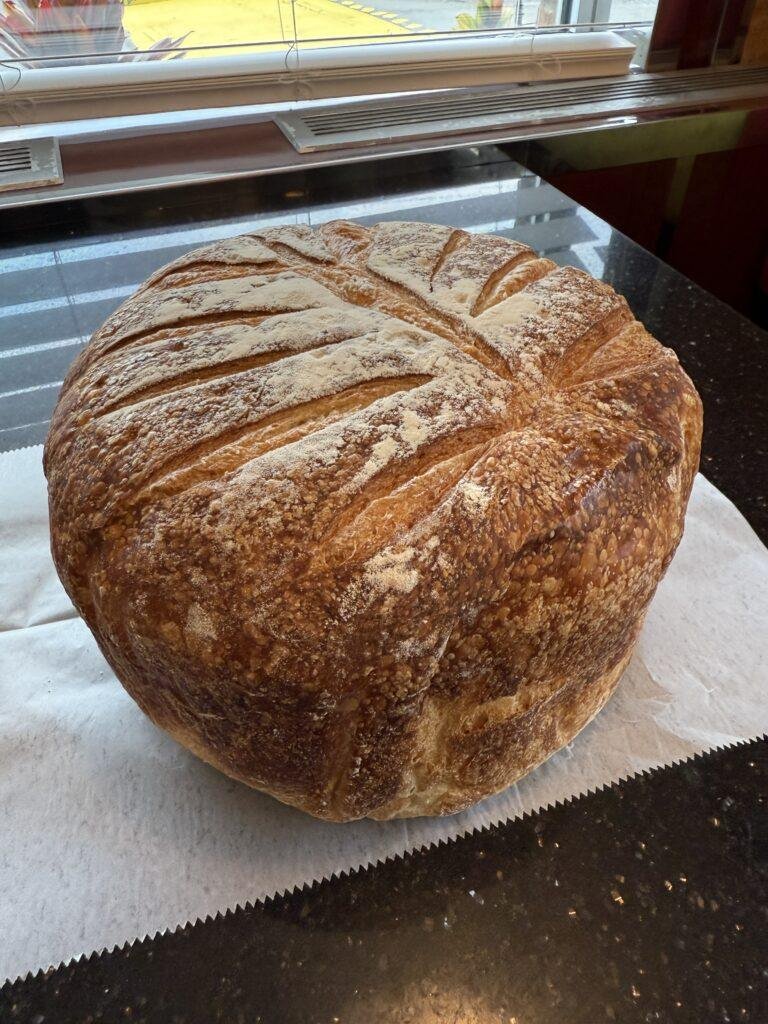
Salt the skin generously before cooking. Salt draws moisture to the surface and then evaporates it, drying the skin further and accelerating the Maillard reaction — the same browning chemistry responsible for the crust on a well-seared steak or the heel of a well-baked sourdough loaf.
The Cold Pan Method: Patience as Technique
Every instinct in a hot kitchen says to preheat the pan until it smokes, then sear. With duck breast, that instinct will ruin the dish. The correct approach is the opposite: place the scored, seasoned duck breast skin-side down into a cold, dry, heavy pan — cast iron or stainless steel, never non-stick — and then turn the heat to medium-low.
Starting cold gives the fat a gradual temperature curve. As the pan slowly heats, the fat begins to melt from the inside out, gently and evenly. By the time the pan is fully hot, a significant portion of the fat has already rendered into the pan. The skin is now cooking in its own duck fat, browning slowly toward that ideal deep amber without scorching. If you were to press start with a blazing hot pan, the outer proteins of the skin would seize immediately, the fat beneath would have no time to melt, and you would be left chewing through a thick, greasy layer topped by a thin burnt shell.
Press the breast lightly against the pan when you first lay it down to ensure full contact across the surface. A bacon press or the flat of a spatula works well. You’ll see fat begin to pool within the first few minutes — this is exactly what you want. Pour off the excess rendered fat periodically into a heatproof container. Do not discard it. Duck fat is culinary gold: silken, deeply flavored, and ideal for roasting potatoes, sautéing vegetables, or finishing savory sauces.
For a standard Pekin or Magret breast, cook skin-side down for 10 to 15 minutes at medium-low heat, adjusting the temperature so the sizzle stays at a steady, confident pace rather than an aggressive sputter. When the skin is a uniform deep golden-brown and has visibly thinned, flip the breast and sear the flesh side for no more than 2 to 3 minutes. Transfer the pan to a 350°F oven for 5 to 8 minutes, or until an instant-read thermometer registers 130°F (54°C) for medium-rare at the center.
Remove the duck from the pan. Rest it on a wire rack — not a cutting board — skin-side up for a minimum of 8 minutes. The rack matters: resting on a flat surface traps steam beneath the skin and softens everything you just worked to achieve. The wire rack keeps air circulating, preserving the shatter.
Building the Cherry Gastrique: The Architecture of Balance
A gastrique is one of classical French cuisine’s most elegant constructs, and it is fundamentally a study in contrast. The word itself refers to a sauce base built from caramelized sugar deglazed with an acid — traditionally vinegar. From that sweet-tart foundation, fruit, stock, and aromatics are added to develop complexity. The result is a sauce that is neither sweet nor sour but something more precise: a deliberate counterpoint to richness.
The pairing of duck and cherry is not arbitrary. Duck is one of the fattiest proteins in Western cuisine. The acids in a properly made gastrique stimulate the production of saliva, which physically clears fatty residue from the palate between bites. The sweetness softens the vinegar’s edge. The natural tannins in dark cherries echo the faint gaminess of the duck meat. Every element is doing measurable sensory work.
To build the cherry gastrique, begin with a heavy-bottomed stainless saucepan — stainless allows you to accurately monitor the color of the caramel, which is your primary visual cue. Add three-quarters of a cup of granulated sugar and two tablespoons of water. Cook over medium heat without stirring, swirling the pan gently as the sugar dissolves and begins to caramelize. Watch the color: pale gold is not enough. You want a deep amber — the color of dark honey or aged bourbon — which signals that the sugars have reached approximately 340°F and developed the bitter, complex notes that give a gastrique its depth. Caramel at this stage smells faintly of toffee and nuts. If it begins to smoke or turn too dark, pull the pan from the heat immediately.
Once the caramel reaches that deep amber, remove the pan from the heat and carefully add a half cup of good red wine vinegar in a slow pour — it will boil violently, which is expected. Whisk to dissolve the caramel back into the acid. Return the pan to medium heat, then add one cup of pitted dark cherries (fresh Morello or Bing cherries in season, or frozen out of season), a half cup of ruby Port wine, and a half cup of duck or chicken stock. Bring to a steady simmer and reduce until the sauce coats the back of a spoon with a glossy, syrupy consistency — roughly 15 to 20 minutes. Taste and adjust: if the acidity dominates, add a small spoonful of honey. If the sweetness feels one-dimensional, a few more drops of vinegar will sharpen it. Finish with a knob of cold unsalted butter whisked in off the heat for gloss and body. Strain if a smoother texture is preferred, or serve with the cherries intact for a more rustic presentation.
The gastrique can be made up to five days in advance and refrigerated. Rewarm gently before serving, adding a splash of stock if it has thickened too much.
The Oven Finish: Even Heat, Controlled Doneness
Duck breast is best treated more like a lean steak than a chicken breast in terms of doneness. Medium-rare — that blush of deep rose throughout the center with a slightly firmer outer layer — is the professional standard, and for good reason. At medium-rare, the muscle fibers remain relaxed and moist, the rendered fat in the meat contributes richness without heaviness, and the texture has a suppleness that well-done duck completely loses. Overcooked duck breast turns gray, chalky, and dense, with none of the qualities that justify cooking with such an expensive and time-consuming protein.
The oven finish after the initial stovetop render is the most reliable way to achieve uniform internal temperature without overcooking the flesh. Finishing in the oven allows heat to circulate evenly around the breast, pulling the center temperature up steadily rather than relying on conductive heat from below, which can overcook the edges before the center is done. The target is 130°F (54°C) at the thickest point for medium-rare, measured with an instant-read thermometer inserted horizontally from the narrow end into the center.
After resting, the temperature will rise an additional 3 to 5 degrees through carryover cooking. This is not an estimate — it is physics. Plan for it.
Sourcing and Seasonality: Building from the Ingredient Up
A dish at this level rewards attention to sourcing. For duck, Crescent Duck Farm’s Pekin breasts are the standard of Long Island heritage — available through select North Shore butchers and specialty food suppliers. D’Artagnan’s Magret duck breasts, sourced from Moulard ducks raised for foie gras production, offer a larger breast with more pronounced flavor, well-suited to this preparation. Whatever you source, look for skin that is uniformly pale, firm to the touch, and without blemishes or tears. The fat layer beneath should be even and thick — this is what you’ll render away.
For the gastrique, cherry seasonality matters. Long Island’s own cherry season peaks in mid-to-late June, and fresh local Bing or sour cherries from North Shore farm stands — the same ones lining Route 25A in late spring — are exceptional. The tartness of a locally grown sour cherry will do things in a gastrique that a commercially packed version simply cannot. Outside of cherry season, frozen dark cherries retain their flavor and acidity admirably and are far preferable to jarred options packed in syrup.
Duck also pairs beautifully with other seasonal fruits — black figs in late summer, Seckel pears and fresh cranberries in autumn, blood oranges in winter. The gastrique technique remains the same; only the fruit and its corresponding acids shift with the calendar. Once you understand the architecture of the sauce, the variations become intuitive.
Plating and Finishing: The Unseen Details
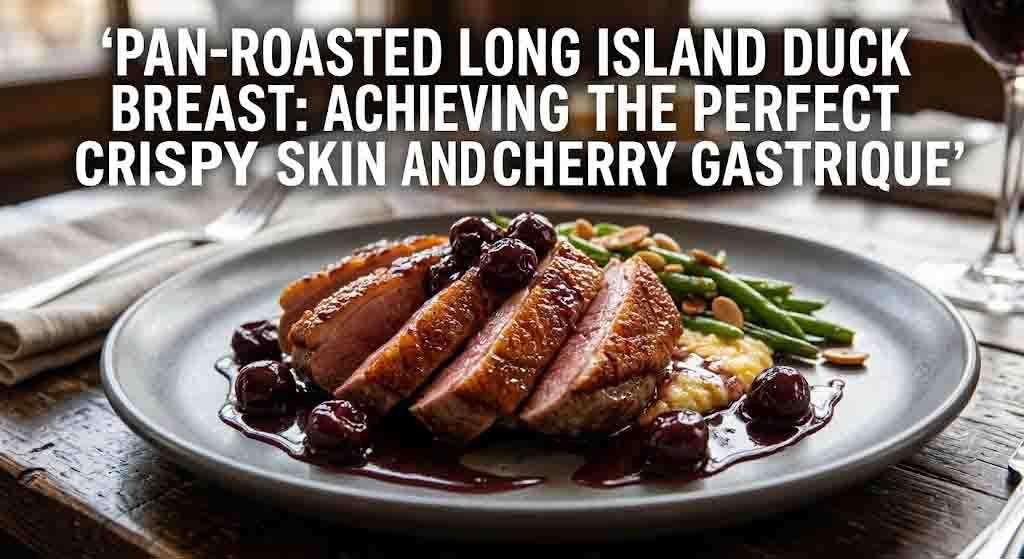
Slice the rested duck breast across the grain at a slight diagonal, aiming for pieces roughly a quarter-inch thick. The cut should reveal that rose center clearly — if it’s gray at the core, it was either overcooked or not rested properly. Fan the slices slightly on a warmed plate, skin side facing up so the crust remains visible and crackle-sharp.
Spoon the cherry gastrique along one side of the duck, allowing it to pool naturally rather than covering the meat. The skin should stay dry and exposed. A sprig of fresh thyme, a few whole cooked cherries, a scatter of microgreens, or a touch of fleur de sel on the skin adds dimension without cluttering the plate. Warm the plates before plating — cold porcelain drops the temperature of the duck fast, and this dish deserves to arrive at the table the way it left the pan.
Classic accompaniments include duck fat-roasted fingerling potatoes, braised lentils with shallots and thyme, sautéed wilted greens, or a simple potato gratin. Each provides a starchy, neutral base that allows the duck and gastrique to remain the center of attention. A glass of Pinot Noir — particularly from Burgundy or Oregon — finds the same sweet-tart-earthy harmony that the gastrique constructs in the sauce, and makes the pairing feel inevitable rather than engineered.
Closing
There is a reason duck with cherry gastrique has endured in professional kitchens for generations without modification. It doesn’t need modification. The fat-to-acid equation is chemically sound. The flavors belong together in the same way that a good life requires both richness and the moments that cut cleanly through it. Mastering this dish is less about accumulating tricks and more about developing patience — patience with the rendering fat, patience with the caramel, patience with the rest that the meat needs before the knife comes down.
Cook it right once, and you’ll understand why it stays on menus that could afford to put anything at all on the plate.
Sources
- Crescent Duck Farm – History
- Jess Pryles – How to Perfectly Cook Crispy Duck Breast
- Honest Food – How to Cook a Duck Breast (Hank Shaw)
- RecipeTin Eats – How to Cook Duck Breast
- Headbanger’s Kitchen – How to Cook the Perfect Duck Breast
- The Sauce Lab – Gastrique: The Sweet-and-Sour Balance
- Flavor365 – How to Make and Use a Gastrique
- Modern Farmer – A Brief History of Long Island Duck Farming
- SciFisland – A Brief History of Long Island’s Historic Duck Industry
- 27East – The Story of Long Island’s Duck Farming Industry