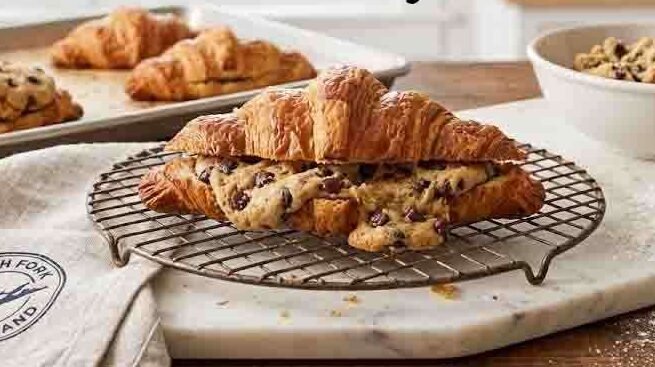
Viral food trends have a strange and wonderful life cycle. They are born in obscurity — often in the back corner of a small bakery where nobody is watching — and then, without warning, a single smartphone video detonates across the internet and suddenly every home kitchen from Paris to Port Jefferson is covered in flour and melted chocolate. The crookie is the perfect case study. It didn’t emerge from a corporate test kitchen or a Michelin-starred lab. It came from a Saturday morning in October 2022, when a baker in Paris’s 9th arrondissement looked at his freshly laminated croissants, glanced over at the cookie dough his team was rolling out nearby, and decided — why not?
That baker was Stéphane Louvard of Maison Louvard, at 11 Rue de Châteaudun. His creation was modest at first: a croissant split open, stuffed with raw chocolate chip cookie dough, sealed back up, crowned with more dough on top, and run back through a hot oven a second time. A twice-baked pastry that was equal parts flaky and gooey, buttery and rich, French and unmistakably American in its indulgence. He sold a few dozen a day. His regulars loved it. Life went on.
Then the internet found it.
From 100 Crookies a Day to 1,600: How TikTok Rewrote the Playbook
The crookie’s climb from neighborhood curiosity to global phenomenon tracks almost exactly with the mechanics of modern food virality. An Instagram account called The Ultimate Guide — which covers Paris restaurants — posted about Maison Louvard and pushed daily sales to 150–200. That was the slow burn. Then, in early 2024, TikTok influencer Johan Papz filmed himself biting into one of Louvard’s crookies and posted it. The video accumulated 2.7 million views. Within days, lines stretched down Rue de Châteaudun. Louvard had to hire two additional workers and scale production to between 1,000 and 1,600 crookies per day — with Saturdays pushing 2,000.
The man behind the craze was, by all accounts, bemused. “At some point you have to stop,” Louvard told AFP. “It’s just some cookie in a croissant, it’s not some revolutionary invention.” He declined to file for a patent. “What for? To find myself in court with half the planet?”
That kind of disarming honesty is actually part of what makes the story compelling. Louvard wasn’t chasing a trend. He was playing in his own kitchen. And the internet — which has a finely tuned nose for authenticity — rewarded him for it.
This isn’t the first time a Paris-adjacent hybrid pastry has pulled off this trick. In 2013, Dominique Ansel’s Cronut had New Yorkers sleeping on pavement outside his SoHo bakery. In 2022, the New York Roll — a croissant-bombolone mashup — racked up hundreds of millions of TikTok views. The pattern is consistent: take a laminated dough that people already love, marry it to something equally familiar from a different culinary tradition, bake it twice, and watch the world lose its mind.
The crookie followed this blueprint to perfection.
Why It Actually Works: The Science of the Second Bake
What makes the crookie more than just a novelty is that it genuinely makes sense from a textural standpoint. Croissants are made from a laminated dough — alternating layers of butter and dough folded repeatedly to create hundreds of distinct, flaky sheets. That structure, once baked, has an open, airy crumb that’s surprisingly receptive to fillings. It’s why the almond croissant — another twice-baked pastry where a day-old croissant is soaked in almond syrup, stuffed with frangipane, and re-baked — has been a Parisian staple for generations.
The second bake is the key. Raw cookie dough placed inside a pre-baked croissant doesn’t turn the whole thing soggy. Instead, the pastry’s existing structure acts as a shell. The outer layers re-crisp in the oven. The cookie dough inside, meanwhile, goes through its own transformation: the butter melts into the surrounding crumb, the sugars caramelize at the edges, and the chocolate chips soften into pools. The result is a contrast that every good bite of food aspires to deliver — crackling on the outside, yielding on the inside, with pockets of bittersweet chocolate interrupting the butterscotch warmth of the dough.
From a flavor chemistry standpoint, the pairing works because both elements are built on the same foundation: butter, sugar, and the Maillard reaction. The croissant already tastes deeply of caramelized dairy. The cookie dough amplifies and extends that profile, adding molasses from the brown sugar and vanilla. They aren’t fighting each other. They’re finishing each other’s sentences.
The North Fork Connection: Why This Craze Landed Here Perfectly
Long Island’s North Fork has quietly developed one of the most sophisticated artisan food cultures on the East End. Greenport, Southold, Cutchogue, and the surrounding hamlets are home to bakeries and pastry shops that have been doing serious, farm-sourced, handcrafted work for years. Blue Duck Bakery Café has been producing artisan breads and laminated pastries across multiple locations. Southold General — with croissants from François Payard — has become a destination for the kind of pastry that’s worth a drive. Briermere Farms in Riverhead has been selling homemade pies and breads since 1950. And newer arrivals like Pip’s in Greenport and Bourdon Patisserie at Zey Hotel have elevated the conversation even further, bringing Parisian-caliber technique to a stretch of Sound Avenue that already pairs naturally with the European sensibility.
It’s a region that respects the tradition of the well-made thing. Which is exactly why the crookie lands here with a particular resonance. The North Fork crowd isn’t chasing trends for trend’s sake — but when something is genuinely good and rooted in real craft, it finds its audience quickly.
The crookie is that thing. And making it at home, especially with the quality ingredients available from the farm stands and specialty grocers that dot Route 25, is a project worth an afternoon.
How to Bake the Crookie at Home: The Complete Method
The crookie is a two-ingredient recipe at its floor and a four-ingredient recipe at its ceiling. The variables are the quality of the croissant and the composition of the cookie dough. Both matter.
The Croissant
Start with all-butter croissants. This is non-negotiable. Check the label — anything that lists vegetable shortening or partially hydrogenated oil will produce an inferior result. The best option is to source your croissants from a local bakery the day before you plan to make crookies. A day-old croissant, slightly firmed up, actually holds the filling better than a same-day pastry and re-crisps more effectively in the second bake. If bakery croissants aren’t available, large-format grocery store croissants — Trader Joe’s and Costco both carry decent all-butter options — will get the job done.
The Cookie Dough
Store-bought refrigerated cookie dough (Pillsbury, Nestlé Toll House) is the fastest path, and it works. But making your own dough from scratch takes about fifteen minutes and produces a noticeably better result. Here is a reliable base recipe for six croissants:
- 1 stick (½ cup / 115g) unsalted butter, softened to room temperature
- ½ cup (100g) light brown sugar, packed
- ¼ cup (50g) granulated white sugar
- 1 large egg
- 1 teaspoon vanilla extract
- 1¼ cups (155g) all-purpose flour
- 1 teaspoon cornstarch (for chewiness)
- ½ teaspoon baking soda
- ½ teaspoon fine sea salt
- 1 cup (170g) semi-sweet chocolate chips or chopped dark chocolate bar
Cream the butter and both sugars in a stand mixer fitted with a paddle attachment until light and fluffy, about three minutes. Add the egg and vanilla, mix until fully incorporated. Reduce speed to low and add the flour, cornstarch, baking soda, and salt. Mix until just combined. Fold in the chocolate by hand. The dough should be soft and pliable but not sticky. Refrigerate for at least 30 minutes before assembling.
Assembly and Bake
Preheat the oven to 350°F (175°C) and line a baking sheet with parchment paper.
Using a sharp serrated knife, slice each croissant horizontally — not all the way through, but enough to open it like a book. Take roughly 2 to 3 tablespoons of cookie dough and flatten it into a disc slightly smaller than the interior of the croissant. Press it into the bottom half. Close the croissant gently and press down to seal. Take another tablespoon of cookie dough and spread or press it across the top of the croissant, covering the surface. Press a few additional chocolate chips directly into the top layer for visual effect.
Place the assembled crookies on the prepared baking sheet, spacing them at least an inch apart. Bake for 10 to 12 minutes, until the top cookie dough is golden at the edges and the croissant has crisped and deepened in color. For a more half-baked, molten interior — the Paris standard — pull them at 8 to 9 minutes.
Let them rest on the pan for three to four minutes before serving. The interior will be dangerously hot.
Finishing Touches
A pinch of flaky sea salt (Maldon or Fleur de Sel) scattered over the top immediately after pulling from the oven does something genuinely transformative — it cuts through the richness, sharpens the chocolate, and elevates the whole thing from decadent to complex. A drizzle of melted dark chocolate, if you want to lean fully into the occasion, adds another layer. Both are optional. Neither is a mistake.
Serving
Eat them warm. This is not a suggestion. The magic of the crookie is entirely temperature-dependent. If you’re baking a batch to share, note that they reheat beautifully in a 350°F oven for four to five minutes. A glass of cold whole milk or a properly pulled espresso are the ideal companions. A scoop of vanilla ice cream served alongside is not beneath you.
Variations Worth Trying
Once you understand the base logic — laminated dough + raw cookie dough + second bake — the variations are intuitive. Brown butter cookie dough, where the butter is cooked until it smells nutty and toasted before creaming, adds a depth that standard butter can’t match. Miso cookie dough — a small spoonful of white miso blended into the butter — introduces a subtle umami that amplifies the sweetness in unexpected ways. Nutella or Biscoff spread pressed into the center of the interior dough before closing the croissant creates a molten layer that borders on irresponsible. Chocolate croissants, used in place of plain ones, double down on the cocoa and produce something that belongs at a dessert table, not a breakfast counter.
The croissant format itself also scales. Mini croissants work beautifully for two-bite versions that make sense for brunch spreads or entertaining. Large croissants from a bakery allow for more aggressive stuffing and a more dramatic bake.
The Bigger Picture: What Viral Food Culture Actually Tells Us
The crookie’s trajectory illuminates something real about how food culture moves in 2025. The algorithm doesn’t care about Michelin stars or cooking school credentials. It cares about the moment of reveal — the pull-apart, the cross-section, the steam rising from a split pastry on camera. Food virality is, at its core, a theater of texture and contrast. The foods that travel fastest are always the ones that deliver a visual payoff: the stretch, the drip, the shatter.
But here’s the more interesting observation: the foods that sustain their relevance beyond the initial wave are the ones that are actually good. The cronut endured because Dominique Ansel’s lamination technique was genuinely exceptional. Tate’s Bake Shop chocolate chip cookies went national because Kathleen King’s recipe is actually better than most. The crookie has shown staying power — two-plus years after its invention, it’s still being made in home kitchens from Brussels to the North Fork — because biting into one is, without question, a genuinely pleasurable experience.
Stéphane Louvard didn’t engineer a marketing campaign. He made something delicious on a Saturday morning and let the thing speak for itself. That’s a principle that applies well beyond pastry.
The crookie is now yours to make. Source your croissants from a bakery you trust, give yourself a Saturday afternoon, and resist the urge to over-bake it. The gooey center isn’t a flaw in the recipe — it’s the whole point.
Sources
- France 24 / AFP — The Crookie: the French pastry craze that took over TikTok (April 2024): https://www.france24.com/en/live-news/20240404-the-crookie-the-french-pastry-craze-that-took-over-tiktok
- Reporter Gourmet — Crookie: The Croissant-Cookie Hybrid Taking Paris by Storm (2024): https://reportergourmet.com/en/products-and-companies/438-crookie-the-croissant-cookie-hybrid-taking-paris-by-storm-on-social-media-7-but-worth-every-penny
- Comunicaffe — Paris introduces the crookie: a mix between croissant and chocolate biscuit (2024): https://www.comunicaffe.com/paris-introduces-the-crookie-a-mix-between-croissant-and-biscuit/
- Tasting Table — Ooey-Gooey Viral Crookies Recipe (October 2024): https://www.tastingtable.com/1668827/viral-cookie-croissant-recipe/
- Belly Full — Cookie Croissant (Le Crookie) (April 2024): https://bellyfull.net/cookie-croissant/
- Northforker — Sweets for the Sweet: 7 places to find perfect pastries on the North Fork (October 2024): https://northforker.com/2024/10/sweets-for-the-sweet-7-places-to-find-pastry-perfect-pastries-on-the-north-fork/
- Maison Louvard: https://maisonlouvard.fr/le-crookie/