Fourteen decades before Williamsburg became synonymous with craft cocktails and vintage denim, a Bavarian immigrant named Carl Luger understood something fundamental about permanence: that a neighborhood anchors itself not around architecture or commerce, but around the table where its people gather to eat. In 1887, at the corner of Broadway and Driggs Avenue in what was then a densely German enclave of Brooklyn, Carl opened a café, billiards hall, and bowling alley that would, through the slow alchemy of fire and fat and family stubbornness, become the most mythologized steakhouse on the American continent. Peter Luger Steak House is not merely a restaurant. It is an argument — one made in seared protein and melted tallow — that the old ways, when practiced with obsessive precision, cannot be improved upon by innovation, trend, or review (Peter Luger Steak House, peterluger.com). As someone who has spent 25 years behind the counter at The Heritage Diner in Mount Sinai, I can tell you that what keeps a restaurant alive for a quarter-century is not marketing. What keeps one alive for nearly a century and a half is something closer to theology.
A German Beer Hall Becomes a Brooklyn Cathedral
The building at 178 Broadway has witnessed the kind of transformation that only New York can produce. Carl Luger — often confused with his nephew Peter, who would lend the establishment its lasting name — opened the doors during a period when Williamsburg’s population was overwhelmingly German-speaking, its streets lined with biergartens and social clubs (Wikipedia, 2025). Peter Luger himself, born in 1866 in the Kingdom of Bavaria, immigrated to the United States at thirteen and eventually took ownership of his uncle’s establishment, converting the café and bowling alley into something that more closely resembled a proper dining house (Wikipedia, 2025). The completion of the Williamsburg Bridge in 1903 changed everything. Suddenly, Manhattan’s businessmen could cross the East River for lunch, and the restaurant’s reputation began spreading beyond the neighborhood’s ethnic boundaries. Wall Street bankers, Garment District operators, and dockworkers shared the same worn wooden tables, united by the singular democracy of hunger. What started as a local watering hole had become a destination.
When Peter Luger died in 1941, his son Frederick attempted to maintain the business but lacked his father’s conviction. The restaurant deteriorated. By 1950, Frederick shuttered the operation and put the building up for auction. The winning bidder — the only bidder, in fact — was Sol Forman, a metal giftware manufacturer who ran a factory directly across the street (Peter Luger Steak House, peterluger.com). Forman and his partner Seymour Sloyer acquired the building and the restaurant for $35,000, a sum that included everything from the brass chandeliers to the beer-stained tables. Forman had been eating at Luger’s for twenty-five years. He needed a place to entertain clients, and the prospect of losing his daily steak was, evidently, unacceptable. That transaction — born from appetite rather than ambition — would produce one of the most enduring restaurant dynasties in American history.
The Forman Legacy and the Religion of Beef Selection
Sol Forman’s genius was not culinary in the traditional sense. He was a manufacturer, a man of systems and precision. He understood that the difference between a good steakhouse and a legendary one resided not in the kitchen but in the selection process that preceded it. When Sol took over Peter Luger’s, the critical task of inspecting and purchasing meat fell to his wife, Marsha Forman, who spent two years studying under a retired USDA grader, accompanying him through the wholesale houses along the West Side Highway’s old meat market district (Peter Luger Steak House, peterluger.com). Marsha learned to evaluate short loins the way a diamond cutter assesses rough stones — by conformation, color, marbling, and texture. She continued making those selections, wearing her signature white coat and fur hat, well into her eighties.
This is the detail that most casual observers miss when they evaluate Peter Luger against its competitors. The steakhouse’s advantage is not technique or seasoning — it is access. Only USDA Prime beef is considered, a classification that typically represents less than two percent of all graded beef cattle in the United States (USDA, National Restaurant Association data). From that already rarefied pool, the Forman family — now in its fourth generation under co-owner Daniel Turtel, Sol’s great-grandson — further narrows the selection through personal, hands-on inspection at wholesale markets (Goldbelly, 2025). The chosen short loins and shells are then transported to Peter Luger’s on-site dry-aging facilities, where they rest under precisely regulated conditions of temperature, humidity, and air circulation. When a steak finally reaches the 1,800-degree broiler, it has already passed through more quality gates than most restaurants apply to their entire supply chain. At Marcellino NY, my bespoke leather workshop in Huntington, I operate by a similar philosophy — the quality of the finished briefcase is determined not by the stitching but by the hide selection that happens months before the needle ever touches leather. The Formans understood this principle in 1950. The unseen labor is always the one that matters.
The Menu: A Masterclass in Deliberate Restraint
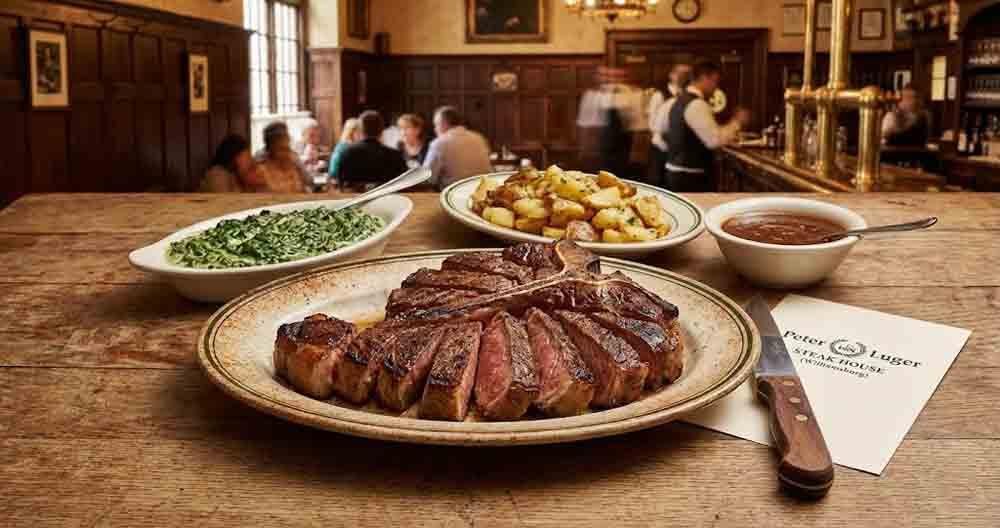
Peter Luger’s menu is an act of philosophical commitment. In an era when most high-end steakhouses bloat their offerings with towers of seafood, truffle-infused sides, and molecular gastronomy stunts, Luger’s operates with the spare discipline of a Bauhaus architect. The porterhouse — cut from the rear end of the short loin to include a generous portion of the tenderloin — is the gravitational center, available sized for two, three, or four diners (Peter Luger Steak House, peterluger.com). It arrives pre-sliced on a sizzling platter, bathed in clarified butter and its own rendered tallow, the server spooning the liquid fat over the meat with a practiced, almost liturgical gesture. The supporting cast is equally unapologetic in its simplicity: extra-thick slabs of house-smoked bacon that function more as a steak of pork belly than an appetizer; an iceberg wedge salad dressed with homemade Russian, vinaigrette, or crumbled blue cheese; German fried potatoes with the kind of golden crust that requires a seasoned griddle and zero hesitation with oil; and creamed spinach rich enough to serve as its own argument against veganism.
The legendary Peter Luger hamburger — available only during lunch service and crafted from the same dry-aged USDA Prime trim as the steaks — is widely considered among the finest in New York City, a claim that carries particular weight given the city’s obsessive burger culture (The Infatuation, 2024). Desserts remain gloriously old-fashioned: pecan pie, apple strudel, cheesecake, and the Holy Cow sundae, all accompanied by generous bowls of schlag, a dense German whipped cream that arrives at the table with the authoritative thud that long-time patrons recognize as the final movement of the Peter Luger symphony. Each meal concludes with a complimentary gold-foil chocolate coin — a small, sweet absurdity that perfectly captures the restaurant’s ability to be simultaneously grave and playful about its own mythology.
Controversy, Critics, and the Zero-Star Reckoning
No profile of Peter Luger can avoid the seismic event of October 29, 2019, when New York Times restaurant critic Pete Wells published a zero-star review under the headline that would ripple across the food world. Wells took issue with nearly every dimension of the experience — the service, the pricing, the sides, and most damagingly, the porterhouse itself, which he characterized as unremarkable relative to the city’s broader steakhouse landscape (Gothamist, 2019). The review generated over 1,800 comments on the Times website and trended nationally, prompting a cultural reckoning about whether institutional reputation could survive genuine decline.
Peter Luger’s response was characteristically unflinching. General manager David Berson, grandson of Sol and Marsha Forman, issued a statement that read, in part, that the restaurant had always focused on doing one thing exceptionally well — serving the highest quality of steak — with a member of the family buying every piece of USDA Prime beef individually, just as they had done for decades (Fox News, 2019). The broader culinary community was divided. Chef and author Eddie Huang published a vigorous defense, arguing that the restaurant represented exactly the kind of singular, community-anchored identity that was disappearing from New York’s dining landscape (Gothamist, 2019). The data supported the loyalists: Peter Luger’s reservation lines remained jammed. Its ratings on consumer platforms barely budged. And the cultural conversation it generated arguably drove more first-time visitors through its doors, curious to judge for themselves.
From where I sit — having survived every food trend, economic downturn, and Yelp brigade that the past quarter-century has thrown at The Heritage Diner — I can tell you that the Wells review, whatever its merit as criticism, illuminated something important about longevity. Institutions do not survive by being perfect in every moment. They survive by being irreplaceable. Peter Luger occupies a category of one, and no zero-star review can vacate that position.
Silver Screen, Pop Culture, and the Celebrity Table
Peter Luger’s cultural reach extends far beyond the dining room. Martin Scorsese chose the restaurant as a filming location for The Wolf of Wall Street (2013), the scene in which Leonardo DiCaprio’s Jordan Belfort persuades Jonah Hill’s Donnie Azoff to join his penny-stock brokerage — a moment of corrupted ambition staged against the backdrop of broiled beef and burnished wood (TravelAge West, 2013). The casting was deliberate. Peter Luger represents a particular strain of New York power — old money, earned appetites, deals sealed over porterhouse — that Scorsese understood as the perfect visual shorthand for the world Belfort was attempting to infiltrate. The restaurant was also famously busted for bootlegging during Prohibition, a historical footnote that only deepens its outlaw credibility (Accidentally Wes Anderson, 2023).
Craig Claiborne of the New York Times awarded the restaurant four stars in 1968 under the Forman ownership, cementing its status in the city’s critical establishment (Wikipedia, 2025). The James Beard Foundation named it to its prestigious list of “America’s Classics” in 2002. Peter Luger held a Michelin star from the guide’s inaugural New York edition in 2006 through multiple consecutive years. And Zagat rated it New York City’s top steakhouse for an extraordinary 28 consecutive years beginning in 1984 — a record of consistency that borders on the geological (Goldbelly, 2025). Generations of New Yorkers have marked promotions, engagements, and family reunions within its wood-paneled rooms, and the restaurant’s Great Neck, Long Island location (opened in 1968, rebuilt after a severe 1984 fire) extends that tradition to the suburbs. In November 2023, Peter Luger expanded for the first time outside New York in sixty years, opening at Caesars Palace in Las Vegas in the space formerly occupied by Rao’s — a steakhouse succession that felt almost dynastically ordained (Wikipedia, 2025).
The Analog Soul of a Digital Age
One of Peter Luger’s most quietly radical characteristics is its relationship with technology — or rather, its principled rejection of it. The Brooklyn and Great Neck locations do not accept credit cards. Payment is limited to cash, US debit cards, US checks with identification, or the house-issued Peter Luger Card (Peter Luger Steak House, peterluger.com). Reservations have historically been recorded in a handwritten book. Accounting is managed by hand in bound ledgers. The restaurant once maintained a manual cash register. Co-owner Jody Storch has explained that the family resisted technology because they felt it was inappropriate for diners to see staff running to terminals — that the analog rhythm of handwritten checks and spoken orders preserves something essential about the experience.
This philosophy resonates deeply with my own work at Marcellino NY, where every briefcase is hand-saddle stitched using techniques unchanged since the 19th century. The refusal to automate is not nostalgia — it is a philosophical position about where value resides. Peter Luger’s insistence on physical presence, on cash exchanged hand-to-hand, on meat selected by family members who physically visit the wholesale market, represents a form of resistance against the abstraction that defines modern commerce. As Paola and I prepare to launch Maison Pawli in 2026, our boutique real estate venture on the North Shore, we draw considerable inspiration from businesses like Peter Luger that prove premium markets will always reward the tangible and the personal over the scalable and the convenient. In real estate, as in steak, the client who walks through the door deserves to encounter a human being who has made choices on their behalf — not an algorithm.
Visiting Peter Luger: What You Need to Know
For those planning a pilgrimage, the essential details are as follows. The Brooklyn flagship operates at 178 Broadway, Williamsburg, Brooklyn, NY 11211, with hours running Monday through Thursday from 11:45 AM to 9:45 PM, Friday and Saturday from 11:45 AM to 10:45 PM, and Sunday from 12:45 PM to 9:45 PM. Reservations for parties of ten or fewer are made by calling (718) 387-7400; larger banquet reservations can be arranged via reservations@peterluger.com. The Great Neck location sits at 255 Northern Boulevard, Great Neck, NY 11021, reachable at (516) 487-8800. For those outside the tri-state area, Peter Luger ships dry-aged USDA Prime porterhouse steaks, strip steaks, and their celebrated burgers nationwide through Goldbelly (goldbelly.com/peter-luger-steak-house), allowing the home cook to approximate the Luger experience from any kitchen in America.
Remember: no credit cards at the Brooklyn or Great Neck locations. Bring cash, a debit card, or apply for the Peter Luger Card in advance. Credit cards are accepted only for online ordering. And a final word of advice from someone who understands the sacred geometry of a well-run dining room — arrive hungry, order the porterhouse medium-rare, say yes to the bacon, and do not, under any circumstances, skip the schlag.
Website: peterluger.com
Brooklyn Phone: (718) 387-7400
Great Neck Phone: (516) 487-8800
Reservations Email: reservations@peterluger.com
Nationwide Delivery: goldbelly.com/peter-luger-steak-house
Address (Brooklyn): 178 Broadway, Brooklyn, NY 11211
Address (Great Neck): 255 Northern Boulevard, Great Neck, NY 11021
Address (Las Vegas): Caesars Palace, 3570 Las Vegas Blvd S, Las Vegas, NV 89109
Peter from The Heritage Diner — 275 Route 25A, Mount Sinai, NY — has spent 25 years studying what makes a restaurant survive. He is the founder of Marcellino NY (marcellinony.com), a bespoke English bridle leather workshop in Huntington, and holds graduate degrees in Philosophy from Long Island University and The New School in NYC. He and his wife, Broker Paola, are launching Maison Pawli, a boutique real estate venture on Long Island’s North Shore, in 2026.