The Port Jefferson to Bridgeport crossing isn’t just a scenic commute. It’s one of the oldest continuously operating ferry routes in Long Island Sound — and it started because Long Island farmers needed to move strawberries to industrial New England faster than a sailing packet could manage.
That’s the version nobody puts on a brochure.
Before the Railroad, the Steamboat
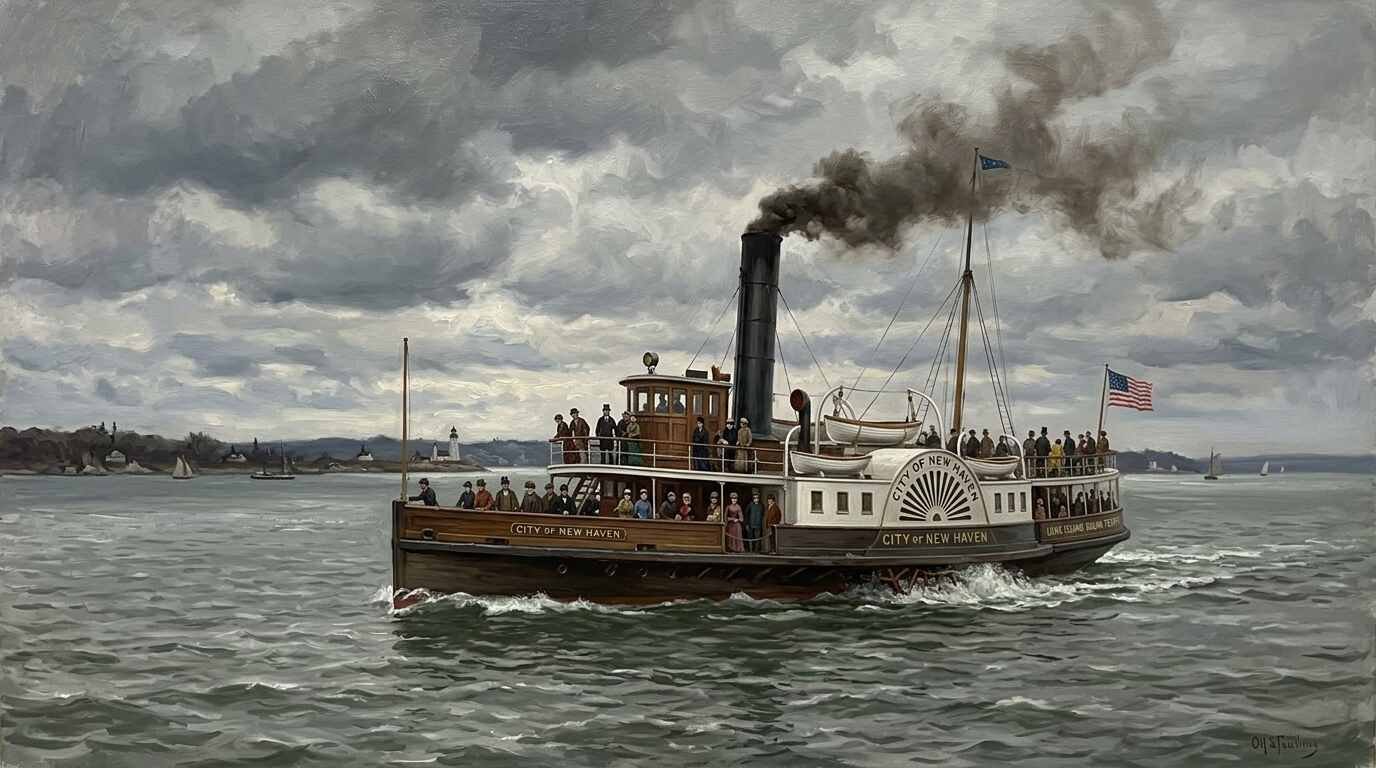
On July 4, 1840, a diarist named George T. Strong arrived in Port Jefferson for the holiday — not on a sailing packet, not on horseback, but aboard a steamboat called the Sun. He noted in his diary that the vessel had left Manhattan at 8 a.m., stopped at Cow Harbor (now Northport), and arrived in Drowned Meadow (Port Jefferson’s name at the time) at 2:30 p.m. About 100 passengers, a “cotillion band” that twanged and squeaked, and a comfortable voyage.
That trip marked the beginning of regular steamboat service into Port Jefferson — and the beginning of a transportation shift that would reshape the entire North Shore over the next three decades. The Sun was followed over the years by a succession of steamers: the Mt. Pleasant, the Suffolk, the Island Belle, the Golden Gate, the John Faron. Each one bound the village a little tighter to New York City, to the regional economy, to the networks of commerce that ran up and down the Sound.
What’s worth understanding is the sequence. The steamboat came first. The Long Island Rail Road didn’t reach Port Jefferson until 1873 — thirty-three years after Strong rode the Sun up from Manhattan. For over three decades, if you wanted to get to Port Jefferson from anywhere beyond a horse-ride away, you came by water.
The Commercial Logic Nobody Talks About
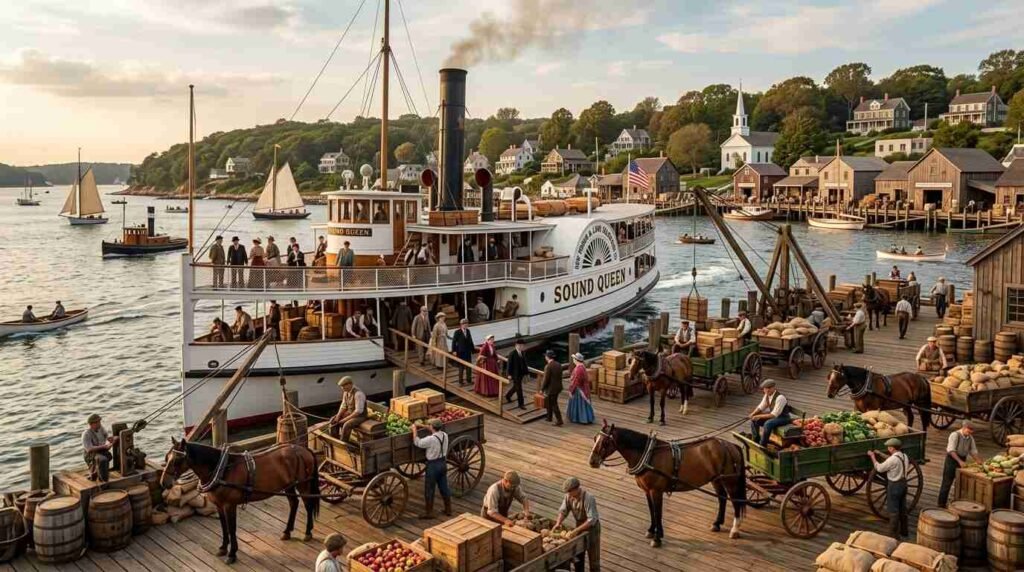
Here’s what actually drove early steam service on the Sound, and why Port Jefferson specifically became a waypoint: it wasn’t tourists. It wasn’t commuters. It was agricultural freight.
Long Island in the mid-19th century was a working farm economy — strawberries, vegetables, cord wood. New England, particularly Connecticut’s manufacturing belt, was the opposite: industrialized, urbanized, hungry for food products from outside the region. The Sound was the highway between them. Steam power made the crossing faster and more reliable than sail, which meant perishable cargo — strawberries especially — could actually survive the trip in marketable condition.
A group of prominent Port Jefferson businessmen recognized this in 1858 and moved to incorporate the Long Island Steamboat Company, partly to wrest control of routes and fares from outside operators who had monopolized Sound navigation. Led by investors Thomas Ritch, Reuben Wilson, and Thomas Strong, they purchased the sidewheeler Ocean Wave, which began runs between New York City and Port Jefferson in summer 1859. Low ridership eventually forced the company into bankruptcy by 1861, and the Ocean Wave was sold at auction — but the impulse behind it was real and commercially sound.
The Port Jefferson–to–Bridgeport leg specifically took shape later. The steamer Brookhaven, known locally as the “Little Bedbug” — a name that tells you something about its size and reputation — ran the Port Jefferson to Bridgeport route from 1872 to 1881. Besides passengers, these steamships transported strawberries and produce from Long Island’s agricultural communities to industrial New England’s markets. The route made sense because of the freight, not the tourists.
P.T. Barnum and the Founding of Something Durable
By 1883, two men with complementary assets saw an opportunity. Captain Charles E. Tooker was a Port Jefferson seaman who had first sailed at age nine and knew the Sound as well as anyone alive. P.T. Barnum was the circus impresario and Bridgeport, Connecticut resident who brought his talent for organizing enterprises to a commercial ferry operation. They founded the Bridgeport & Port Jefferson Steamboat Company that year, with Barnum — then in his seventies — serving as the company’s first president.
The first vessel was the Nonowantuc, a 120-foot wooden ferry with two masts rigged with staysails, carrying up to 350 passengers. It was followed over the decades by the Park City — built by Mather and Wood, called “The Lady of the Sound,” 600 passengers — and then a succession of vessels that carried this particular crossing through two world wars, the rise of automobile culture, the construction of the interstate highway system, and every transportation disruption in between.
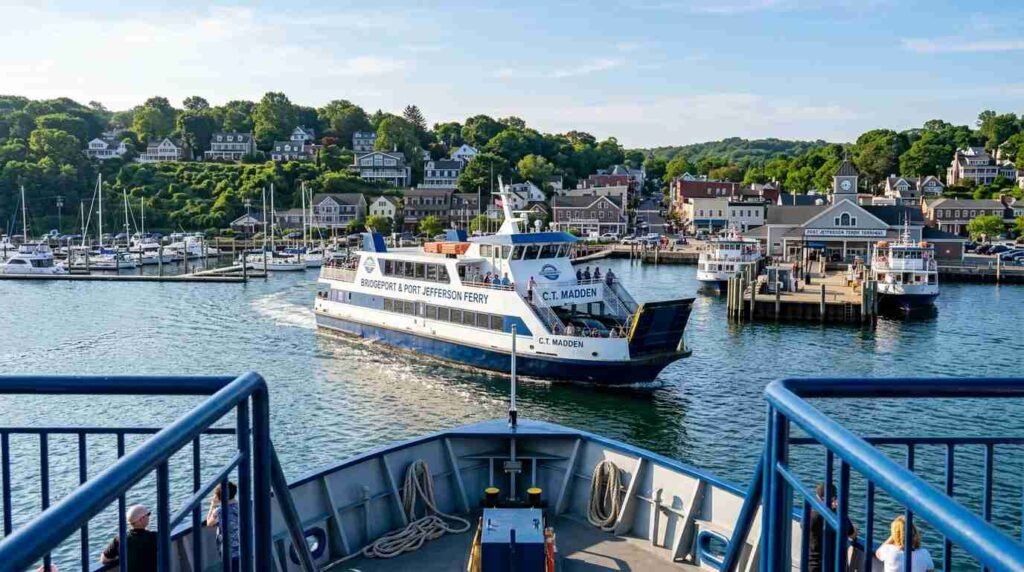
The company sold steamship service to diesel-powered vessels in 1968, when it acquired the Martha’s Vineyard. It formally retained its Steamboat Company name anyway. As of 2024, it added its newest vessel, the MV Long Island, 302 feet long with capacity for 124 automobiles.
That’s a direct line from the Nonowantuc in 1883 to a 300-foot diesel ferry in 2024. Almost nothing in American transportation has that kind of continuity.
Why the Ferry Survived Everything That Should Have Killed It
Railroads should have ended ferry services across the Sound. For many routes, they did. Port Jefferson is the exception, and the reason is geographic stubbornness: there’s no good way to drive between the North Shore of Long Island and coastal Connecticut without either going through New York City or adding two hours to the trip. The Sound is not bridgeable at this width without extraordinary engineering and cost — bridge proposals have come up repeatedly and been rejected by communities on both sides for environmental and practical reasons.
So the ferry persists. Not as a nostalgic throwback, but as genuinely the most efficient option for a specific category of trip. People relocating from Connecticut who buy on the North Shore use it for exactly this reason — it makes the geography work in a way that roads cannot.
If you’re one of those buyers — and a lot of people coming to Port Jefferson and Miller Place right now are exactly that, either former Connecticut residents or people who still have family or work ties across the Sound — the ferry is part of what you’re buying into. It’s not an amenity. It’s infrastructure. There’s a difference.
The interest rate and purchase-power landscape on the North Shore is worth understanding separately, but for buyers coming in from Connecticut, the ferry makes the commute math work in a way that pure Long Island listings can’t replicate. That calculus is built into the pricing near the harbor, and it’s been built in since 1883.
The Village the Ferry Made
Port Jefferson would look very different without the crossing. The commercial village center, the ferry terminal at the foot of Main Street, the restaurants that exist because 1.3 million passengers a year flow through this harbor — all of it flows from a decision two men made in 1883, which itself flowed from a commercial logic that started with strawberry farmers who needed to move perishables to New Haven before they rotted.
The history of a place is never just atmosphere. It’s the explanation for why the street grid runs the way it does, why the commercial district sits where it sits, why certain properties carry a premium that comparable square footage elsewhere doesn’t command. Port Jefferson’s identity is inseparable from its relationship with the Sound, and that relationship was defined — practically and commercially — by steam.
You Might Also Like
- The Old Field Point Lighthouse: Granite, Gale, and the Conscience of Long Island Sound
- Interest Rate Volatility and the North Shore Buyer
- The 1699 Stony Brook Grist Mill: Where Water, Grain, and Commerce Built Long Island’s North Shore
Sources
- Bridgeport & Port Jefferson Steamboat Company — About Us: 88844ferry.com/about
- Bridgeport & Port Jefferson Ferry — Wikipedia: en.wikipedia.org
- TBR News Media — Hometown History: Steamboat Days in Early Port Jefferson: tbrnewsmedia.com
- Accidentally Wes Anderson — Port Jefferson Ferry history: accidentallywesanderson.com
- Steamship Historical Society of America: sshsa.org
- Connecticut State Library — early steamboat licensing records (Hartford)
- Mystic Seaport Museum — Long Island Sound steamboat records