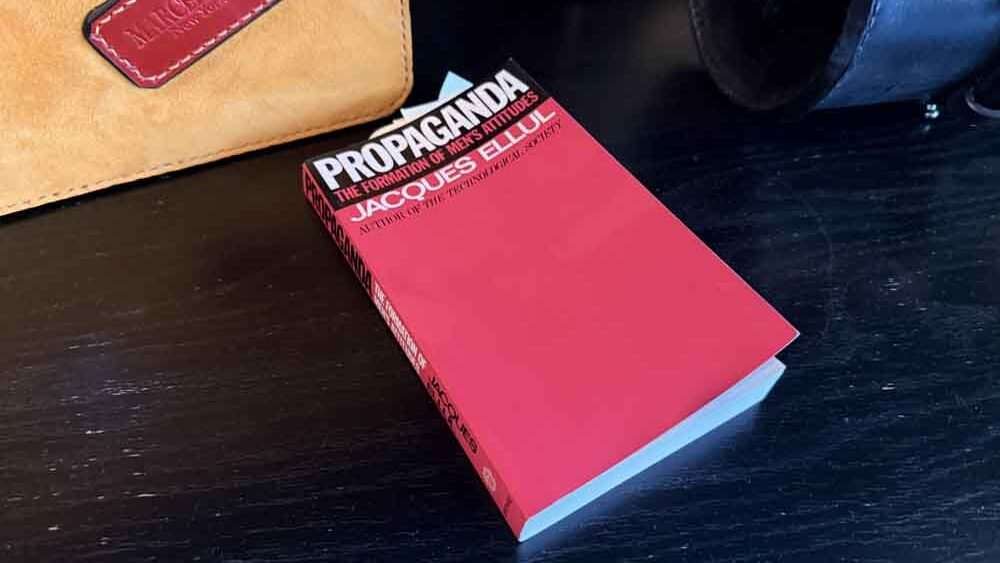
Sixty years ago, a French philosopher and theologian named Jacques Ellul sat down and described the exact media environment you are living in right now. He did it before cable news. Before the internet. Before the algorithm. Before any of it. That’s either impressive or terrifying. Probably both.
Propaganda: The Formation of Men’s Attitudes was published in France in 1962 and translated into English in 1965. It has never gone out of print. It has never stopped being relevant. And if you’ve never read it, it will rearrange something behind your eyes that you won’t be able to put back.
Two Men, Two Different Warnings
Most people who think about media and manipulation eventually land on Marshall McLuhan. I did too — I’ve written about McLuhan’s Understanding Media on this blog, and the man deserves every word of attention he gets. McLuhan’s insight — that the medium itself is the message, that the pipe shapes what flows through it — is one of the most genuinely useful ideas of the twentieth century.
But McLuhan and Ellul were issuing two different warnings from two different angles, and reading only one of them leaves a gap.
McLuhan was watching the form. He saw that television restructures perception, that radio creates tribal intimacy, that print linearizes thought. He was an analyst of how the channel rewires the receiver. His tone was curious, almost playful. He wasn’t exactly alarmed — he was fascinated. The man could discuss the electric light bulb as a medium with the enthusiasm of someone who’d never seen one before.
Ellul was watching the content — and he was alarmed. He wasn’t interested in the sociology of media forms. He was interested in what propaganda does to a human being from the inside: how it colonizes the will, how it makes people feel like they’re thinking when they’re only reacting, how it converts information into action-readiness without ever passing through the critical faculty. Where McLuhan studied the architecture, Ellul was studying the tenant — and what happened to the tenant once they moved in.
Together they describe the whole building. Separately, each one leaves you with half a map.
What Ellul Actually Argues
The first thing Ellul does is destroy the definition you walked in with.
Most people, if you ask them what propaganda is, will describe something crude: a government poster, a wartime newsreel, a demagogue at a podium. Ellul says that is the least effective form propaganda has ever taken. The moment you recognize propaganda, it has already lost. Real propaganda doesn’t announce itself. It arrives dressed as information, as education, as common sense, as the obvious thing any reasonable person would believe.
He goes further. Ellul argues that modern propaganda requires a literate, informed population to function. The peasant who can’t read is actually harder to propagandize in the modern sense. He has fewer entry points. The person who reads three newspapers, watches the evening news, stays informed — that person is the ideal target. The more input they consume, the more vectors there are for shaping their pre-reflexive assumptions. He called this “sociological propaganda” — the kind that doesn’t push you toward a position so much as it creates the atmosphere in which certain positions feel self-evident and others feel embarrassing.
That should stop you cold. It stopped me.
The people who consume the most information are not the most protected from propaganda. They are, in Ellul’s framework, the most thoroughly propagandized. Because they have the highest confidence in their own conclusions. They felt themselves arrive at those conclusions through a process of reading and watching and thinking. What they don’t see is the pre-selection that happened before any of that — which sources exist, which framings are available, which questions it even occurs to you to ask.
The Individual and the Crowd
Ellul makes a distinction that most propaganda analysis skips over: the difference between propaganda aimed at individuals and propaganda aimed at masses, and the relationship between the two.
Propaganda doesn’t just produce compliant crowds. It produces isolated individuals who feel like crowds. The person watching the news alone in their living room is not outside the mass psychological event — they are the mass psychological event, replicated in ten million living rooms simultaneously. The isolation is part of the mechanism. The individual who doesn’t have strong community ties, who isn’t embedded in thick local networks of people who know each other and argue face-to-face, is more susceptible — not less. Because propaganda fills the vacuum left by the dissolution of those communities. It provides the sense of participation, of belonging to something larger, of being on the right side of history.
I’ve thought about this in the context of the diner. A lunch counter is not just a place to eat. It’s a venue for exactly the kind of messy, local, face-to-face disagreement that Ellul would recognize as a partial prophylactic against mass manipulation. People who argue with their neighbors in person, who know each other’s names and histories and contradictions, are harder to sort into clean ideological units. They’re complicated to each other. Propaganda needs you simple.
Technology Is Not Neutral
Here is where Ellul and McLuhan converge, even if they never quite meet.
McLuhan said the medium shapes the message. Ellul said technology is not a tool you pick up and put down — it is a system that imposes its own logic on everything it touches. He developed this argument most fully in The Technological Society, his earlier and arguably more comprehensive work. But Propaganda is where you see the implication play out in real time: the mass media apparatus doesn’t just transmit propaganda, it requires propaganda to function. It needs content at scale, constantly, and propaganda is perfectly optimized for that need. The machine and the message co-evolve. You can’t have one without the other tending toward the other.
McLuhan described how television restructures perception. Ellul would say: and that restructured perception becomes the precondition for the next generation of propaganda. They’re describing the same feedback loop from different ends.
What Makes This Book Hard
Ellul offers almost no exit. That’s the honest and frustrating thing about him.
Most books of this kind — books that diagnose cultural pathology — end with a chapter on solutions. Media literacy programs. Critical thinking curricula. Slow news diets. Something actionable. Ellul doesn’t do that. He thinks those solutions are largely absorbed by the system and become new forms of the problem. Media literacy, if it’s delivered through the same mass channels and with the same techniques as the propaganda it’s trying to counter, becomes — in his framework — a propaganda of media literacy.
He believed the only genuine counter was the recovery of genuine community: local, specific, embodied, slow. Not an online community. Not a national movement. The kind where people disagree in person and have to live with each other afterward.
Whether he was right about that is a question worth sitting with for longer than a paragraph.
Why It Reads Like 2026
The man wrote this before personal computers existed. He could not have known about social media or recommendation algorithms or the way a platform optimizes for engagement by maximizing emotional activation. And yet every mechanism he describes — the bypassing of rational deliberation, the manufacture of urgency, the conversion of information into pre-political attitude — is the precise operating logic of the attention economy.
McLuhan said we drive into the future using the rearview mirror. Ellul wrote the manual for the road ahead without knowing what road it was.
Read them together. McLuhan tells you what the machine is made of. Ellul tells you what it does to the person sitting inside it. Between the two of them, you get something close to the full picture — and the full picture is not comfortable. But it’s a lot better than the alternative, which is driving without either mirror.
You Might Also Like:
- Understanding Media: The Extensions of Man — Marshall McLuhan
- The Gay Science by Friedrich Nietzsche: God Is Dead, and Heavy Metal Has Known It Longest
- An Introduction to Logic and Scientific Method by Morris R. Cohen & Ernest Nagel — A Review
Sources:
- Ellul, Jacques. Propaganda: The Formation of Men’s Attitudes. Translated by Konrad Kellen and Jean Lerner. Vintage Books, 1973. https://www.penguinrandomhouse.com/books/320233/propaganda-by-jacques-ellul/
- Ellul, Jacques. The Technological Society. Vintage Books, 1964.
- McLuhan, Marshall. Understanding Media: The Extensions of Man. McGraw-Hill, 1964.
- Merton, Robert K. Introduction to Propaganda by Jacques Ellul. Vintage Books, 1973.
- Christians, Clifford G., and Jay M. Van Hook, eds. Jacques Ellul: Interpretive Essays. University of Illinois Press, 1981.