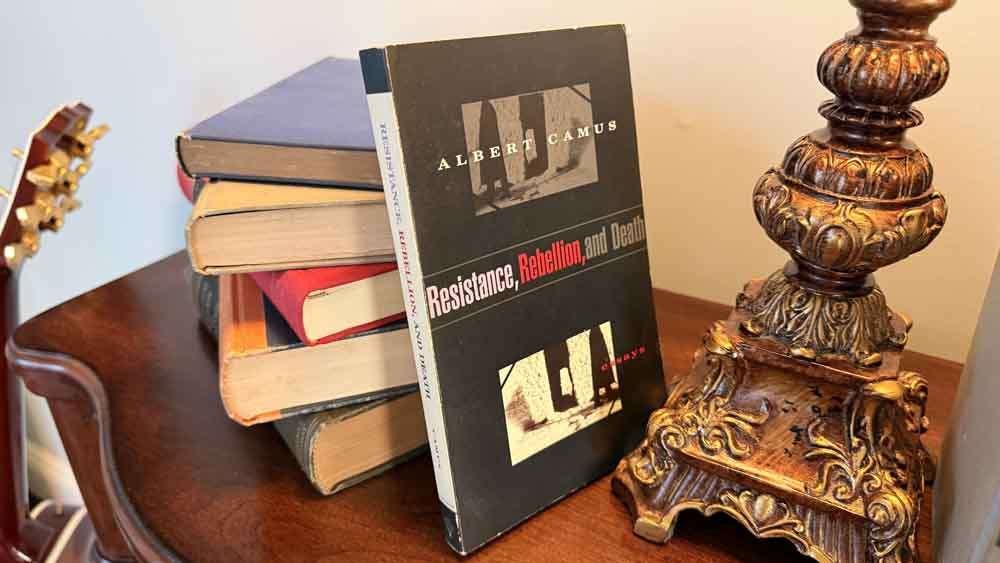
Few books ask more of a reader than one assembled from the political writings of a man who believed that to think clearly was itself a form of courage. Albert Camus wrote Resistance, Rebellion, and Death across the bloodiest decades of the twentieth century — and somehow, the essays collected here feel less like historical artifacts than they do like dispatches from a fight that never quite ended. Published in French in 1960 and translated into English that same year by Justin O’Brien, this is not a philosophical manifesto in the academic sense. It is something harder to categorize and harder to put down: a sustained argument for the insistence on being human, even when the world is structured to crush that insistence.
Camus was thirty-five years old when World War II ended. He had edited the clandestine French resistance newspaper Combat from occupied Paris. He had watched friends die, watched ideology devour people, watched the century’s great political experiments curdle into terror. By the time he sat down to write many of these pieces — on capital punishment, on the Hungarian uprising, on the ethics of political murder — he carried a weight that most thinkers never have to bear: not just the weight of ideas, but of consequences.
The Absurdist Who Could Not Stay Silent
There is a tendency, particularly in introductory philosophy courses, to present Camus as the man who wrote The Myth of Sisyphus and leave it at that — a tidy parable about rolling boulders and finding meaning in futile repetition. Resistance, Rebellion, and Death dismantles that reduction entirely. Here, Camus is not abstractly contemplating the absurd from a comfortable remove. He is furious. He is grieving. He is writing letters to German friends about why Europe cannot simply rebuild on the foundation of violence and call it peace.
The opening section, drawn from the Lettres à un ami allemand (Letters to a German Friend), sets the tone with an almost shocking directness. Camus refuses to equate German nationalism with French resistance as two versions of the same impulse. His argument is precise: France fought not because it believed in nothing, but because it believed that certain things — truth, justice, the dignity of the individual — were worth dying for without making them into gods. “I loved you,” he writes to his imagined German interlocutor, “but now I understand that even love has a limit, and that limit is injustice.” That kind of moral clarity, unfashionable as it sounds, lands differently when it comes from someone who lived it rather than theorized it.
Algeria, Complexity, and the Refusal of Easy Positions
No honest reading of this book can sidestep the section on Algeria, which remains one of the most contested aspects of Camus’s legacy. Born in colonial Algeria to a French working-class family, Camus occupied an impossible position in the independence debates of the 1950s. He condemned French torture of Algerian prisoners. He also could not endorse terrorism targeting civilians — including the French Algerian community he came from.
His critics, Sartre chief among them, called this a failure of nerve, a bourgeois sentimentalism that chose comfort over justice. Camus’s response, embedded across several of these essays, was less a defense than a refusal. He would not accept a logic that demanded the murder of innocents as the price of political liberation. “I believe in justice,” he wrote in a 1958 preface, “but I will defend my mother before justice.” That line has been extracted, misread, and weaponized in a hundred directions. In context, it is not a rejection of justice but a statement that abstract principles do not override the specific, breathing human being in front of you.
Whether one agrees with Camus or not — and reasonable people have disagreed sharply — the honesty of the wrestling is worth something. He did not reach for a comfortable position. He sat inside the contradiction and reported from it.
Capital Punishment and the Abolition Essay
The centerpiece of the collection, at least in terms of sheer argumentative force, is “Reflections on the Guillotine,” Camus’s extended indictment of capital punishment. Written in 1957 alongside Arthur Koestler’s companion essay, it remains one of the most devastating pieces of moral reasoning published in the twentieth century. Camus does not argue against capital punishment on sentimental grounds. He argues on epistemic ones: the state can be wrong, juries can be wrong, circumstance can be wrong, and death is irreversible. There is no mechanism for correction. “Capital punishment,” he writes, “is the most premeditated of murders, to which no criminal’s deed, however calculated, can be compared.”
He goes further, examining the psychology of execution itself — the deliberate concealment of it, the pre-dawn timing, the bureaucratic choreography designed to make state killing feel administrative rather than violent. This is Camus at his analytical sharpest, stripping the machinery of punishment down to its constituent parts and asking whether any society that claims to value human life can sustain the logic of its own death sentences. Nearly seventy years on, the argument has not aged. If anything, the documented history of wrongful convictions in the United States since the advent of DNA evidence has made his epistemic objection stronger, not weaker.
The Rebellion Against Nihilism
Running beneath all of these essays is a single sustained argument that Camus had been building since The Rebel (1951): that true rebellion is not nihilism, and nihilism is not rebellion. The revolutionary who decides that the ends justify any means has not broken free of oppression — he has merely changed its address. “To insist that one man’s suffering matters,” Camus argues in various forms across these pages, “is not weakness. It is the only thing that prevents politics from becoming a slaughterhouse managed by accountants.”
This distinction separates Camus from many of his contemporaries on the French left, who were willing to excuse Soviet labor camps in the name of historical inevitability. Camus was not willing. He paid for it socially — the Sartre-Camus rupture of 1952 was public and brutal — but he did not move. His position was not anti-revolutionary so much as anti-sacrificial: he could not accept a politics that treated living human beings as raw material for a better future.
For readers who have spent time with Thus Spoke Zarathustra or wrestled with Nietzsche’s will to power, Camus offers something like a corrective temperature. Where Nietzsche tears down with gleeful ferocity, Camus rebuilds — carefully, stubbornly, with full awareness of how much rubble he is working in. The comparison illuminates both thinkers.
Why This Book Matters Now
There is a particular kind of political noise that characterizes our current moment: loud, binary, allergic to complexity. Camus was writing against precisely that condition, even if his version of it wore different clothes. The essays in Resistance, Rebellion, and Death model something rarer than correct political positions — they model what it looks like to hold a position while acknowledging its costs, to disagree without dehumanizing, to insist on the individual in an age of mass movements.
His essay on the Hungarian uprising of 1956 — written as Soviet tanks crushed the rebellion and Western powers looked away — is a piece of moral witness that should be read alongside any discussion of geopolitical realpolitik. He does not pretend to have a solution. He refuses to pretend the silence is acceptable. That is not a small thing.
Those drawn to The God Delusion by Richard Dawkins for its intellectual willingness to stand against institutional consensus will find in Camus a different but compatible current — an atheist humanism built not on the demolition of faith, but on the insistence that human beings have enough dignity to govern their own conduct without recourse to either God or History as enforcement mechanisms.
A Man Who Paid His Tab
Camus died in a car accident in January 1960, at forty-six. The manuscript of his unfinished novel The First Man was found in the wreckage. Resistance, Rebellion, and Death was among the last works published in his lifetime, appearing just months before his death. That timing gives the collection a particular gravity — not because it serves as a final statement, but because it confirms that he was still arguing, still refusing comfortable positions, still insisting on the examined life as the only one worth defending.
What remains, decades on, is not a system or a school. It is a posture: eyes open, hands in the dirt, unwilling to abstract away the human cost of anything. For anyone who has ever felt the tension between what is true and what is convenient — between what a situation demands and what conscience permits — Camus is not merely relevant. He is necessary.
Resistance, Rebellion, and Death is available through Vintage Books / Knopf.
You Might Also Like:
- Thus Spoke Zarathustra by Friedrich Nietzsche: The Book That Rewired My Understanding of Everything
- The God Delusion by Richard Dawkins: A Review
- Steppenwolf by Hermann Hesse
Sources
- Camus, Albert. Resistance, Rebellion, and Death. Translated by Justin O’Brien. Vintage Books, 1974. Penguin Random House
- Judt, Tony. The Burden of Responsibility: Blum, Camus, Aron, and the French Twentieth Century. University of Chicago Press, 1998.
- Aronson, Ronald. Camus and Sartre: The Story of a Friendship and the Quarrel that Ended It. University of Chicago Press, 2004. University of Chicago Press
- Carroll, David. Albert Camus the Algerian: Colonialism, Terrorism, Justice. Columbia University Press, 2007.
- The Nobel Prize. “Albert Camus — Biographical.” Nobel Prize Official Site