You know the pose. Chin on fist, elbow on knee, body coiled in on itself like a man trying to swallow something he can’t digest. You’ve seen it on mugs, on bumper stickers, on the cover of philosophy textbooks. You probably know it means thinking. What you almost certainly don’t know is that the original figure wasn’t meant to represent a philosopher at all. He was Dante Alighieri, staring into Hell.
That gap — between what Rodin made and what the world decided it meant — is the most interesting story in the history of modern sculpture.
The Commission That Started Everything
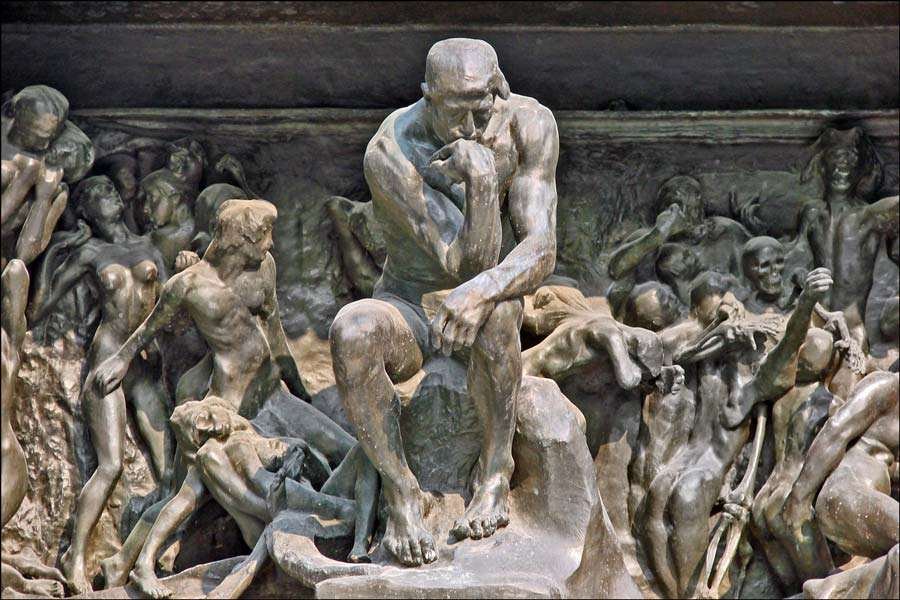
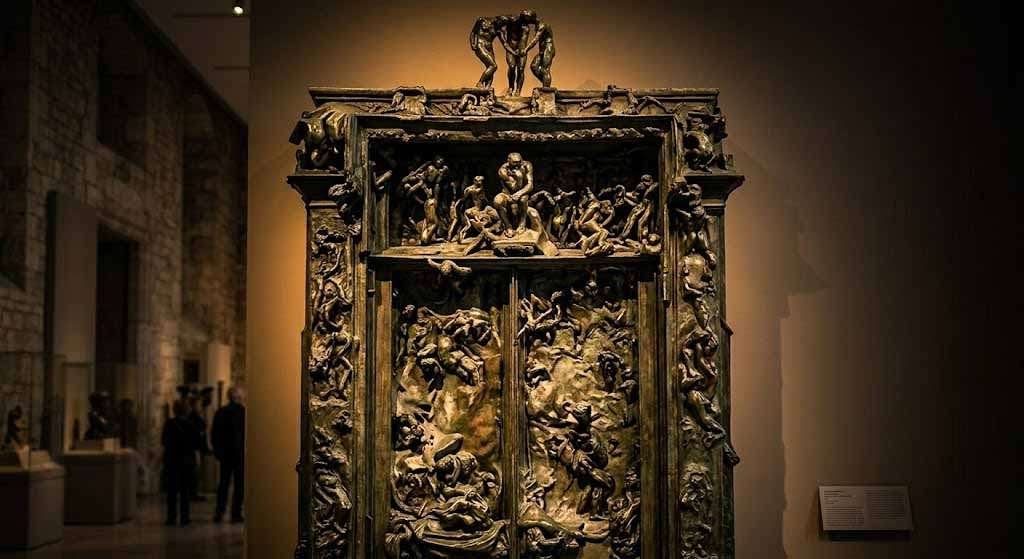
In 1880, the French government handed Auguste Rodin a commission to design a pair of bronze doors for a planned decorative arts museum in Paris. The subject was Dante’s Divine Comedy. Rodin called the project The Gates of Hell, and he would work on it, obsessively and incompletely, for the rest of his life. The museum was never built. The doors were never officially finished. But in the process of building them, Rodin produced some of the most important sculpture of the nineteenth century — figures that were eventually cast separately and sent out into the world on their own terms.
The Thinker was one of those figures. Rodin placed him at the top of the doors, seated above the swirling mass of damned souls below. The figure was, in Rodin’s own conception, the poet himself — Dante, surveying the suffering he had imagined into existence. The intellectual brooding wasn’t generic contemplation. It was a specific anguish. A man watching the consequences of human failure pour out beneath his feet.
That context collapsed the moment the figure was cast at monumental scale and placed in a garden. Without the Gates, without the damned writhing below him, the seated figure became something else. He became The Thinker — universal, anonymous, a logo for the life of the mind.
Why the Body Doesn’t Match the Idea
Here is what I keep coming back to when I stand in front of this work: the body is wrong for the concept it supposedly represents.
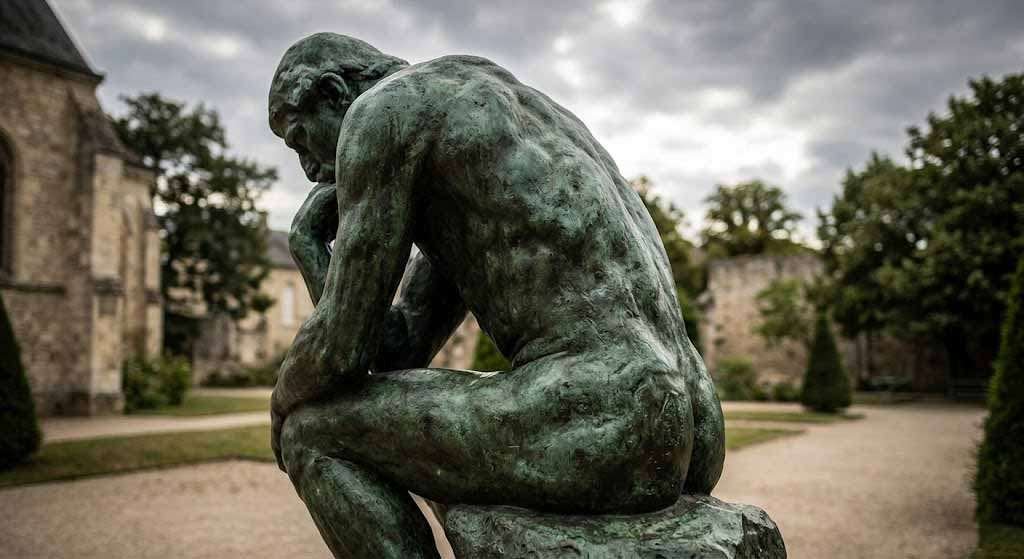
Thinking, as most people imagine it, looks like stillness. A man in a chair. Maybe a cup of coffee. Maybe a window. What Rodin gave us is nothing like that. The figure is enormous, corded with muscle across the back and thighs, every part of the body under visible tension. The right elbow doesn’t rest comfortably on the left knee — it’s pressed there, the whole torso twisted and compressed into a posture that no one would sustain voluntarily for more than thirty seconds. The fist under the chin isn’t a gentle support. It’s a barrier, the knuckles jammed against the jaw as though the man is holding his own face together.
This is not rest. This is strain. The body is doing something.
That was entirely deliberate, and it was Rodin’s central departure from what had come before. Classical idealism — the tradition running from ancient Greece through the Renaissance and into the academic sculpture of Rodin’s own era — tended to show the ideal form in repose. The body as it should be, in equilibrium, representing some abstract perfection. Beauty as a synonym for calm.
Rodin didn’t believe that. He believed the body told the truth about the inner life. Not a sanitized truth — the full one, with all the effort and contradiction intact. If thought is difficult, if genuine reflection is a kind of suffering, then a figure lost in thought should look like he’s suffering. The muscles should be doing the work. The pose should cost something.
He was not the first sculptor to reach for psychological intensity. Michelangelo had done it — and Rodin acknowledged the debt openly, calling Michelangelo the master from whom he learned everything about the expressive body. But where Michelangelo’s tortured figures were often heroic in scale and divine in subject, Rodin’s were intensely human. The Thinker isn’t ascending toward God. He’s grinding against a problem he may never solve.
The Surface That Changed Everything
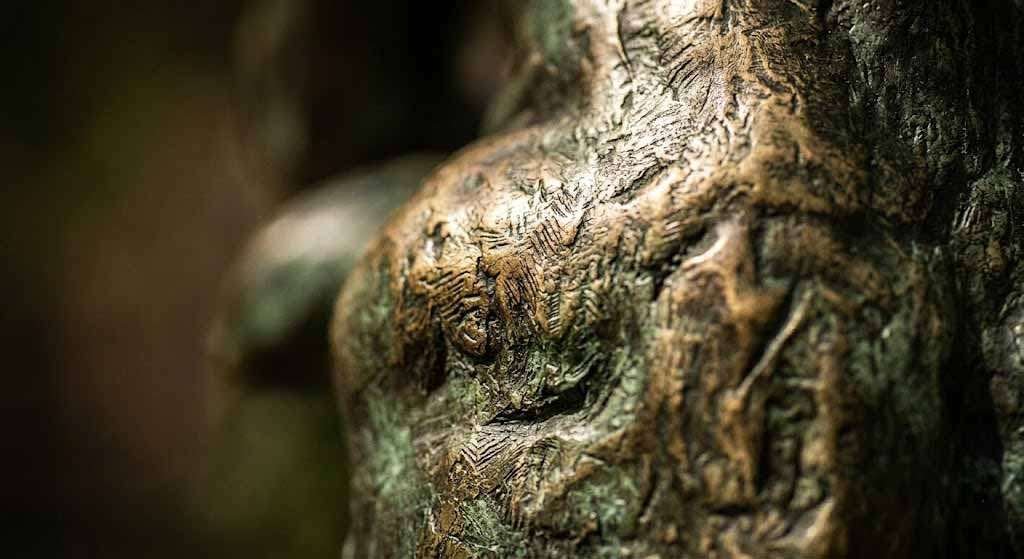
Spend enough time with photographs of The Thinker and you notice something the mug and the bumper sticker never show you: the surface of the bronze is rough. Visibly worked. There are marks left by Rodin’s hands and tools that were never smoothed away — intentional scars in the surface that catch light unevenly, give the figure a quality of becoming rather than completion.
Academic sculpture of the period prized the finish. A polished surface signaled mastery, the human hand disappearing into the perfect form. Rodin kept the hand visible. He kept the process in the product.
This was not carelessness. It was a philosophical position. The rough surface suggests that the figure is still being made — still in the process of emerging from formless material into something defined. For a figure meant to embody the act of thought, that quality of perpetual emergence is exactly right. Thought, after all, doesn’t arrive finished. It grinds forward, stalls, revises, starts again. The surface of The Thinker looks like that. It looks like the process.
It also looks, frankly, more like life than any polished academic figure from the same era. The skin of a real person is not smooth. It’s marked by time and labor. I’ve spent enough years working leather — cutting, stitching, burnishing — to know that the marks left by the making are part of what makes a thing honest. A surface that erases its own history is telling a half-truth. Rodin wasn’t interested in half-truths.
From Dante to Universal Symbol — and What Was Lost
The first monumental cast of The Thinker was installed at the Panthéon in Paris in 1906, and that placement told the world what to do with it. The Panthéon is France’s secular temple — the building where Voltaire, Rousseau, Victor Hugo, and Émile Zola are interred. To put The Thinker there was to consecrate the figure as a symbol of intellectual culture, of the Republic of Letters, of rationalism itself.
The Inferno context was gone. Dante was gone. What remained was the pose — and the pose, stripped of its narrative, became available for any interpretation anyone wanted to project onto it.
Today there are more than twenty full-size casts of The Thinker in major collections and public spaces across the world, plus dozens of smaller authorized editions. The original clay study is at the Musée Rodin in Paris; a cast sits outside the Cleveland Museum of Art; another in front of the California Palace of the Legion of Honor in San Francisco; one in Louisville; one in Tokyo. The image has been reproduced in every form imaginable, appropriated by advertisers and philosophers and politicians with equal enthusiasm.
What was lost in that dispersal was Rodin’s actual argument. He wasn’t making an icon of serene rationality. He was making a figure in anguish. The man at the top of the Gates of Hell is not sitting comfortably in an armchair contemplating pleasant abstractions. He is sitting above a chasm full of human suffering, and the suffering is a direct consequence of human choice, human passion, human failure to see clearly. The straining body, the compressed posture, the rough surface — all of it makes sense in that context. It’s a figure who has looked at the worst of what human beings do to each other and is trying to understand it.
That is a very different proposition than the cheerful logo for intellectual ambition the world has made of him.
Existential Weight Before the Term Existed
Rodin completed the first version of The Thinker in 1882, roughly seven decades before existentialism became a cultural movement. But the figure anticipates the existentialist temperament with eerie precision. The isolation of the individual in the face of something overwhelming and ultimately unjustifiable — the effort of consciousness pressing against its own limits — the refusal to offer any resolution or comfort in the pose itself. All of it is there.
When I wrote about Jacques-Louis David’s The Death of Socrates, I was struck by how differently the neoclassical tradition handled the philosophical subject — clean line, ordered composition, a death scene that looks almost like a seminar. The participants are arranged. The emotion is controlled. The message is legible and reassuring: Socrates died for what was true, and that makes it, in some sense, all right.
Rodin gives you nothing like that reassurance. The Thinker offers no conclusion. The pose is not moving toward resolution — it is suspended in it, frozen in the moment of grappling. The fist against the jaw will never lower. The thought will never arrive. The figure is permanently in the middle of the hardest part.
That is a more honest representation of what serious thought actually feels like, and a more honest representation of what Dante’s poem actually contains. The Inferno is not a story about thinking your way out of suffering. It is a story about descending into it, witnessing it, and carrying it with you.
What He Left Us
Rodin died in 1917, and the gates were never cast in bronze during his lifetime. The first posthumous bronze casting of the complete Gates of Hell wasn’t made until 1926. The Thinker had already been loose in the world for twenty years by then, already fully detached from the context that created him.
What we’re left with is a figure that has been misread into greatness — or maybe not misread so much as expanded. The world took a specific, narrative image and found something larger in it. A posture that could hold the whole of human intellectual struggle, not just one poet’s hell.
That’s not nothing. Symbols earn their power the hard way, through use. The Thinker has been used, reproduced, appropriated, argued over, and placed in front of hospitals and universities and courthouses across five continents. Whatever Rodin intended, the figure has accumulated a life he didn’t plan.
But I think it’s worth knowing where he came from. Worth knowing that the man with his fist under his chin wasn’t thinking pleasant thoughts. He was looking at Hell and trying to make sense of it.
That changes the pose, if you let it. The next time you see him, give him that context back. The coiled body, the rough surface, the permanent tension in the frame — it all lands differently when you know what he was looking at.
Most of what we think we know about famous images, we got secondhand. Rodin’s original argument is right there in the bronze, if you’re willing to read it.
Sources
- Rilke, Rainer Maria. Rodin. Translated by Daniel Slager. Archipelago Books, 2004. https://archipelagobooks.org/book/rodin/
- Musée Rodin, Paris — Collection and historical documentation. https://www.musee-rodin.fr/en/collections/sculptures/thinker
- Lampert, Catherine. Rodin. Royal Academy of Arts, 2006.
- Dante Alighieri. Inferno. Translated by Robert Hollander and Jean Hollander. Anchor Books, 2000. https://www.penguinrandomhouse.com/books/291948/inferno-by-dante-alighieri/
- Metropolitan Museum of Art — “Auguste Rodin: The Burghers of Calais.” https://www.metmuseum.org/art/collection/search/191811
- Butler, Ruth. Rodin: The Shape of Genius. Yale University Press, 1993.
You Might Also Like