This post presents a comparative analysis of documented public positions and statements. It does not claim to represent the private beliefs of either figure beyond what they themselves made public. Readers of all orientations are encouraged to consult the primary sources cited.
Consider the improbability of the following: Carl Sagan — the man who said the cosmos is all that is, or ever was, or ever will be — and Pope John Paul II found themselves, in 1990, on the same side of an argument. Not a small argument. The argument. The fate of a pale blue dot suspended in a sunbeam, drifting through a cosmos that will not notice when it’s gone.
The two men never shared a room. But their intellectual encounter — conducted through open letters, encyclicals, speeches, and the quiet machinery of institutional convergence — is one of the stranger and more philosophically loaded stories of the late twentieth century. It deserves more careful attention than it has received. Because what it reveals is not the comfortable narrative of science and religion making peace. It reveals something stranger: two radically incompatible cosmologies arriving at the same moral conclusion through completely different mechanisms. And then, inevitably, diverging again.
The Letter from the Scientists
In January 1990, Sagan delivered an open letter to the world’s religious communities at the Global Forum of Spiritual and Parliamentary Leaders in Moscow. It was signed by thirty-two Nobel laureates and co-authored with figures including Stephen Jay Gould and Edward O. Wilson — not a group known for theological sympathy. Sagan spearheaded a joint appeal to the religious and scientific communities for environmental action on behalf of mankind, signed by thirty-two Nobel laureates and other scientists and presented to the Global Forum of Spiritual and Parliamentary Leaders Conference in Moscow, Russia.
The text is striking precisely because of who wrote it. Sagan was an agnostic who regarded the cosmos as a closed causal system — no interventions, no personhood behind the physics, no divine author giving the universe its stage directions. And yet the letter contained this line, preserved in the archive of that Moscow conference: problems of such magnitude must be recognized as having a religious as well as a scientific dimension.
That is not a line you expect from the man who built a career telling us the cosmos has no special interest in human affairs. But Sagan was too honest a thinker to pretend that science alone — as a social and political force — could generate the moral gravity the crisis demanded. He needed, as one analysis of that meeting put it, the moral fervor that science techniques cannot by themselves ignite.
Prominent scientists decided that science has the techniques, but is unable to ignite sufficient moral fervor to induce the public to accept and finance policies that apply them — and that it would be worth a try to appeal to religion to supply the missing moral fervor as a basis for political consensus and action.
Two hundred and seventy-one religious leaders from eighty-three countries signed a response. Two years later, in May 1992, Sagan joined with Wilson and Gould to issue the Declaration of the “Mission to Washington” — a formal Joint Appeal by Science and Religion for the Environment, signed by 150 scientists and religious leaders and hosted by then-Senator Al Gore. The encounter was real. The convergence was real. It just happened in Washington and Moscow, not Rome.

What John Paul II Was Doing at the Same Time
While Sagan was marshaling Nobel laureates, Karol Wojtyla was working a different set of tools. In October 1992, at the Pontifical Academy of Sciences — an institution with Galileo’s fingerprints on its founding charter — John Paul II delivered his address on the Galileo case. He acknowledged the seventeenth-century tribunal’s error. He called for a new dialogue between theology and science. He said the myth of permanent conflict between faith and scientific inquiry had become a sad misunderstanding that now belongs to the past. The Pope declared that theologians should keep themselves regularly informed about scientific advances and that the myth of the Galileo case had encouraged the erroneous idea that science and the Christian faith were in opposition, but that this “sad misunderstanding now belongs to the past.”
Those are not the words of a man fighting a rearguard action. Wojtyla was a phenomenologist trained in the tradition of Max Scheler — a philosopher who believed the person, in all their irreducible specificity, is the axis around which any adequate account of reality must turn. His 1998 encyclical Fides et Ratio extended that project. Faith and reason, he argued, are two wings on which the human spirit rises to the contemplation of truth. They are not adversaries. They are different instruments trained on the same target.
That target, for John Paul II, had a name and a face and a resurrection. For Sagan, it did not.
The Pale Blue Dot and the Imago Dei
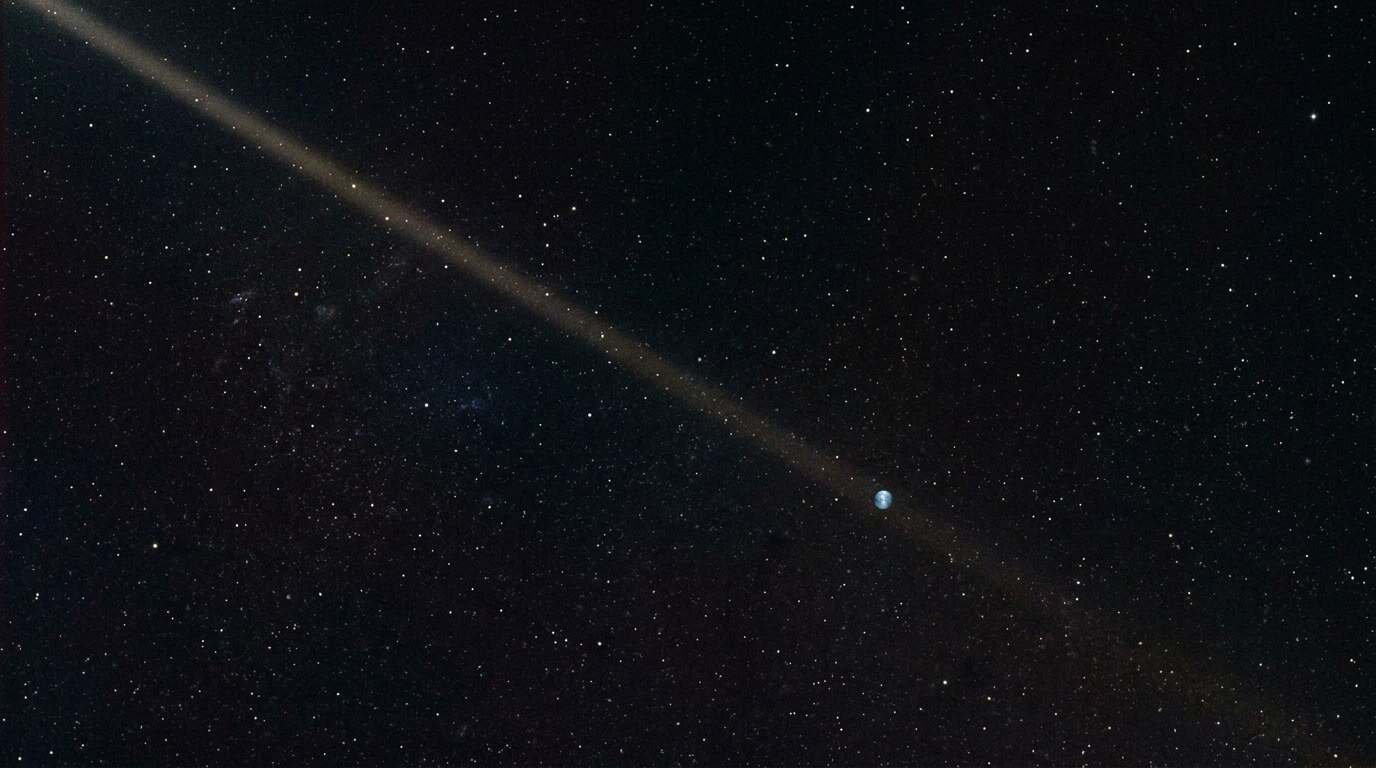
Sagan’s Pale Blue Dot was published in 1994 — the year after Voyager 1 turned its camera back toward Earth from a distance of about four billion miles and took the photograph that became the book’s centerpiece. You have seen the image: a mote of dust suspended in a sunbeam. Earth. Our only home. The passage Sagan wrote to accompany it has become, for a certain kind of secular humanist, something close to sacred text:
Every king and peasant, every creator and destroyer of civilizations, every hero and coward, every saint and sinner in the history of our species, all of them lived out their lives on a mote of dust suspended in a sunbeam.
The argument of that passage is ontological humility by force of scale. We matter less than we think. Our wars, our theologies, our empires — the cosmos registers none of it. The appropriate response, Sagan concluded, is a responsibility to deal more kindly with one another and to preserve and cherish the pale blue dot, the only home we’ve ever known.
John Paul II’s cosmology produces the same behavioral prescription through the opposite route. The Earth is not a mote of dust suspended in meaningless space — it is creation, authored by a being whose attention never wavers from what He made. Its preservation is not a response to cosmic insignificance but an obligation rooted in human dignity, which is itself rooted in the imago Dei — the image of God in which every person is made. Stewardship, in the Thomistic tradition the Pope inhabited, is not managing a rock. It is tending to what belongs to another. Pope John Paul II himself affirmed the principle: “The earth will not continue to offer its harvest, except with faithful stewardship. We cannot say we love the land and then take steps to destroy it for use by future generations.”
Two frameworks. One planet. Same conclusion. And that convergence is philosophically uncomfortable in ways that neither party fully acknowledged at the time.
The Uncomfortable Middle
Philosophy has a word for what both men were doing: they were bridging the is and the ought. From the fact that we live on a fragile planet, what follows? Nothing — unless you introduce some premise about value. Sagan’s secular humanism supplied that premise quietly: we ought to preserve ourselves because consciousness, curiosity, and love are worth something, even in a universe that doesn’t know they exist. John Paul II supplied his premise overtly: we ought to preserve creation because it is not ours to destroy.
I’ve spent time over the years with both frameworks — the Dawkins shelf and the Kierkegaard shelf, in rough terms, and neither sits cleanly. What stays with me from my reading of The Demon-Haunted World, Sagan’s 1995 defense of scientific skepticism, is how much Sagan genuinely respected the function of religion even as he rejected its metaphysical claims. He understood that institutions capable of generating moral community across centuries have accomplished something that science, as a method, cannot replicate. He needed them. He wrote them a letter.
Sagan himself acknowledged the prodigious diversity and complexity of religious thought and practice over the millennia; the growth of liberal religion and ecumenical fellowship; and the fact that religion has fought, with varying degrees of success, its own excesses.
That is a remarkable sentence from a man whose public reputation is that of a secular rationalist. It suggests a more nuanced intellectual position than the culture-war version of Sagan that tends to circulate online. He was skeptical, not contemptuous. There is a difference, and it matters.
You can read my review of The Selfish Gene — a book that helped crystallize what the evolutionary framework can and cannot tell us about meaning — and notice that Dawkins, Sagan’s intellectual heir in some respects, is considerably less generous toward religion’s functions than Sagan ever was. The distinction is worth holding.
Karol Wojtyla’s Phenomenological Personalism
What tends to get lost in the science-versus-religion framing is how sophisticated John Paul II’s philosophical formation actually was. Before he became pope, Karol Wojtyla wrote a serious philosophical treatise — The Acting Person (1969) — that engaged Husserl, Scheler, and Kant in technical detail. His was not a faith that had never heard of Kant. It was a faith that had answered Kant on his own terms, or tried to.
His phenomenological personalism begins with human experience, not with revelation. The person, as acting and experiencing subject, discloses features of reality that a purely physical description cannot capture. Consciousness. Moral obligation. The sense that other people are ends in themselves, not instruments. From these phenomenological starting points, he built toward a metaphysics that included God — not as a gap-filler for unexplained physics but as the necessary ground of the moral and experiential reality we already inhabit.
Sagan, working from the opposite direction, found no such necessity. The cosmos, observed carefully, yields no evidence of such a ground. It yields instead billions of galaxies, most of them uninhabitable, all of them indifferent. It yields a planet whose biosphere is fragile and old and will eventually be swallowed by an expanding sun, at which point every human achievement will have been, in the words of the astrophysicist, irrelevant to the universe. The appropriate emotional response to this, Sagan consistently suggested, is not despair — it is wonder and responsibility.

Which Cosmology Prepares Us Better?
The question the brief for this post poses — which framework better prepares humanity for cosmic insignificance — may not have a clean answer. But it has an honest one.
Sagan’s framework is more intellectually defensible in light of what the evidence actually shows. The cosmos does not appear to be addressed to us. The mathematics of planetary formation do not suggest special arrangement. The extinction of 99.9 percent of all species that have ever lived on this planet does not suggest providential care in any conventional sense. If you are calibrating your cosmology against the observable universe, Sagan’s version fits better.
But frameworks are not only calibrated against evidence. They are also calibrated against their ability to generate durable human behavior. And here, the record is more ambiguous. Sagan’s secular humanism produced a magnificent letter in Moscow and a June 1992 Joint Appeal in Washington. It did not, in the decades that followed, produce the political will to address the crisis it identified. Despite the appeal’s widespread support, little if any progress was made on the issues it raised, other than chlorofluorocarbons and a lessening of nuclear saber rattling.
John Paul II’s framework produced Laudato Si — though that encyclical came from his successor Francis, twenty-three years later, when the crisis had deepened considerably. It produced a tradition of stewardship theology that, whatever its metaphysical warrant, has consistently pushed its institutional adherents toward environmental obligation.
Neither cosmology won. The planet lost twenty years of necessary action while the argument continued.
The Strange Fact of Their Agreement
What remains genuinely strange about the Sagan-JPII encounter is that the agreement happened at all. A man who believed consciousness ends at death, and a man who believed it does not — finding themselves, in the same historical moment, writing similar things about the same rock. The strangeness is not resolved by noting that they disagreed about everything upstream. The strangeness is the agreement itself.
Philosophy of science has a concept called underdetermination: the same data set can be consistent with multiple, incompatible theories. The pale blue dot is consistent with Sagan’s secular humanism and with John Paul II’s Christian personalism. Both men looked at the same photograph and arrived at the same imperative. The mechanisms differed. The conclusion did not.
If you are looking for a lesson in that — and I am, though I hold it loosely — it might be this: whatever framework a civilization uses to ground its moral obligations, the obligations themselves are not framework-dependent. The planet does not care what metaphysical story you tell about it. It cares whether you act.
You can read more on the territory where science and religion make contact, and where they don’t, in my pieces on Hume’s Dialogues Concerning Natural Religion, Dennett’s Darwin’s Dangerous Idea, and the Kierkegaard vs. Nietzsche problem — three pieces that together get at what neither Sagan nor Wojtyla resolved, and maybe couldn’t.
The cosmos does not announce its meaning. That has always been the problem. Both men spent their lives building instruments to detect it — one pointing outward toward the stars, one pointing inward toward the person. The photograph exists. The silence around it continues.
This is for informational and philosophical discussion only. It does not represent the official positions of any religious or scientific institution.
Sources
- Carl Sagan, The Demon-Haunted World: Science as a Candle in the Dark (1995, Random House) — Penguin Random House
- Carl Sagan, Pale Blue Dot: A Vision of the Human Future in Space (1994, Random House)
- Keay Davidson, Carl Sagan: A Life (1999, John Wiley & Sons)
- Pope John Paul II, Address to the Pontifical Academy of Sciences, October 31, 1992 — Vatican Archive
- Pope John Paul II, Fides et Ratio encyclical (1998) — Vatican
- “Preserving and Cherishing the Earth: Joint Appeal in Religion and Science” (January 1990, Moscow) — SolTech Designs archive
- Joint Appeal by Religion and Science for the Environment, Declaration of the “Mission to Washington,” May 1992 — Archives at Yale
- Karol Wojtyla, The Acting Person (1969; English translation 1979, D. Reidel Publishing)