
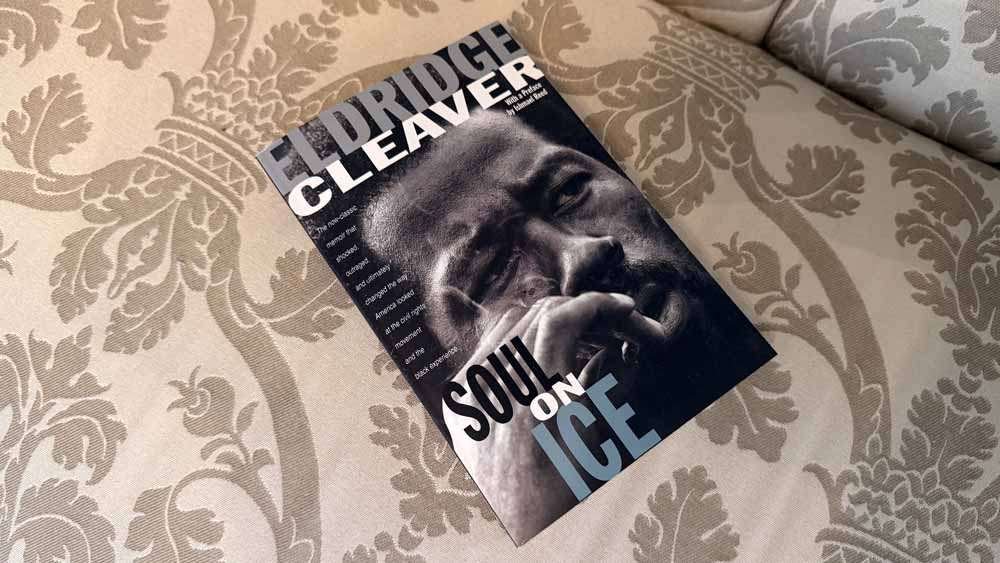
Rage, when it has nowhere to go, either destroys the person holding it or becomes something else. Eldridge Cleaver, writing from a cell in Folsom Prison in the early 1960s, chose the second path. Soul on Ice — published in 1968 and assembled from letters and essays written during his incarceration — is not the book its reputation sometimes suggests. It is not simply a document of Black Power fury, though the fury is real and earned. It is a man using the only weapon available to him — his mind — to construct a philosophy out of the conditions trying to eliminate him.
That is what makes it worth reading now, and what makes it uncomfortable to read now. Both things are true at once.
Writing as a Philosophical Act
Cleaver begins writing in prison not as protest, exactly, but as survival. He describes the moment in almost clinical terms — the decision to put words on paper as a way of holding on to the self that the prison system was designed to dissolve. This is where the existentialist architecture of the book becomes clear: the act of writing is not decorative. It is the act of asserting that a self exists. In a system built to reduce a man to a number, to a threat, to a body being warehoused, the insistence on a thinking, examining, questioning inner life is the most radical thing possible.
Sartre would have recognized it immediately. So would Camus. The parallels are not accidental — Cleaver was reading seriously while incarcerated, and the existentialist tradition runs through Soul on Ice in ways that don’t always get named. But his existentialism has a specificity that European philosophy largely lacked. His absurdity is not the absurdity of a free man contemplating a meaningless universe. It is the absurdity of a man who can see clearly that the system he is inside is not neutral, not blind, not accidental — and who must construct meaning anyway. That is a harder problem. Camus was working with the human condition in the abstract. Cleaver was working with America in the concrete.
The Honest Accounting
The book’s most difficult section is also its most important. Cleaver admits, with a directness that is almost staggering, that he committed rape — and that he understood it at the time as a political act, an insurrection against the white social order. He later recants this framing, calls it monstrous, and takes the full weight of what he did. The recantation is not performed. It reads like a man who followed his own logic to its conclusion and found it leading somewhere he could not justify.
This is the kind of self-examination that most writers — most people — will not do. It costs too much. Cleaver does it in print, in a book that was already being read by thousands. The courage required is not small. And the philosophical weight of it is significant: he is demonstrating that ideology can corrupt reason, that the mind building a framework for its own actions is not automatically a reliable narrator of those actions. He catches himself. He prosecutes himself. He does not ask the reader for absolution.
This is where Soul on Ice separates itself from most political writing of the era, which is often more interested in the cause than in the interior life of the person advancing it. Cleaver is interested in both, and he is honest enough to let them contradict each other.
Power, the Body, and the American Mythology
The middle sections of the book develop a theory — controversial, sometimes overstated, sometimes brilliant — about the relationship between race, sexuality, and power in American culture. He divides the social order into archetypes: the Omnipotent Administrator, the Supermasculine Menial, the Ultrafeminine, the Amazon. These categories are not sociology; they are political poetry. They are a way of naming what the body means in a society that has assigned meaning to bodies before the person inside them gets any say.
What Cleaver is doing here is not far from what Nietzsche was doing when he traced the genealogy of moral values — asking not what do we believe but who benefits from us believing it, and how did we come to believe it in the first place. The conclusions are different. The method is related. Both are trying to get underneath the official story and find the power arrangement it was built to protect.
Whether you accept every piece of his framework is less important than recognizing what he is attempting. He is treating American racial mythology as a philosophical system — one with internal logic, historical roots, and material consequences — and he is trying to dismantle it from inside a prison cell using nothing but a legal pad and a pencil. That is not nothing.
What the Book Still Does
James Baldwin, who engaged with Cleaver’s work both publicly and critically, recognized the genuine force of Soul on Ice even where he disagreed with it — and he disagreed sharply on certain points, particularly around masculinity. The tension between Baldwin and Cleaver became one of the defining intellectual arguments of the period. Baldwin saw in Cleaver’s framework a kind of machismo that replicated some of the values it claimed to oppose. He was not wrong. And yet the book survives both its flaws and its era.
It survives because the central act — a man using philosophy to refuse erasure — does not age. The specific historical moment is 1960s America. The underlying problem is older and remains unresolved. What do you do with the rage that a system produces, when the system is not interested in your answer? Cleaver’s answer was to turn it into thought. To write. To examine. To refuse to be only what the cell defined.
That is a philosophical position. And it is still a hard one to argue with.
You Might Also Like:
Suicide: A Study in Sociology by Émile Durkheim — The Book That Turned Death Into Data and Data Into a Mirror
Propaganda by Jacques Ellul — The Book That Explains Why You Think What You Think
The Revolt of the Masses by José Ortega y Gasset — A Review
Sources
- Cleaver, Eldridge. Soul on Ice. McGraw-Hill, 1968. penguinrandomhouse.com
- Baldwin, James. “Notes on the House of Bondage.” The Nation, 1979. thenation.com
- Rampersad, Arnold. Introduction to Soul on Ice, Delta Trade Paperbacks edition, 1999.
- “Eldridge Cleaver.” Encyclopedia Britannica. britannica.com