Before the highway median strips were planted, before the strip malls and chain restaurants filled every county road, Long Island was shaped in part by two factories you’ve probably never heard of. One sat in Newark, New Jersey. The other occupied a plant in New Rochelle, New York. Between them, they fabricated thousands of diners — prefabricated, trucked in sections, bolted together on suburban lots — that became the most recognizable buildings on the Island’s roadside for most of the twentieth century.
This is that story.
Two Men, Two Factories, One Industry
The American diner didn’t start in a factory. It started on the street — lunch wagons, horse-drawn, parked outside newspaper offices and factory gates after midnight when the restaurants closed. Walter Scott of Providence, Rhode Island, is credited with the first, in 1872. From there the idea migrated, commercialized, and eventually industrialized. By the 1920s, New Jersey had become the undisputed capital of diner manufacturing, home to a concentrated cluster of fabricators who were, in essence, running assembly lines for small-scale American restaurants.
The man who became the dominant force in that industry was Samuel Kullman, a Russian immigrant who had arrived in the United States at thirteen and worked his way up as an accountant for the Tierney Dining Car Company, then one of the leading names in the business. Kullman eventually ventured out on his own, pioneering the manufacture of wheel-equipped, pod-shaped diners that could be easily relocated to serve truckers and travelers along the expanding American highway network. He founded the Kullman Dining Car Company in Newark in 1927.
The company that became his chief rival — and eventually his heir apparent in volume — grew from a different kind of ambition. Angelo DeRaffele began to work at the Tierney Dining Car Company as a carpenter in 1921, learned the business thoroughly in a short time, and rose to the level of foreman. When Tierney collapsed during the Depression, DeRaffele didn’t scatter. Along with Carl A. Johnson, the former President at Tierney, he resumed the fabrication of diners at the Tierney plant itself, under the business name Johnson & DeRaffele. By 1947, DeRaffele owned the company outright. He had taken the ruins of his old employer’s operation and built something that would outlast everything around it.
Both men — the accountant from Russia, the Italian carpenter from New Rochelle — came to the diner business from the inside. Neither started with capital or connections. They started with knowledge, stubbornness, and the understanding that what people wanted, especially after a war or a Depression, was a clean counter, a hot cup of coffee, and a place that asked nothing of them beyond showing up.
The Factory Floor
What Kullman and DeRaffele were really building was not restaurants. They were building buildings — prefabricated structures that happened to serve food. The manufacturing logic was closer to modular construction than to traditional contracting, and it gave both companies an enormous speed and cost advantage over anything built on-site.
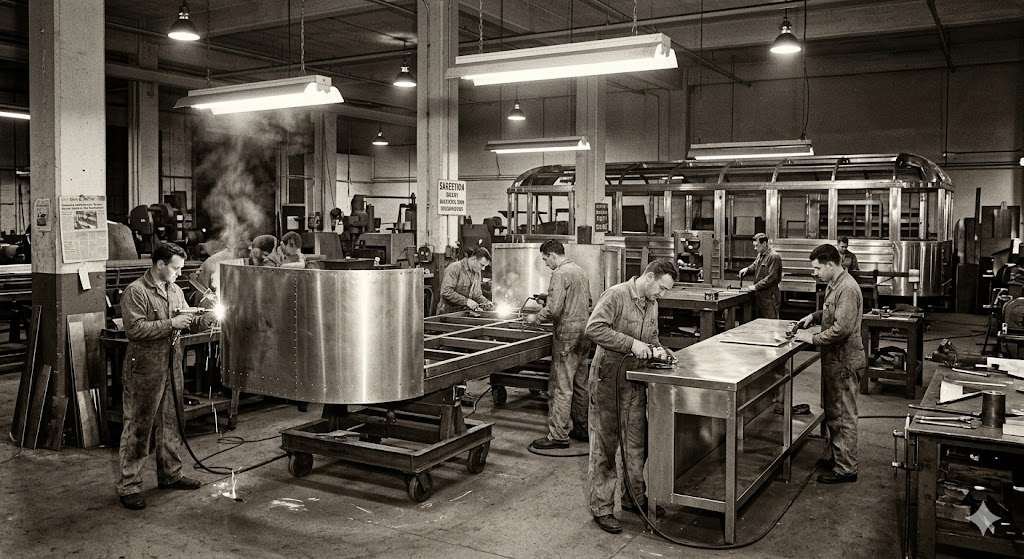
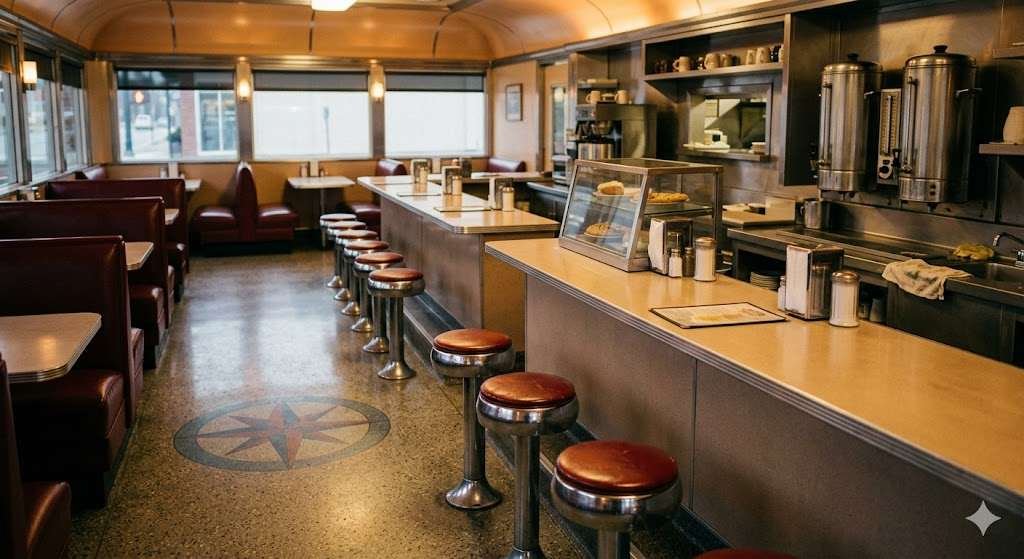
Under Harold Kullman’s leadership, the company significantly expanded diner production, manufacturing 30 to 40 units annually in the late 1940s and 1950s by assembling them in modular sections that were transported and installed on-site. Picture that for a moment: a factory in New Jersey producing a finished restaurant every week or two, crating it in sections, loading it on flatbeds, and driving it to a lot in Smithtown or Babylon or Cutchogue where a crew would bolt it back together like a machine from a kit. The counter, the stools, the grill hood, the terrazzo floor, the chrome trim — all of it arrived as a package. A diner could go from empty lot to open for business in days.
At DeRaffele’s 10,000-square-foot warehouse at 2525 Palmer Avenue in New Rochelle, the staff — including stonecutters, sheet-metal workers, carpenters, and welders — would build a complete custom diner. After fabrication, the diners were taken apart for delivery in sections, transported by DeRaffele trucks, and reassembled on the site. From start to finish, the process took about four to five months.
The materials defined the look that people still associate with the word “diner” — stainless steel cladding, glass brick, porcelain enamel panels, neon signage that was sometimes baked into the structure itself. These weren’t decorative choices made by aesthetes. They were industrial choices made by engineers. Stainless steel doesn’t rust. Porcelain enamel doesn’t stain. They hold up under the daily assault of grease, steam, and a thousand strangers. The gleam was a byproduct of function, and the function produced something that turned out to be beautiful.
Art Deco on a Flatbed
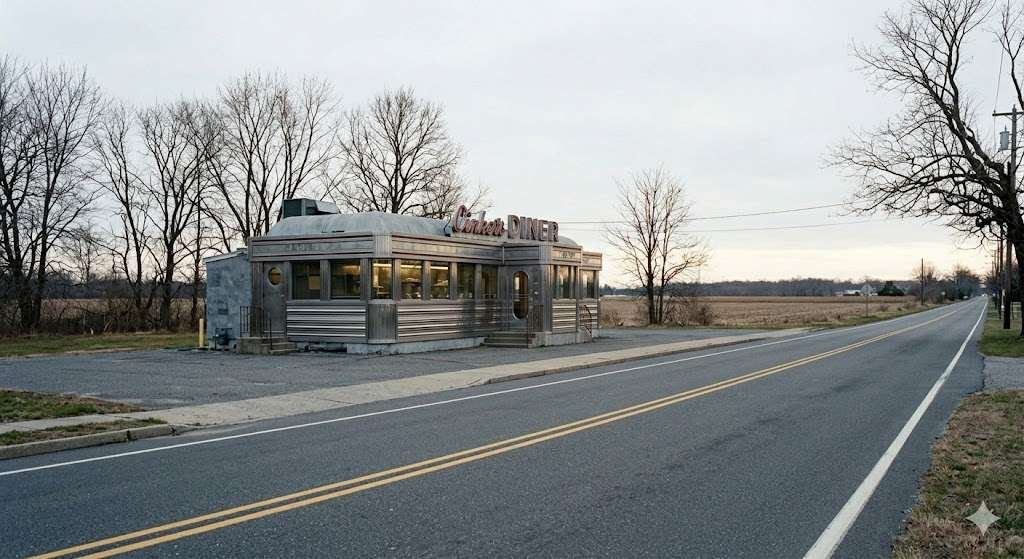
The postwar designs coming out of both factories owed a debt to two things: railroad dining cars and the Streamline Moderne movement that had swept American design in the 1930s. The early diners turned out by these manufacturers were gems of American industrial design; often, they resembled gleaming railroad cars. They remain prime examples of Streamline Moderne architecture, a concept emphasizing sleek lines and aerodynamic forms — the American Machine Age rendered in stainless steel and neon, placed at eye level on every highway Long Island built after the war.
Kullman’s designs in the late 1940s and through the 1950s were among the most confident expressions of that aesthetic anywhere in the built environment. Chrome-wrapped edges. Low rooflines with gentle curves. Windows that ran in horizontal bands. Neon tubes bent into script lettering that lit up Route 25 or Sunrise Highway at dusk like something from a science fiction magazine. These weren’t humble structures. They were statements — small ones, maybe, but placed at eye level where every driver and every passenger on Long Island could see them.
Philip DeRaffele, who joined his father’s company during his high school years and graduated from the Delahanty School of Architectural Design in Manhattan, became the person who pushed the design language hardest. He understood that the chrome-and-stainless vocabulary was reaching its limits, and tried to convince his father that people were tired of the same small structures that kept coming out of their shop. The result was the Peter Pan diner — designed, manufactured, and delivered to Long Island in the 1950s, and later moved to the Wilmington, Delaware area. The exterior had wings, a bigger canopy, and novel window shapes, transforming the look of diners. Philip DeRaffele had designed it at seventeen years old.
When the Zoning Boards Pushed Back
The stainless steel look didn’t last forever, and the reason it faded had less to do with taste than with power. In the early 1960s, municipalities didn’t want diners. Zoning boards objected to the stainless-steel, truck-stop image of the classic structures. They didn’t even want the word “diner” in the sign.
Postwar suburbia was organizing itself around class aspirations, and the chrome diner read as working class to the people running planning departments. As a result, Kullman’s parents, Harold and Betty, created what they called the colonial look — substituting wood-and-brick exteriors for the stainless-steel facades. Interiors got a warmer, family-friendly look, with wood paneling, hanging light fixtures, smaller counters, and larger booths and tables. Words like “restaurant” and “grill” replaced “diner” in the signage. As tastes continued to change in the 1960s and ‘70s, the company rolled out a “Mediterranean” design, with white stone exteriors and red tile roofs.
The chrome cathedrals were being stuccoed over. Not demolished — that came later — but disguised, given a coat of respectability by municipalities that didn’t want a truck-stop image on the main road. It was a minor social history playing out in architecture, and it happened to most of the Island’s classic buildings.
What Survived on Long Island
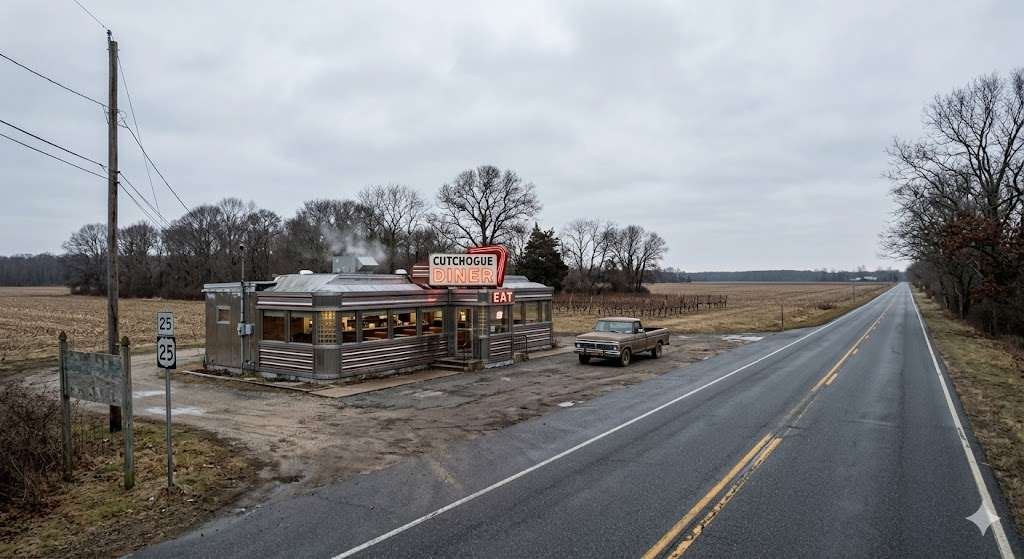
Not everything was lost. The most intact Kullman on Long Island’s eastern reach is the Cutchogue Diner on Route 25, a 1941 structure that has been operating continuously since it was delivered. The counter, the tilework, the marble top — the original bones are still there. For anyone making a run out to the North Fork wine country, it’s a working artifact, a piece of the Island’s mid-century manufacturing economy that still serves eggs and coffee.
On the Suffolk side, surviving DeRaffele builds can still be found at Middle Island on Route 25, in Wantagh on Old Country Road, and at several other locations scattered across the Island. Some have been heavily renovated. Some retain enough original fabric to tell you what the factory sent. A 1940 Kullman at 529 Middle Country Road in St. James is still in operation. These are not museums. They are functioning businesses — which is exactly the condition that keeps them standing.
I wrote about some of these Long Island institutions in Long Island’s Best Old-School Diners and Why They Still Matter, and there’s a particular kind of satisfaction in knowing that certain of those buildings came off an assembly line in New Jersey or out of a warehouse in New Rochelle, section by section, and have been serving the same stretch of road for eighty years.
The End of the Line
Kullman kept building, kept pivoting. Diversification began in 1969 under Robert Kullman, grandson of the founder, leveraging the company’s prefabrication expertise for institutional and commercial structures — housing, dormitories, prisons, schools, banks. In 1994, Kullman built the U.S. embassy in Guinea-Bissau at its plant and shipped the entire thing across the Atlantic. The same modular logic, applied to diplomatic infrastructure. By the 1990s they were exporting American diners to Germany, where a franchise called Sam Kullman’s Diner operated locations in Berlin, Kaiserslautern, and Regensburg. America’s working-class counter culture, shipped abroad as nostalgia product. By 2011, the company had gone out of business, the assets auctioned off in Hunterdon County. A company that had fabricated an estimated 1,500 diners over eight decades — gone.
DeRaffele endured. The company, now owned by brothers Joe, Steven, and Phil Jr., is the only diner manufacturer remaining in the region. They still operate out of the same Palmer Avenue address in New Rochelle where Angelo DeRaffele took over the Tierney plant in 1933. Philip DeRaffele died in 2021 at 93 years old. He was at his factory every day at 5:30 in the morning until he passed. The New Rochelle Diner near Exit 15 of the New England Thruway — the one his family built in 2014 — was his final act of place-making, a craftsman building the landmark his hometown had lost.
What They Were Actually Building
The diner is a particular kind of American idea. Not fast food, not fine dining — something in between that doesn’t really exist anymore. A place where a truck driver and an insurance agent could sit at the same counter and both feel like they belonged. Where the same family could come for three generations and order the same thing. Where the coffee was bad and you kept coming back anyway, because the counter was warm and the waitress knew your name.
Kullman and DeRaffele built the physical containers for that idea — assembled them in factories, numbered the sections, bolted them together on Long Island lots and left them there. The chrome was functional. The neon was economical. The communities that grew up around those buildings didn’t think of them as architecture. They thought of them as Tuesday morning.
That’s the whole point, actually. The best buildings don’t announce themselves. You find out they mattered later, when they’re gone. Long Island is losing them faster than most people realize. The ones that remain — on Route 25, on Old Country Road, on the North Fork — are worth going out of your way for. Not as museums. As diners.
Which is what they were always supposed to be.
For more on the Long Island roadside and the history it contains, The Ride Down 25A: A Historic Motorcycle Journey Along Long Island’s North Shore covers how Route 25A itself shaped the North Shore’s character — and Rum Row and the Freeport Bootleggers looks at another piece of the Island’s working-class industrial history that most people have forgotten.
You Might Also Like
- Long Island’s Best Old-School Diners and Why They Still Matter
- The Ghost Station Capital: How the World’s Lost Railway Architecture Continues to Define the Cities That Erased It
- The Ride Down 25A: A Historic Motorcycle Journey Along Long Island’s North Shore to The Heritage Diner
Sources
- Kullman Building Corporation — Wikipedia
- DeRaffele Manufacturing — Wikipedia
- DeRaffele Manufacturing Among Last of the Diner Builders — Westfair Communications
- Philip DeRaffele Obituary — Talk of the Sound
- Classic Diners, Offering a Glimpse Into the Past — NJ Monthly
- Diner Dreams and Declines: The Kullman Dining Car Company — Digital Inkd
- Diner Builders — Dream Diner
- The Cutchogue Diner on Long Island’s North Fork — Retro Roadmap
- Diners in Suffolk County — Dinerville
- End of an Era as Kullman Building Corp. Goes Under — Diner Hotline