
Six hours and forty-five minutes. That’s the drive from Port Jefferson to Old Montréal if you don’t stop — which you won’t, because the Adirondacks will make that impossible.
Pull up Google Maps and plug in the ferry terminal at Port Jefferson. The route sends you north through Connecticut, catches I-87 at Albany, and then punches straight up through the spine of New York State — past Lake George, past Plattsburgh, across the border at Champlain, and into Québec. It is one of the best drives in the Northeast. Not the most dramatic. Not the most famous. But one of those routes that earns its keep in stages: the density of Long Island draining away, the Hudson Valley opening up wide, the Adirondacks going dark and forested around you, and then — somewhere above Plattsburgh — that first glimpse of French on the road signs. Frontière. Bienvenue.
You made it. You left Long Island.
The Drive: Why the Adirondacks Deserve More Than Your Rearview Mirror
Most people treat I-87 as the price of admission to Montréal — something to get through. That’s a mistake.
Take the exit for Lake George and spend twenty minutes standing at the lake. Not a long stop. Just enough to remind yourself that New York State is enormous and that most of it looks nothing like the Cross Island Parkway. The water in Lake George has a color that’s hard to name — something between grey-green and blue, depending on the sky. In mid-March it’s still cold and the crowd is thin. Perfect.
North of Lake George, the mountains close in. There’s no other word for it — they close in. The road narrows in feeling if not in lane count, the treeline thickens, and the signs for gas stations start thinning out. Fill up at Plattsburgh. That’s not a suggestion; it’s a lesson learned from people who were very confident they had enough gas.
The border crossing at Champlain/Saint-Bernard-de-Lacolle is typically the fastest crossing between New York and Québec. Have your passport ready — it’s the law, not a suggestion — and expect to answer a few standard questions about purpose of visit and how long you’re staying. Be straightforward. They’ve heard every story. From the crossing to downtown Montréal is roughly an hour, and the city announces itself gradually: flat farmland, then suburbs, then the sudden rise of Mount Royal and the skyline of a place that has been doing exactly what it wants since 1642.
Day One: Eat Your Way Across the Plateau
Park in Old Montréal near the Vieux-Port and walk. This is not a car city — or rather, it is, but not for visitors. The neighborhoods you want are dense and human-scaled, and nothing useful is far from anything else.
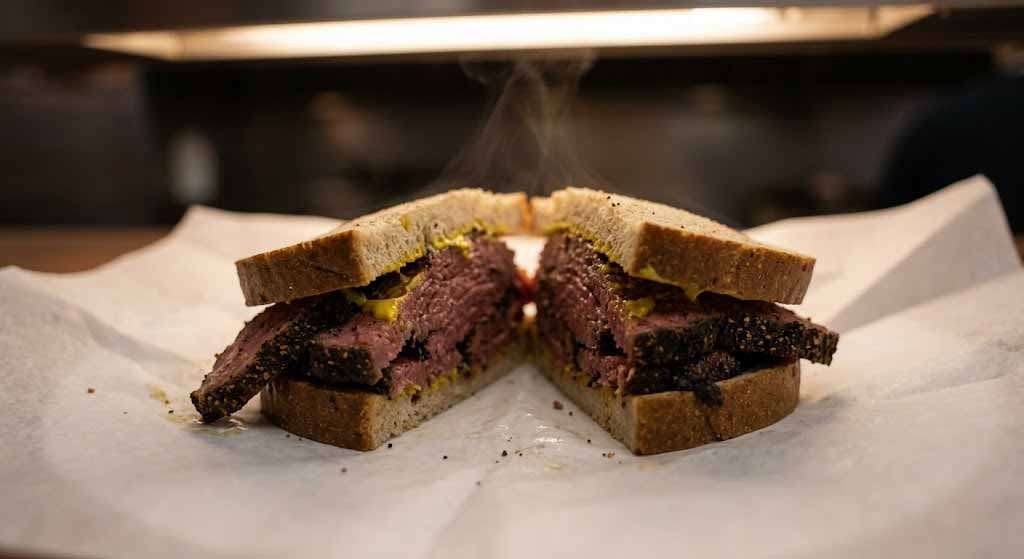
The smoked meat at Schwartz’s on Boulevard Saint-Laurent is mandatory. It’s been mandatory since 1928. The place is small, loud, and has absolutely no interest in modernizing. Sit at the counter if you can get it. Order the medium-fat — not the lean, not the extra-fat, the medium — on rye with mustard, and get a side of the house coleslaw. The meat is dry-cured for ten days, seasoned with a spice blend that nobody outside that kitchen fully knows, and hot-smoked until it is something entirely its own. It is not pastrami. It is not corned beef. Montréal smoked meat is a distinct thing, and Schwartz’s is the version against which all other versions are measured. There will be a line. Wait in it.
Two blocks away, the Plateau-Mont-Royal neighborhood opens up: duplexes with winding exterior staircases that are simultaneously impractical and iconic, cafés running on espresso and Québécois pride, independent bookshops with French-language poetry in the window. Walk it. There’s no agenda here. You’re absorbing a city that made different choices than yours.
For dinner, Montréal is serious. The restaurant scene punches well above the city’s weight class — the combination of French culinary tradition, excellent local produce, and a cost structure that hasn’t been completely destroyed by real estate has produced a dining culture that New York should be jealous of. Joe Beef on Notre-Dame Ouest is the pillar: meat-centric, market-driven, eccentric in the best possible way. Getting a reservation requires planning ahead, but the bar seats are often available for walk-ins, and the bar menu is worth the trip on its own. If Joe Beef is full, Liverpool House is next door and shares the same kitchen philosophy.

Day Two, Morning: Jean-Talon Market
Wake up early for this. Jean-Talon Market — Marché Jean-Talon — in the Mile End neighborhood is one of the great public markets in North America, and in late winter the vendors are setting up after months of cold. Maple syrup in every grade, jarred preserves, fresh cheeses, butchers who will look you in the eye and tell you where the animal was raised, and the best cider you will drink outside of Normandy.
March is shoulder season at Jean-Talon, which means it’s less crowded than summer without being empty. The flower stalls are quiet but the food vendors are fully operational. Buy things you have to explain to customs on the way home. If it’s commercially sealed, you’re usually fine bringing Canadian food products across the border; check the U.S. Customs and Border Protection guidelines at cbp.gov before you pack anything perishable.

The Bagels: A Different Religion
The Montréal bagel debate — St-Viateur vs. Fairmount — is ongoing and probably irresolvable. The short version: both are better than what you’ll find in most of New York. Not because of water or flour or any of the reasons people argue about bagels, but because of technique. Montréal bagels are smaller, denser, sweeter, and wood-fired. They are boiled in honey-water before baking. The result has a chew and a crust that’s structurally different from the boiled-and-steam-injected variety you get on Long Island — different enough to feel like a separate thing.
St-Viateur Bagel on Avenue Saint-Viateur has been going since 1957. They’re open 24 hours. Watch them shape the dough by hand and slide the rings onto long wooden dowels into the wood-burning oven. Buy a dozen. Eat two on the walk back to the car and let the rest go cold in the bag — they’re still good.
Fairmount Bagel has its partisans. The sesame is excellent. The debate will never end. Go to both.
Day Two, Afternoon: Old Montréal and What It Means to a City That Old
Old Montréal is not a theme park, though it sometimes skirts the line. The cobblestones on Rue Saint-Paul are original — they are genuinely old, not cast to look it. The Basilique Notre-Dame de Montréal at 110 Rue Notre-Dame Ouest is one of the most extraordinary interiors in North America. The blue and gold vaulted ceiling, the hand-carved wood, the sheer ambition of it. It was built between 1824 and 1829 by an Irish-American architect named James O’Donnell, who was so moved by the building he converted from Protestantism to Catholicism to be buried inside it. Whatever you believe, that’s a response.
Walk down to the Vieux-Port and watch the St. Lawrence. The river at Montréal is wide — wider than you expect, wide enough to make you reckon with scale. The whole city was built on trade at this point, on the fact that this was as far inland as a deep-draft ship could reach before the rapids. The city is old in a way that most North American cities aren’t, and standing at the edge of the port you feel that. A place where people made serious decisions for a very long time.
Poutine: Don’t Let Anyone Tell You It Doesn’t Matter
It matters.
Poutine is fries, cheese curds, and beef gravy. That description does no favors. The curds have to be fresh — they squeak, literally squeak against your teeth — and the gravy has to be dark and deeply savory. The fries need to be thick enough to hold structure under the weight. All three elements have to be good, and they have to be hot.
La Banquise on Rue Rachel Est is the definitive version. Open 24 hours, loud, unpretentious, and with a menu of some thirty poutine variations if you want to get complicated. Get the original classic first. Then decide if you want to experiment with the pulled pork version or the merguez one.
Most food historians will tell you poutine emerged in rural Québec in the 1950s, though the precise origin is contested across a half-dozen small towns. It doesn’t matter. What matters is that it arrived in Montréal, that Montréal refined it, and that when you eat it on Rue Rachel at midnight with snow on the ground outside, it is the correct food for that moment.
The Logistics: A Practical Summary
The round trip from Port Jefferson to Montréal runs approximately 750 miles. A standard mid-size vehicle at 30 mpg burns roughly 25 gallons. Fill up before the border in both directions.
For accommodation, the Hôtel Le Germain Montréal on Mansfield Street is independent, well-located, and designed with enough respect for its own city to make you feel like you’re actually somewhere. The Auberge du Vieux-Port in Old Montréal puts you in a 19th-century warehouse with exposed stone walls and the port outside the window. Both are worth the cost.
A few things before you go: the currency is Canadian, and even with the exchange rate hovering around 1.43 CAD to the dollar, Montréal feels remarkably affordable by New York standards. Tipping follows North American convention — 18 to 20 percent at restaurants. Most menus are bilingual; don’t worry about not speaking French, though any attempt at merci or s’il vous plaît will be received warmly.
The border crossing home at Champlain is usually faster than on the way in. You’re a U.S. citizen returning home. Have your passport, your declaration form, and a reasonably tidy account of what you’re bringing back. The declaration includes food items, tobacco, and alcohol. Adults are permitted to bring back one liter of alcohol duty-free; beyond that there’s a fee. Whatever you do, don’t try to bring back unpasteurized cheese. Customs will take it and it will hurt.
The drive south through the Adirondacks is better than the drive north. You already know what’s ahead of you. The mountains are easier to see when you’re not rushing past them toward something else. Stop at Lake George again if the light is good.
Why You Should Go
I run a diner. I’ve been running one since 2000. My whole professional life has been structured around a kitchen that opens before dawn and doesn’t close until people stop being hungry. There is not a lot of spontaneous 48-hour escapes to Montréal in that life. When I go, I plan it, I schedule it, and I spend the whole drive up reminding myself that the place will run fine without me for two days.
It always does. And Montréal always delivers. Not because it’s exotic — it’s not, it’s a six-hour drive — but because it is actually another place. The French on the signs, the different architecture, the fact that the food culture traces back to French settlers and then absorbed Québécois farmers and then absorbed Jewish delis and Italian butchers and Haitian immigrants and made something entirely its own. You can taste those layers. That’s what travel is supposed to do: put you somewhere that processed the world differently, so you can bring that back with you.
Port Jefferson to Montréal. Fill the tank. Bring the passport. Leave Friday afternoon, come back Sunday night. The Adirondacks will do the rest.
You Might Also Like
- Tenmile Distillery — 78 Sinpatch Road, Wassaic, NY 12592 — a New York State distillery worth a stop on any upstate run
- Rum Row and the Freeport Bootleggers: Long Island’s Clandestine War on the Water — the history of drinking and smuggling this close to home
Sources
- U.S. Customs and Border Protection — prohibited and restricted items: cbp.gov
- Schwartz’s Hebrew Delicatessen, Montréal: schwartzsdeli.com
- St-Viateur Bagel: stviateurbagel.com
- Fairmount Bagel: fairmountbagel.com
- Joe Beef / Liverpool House: joebeef.com
- Marché Jean-Talon: marchespublics-mtl.com
- La Banquise: labanquise.com
- Hôtel Le Germain Montréal: germainhotels.com
- Auberge du Vieux-Port: aubergeduvieuxport.com
- Basilique Notre-Dame de Montréal: basiliquenotredame.ca