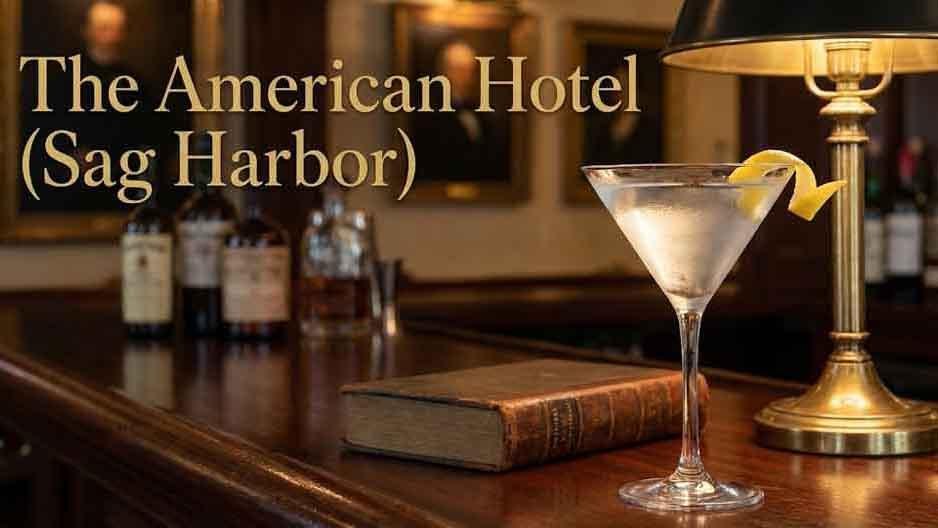
Beneath the floorboards of a three-story brick building on Main Street in Sag Harbor, thirty thousand bottles of wine rest in a cellar that was once packed with coal dust and the detritus of a century’s neglect. Above them, eight guest rooms furnished with American antiques have hosted Nobel laureates, rock legends, literary giants, and the occasional billionaire seeking refuge from the performative gloss of East Hampton. The American Hotel is not merely a restaurant, nor simply a hotel. It is one of those rare American establishments where the architecture itself functions as a living document — where the creaking of wide-plank floors recalls the footsteps of whaling captains, traveling salesmen, Revolutionary War officers, and, more recently, the quiet shuffle of a 23-year-old visionary named Ted Conklin, who walked through the front door in 1972 and refused to leave for the next fifty-three years.
As someone who has spent a quarter century behind the griddle at The Heritage Diner in Mount Sinai, I understand what it means to pour your entire identity into a building. A restaurant is not a business plan. It is a nervous system. And The American Hotel, more than perhaps any other establishment on Long Island, proves that the right proprietor can transform a condemned relic into an international landmark — one that Wine Spectator has recognized with its Grand Award every single year since the prize was inaugurated in 1981 (Wine Spectator, 2025).
From Whaling Port to Revolutionary Battlefield
The ground beneath The American Hotel carries weight that predates the republic. Sag Harbor was already a thriving colonial settlement by the early 1700s, and for a brief period served as the official port of entry for the state of New York (The American Hotel, 2025). Before the current brick structure existed, the James Howell Inn stood on this exact site. During the Revolutionary War, British officers were quartered there — until Colonel Return Jonathan Meigs led a daring 1778 raid across open water in small boats, seizing control of the harbor by capturing those officers before they could step outside (The American Hotel, 2025). That moment alone would be enough to sanctify the ground. But the history only deepened.
In 1824, a local cabinetmaker named Nathan Tinker began constructing the brick edifice that would become The American Hotel’s permanent structure. By 1846, at the zenith of the whaling era, Tinker had expanded the building into a full-service hotel with a bar, a dining room, and twenty-five rooms for the merchants and sailors flooding through Sag Harbor’s prosperous port (Dan’s Papers, 2022). The village was bursting with whale oil, hemp, tar, harpoons, and money. Herman Melville’s Queequeg, en route to Ahab’s Pequod, briefly passed through Sag Harbor in the pages of Moby-Dick. The American Hotel was the cosmopolitan anchor of a village that, for one brief and extraordinary moment, rivaled any port in the new world.
The Long Decline and the Man Who Refused to Accept It
Whaling collapsed after the California Gold Rush of 1849, and Sag Harbor receded into a quiet, beautiful backwater for over a century. The hotel’s fortunes mirrored the village’s own trajectory. By the early 1970s, three major factories — Grumman Industries, Rowe Industries, and the Bulova Watchcase Factory — had shuttered or dramatically reduced operations. The population had plummeted below two thousand. The American Hotel hadn’t hosted an overnight guest since the 1930s, hadn’t legally served alcohol since before World War I, and hadn’t put a meal on a table in decades (27east, 2026). The coal stove was rusted. The outhouses had collapsed. The nonagenarian owner, Will Youngs, had converted the first-floor dining room into his living quarters.
Into this wreckage walked Theodore Brigham Conklin III. Born in Manhattan in 1948, raised in Manhasset, descended from families who had helped settle Huntington, Long Island as early as the 1600s, Ted Conklin was twenty-three years old and possessed the impractical conviction that beauty could be rescued from decay (Wine Spectator, 2026). He had already opened Magic’s Pub and the Artful Dodger in Westhampton Beach — a place locals called a home away from home. He had tried gentleman farming upstate. He had studied at Babson College. And then, in 1972, he found his calling in a derelict vestige of the 1840s.
Conklin shoveled coal dust from the basement one bucket at a time. He demolished the outhouses, replaced the coal stove, installed electricity, waxed the old bar, and reopened The American Hotel on the Fourth of July, 1972 (Dan’s Papers, 2022). With a Conklin bloodline tracing back to the American Revolution, the date seemed ordained.
The Wine Cellar That Changed American Dining
The menu was distinctly French from day one. Fresh white linen tablecloths at every turnover, fresh flowers at every table, flatware set with precision that bordered on devotion. But it was the wine that would make The American Hotel legendary.
Conklin’s early education came through a mentor named Gus Gants of Austin-Nichols, who sold him basic French wines at his first restaurant. When Austin-Nichols shuttered in the mid-1970s, Gants guided Conklin through purchasing their high-quality Bordeaux inventory at exceptional prices. That foundation launched what would become one of the greatest restaurant wine programs in American history (Social Life Magazine, 2025). By 1981, The American Hotel earned Wine Spectator’s Grand Award — one of only fourteen establishments worldwide to receive the inaugural honor. The hotel has held that distinction every single year since, making it one of only three restaurants on earth to maintain an unbroken streak from the award’s inception (Dan’s Papers, 2022).
The cellar beneath the barroom now holds over thirty thousand bottles representing approximately 2,500 selections. The eighty-five-page wine list features vertical selections of all five Bordeaux First Growths, seventeen vintages of Château Pétrus, and one of the finest assemblages of Domaine de la Romanée-Conti imaginable (The American Hotel, 2025). Conklin’s philosophy was direct: seek out wines that are natural, expressive of their terroir, and that deliver extraordinary value — which, as he always insisted, is not solely a function of price but of flavor per dollar.
I think about this principle often at the Heritage Diner, where every decision behind the line — whether it concerns the sourcing of eggs or the seasoning of a cast-iron griddle — comes down to the same equation. Excellence is never about the most expensive ingredient. It is about the most considered one. Conklin understood this in his bones.
A Literary and Celebrity Crossroads
What Conklin built was not a velvet-rope destination for the conspicuously wealthy. It was, in his own words, a proud home for Sag Harbor’s incredible breadth of people — local and international, poor and wealthy, ascendant, struggling, famous, occasionally unsavory, accomplished and powerful, published and unpublished, beautiful and ordinary (The American Hotel, 2025). That democratic spirit, paired with uncompromising quality, is what drew the extraordinary parade of figures who made the bar and dining room their unofficial living room for half a century.
Sag Harbor has long been a literary village. John Steinbeck lived at nearby Bluff Point, wrote The Winter of Our Discontent overlooking the Sound, and won the Nobel Prize while calling this fishing village home (Literary Hub, 2019). Playwright Lanford Wilson walked Main Street daily, known around town as an excellent cook who tended an immaculate garden. Thomas Harris created Hannibal Lecter in a room above a Sag Harbor barbershop and continued to frequent The American Hotel for decades (Social Life Magazine, 2025). Betty Friedan summered on Glover Street, hosting Sunday lunches for the literary elite. Colson Whitehead set his semi-autobiographical novel Sag Harbor in the village’s historic African American beach community. Spalding Gray wrote at his Victorian home nearby. E.L. Doctorow, Joseph Heller, Kurt Vonnegut, George Plimpton, James Fenimore Cooper — the list of writers who passed through Sag Harbor and inevitably found their way to The American Hotel reads like a syllabus for an American literature survey course.
The bar attracted celebrities and athletes with equal discretion. Billy Joel, Bill Murray, Jimmy Buffett, Jimmy Fallon, Alan Alda, Keith Hernandez of the Mets’ 1986 World Series team — they came because Conklin never promoted their presence, insisting on a privacy that allowed genuine human chemistry to form without fanfare (27east, 2026). As one longtime associate recalled, the whole point was to allow bonds to form with no stirring or fuss.
The Cuisine: Classical French with East End Soul
Executive Chef Jonathan Parker leads a kitchen that has remained faithful to the hotel’s founding culinary identity: inventive American-French cuisine grounded in the classical tradition (The American Hotel, 2025). The menus change seasonally, drawing from the extraordinary bounty of Long Island’s East End — Montauk swordfish, Peconic Bay scallops, locally sourced duck, farm-fresh produce from the surrounding agricultural corridors. Diners can expect unparalleled filet and sirloin, foie gras, oysters Rockefeller, caviar, lobster, bone marrow, and preparations that occasionally feature partridge, pheasant, sweetbreads, or calves liver.
The restaurant features five distinct dining areas: The Main Dining Room, which seats approximately eighty guests beneath the famous giant moose head; The Drew Room, a quieter and more intimate space; The Alley, a glass-covered atrium filled with palms and ficus; The Bar and Lobby, the social heart of the establishment where literary icons share space with local firefighters; and The Front Porch, which during warmer months offers what many consider Sag Harbor’s finest people-watching alongside impeccable cuisine (Hamptons.com, 2024). Breakfast on the porch is a celebrated tradition, and the continental spread — fresh orange juice, croissants, artisan cheeses, and cured meats — sets a tone that carries through dinner service.
A dress code is maintained with old-world conviction: collared shirts are required, and hats, t-shirts, tank tops, gym wear, and clothing with offensive imagery are not permitted (The American Hotel, 2025). This is not pretension. It is a statement of values — the same philosophy that keeps me insisting on proper plating at the Heritage Diner even during a Saturday morning rush. Standards are not negotiable if you believe in what you’re building.
Bobby Flay featured The American Hotel on Food Network’s FoodNation, and the restaurant has been profiled by Playboy, Wine Spectator, and virtually every major food and travel publication on the Eastern Seaboard (Food Network, 2025). The Food Network highlighted signature dishes including the lobster bisque, the plateau de fruits de mer, and the local Peking duck à la bigarade.
A Passing and a Promise
On February 1, 2026, Ted Conklin died at the age of seventy-seven after a long illness. The cause was complications from bladder cancer (Wine Spectator, 2026). He was still maintaining the wine list up until two weeks before his passing. The loss reverberated through Sag Harbor and the broader hospitality world like few deaths in recent memory. Memorial services were held on February 24 at the First Presbyterian Old Whalers’ Church and at Bay Street Theater (Dan’s Papers, 2026).
His widow, Susie Franklin, has assumed the role of CEO and has been unequivocal in her message: the hotel is not for sale, the vision remains Ted’s vision, and the commitment to excellence, service, and extraordinary food will not waver (27east, 2026). The front and back of the house will remain intact. Franklin has described plans for a tribute inside the hotel — something visitors will immediately recognize as Conklin’s presence made permanent.
Those of us who build establishments intended to outlast us understand this moment with particular clarity. At the Heritage Diner, I have spent twenty-five years thinking about what happens when the founder steps away. At Marcellino NY, every briefcase I stitch by hand carries the same question embedded in its seams: will this endure? The answer, for Conklin and for The American Hotel, appears to be yes. Because what he built was never about one man’s ego. It was about creating a space where the necessities of life — fine food, proper wine, good company, and the quiet dignity of a well-kept room — could be honored without apology.
Visiting The American Hotel
Address: 49 Main Street, Sag Harbor, NY 11963
Telephone: (631) 725-3535
Website: theamericanhotel.com
Instagram: @theamericanhotelsagharbor
Hours:
- Monday–Thursday & Sunday: 11:30 AM – 9:00 PM
- Friday–Saturday: 11:30 AM – 10:00 PM
- Breakfast (Saturday & Sunday): 8:00 AM – 10:45 AM
Dining Areas: The Main Dining Room, The Drew Room, The Alley, The Bar/Lobby, The Front Porch
Guest Rooms: Eight individually appointed rooms with American antiques, private bathrooms, queen and king beds. Room 5 is recommended for its spacious layout and jacuzzi tub. No elevator — stairs only to upper floors.
Dress Code: Collared shirts required. No hats, t-shirts, tank tops, gym wear, or beach attire.
Special Events: Contact Mary Ferrara for groups of eight or more.
The Motor Yacht America: A 75-foot John Trumpy classic cruising houseboat, docked at the harbor and available for charter.
Reservations: Highly recommended, especially for summer weekends. Dinner reservations during peak season are competitive — plan well in advance. Lunch offers easier access to the same kitchen and wine list.
Rating: 4.5 stars (Google, 421 reviews) · 4.2 stars (TripAdvisor) · Ranked #2 of 37 restaurants in Sag Harbor
Nearby Attractions: Sag Harbor Whaling & Historical Museum (6-minute walk), Bay Street Theater, Sag Harbor Cinema, Havens Beach, the harbor waterfront, boutique shops and art galleries along Main Street.
Peter, from The Heritage Diner in Mount Sinai, holds graduate degrees in Philosophy from Long Island University and The New School in New York City.