Spend thirty seconds with a well-constructed leather tote — really spend it, fingertips moving deliberately across the seams, dipping into the interior, tracing the perimeter where raw hide meets finished edge — and you’ll understand more about craft than most people absorb in a lifetime of shopping. The exterior tells you one story. The interior tells you whether the maker meant it.
Luxury, genuinely understood, is not a price point. It is a philosophy of the interior. And nowhere in leatherwork does that philosophy announce itself more clearly than in two decisions that most buyers never consciously register: the choice of lining material and the method of edge finishing. Suede linings and painted edges — these are the details that separate a bag that performs from a bag that endures.
The Lining That Earns Its Keep: Why Suede
Open a mass-market tote and you’ll find polyester. Tightly woven, vaguely synthetic, practical in the way that a fluorescent light is practical — it functions, it doesn’t illuminate. Open a serious bag and more often than not you’ll find suede, and the difference is not merely tactile. It is philosophical.
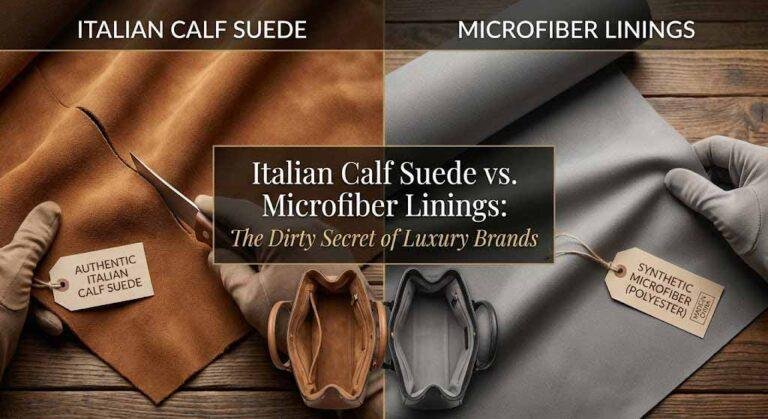
Suede’s soft, velvety feel gives a high-end look and a texture people remember. Authentic suede comes from the underside of animal hides — a process that creates a uniquely soft surface that customers genuinely respond to. Leeline Bags That napped finish is the result of buffing or abrading the flesh side of the hide until its fibers stand at attention, creating a surface that is warm rather than cool, organic rather than engineered.
But suede earns its place functionally as well as aesthetically. The napped texture provides a subtle grip — unlike silky linings where items can slide around easily, suede helps hold things in place, which proves useful for keeping contents organized. Veggance Your phone doesn’t migrate to the bottom. Your keys don’t abrade the leather walls. The interior behaves. There is also a breathability argument: leather, even in its split-suede form, allows air exchange in ways synthetic linings structurally cannot, which matters over decades of daily use.
For high-end construction, Italian micro-suede from makers like Luigi Carnevali has become something of a standard — available at just 0.5mm thickness, thin enough to avoid adding bulk to interior walls while delivering the tactile richness associated with full natural suede. It is the kind of material specification that never appears on a hangtag but announces itself every time the bag is opened.
The Hermès tradition illustrates what suede lining communication looks like at the apex of the market. Suede Hermès bags bring a tactile, almost sensual quality to the design house’s most iconic silhouettes, softening their precision with an intriguing touchability and relaxed elegance. The velvety nap captures light in a muted glow, emphasizing every curve. Madison Avenue Couture When the exterior of a Birkin is Doblis suede and the interior matches in lambskin, the bag is speaking a single material language from outside to in — a coherence that the eye processes as expensive before the mind articulates why.
Suede linings are most appropriate when the bag is meant to carry items that won’t punish them. Evening bags, structured totes used for documents and devices, carry pieces rather than field bags — these are the right homes for suede interiors. The material demands some reciprocity from its owner: keep sharp objects sheathed, avoid transfer from dark denim, and treat with a dry brush rather than moisture.
The Philosophy of the Edge
Here is where craft separates itself from manufacturing most nakedly: the edge of a cut piece of leather is essentially a confession. The maker cannot hide what they’ve done with it. A sloppily painted edge, a raw fraying cut, an over-polished burnish that cracks after six months — all of it is visible, all of it tactile, all of it tells you exactly what the bag cost in care as opposed to what it cost in currency.
There are, broadly, four approaches to the leather edge in tote construction. Each reflects a different philosophy, a different economic reality, and a different relationship with time.
Raw Edge: The Honest Cut
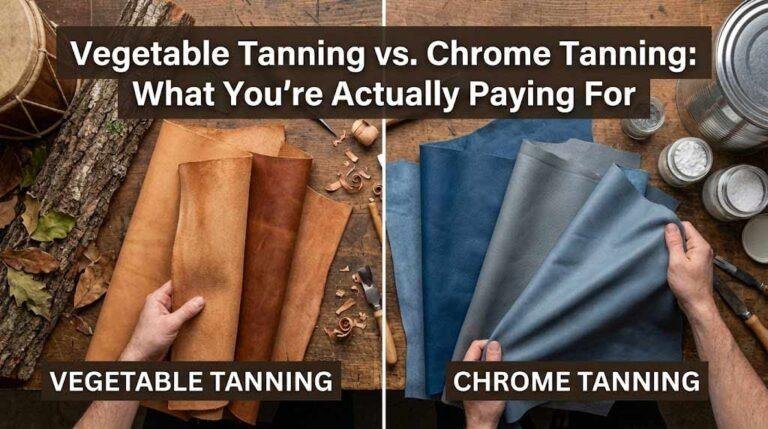
The raw edge, left unfinished, is the choice of confidence. It requires vegetable-tanned leather — in order to hand-burnish a cut leather edge, you must start with a quality, naturally vegetable or bark-tanned leather. It is not possible to burnish chrome-tanned leather. Tanner Bates When the tannage is right, the raw edge of full-grain leather has a dignity to it: the compressed fiber structure, the color variation from hide surface to interior, the slight roughness that will smooth with handling over months of use.
Brands working in the American heritage tradition — Lotuff in Maine, Tanner Goods in Oregon — often leave their edges raw or minimally treated specifically because the vegetable-tanned leather they source is confident enough to stand without cosmetic intervention. The edge becomes part of the material story, another surface for patina to develop.
Burnishing: The Long Art
Burnishing is the slow answer to the edge question — slow in execution, slow to develop, slow to fail. The process begins with beveling: the edge beveller, a tool with a sharp semi-circular blade, removes the sharp corner and gives the edge a rounded appearance. Tanner Bates After beveling comes progressive sanding — coarser grits removing larger imperfections, finer grits polishing — followed by the application of heat, friction, and in some traditions a slick of beeswax or gum tragacanth to bind the fibers together into a glassy, compressed finish.
The art of creating perfect hand-burnished edges is probably the most time-consuming procedure in making leather goods. There are no shortcuts. Starting with the raw cut leather edge, artisans sand with finer and finer emery cloth down to 1200 grit. It is the act of repeated sanding and burnishing with a canvas cloth that smooths the individual fibres flat until a smooth, mirror-like finish is achieved. Tanner Bates
What results is not paint. It is the edge itself, made denser and more uniform than any coating could achieve from the outside in. A well-burnished edge on quality vegetable-tanned leather will outlast the bag — it will not peel, crack, or need refinishing. The seam between edge and surface becomes so clean it reads as intentional architecture rather than construction necessity. American ateliers producing precision work specify beeswax burnished edges with a 1200-grit final pass; the best English belt-makers, among them the Tanner Bates workshop, build reputations on nothing else.
Skiving: The Foundation Nobody Sees
Before any edge finishing begins, before the bag is even fully assembled, the artisan’s first investment in edge quality is skiving — and it receives almost no public attention despite being foundational to everything that follows. Skiving is a process where artisans thin specific areas of the leather to make it more pliable for folding, stitching, and layering. This step ensures the bag maintains a sleek and professional look. Apexleathergoods
At seams and fold lines, unmodified leather is too thick to turn cleanly or stitch without producing bulge. The skiving knife — essentially a surgical blade in the hands of someone who has spent years with it — tapers the leather from full thickness down to near nothing at the very edge, allowing multiple layers to register flush rather than stepping. American production specifications often call for a skive tolerance of 0.8mm ± 0.1mm at fold points — a margin narrower than most hobbyist woodworking and executed by hand, in leather.
Skiving is the foundation because every edge finishing technique depends on what it encounters at the edge: a consistent thickness means consistent results from burnishing tool or paint applicator. Variable thickness produces inconsistency, and inconsistency in edge work is visible from across a room.
Edge Paint: The Precision Option
Edge paint is the technique most luxury brands reach for when burnishing isn’t possible — chrome-tanned leather, complex multi-layer seams, high-contrast interior-to-exterior color relationships all make paint the more practical answer. When executed properly it is not a shortcut; when executed improperly it reveals itself within months as exactly that.
The process at a serious atelier begins with edge preparation: two to three coats of base coat help fill any small crevices, providing a smooth surface for the final coat. Between each coat, light sanding helps subsequent coats adhere; lightly sanding the base coat after drying removes any fibers or imperfections. The sanding should leave a perfectly smooth edge, ready for the final coat. Sabrina Lee
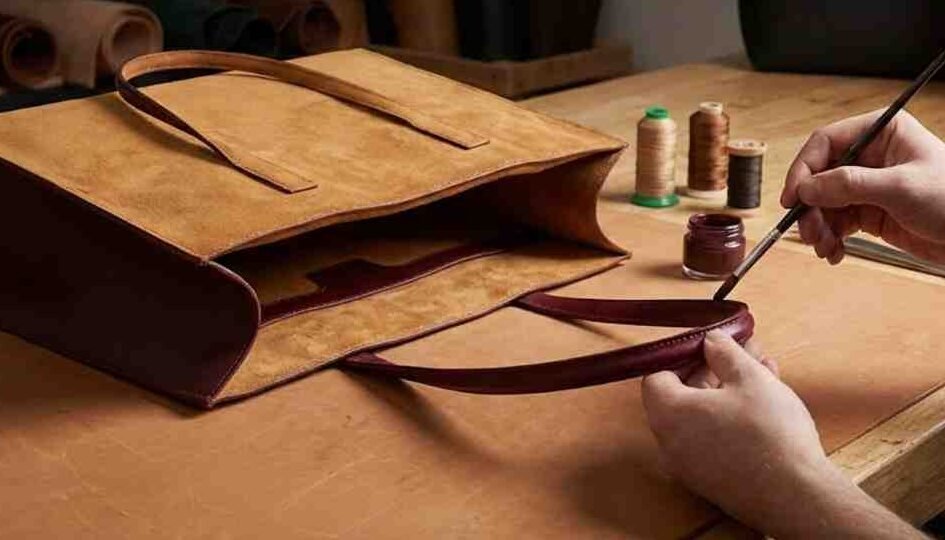
The paint itself can be matte or glossy, tonal or contrasting. Finish changes the personality of a bag — gloss can feel bold and light-catching, while matte reads more understated and classic. Edge paint can be mixed to complement leather tones, contrast for pop, or match other design elements. MONOLISA A well-chosen contrast edge, say a burgundy paint line along the perimeter of a tan calfskin tote, can be as visually decisive as any hardware decision. It frames the piece the way a passepartout frames a print — containing, defining, completing.
The failure mode of edge paint is delamination: the coating separating from the underlying leather at flex points, typically where handles meet body or at the base corners of a bag that sees daily use. This is not inevitable — it is a function of preparation, product quality, and application technique — but it is the reason that purists maintain burnishing as the superior long-term solution for any bag expected to outlast a decade of service.
Handle Construction and the Logic of Load Transfer
The tote handle is a study in structural engineering expressed through craft. The load path from packed bag to shoulder or hand runs through the handle attachment — and how that attachment is executed determines whether a tote lasts two years or twenty.
Handles cut from vegetable-tanned leather, folded and saddle-stitched, are rated for a 25kg load in serious American production. Szoneierleather The stitching is not decorative at this point; it is the primary load-bearing element. Saddle stitch — two needles, one thread, worked from opposing sides — creates an interlocked pattern that, unlike machine lock-stitch, will not unravel completely if a single stitch breaks. One thread breaks and the remaining stitches hold. This is why hand saddle-stitching at high stitch-per-inch counts is the specification of choice for any bag expected to carry serious weight over serious time.
Where handles attach to the tote body, reinforcement becomes essential. Copper or solid brass rivets — not plated, not hollow — bear compressive and tensile load simultaneously, distributing stress across a wider area than stitching alone. Employing traditional methods like individually hand-set copper rivets and edge burnishing ensures that each tote is not just durable but a unique artifact of artisanal expertise. Mission Mercantile The rivet placement is not arbitrary: it follows a geometry designed to spread stress away from any single point, borrowing engineering logic that goes back to saddlery, to the harness-making shops of nineteenth-century Paris where Hermès itself began.
Reading a Tote: What Interior Detail Tells You
The educated buyer opens the bag before they consider the exterior. The lining material tells you the maker’s values. The pocket attachment — whether the interior pockets are stitched to a separate liner that is then inserted, or whether they are stitched directly through the shell — tells you the production approach. The edge finishing of interior seams, often left raw even on premium bags because no one is expected to look, tells you whether the standard holds even in the unseen places.
A truly well-built tote will have consistent edge treatment from exterior to interior: the same care that produced the glossy painted edge on the outside perimeter will have addressed the cut edges of interior dividers and pocket openings. A bag that has polished exterior edges and raw, untreated interior edges is a bag that was built for the display case, not for the decades of use that justify the investment.
The base of the interior is another diagnostic: metal feet on the bag’s exterior protect the base leather from abrasion, but they also tell you the maker expected this bag to be set down on surfaces. An interior base stiffener, covered in coordinating suede or leather, tells you the structure was designed rather than assembled.
The suede lining, when done well, completes the enclosure. You reach into the bag in darkness — on a crowded train, in a dim restaurant — and your hand knows immediately what it has entered. Not because it has been trained to know, but because the material communicates warmth and quality in the only language hands understand: texture.
That is the whole argument for craft over commerce, expressed in the most compact possible form. The buyer who will never see the skiving, who will never know whether the edge paint was built up in three coats or daubed on in one, who cannot see the thread-per-inch count of the saddle stitch — that buyer still feels the difference. The interior of a well-made tote is a communication to the nervous system, not the mind. The mind rationalizes the price. The hands understand the value.