
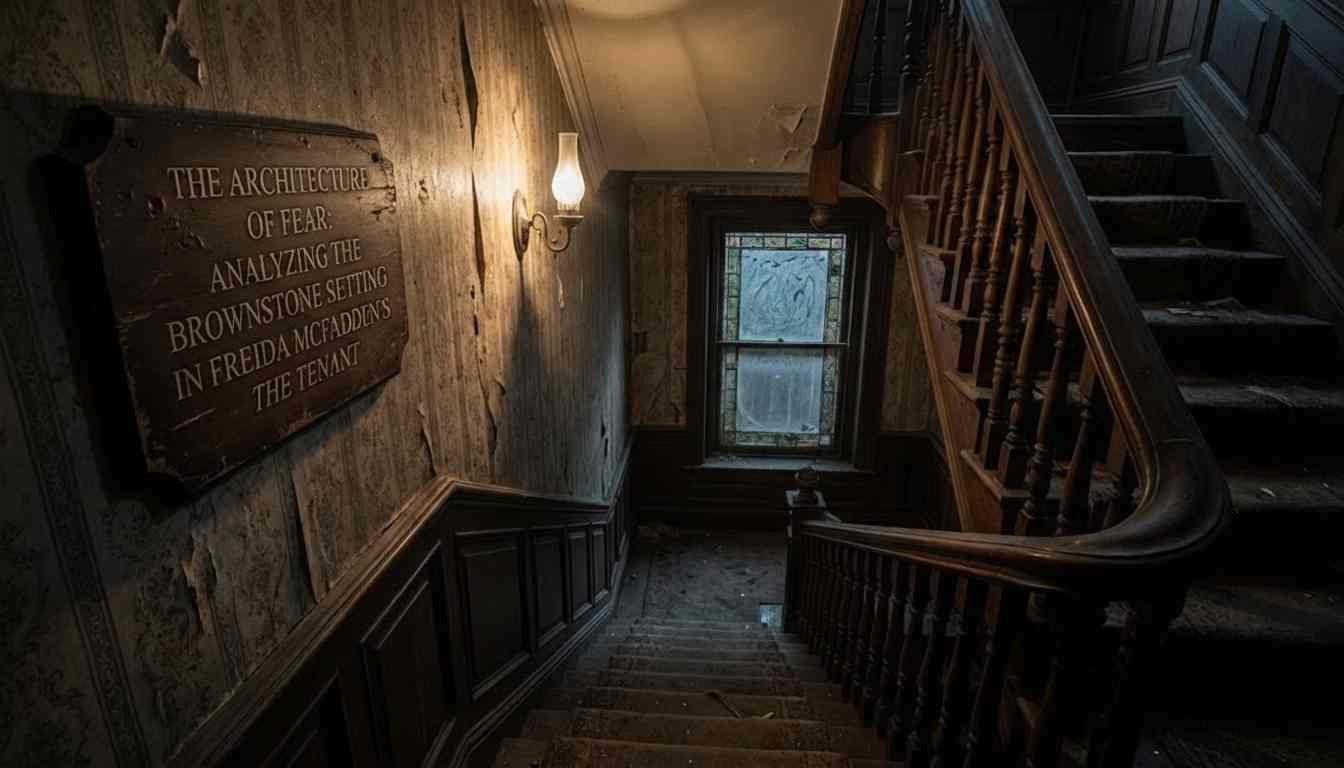
Few structures in the American literary imagination carry as much psychological freight as the New York City brownstone. Before Freida McFadden’s Blake Porter ever lets a stranger through his front door, the building itself is already doing narrative work — whispering of aspiration acquired and then threatened, of identity tied to four stories of reddish sandstone and a stoop that rises above the street as though trying to stay clean in a city that never really lets you.
The Tenant, McFadden’s 2025 psychological thriller, is many things at once: a story of revenge, class anxiety, secrets, and a long-con unraveling in real time. But strip away the plot mechanics — the gaslighting, the decay, the neighbor who suddenly looks at Blake differently — and what you find at the center of the novel is an architectural argument. The brownstone is not backdrop. It is the story’s beating heart, the externalization of everything Blake has won and everything he stands to lose.
Stone That Deceives: The Brownstone as Performance
The brownstone as building material is, at its foundation, a kind of theater. When the style peaked in New York during the 1840s through the 1890s, builders were constructing brick structures and applying a four-to-six-inch veneer of sandstone over the façade — a handsome mask over more utilitarian bones. The stone itself, quarried primarily from Portland, Connecticut, turns pink when first cut and only deepens into its characteristic chocolate brown once it weathers, once the iron hematite within it oxidizes under open air. The appearance of permanence and dignity that made it fashionable was, from the beginning, earned through exposure rather than inherent in the material.
McFadden understands this contradiction intuitively. Blake Porter, VP of marketing, Upper East Side brownstone owner, man-about-Manhattan with a fiancée and a future — his entire life has the texture of that façade. Confident from a distance, composite at the core. The moment he loses his job, the veneer begins to show its age. He cannot afford the mortgage. The life he has constructed, like the stone it is housed in, was never as solid as it appeared. Renting a room to a stranger is, in architectural terms, the crack that lets the water in.
The Stoop as Class Signifier
One architectural detail McFadden never lets the reader forget, even implicitly, is the stoop — that steep ceremonial staircase that carries residents from street level up to the brownstone’s main entrance. The original purpose of the stoop, historians note, was hygienic: to rise above the manure and filth of 19th-century New York streets. The irony built into the design is profound. What became the most recognizable symbol of upscale urban living was engineered, at first, simply to avoid the muck below.
Blake’s brownstone works in exactly this symbolic register throughout The Tenant. His stoop is a performance of elevation — a daily physical act of rising above, of separating himself from the street-level world of financial precarity and professional failure. When Whitney Cross enters his home, she doesn’t just take a room; she subverts the stoop’s promise. The decay she brings — the smell, the rotting fruit, the infestation — rises from within the structure itself. The threat isn’t climbing up from the street. It’s already inside, on the other side of the wall.
Walls That Remember: The Psychogeography of Shared Space
The specific horror that McFadden architects in The Tenant is not the horror of the unknown. It is the horror of proximity — of someone who knows your patterns, hears your conversations through shared walls, and moves through your kitchen while you sleep. The brownstone, with its narrow footprint and vertical layout, is uniquely designed to amplify this terror. Three to four stories tall, typically no more than twenty to twenty-five feet wide, these homes force intimacy. The floors creak. Sound travels. The architecture refuses privacy.
There is a passage in Martin Heidegger’s Being and Time that speaks to the uncanny quality of dwelling — the German word unheimlich, which we translate as “uncanny,” literally means “un-home-like.” The sensation of the familiar made suddenly strange. McFadden exploits exactly this philosophical register throughout the novel. Blake’s brownstone, his dream home, his monument to professional achievement, becomes unheimlich the moment Whitney crosses the threshold. The smell that permeates the rooms no matter how hard he scrubs is not just a plot device — it is the house itself becoming strange, refusing to be the stable container of identity it once was.
The Upper East Side Address and What It Costs to Keep It
McFadden situates Blake’s brownstone in the Upper East Side — a specific choice that carries the full weight of Manhattan’s class geography. The Upper East Side brownstone is not merely expensive real estate. It is a statement of arrival, a credential as legible to New York insiders as any diploma on a wall. To own one, particularly as a young professional, is to have translated ambition into stone and mortar.
Today, a brownstone in New York City runs from roughly $3.5 to $20 million, with Upper East Side properties at the upper register of that range. The Portland Brownstone Quarry, which supplied virtually all of Manhattan’s and Brooklyn’s original brownstone, closed permanently in 2012 after 300 years of operation. There is no longer a source for matching material. These buildings cannot be replicated. Their scarcity is now absolute, which has transformed them from aspirational real estate into something closer to inherited cultural artifacts — objects whose value is inseparable from their irreproducibility.
Blake cannot afford this irreproducible thing he has purchased. That gap — between what the address represents and what it actually costs to sustain — is where McFadden plants her narrative explosive. The brownstone becomes a trap precisely because it means too much to give up. Renting a room is humiliation packaged as pragmatism. It is the crack in the façade that the novel’s real antagonist, with surgical patience, will widen into ruin.
From Dream Address to Crime Scene: Architecture and Revelation
What The Tenant does with particular craft is use the brownstone’s physical architecture as a map of its psychological revelations. The smell of decay that cannot be scrubbed away — it is coming from somewhere inside the walls, inside the structure Blake thought he owned and understood. The strange noises at night rise from the floors and ceilings of the home he believed to be his sanctuary. The neighbors who begin treating him differently are reading his house differently — the same building that once signaled his status now signals something gone wrong.
The architecture of real estate is never morally neutral in great fiction. Working in real estate alongside my wife Paola, I have seen this dynamic play out in ways that mirror McFadden’s fictional logic: buyers who need a particular address to complete a self-image they have been constructing for years, whose entire sense of stability becomes tied to the property’s continued meaning. When that meaning is threatened — by a difficult neighbor, a shifting market, a secret that surfaces — the home transforms into something that constricts rather than shelters.
McFadden understands that in New York, perhaps more than anywhere in the world, the address is the biography. The brownstone tells people who Blake is before he opens his mouth. And when Whitney Cross moves in and begins systematically dismantling the brownstone’s story — through chaos, through manipulation, through the patient introduction of disorder — she is not simply disrupting a living arrangement. She is rewriting him.
The Ending the Building Demands
By the novel’s conclusion, Blake sells the brownstone and leaves Manhattan for his father’s business in Cleveland. Read sentimentally, this is defeat. Read architecturally, it is the only honest ending available to a man whose identity was built on a structure he could not afford, whose life was a veneer over more uncertain material. The brownstone gets to remain what it always was — a monument to aspiration, to scarcity, to the complicated performance of New York success. Blake gets released from it.
McFadden is too sophisticated a writer to let this read simply as failure. The selling of the brownstone is also a kind of reckoning — a return to something more load-bearing than sandstone facades and Upper East Side postal codes. The house was always more vulnerable than it looked. The man, it turns out, was too.
What Buildings Know
Freida McFadden’s The Tenant works as a thriller at the level of plot. It works as literature at the level of space. The brownstone she builds her novel inside is not a neutral container for action. It is the thesis — about class, about the fragility of performed success, about what happens when the structure you have mistaken for permanence turns out to have been soft sandstone all along, porous and prone to cracking in weather it was never designed to withstand.
The most durable buildings are not the ones that look the most imposing from the street. They are the ones whose foundations were laid honestly, whose materials were chosen for strength rather than appearance. The stoop can rise as high as it likes above the muck. What matters is what lives behind the door.