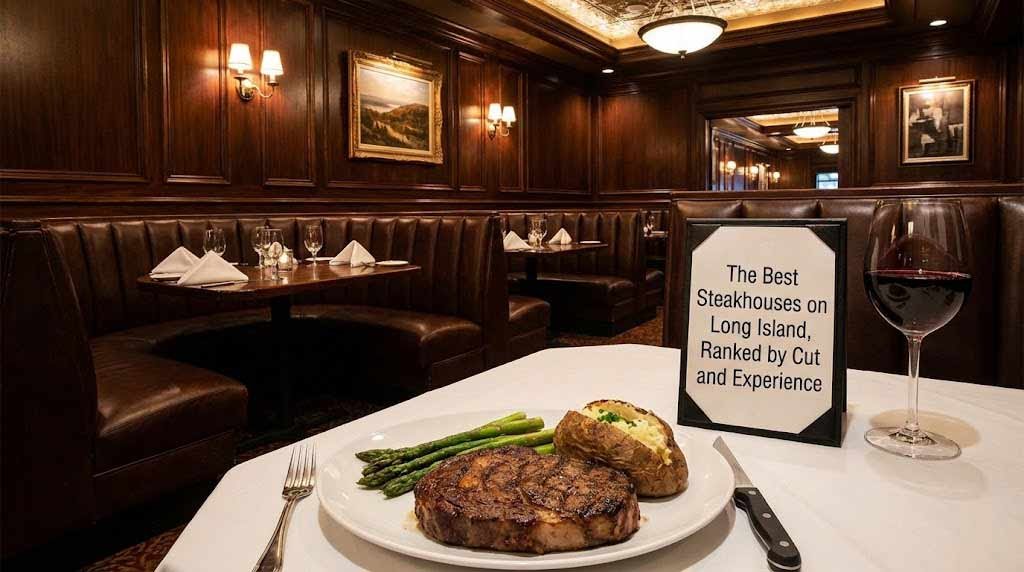
When it comes to exceptional steakhouse dining on Long Island, you’re not settling for a commodity experience—you’re making a statement about your commitment to quality meat, impeccable service, and the kind of culinary destination that justifies the drive, the reservation, and the price point. Long Island’s steakhouse landscape has evolved dramatically over the past three decades, transforming from a region dominated by family-owned chophouses into a sophisticated dining ecosystem where dry-aged beef is treated as seriously as it is in Manhattan’s most prestigious establishments, yet without the Manhattan pretension.
The art of the steakhouse—that distinctly American institution born in the Gilded Age—represents something deeper than protein and fire. It’s a commitment to craft, to sourcing, to understanding the nuances between a bone-in ribeye and a center-cut filet. According to industry data from the National Restaurant Association (2025), steakhouses remain among the highest-grossing restaurant categories in the northeastern United States, with premium establishments reporting average check sizes that exceed $95 per diner. Long Island, with its affluent suburban communities and proximity to New York City’s sophisticated palates, has cultivated a steakhouse culture that rivals many of the iconic establishments found across Manhattan’s Midtown corridor.
The Dry-Aged Difference: Understanding What Separates Good Beef from Transcendent Beef
The foundation of any world-class steakhouse begins with sourcing, and the steakhouses that dominate Long Island’s rankings are obsessive about their beef. Peter Luger Steak House, with its outpost in Great Neck, has maintained a reputation for uncompromising standards since 1887, when the original location opened in Brooklyn (VUE Magazine, 2024). The restaurant’s porterhouse for two remains one of the most coveted reservations on the island, a status maintained through a singular commitment: dry-aging their USDA Prime beef for extended periods under pristine conditions of temperature, humidity, and air circulation.
Dry-aging beef is not a shortcut; it’s a discipline. The process concentrates flavor through moisture loss while enzymatic breakdown tenderizes the meat to an almost butter-like consistency. A 45-day dry-aged porterhouse achieves a mineral-forward, almost umami-rich character that transcends the experience of restaurant beef into something approaching the transcendent. Blackstone Steakhouse in Melville has taken this commitment further, becoming Long Island’s only restaurant certified by the Official Kobe Beef Association, offering diners access to authentic Japanese Wagyu alongside American prime cuts (Blackstone Steakhouse, 2025). The marble-like intramuscular fat in Wagyu beef melts at a lower temperature than conventional beef, creating a mouthfeel that seasoned carnivores describe as fundamentally different from even the finest dry-aged American beef.
Watch this exploration of steak grading and preparation techniques: https://www.youtube.com/watch?v=jO-9CUP-3ps
The Iconic Institutions: Where History Meets Meat
Bobby Van’s in Bridgehampton operates in a different register entirely—the restaurant, once a gathering place for Truman Capote and John Knowles, channels old money elegance and literary mystique in equal measure (VUE Magazine, 2024). The dining room features a lighter, more open atmosphere than its Brooklyn predecessor, with scenic views of Hamptons streets that remind diners they’re eating in one of the most desirable zip codes in America. The menu hovers between classic and elevated, taking simple steakhouse fare and elevating the plating and presentation to something approaching fine dining.
Pace’s Steakhouse in Hauppauge tells a different story—a family narrative spanning generations. Owner Jimmy Pace oversees a restaurant that has occupied its Hauppauge location for three decades, a tenure during which it became the catering choice for Jones Beach Theater talent, from touring Broadway productions to concert headliners (Best of Long Island, 2025). The signature steak recipe, brewed in a legendary secret sauce, represents a culinary genealogy that traveled from Italy to New York City before settling on Long Island, a geographical and cultural metaphor for the American steakhouse tradition itself.
The Modern Luxury Steakhouse: Where Japanese Beef Meets Mediterranean Technique
If Bobby Van’s represents old-money Hamptons elegance and Peter Luger represents Brooklyn history transplanted with reverence, then Rare650 in Syosset represents a different thesis entirely: the contemporary steakhouse as destination concept. This Syosset establishment features a greenhouse patio, sushi counter, and cocktail program that positions steak not as the centerpiece of a conservative dining philosophy but as the centerpiece of a lifestyle statement. The restaurant’s wagyu meatball starter and its offerings of Australian and Japanese Wagyu steaks appeal to diners who view steakhouse dining as an immersive experience rather than a transaction.
Blackstone, already mentioned for its Kobe certification, deserves expansion here for its architectural audacity. The Melville location functions as an “architectural masterpiece,” according to its official description, featuring cathedral-like ceilings, floor-to-ceiling marble fireplaces, and an outdoor lounge with ambient lighting and lush landscaping that transforms the steakhouse experience from indoor transaction to destination ritual (Blackstone Steakhouse, 2025). The wine list exceeds 600 bottles, and the sommelier program reflects an investment in service sophistication that historically has defined only Manhattan’s most exclusive establishments.
The Neighborhood Steakhouses: Accessibility Without Compromise
Not every exceptional steakhouse experience requires valet parking and a marble fireplace. Frank’s Steaks in Rockville Centre occupies the old-school no-nonsense category, famous for its marinated Romanian skirt steak—a cut that demands proper technique and dry heat to express its potential. The restaurant’s decades of operation in the same location speak to a simple proposition: make excellent food in a straightforward setting and people will return (Best of Long Island, 2025). Bryant & Cooper in Roslyn has maintained its position as one of Long Island’s premier steakhouses for over three decades precisely because it never attempted to become anything more complicated than what it is: a sophisticated chophouse serving perfectly seared cuts in a refined but not ostentatious setting.
Hooks & Chops operates under the philosophy that the best possible cuts of meat, cooked exactly the way diners prefer them, served with hospitality that genuinely can’t be beat, represents sufficient excellence. The menu features traditional USDA Choice Certified Black Angus, a flat iron steak, the restaurant’s own Delmonico cut, and filet mignon prepared under the direction of Executive Chef Steven Del Lima, a kitchen commander whose commitment to technical excellence is matched only by his understanding that great steakhouse cooking is fundamentally about restraint (Best of Long Island, 2025). The extensive wine program complements rather than overwhelms, and the dining room reflects the philosophy that ambiance matters but never overshadows the food.
Specialty Steakhouse Concepts: The Brazilian and Portuguese Challenge
Texas de Brazil operates as Long Island’s most accessible entry point into the churrasco tradition—the Brazilian steakhouse service model where gaucho-style servers deliver skewers of grilled meat to the table in continuous rotation. The Lake Grove location, positioned strategically at the center of Long Island, serves the dual purpose of catching commuters returning from Manhattan and travelers headed east for weekends in Montauk. The experience compresses the entire steakhouse ritual into something approaching theater, with the visual abundance of moving meat carts creating an energy that contrasts sharply with the refined silence of traditional steakhouses.
Churrasqueira Bairrada in Smithtown specializes in rodizio service—the all-you-can-eat grilled meats model that originated in Portuguese steakhouse tradition. The restaurant offers the theatrical element of Brazil with the culinary sophistication of Portugal, including grilled swordfish, garlic shrimp, and tilapia alongside the beef program (Nassau County Tourism, 2025). The suckling pig offering on weekends represents the kind of protein specificity that separates truly ambitious steakhouses from ordinary ones—a dish that demands sourcing discipline, technical skill, and customers adventurous enough to embrace flavors beyond the filet mignon canon.
The Surf and Turf Sophistication: When Steakhouses Transcend Their Genre
The finest Long Island steakhouses refuse to be limited by category. Blackstone’s Mediterranean seafood sourced from Hawaii and Holland, George Martin’s Strip Steak’s expansive seafood program, and Capital Grille’s focus on both premium beef and exceptional fish create establishments that function simultaneously as steakhouses and contemporary American fine dining destinations. The 2025 restaurant trends data shows that the most successful high-end establishments offer flexibility, recognizing that contemporary diners increasingly reject rigid categorical thinking in favor of restaurants that demonstrate mastery across protein categories (Malou.io, 2026).
The wine program operates as an equal player in this equation. Blackstone’s 600-bottle collection and Rare650’s extensive offerings reflect an understanding that the steakhouse wine culture—long dominated by Cabernet from Napa Valley—has evolved to embrace wines from underrepresented regions. The current beverage trend emphasizes personalization and diversity; steakhouses that offer tasting menus curated by sommeliers for specific steaks perform better than those offering static wine lists (Toast Table, 2025).
Take your dining research to the next level by exploring Long Island’s Farm-to-Table Restaurants: Where Your Food Actually Comes From to understand how local agriculture shapes steakhouse sourcing. Consider also Hidden Gem Butcher Shops on Long Island That Serious Meat Lovers Need to Know for insights into how to replicate these restaurant experiences in your own kitchen.