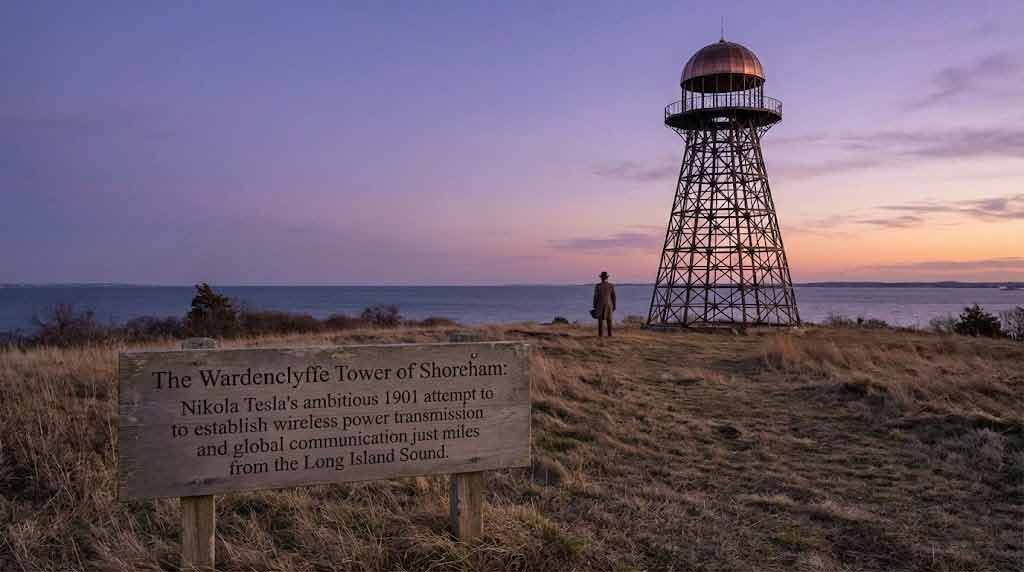
Somewhere along Route 25A in Shoreham, New York, past a stone statue of a Serbian immigrant with penetrating eyes and a quiet half-smile, the octagonal foundation of a demolished tower sits embedded in the earth. Ground-penetrating radar confirmed in 2017 what locals had whispered about for generations: a labyrinth of tunnels, some extending hundreds of feet in every direction, still winds beneath the surface. No one knows their full purpose. The inventor who ordered them dug — Nikola Tesla — gave no public explanation, and his notes on the subject have never surfaced.
That is the nature of Shoreham. It is a village of 560 people that contains within its 280 acres a riddle that the 21st century still cannot fully answer.
From Woodville Landing to Wardenclyffe: A Village Before the Tower
Long before Tesla arrived, this stretch of the North Shore bluffs had a working identity. In the 19th century, the community was called Woodville Landing — named for the cordwood harvested from the surrounding forests and loaded onto flat-bottom boats for shipment to New York City’s construction industry and the brick kilns at Haverstraw on the Hudson. The bluffs broke cleanly enough here to allow boats to dock; the timber was dense enough to make it worth the effort. It was a functional, unglamorous place.
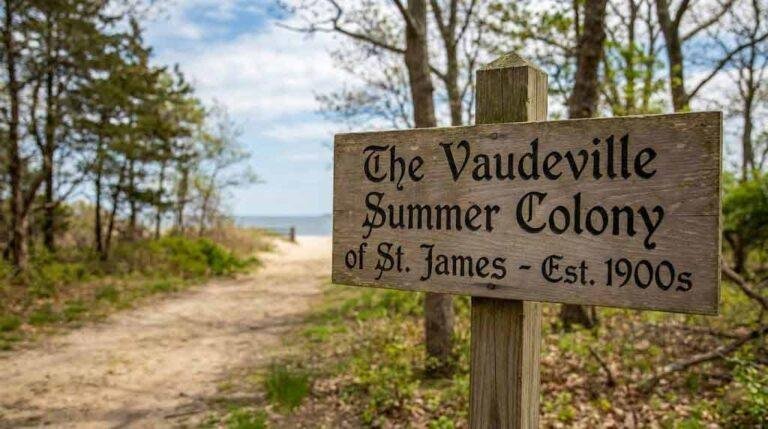
The transformation came with the railroad. When the Long Island Rail Road extended service to this section of the North Shore in 1895, developer James Woodruff Warden saw opportunity. He purchased a substantial land holding — part of an 1,800-acre potato farm — and began positioning the area as an Edwardian summer colony. He renamed the community Wardenclyffe-on-Sound, and set about attracting the kind of wealthy New Yorkers who wanted proximity to the water without the social pressures of the Hamptons. The gambit worked, partially. Shoreham did become a resort enclave, notable for its private beaches, wooded estates, and a sense of deliberate remove from the noise of the city.
It was Warden himself, reportedly sensing the promotional value, who invited Nikola Tesla to establish his experimental station on the property in 1901. Tesla purchased 200 acres. What followed would define the village’s identity for the next 125 years.
After Warden’s death in 1906, a new wave of developers took over. Elizabeth Upham, wife of partner Richard Upham, renamed the community “Shoreham” — after Shoreham-by-Sea in England. The village was formally incorporated in 1913, at the time the smallest incorporated village in New York State. Its population would not exceed 11 full-time residents until the 1920s.
The Man Who Came to Shoreham with an Impossible Plan
By 1901, Nikola Tesla was the most celebrated electrical engineer in America and arguably the world. His development of the alternating current (AC) induction motor and polyphase power distribution system had made the Niagara Falls generating station possible and positioned AC as the dominant standard for electricity — a victory that ended the so-called War of Currents against Thomas Edison’s direct current infrastructure. He had filed patents for radio transmission as early as 1897, before Guglielmo Marconi’s better-publicized work on the subject. He had conducted experiments with high-frequency electrical resonance in Colorado Springs in 1899 that convinced him the Earth itself could function as an electrical conductor.
What Tesla proposed to build at Wardenclyffe was not simply a radio tower. It was the first node in a planetary grid.
His stated vision, as he described it in published accounts: a system by which a businessman in New York could dictate instructions and have them appear instantly in type at an office in London. A pocket-sized receiver, he wrote, would allow a person “anywhere, on sea or land” to hear music, news, political speeches, or sermons transmitted from any other point on the globe. This was, in unmistakable terms, a description of what we now call the internet — conceived and articulated in 1901, a century before broadband became domestic infrastructure.
But Tesla’s ambition exceeded even this. His deeper goal, which he disclosed selectively and which would ultimately doom the project, was the wireless transmission of electrical power itself — energy broadcast through the Earth’s crust and upper atmosphere to receiving stations anywhere on the planet. Free. Unmetered. Available to anyone with the equipment to collect it.
Stanford White, J.P. Morgan, and the Architecture of a Dream
The facility Tesla envisioned required both a visionary architect and a visionary financier. He secured both — and both relationships would end in ruin.
Stanford White, of the prestigious firm McKim, Mead & White, designed the Wardenclyffe laboratory building: a 94-by-94-foot red brick structure that remains standing today as Tesla’s last surviving laboratory anywhere in the world. White also oversaw the design of the tower itself — a 187-foot wooden structure with a 55-ton steel hemispherical cupola 68 feet in diameter at its crown, and an iron shaft driving 120 feet into the earth below. The total structure, above and below ground, exceeded 300 feet. It was, by any measure, extraordinary to look at. Local newspapers in 1902 described it as the site of “the real war between Marconi and Nikola Tesla.”
The financing came from J.P. Morgan, the most powerful banker in America. In March 1901, Morgan signed a contract agreeing to provide Tesla $150,000 — equivalent to roughly $5.8 million in current value — in exchange for a 51% controlling interest in the company and half of all future wireless patents. Morgan had been impressed by Marconi’s demonstration of radio transmission during the 1899 America’s Cup yacht races off Long Island and was watching the wireless communication market carefully. Tesla assured him that his system was superior to Marconi’s in every respect.
Construction began in September 1901. Almost immediately, the project’s financial reality began to diverge from its projections.
The Fracture: Marconi, Morgan, and the Collapse
In December 1901, Guglielmo Marconi announced that he had transmitted the Morse code letter “S” from Cornwall, England, to Signal Hill in Newfoundland — the first transatlantic wireless signal. The announcement was a commercial and psychological catastrophe for Tesla. Investors who might have backed Wardenclyffe began redirecting their capital toward Marconi’s system, which was cheaper to build, simpler to explain, and — critically — already demonstrating results.
Tesla’s response was to escalate. He informed Morgan that to remain competitive with Marconi, he needed to scale up Wardenclyffe dramatically: a larger tower, potentially 300 to 600 feet, capable of transmitting the low-frequency resonant waves he believed were necessary for planetary power transmission. The cost would be far beyond the original $150,000.
Morgan’s reply was brief and final. He would not “feel disposed at present to make any further advances.” The letter constituted, in effect, a withdrawal.
The reason Morgan refused has been argued about ever since. The most damaging version of the story — which appeared in Tesla’s correspondence and has circulated in various forms through the historical literature — holds that Morgan reacted specifically to learning that Tesla’s intended system would transmit power that could not be metered or commercially controlled. The apocryphal line attributed to Morgan — “If anyone can draw on the power, where do we put the meter?” — may be embellished, but the underlying logic was real. Morgan’s empire was built on the monetization of energy and capital flow. A system of free wireless electricity was not an investment. It was an existential threat.
By the summer of 1903, the tower had come briefly and spectacularly to life. Residents across Shoreham and reportedly as far away as Connecticut reported nights lit by crackling blue lightning arcing from the cupola into the sky. No explanation was offered by Tesla or his staff the following morning. It was the last time the tower operated at any significant capacity.
As investor money continued flowing to Marconi, and a Wall Street downturn in late 1903 further dried up available capital, Tesla’s finances collapsed in sequence. He mortgaged Wardenclyffe in 1904 to cover his mounting hotel bills at the Waldorf-Astoria. A second mortgage followed in 1908. In 1905, his foundational alternating current patents expired, eliminating the royalty income that had partially sustained him. By 1906, the facility’s work had ceased. By 1917, the tower was demolished with dynamite — sold for scrap to satisfy Tesla’s debts. The Waldorf-Astoria’s owner, George C. Boldt, foreclosed on the property in 1922.
Stanford White had been murdered in 1906 — shot at Madison Square Garden’s rooftop theater by millionaire Harry Thaw in a scandal involving the actress Evelyn Nesbit — and never saw the project’s end. Tesla would spend his final decades in diminished circumstances, living in a series of New York hotels and feeding pigeons from his window. He died in January 1943, nearly penniless, in Room 3327 of the Hotel New Yorker. The U.S. Supreme Court had, just months earlier, upheld his foundational radio patents — formally crediting Tesla over Marconi as the inventor of radio. It came too late to matter financially.
What Remained: The Tunnels, the Brick Building, and the Long Silence
The red brick laboratory building survived. After the tower’s demolition, the Wardenclyffe property passed through various commercial uses. For roughly 50 years, the facility was operated as a processing plant for photographic supplies. By 1987, when the last commercial tenant vacated, the grounds had been reduced to 16 acres and the site had been designated a Superfund hazardous waste cleanup location, requiring years of environmental remediation.
The laboratory building stood through all of it. Weathered but structurally intact, it remained visible from Route 25A — the same road where potato farmers had once driven past the tower’s shadow with skeptical curiosity. An octagonal ring of concrete and granite blocks, each fitted with thick metal studs that once connected to the cupola’s infrastructure, marked where the tower had stood.
In 2017, a film crew equipped with ground-penetrating radar conducted a systematic survey of the grounds. They confirmed what rumors had long alleged: a network of tunnels extending for hundreds of feet beneath the facility, running north, south, east, and west from the tower base. Their purpose remains officially undocumented. Theories include infrastructure for the electrical ground system Tesla described in his published schematics — an array of iron pipes and plates designed to transmit resonant energy into the Earth’s crust — but nothing in the surviving record fully accounts for their apparent extent.
Shoreham Without the Tower: A Village That Kept Its Character
What strikes a visitor to contemporary Shoreham, arriving via Route 25A from either the Mount Sinai or Rocky Point direction, is how complete the village feels for its size. With a population that has never exceeded 600 people and an incorporated area of just 280 acres, Shoreham should feel like a postscript to somewhere else. It does not.
The village maintains a private beach on the Long Island Sound, accessible only to residents — a feature that has preserved both the shoreline’s character and, intentionally or not, a degree of social coherence. The Shoreham-Wading River Labor Day tennis tournament, which has run without interruption since 1924, represents the kind of institutional continuity that characterizes communities that have chosen depth over expansion. Median household income, as of recent census data, exceeds $109,000. Housing inventory is thin by design, and properties turn over infrequently. When they do, they move quickly.
The school district — Shoreham-Wading River Central — draws consistent recognition for academic performance. Brookhaven National Laboratory, one of the premier federal research facilities in the eastern United States, sits within reasonable distance and has historically employed a portion of the North Shore’s professional population. The intellectual character of the area is not incidental.
The Tesla Science Center at Wardenclyffe, the nonprofit organization formed to restore the laboratory and develop an educational campus on the grounds, purchased the 16-acre site in May 2013 for $1.6 million, following a crowdfunding campaign that raised $850,000 in under a week and attracted matching funds from New York State. Among the notable donors was Elon Musk, whose electric vehicle company bears Tesla’s name. A groundbreaking for active construction took place in June 2023. The center is not yet open to the public in the traditional sense, but guided walking tours of the grounds — including the brick laboratory, the tower foundation, and a section of the North Shore Rail Trail — are available seasonally.
On September 23, 2013, the President of Serbia, Tomislav Nikolić, traveled to Shoreham to unveil a bronze monument to Tesla on the grounds. He had initially intended the monument for the United Nations plaza in New York. When he learned that Wardenclyffe had been secured for preservation, he chose the site instead. The inventor came home, in whatever form a monument can achieve that.
The Resonance That Remains
Tesla’s vision of a planetary wireless network — one that would carry not just information but power — was not vindicated in his lifetime. The scientific community’s skepticism about the efficiency of long-distance wireless energy transmission has not entirely dissolved in the century since. Modern experiments in wireless power transfer exist and are commercially viable at small scales, but the full-earth resonance system Tesla imagined has not been replicated.
What has been replicated, in a different register entirely, is the informational architecture he described in 1901. The device he predicted — small enough to fit in a pocket, capable of receiving music, news, speeches, and communications from any point on the globe — is now carried by several billion people. The businessman in New York dictating instructions that appear instantly as text in a London office is an ordinary Tuesday morning. Tesla described the internet before the technologies that would build it existed, and he described it from a partially completed wooden tower on a potato farm on the North Shore of Long Island, a few miles from the Sound.
Shoreham absorbed all of this — the ambition, the failure, the long decades of commercial indifference, and the eventual recognition — and remained. It remains a small, private, cohesive village with wooded streets, a residents-only beach, and a median home value well above the national average. The tower is gone. The building stands. The tunnels run their unknown course beneath the ground. And somewhere in the historical record, Tesla’s letter to J.P. Morgan — the one that received the reply declining any further advances — still makes the exact argument that the 21st century would eventually vindicate.
He was simply a hundred years early, and one financier short.
Visit the Tesla Science Center at Wardenclyffe at teslasciencecenter.org. The site is located at 56 Route 25A, Shoreham, NY 11786, on the same road that North Shore communities have traveled for centuries.