
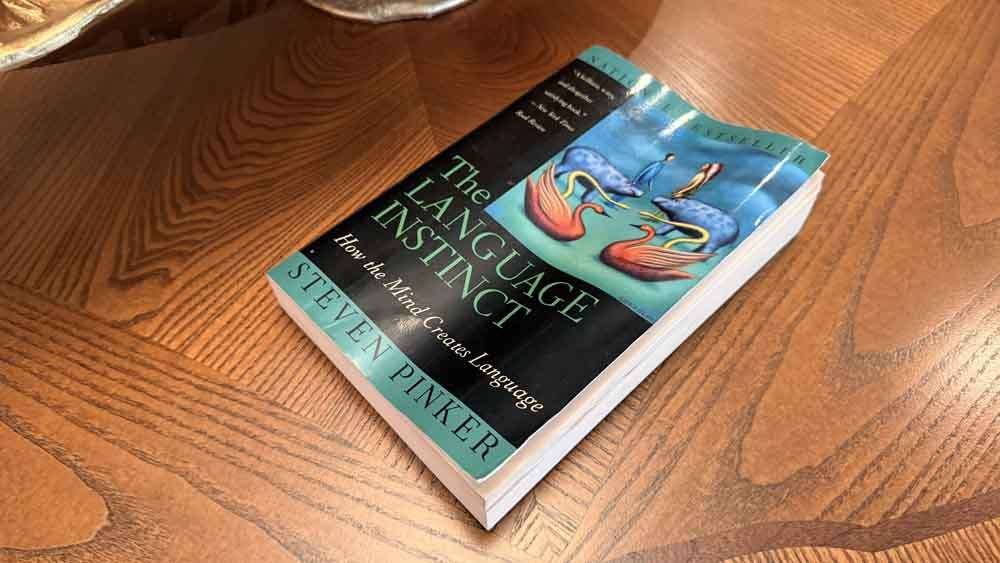
Every child, in every culture, on every continent, with every degree of parental instruction from intensive to nonexistent, learns to talk. They babble on schedule, string words together on schedule, master negation and questions and subordinate clauses on schedule — and they do it without textbooks, without grammar drills, without anyone sitting them down and explaining what a verb phrase is. By the time a child is four years old, they are deploying a grammatical system of staggering complexity, one that professional linguists have spent decades trying to fully describe. That fact alone should stop us cold. Steven Pinker’s The Language Instinct, first published in 1994, takes that fact seriously — and follows it wherever it leads.
Where it leads is somewhere most people find genuinely unsettling: language is not something we learn. Not primarily. It is something we grow, the way we grow a hand.
Grammar Lives in the Genome
The argument at the center of the book is Chomskyan in origin but Darwinian in execution. Noam Chomsky proposed decades ago that human beings are born with a “universal grammar” — an innate mental blueprint that underlies all human languages, regardless of how different they look on the surface. Pinker accepts this, but then takes the step Chomsky never fully took: he asks why such a system would exist. The answer, for Pinker, is natural selection. Language is a biological adaptation, shaped by evolution because it conferred survival advantage on our ancestors. Grammar isn’t a cultural technology, like writing or the calendar. It’s an organ, like the eye.
This is the thesis that animates everything else in the book, and Pinker defends it with relentless ingenuity. He marshals evidence from creole languages — entirely new languages that emerge in a single generation when children are exposed to a jumbled pidgin — and shows that children don’t simply absorb the pidgin. They regularize it, complexify it, and impose grammatical structure onto it, structure no one taught them and no adult model supplied. The grammar comes from the children themselves. It comes from inside. The same pattern appears in Nicaraguan Sign Language, which emerged spontaneously among deaf children in the 1970s and 1980s when they were brought together for the first time. Within two generations, it had developed a full grammatical structure that the children’s teachers — who communicated in a crude manual system — had not provided.
Pinker is at his best in these chapters. The case for innateness isn’t an armchair philosophical claim; it’s built from data — from developmental psychology, from neuroscience, from comparative linguistics, from the study of language disorders. He shows that specific regions of the brain are dedicated to language processing, that damage to those regions produces specific, predictable deficits, and that language acquisition follows the same maturational timetable regardless of culture or input quality. Children of deaf parents who are never taught sign language, but who can observe their parents signing, still acquire the signed language on the normal timetable. Children raised in isolation, as in feral-child cases, lose the capacity to acquire full language after a critical window closes. The critical period itself — the fact that language acquisition becomes dramatically harder after puberty — is exactly what you’d expect from a biologically timed developmental program, and exactly what you would not expect if language were simply a set of habits acquired through repetition and reinforcement.
Against the Language Mavens
Pinker devotes a chapter to what he calls “language mavens” — the editors, usage columnists, and self-appointed guardians of correct English who insist that language is degenerating, that people no longer know the difference between “less” and “fewer,” that split infinitives are a sign of civilizational decline. His demolition of this position is one of the most satisfying passages in popular science writing. The mavens, Pinker argues, confuse a dialect with a language. Standard written English is a prestige dialect — historically contingent, socially powerful, and worth knowing — but it is not grammatically superior to any other form of English. The teenager who says “we was robbed” is not making an error in any meaningful linguistic sense; they are following the perfectly consistent grammar of a different dialect. The mavens rail against “ain’t” and double negatives, not knowing — or not caring — that double negatives were standard in Chaucer’s English and remain standard in virtually every other European language. Italian, French, Spanish, Greek: all use double negatives as a matter of course. The stigma attached to them in English is a historical accident, not a grammatical law.
This connects back to the biological argument in an important way. If language were purely learned behavior, then “correct” and “incorrect” usage would be coherent categories — deviations from the learned norm. But if the capacity for language is innate and all dialects are fully-formed grammatical systems, then the judgment that one dialect is “wrong” is a social judgment, not a linguistic one. Pinker isn’t arguing that standard English doesn’t matter — he’s arguing that we should be honest about why it matters. It matters for social mobility, for access, for being taken seriously in certain rooms. It does not matter because split infinitives violate some deep principle of grammar.
What Pinker Gets Right, and What He Pushes Past
The book’s strengths are considerable. Pinker is a gifted explainer, and his ability to render complex syntax theory, phonology, and psycholinguistics accessible without trivializing them is a real achievement. The chapter on the sounds of language, and the one on how we produce and perceive speech in real time, are alone worth the price of admission. He has a natural talent for the analogy that illuminates rather than distorts, and his humor is dry enough to keep the book moving through stretches of technical material that could easily become airless.
The limitations are real, though, and worth naming. Pinker writes with a confidence that sometimes outpaces his evidence. His treatment of Chomsky, from whom he takes the universal grammar framework, is simultaneously indebted and dismissive — he adopts the core claim while quietly sidelining Chomsky’s skepticism about Darwinian explanations of language. The specific computational architecture Pinker proposes for how the language faculty works — a system of rules operating on discrete symbolic representations — has been contested by connectionionist and emergentist researchers who argue that much of what looks like an innate grammar module can emerge from statistical learning over time. This debate has only intensified since 1994, partly because of the success of large language models, which can produce grammatically sophisticated language through pattern recognition without anything resembling a symbolic grammar module. Pinker’s position remains defensible, but it’s more contested today than his confident prose style would suggest.
There is also a tendency in the book to treat the nativist account as complete — as if demonstrating that language has biological roots settles questions about how language works. Innateness and mechanism are different questions. The eye is clearly a biological adaptation, but knowing that tells us relatively little about how the retina processes light. Knowing that grammar is innate, if it is, would still leave most of the interesting questions open: which aspects of grammar are universal, which are parameters set by experience, how the system interacts with memory and attention and social cognition. Pinker gestures at these questions but doesn’t dwell in their difficulty.
Why It Still Matters
None of that diminishes the book’s importance. The Language Instinct shifted the terms of the debate. Before Pinker, the dominant framework in academic linguistics was still heavily influenced by the behaviorist tradition — the idea that language, like other behavior, is fundamentally a product of conditioning and imitation. Pinker’s contribution was to make the biological case so readable, so well-documented, so hard to dismiss that it forced a generation of scholars to reckon with it seriously. The book belongs in the same conversation as The Selfish Gene and On the Origin of Species — not because it’s as foundational as either, but because it performs the same essential service: it takes a phenomenon we think we understand and reveals how little we’ve really looked at it.
Language feels like breathing. We do it without thinking, without trying, without knowing how. Pinker’s argument is that this effortlessness is the clue — that things which come this naturally, this universally, this reliably, are not habits but inheritances. Whether or not every detail of his model survives the next century of research, the question he centers — why does every human child, everywhere, learn to talk? — is one of the most profound questions in all of biology. The Language Instinct is, thirty years on, still the best place to start with it.
You Might Also Like
- The Selfish Gene by Richard Dawkins — The Book That Unlocked Darwin for Me
- On the Origin of Species by Charles Darwin: The Book That Changed Everything We Thought We Knew About Life
- Thus Spoke Zarathustra by Friedrich Nietzsche — The Book That Rewired My Understanding of Everything
Sources
- Pinker, Steven. The Language Instinct: How the Mind Creates Language. William Morrow, 1994.
- Chomsky, Noam. Syntactic Structures. Mouton, 1957.
- Kegl, Judy, Ann Senghas, and Marie Coppola. “Creation Through Contact: Sign Language Emergence and Sign Language Change in Nicaragua.” Language Creation and Language Change, MIT Press, 1999.
- Bickerton, Derek. Language and Species. University of Chicago Press, 1990.
- Lenneberg, Eric H. Biological Foundations of Language. Wiley, 1967.
- Newport, Elissa L. “Maturational Constraints on Language Learning.” Cognitive Science, vol. 14, no. 1, 1990, pp. 11–28. https://doi.org/10.1207/s15516709cog1401_2
- Elman, Jeffrey L., et al. Rethinking Innateness: A Connectionist Perspective on Development. MIT Press, 1996.