Books don’t get burned anymore. Not literally. They get protested, threatened, pulled from shelves, condemned from pulpits, and in 1988, a Scorsese film adaptation of one caused a pipe bomb to be thrown through the window of a Paris cinema, injuring thirteen people. That’s not metaphor. That happened. A book — and then a movie — made people violent. Which tells you something. Either it was the worst thing ever written about Jesus Christ, or it was the truest.
I’m going with the latter.
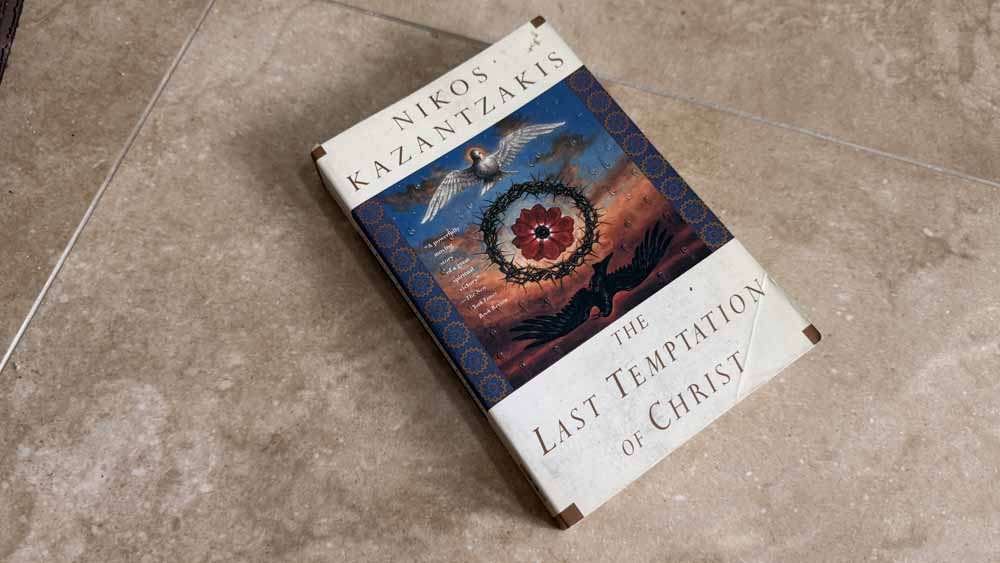
Nikos Kazantzakis published The Last Temptation of Christ in 1955. He was Greek, like me — born in Crete, educated in Athens and Paris, shaped by the Eastern Orthodox tradition the way a person gets shaped by something they spend their whole life loving and questioning simultaneously. The Greek Orthodox Church had already excommunicated him once. When he died in 1957, the Church of Crete refused him a church funeral. He was buried in the walls of the old Venetian ramparts in Heraklion, and his epitaph reads: I hope for nothing. I fear nothing. I am free.
That sentence is the whole book.
What Kazantzakis Actually Wrote
Strip the controversy for a moment, because the controversy has eaten the book alive. What Kazantzakis actually wrote is a literary novel about the inner life of Jesus — not the triumphant Son of God of Sunday school iconography, but a man tortured by his own calling. A carpenter from Nazareth who hears something scratching inside his skull and cannot make it stop. Who wants, desperately, the ordinary life — a house, a woman, children, bread on the table, sleep — and who is denied it by something he didn’t ask for and cannot refuse.
The title refers to the final sequence of the novel, in which a dying Christ on the cross is tempted by a vision of the life he never lived. He sees himself stepping down from the cross, marrying Mary Magdalene, raising a family, growing old. It’s a dream. A hallucination. The last temptation is the most human one: what if I had just been a man?
He refuses it. He returns to the cross. He dies.
That’s the book. That’s what caused pipe bombs.
Kazantzakis wrote in his preface: “Every man partakes of the divine nature in both his spirit and his flesh. That is why the mystery of Christ is not simply the mystery of a particular creed; it is the mystery of every man.” He wasn’t attacking the faith. He was expanding it — into something large enough to contain actual human experience, which is messier and more painful than doctrine typically allows.
The Controversy Is the Point
The Catholic Church placed The Last Temptation of Christ on the Index Librorum Prohibitorum — the list of forbidden books — in 1953, two years before the novel was even officially published in its full form. The Greek Orthodox Church condemned it. When Scorsese’s film came out in 1988, Universal Pictures received death threats. Protesters surrounded theaters. In France, fundamentalist groups firebombed the cinema. In the United States, evangelical leaders organized mass boycotts, and some called for Scorsese to be prosecuted.
What exactly were they protecting people from?
A Jesus who bleeds. A Jesus who feels desire. A Jesus who is afraid. A Jesus who, in Kazantzakis’s rendering, cries out in anguish: “I am not your son! I’m the son of Mary and the carpenter Joseph. I’m a man — don’t touch me!”
That last line is the problem. Not for literature — it’s extraordinary literature. The problem is institutional. If Christ was only divine, the whole architecture holds. If he was also fully human — not symbolically, but literally, viscerally, carnally human — then the neat categories start to bend. And institutions do not like bent categories. They have too much invested in the load-bearing walls.
I’ve thought about this for a long time. Growing up in a Greek immigrant family, the Church wasn’t background noise — it was structure. It was the frame around everything: food, language, death, marriage, identity. I know what that frame does for people. I’m not interested in mocking it. But I am interested in what happens when a book threatens that frame so severely that people reach for weapons.
What they were actually afraid of was doubt made visible. Because Kazantzakis didn’t invent Christ’s doubt — he found it in the Gospels themselves. “My God, my God, why hast thou forsaken me?” is already there. In Matthew. In Mark. It’s been there for two thousand years. Kazantzakis just refused to smooth it over.
What the Film Got Right (and What It Couldn’t)
Martin Scorsese’s 1988 film is a serious piece of work. Willem Dafoe plays Jesus with a physical vulnerability that the role requires — gaunt, trembling, uncertain. Peter Gabriel’s score is genuinely unsettling in the right way. The film is not perfect: some sequences run long, and Paul Schrader’s screenplay occasionally trades the novel’s interior monologue for visual shorthand that doesn’t quite carry the same weight.
But the film understood the central argument. Scorsese, a lapsed Catholic who spent years considering the priesthood, wasn’t making a provocation. He was making an act of faith — his own, complicated, searching kind. In interviews he said he had wanted to make the film for decades precisely because it took the question of Christ’s humanity seriously.
The controversy around the film, as with the book, was almost entirely generated by people who hadn’t read or seen it. The firebombing in Paris — the Studio Saint-Michel cinema — injured thirteen audience members, four of whom were severely burned. The perpetrators were members of a far-right Catholic organization. They attacked people watching a film. In the name of Christ.
The irony is not subtle.
Roger Ebert, reviewing the film, wrote that it was one of the most thoughtful and reverential films about religion he had ever seen. He gave it four stars. The people outside the theater with signs had a different view. That gap — between what the thing actually is and what frightened people decided it was — is the real subject of both the book and its reception.
Kazantzakis as Existentialist
It’s worth placing him. Kazantzakis belongs in the same conversation as Camus, Sartre, Kierkegaard — writers who took the big questions seriously without pretending the answers were easy. If you’ve read my piece on Exploring the Existentialist Philosophy in Albert Camus’ The Stranger, you’ll recognize the territory: a man confronting an indifferent universe, stripped of the comfort of predetermined meaning, forced to construct something in real time. Or my review of Kierkegaard, who had his own complicated relationship with Christianity — believing intensely while refusing to accept the institutional version of belief at face value.
Kazantzakis read all of them. He read Nietzsche deeply — the influence is everywhere in his work, especially the idea that authentic existence demands the rejection of comfortable falsehood. In The Last Temptation, Christ’s agony is essentially existential: he is condemned to be free. He cannot escape the burden of his own consciousness. He cannot choose not to be what he is. That’s Sartre dressed in a robe and sandals, standing in first-century Galilee.
The novel is also saturated with a very Greek understanding of fate — not passive resignation but active, anguished wrestling. Jacob wrestled the angel. Kazantzakis’s Christ wrestles God in every chapter. The spiritual life, in this rendering, is not peace. It’s a permanent, exhausting fight.
That resonates differently when you’ve grown up around people who actually lived that way — who prayed hard and argued loud and didn’t treat faith as a set of propositions to be accepted but as a relationship to be negotiated. That’s a very Greek Orthodox thing, actually. The Greek tradition has always been more comfortable with theological argument, with doubt-as-devotion, than the Western churches that condemned Kazantzakis. There’s something darkly funny about the Greek Orthodox Church excommunicating one of its own for writing what is essentially the most Greek book about Jesus ever written.
What the Book Is Actually About
The last temptation is not sex. That’s what the posters and the protests were about — Mary Magdalene, the dream sequence, the suggestion of physical desire. But Kazantzakis is not writing pornography. He’s writing about the temptation of the ordinary. The temptation to live a small life and be left alone. The temptation to avoid the call. To step off the cross and just be a man with a house and a family and no burning obligation to anyone but himself.
Most people feel that temptation. Not toward divinity — but toward the reverse. The calling that costs too much. The thing you know you’re supposed to do that would require you to give up everything comfortable. Kazantzakis understood that the hardest human act is not sacrifice once you’ve already committed — it’s the refusal of the last exit. The moment when you could still walk away and you don’t.
That’s a book about faith in the deepest sense. Not faith as certainty, but faith as the decision to keep going when certainty is nowhere in sight.
The novel ends with Christ dying on the cross. He has refused the vision. He has refused the ordinary life. In the last lines, Kazantzakis writes: “It is accomplished!” The same words from the Gospel of John. The same three words. But after everything Kazantzakis has put his Christ through — the doubt, the desire, the flesh, the fear — those words land differently. They don’t feel like doctrine. They feel like something earned.
That’s the difference between a catechism and a novel. The catechism gives you the answer. The novel makes you live the question.
Should You Read It?
Yes. Not because it will shake your faith or confirm your atheism or do anything neat and predictable. But because it is a seriously written, seriously felt book about the hardest question in Western civilization: what does it mean to be both human and called to something larger than yourself?
If you’ve read Dostoevsky’s work on faith and suffering — another writer the Church had complicated feelings about — you’ll find a kindred spirit here. If you’ve read Nietzsche’s proclamation that God is dead and wondered what comes after, Kazantzakis gives you a version of Christ who seems to understand the question from the inside.
The people who tried to suppress this book were afraid of it. That’s always been my best recommendation.
You Might Also Like
- Exploring the Existentialist Philosophy in Albert Camus’ The Stranger
- A Kierkegaard Anthology: The Thinker Who Refused to Let Me Go
- The Gay Science by Friedrich Nietzsche: God Is Dead, and Heavy Metal Has Known It Longest
Sources
- Kazantzakis, Nikos. The Last Temptation of Christ. Simon & Schuster, 1960. (Translated by P.A. Bien)
- Bien, Peter. Kazantzakis: Politics of the Spirit, Volume 1. Princeton University Press, 1989. https://press.princeton.edu/books/hardcover/9780691068039/kazantzakis
- Ebert, Roger. Review of The Last Temptation of Christ (1988). RogerEbert.com. https://www.rogerebert.com/reviews/the-last-temptation-of-christ-1988
- “Paris Cinema Firebombing.” The Guardian archive, 1988. https://www.theguardian.com
- Scorsese, Martin. Interview on The Last Temptation of Christ. Various press materials, 1988.
- Catholic Church Index Librorum Prohibitorum (historical record). https://www.newadvent.org/cathen/07721a.htm