Few restaurants earn the right to call themselves the heartbeat of a community. The Meeting House, anchored in the brick-and-garden enclave of Amagansett Square, has done so twice — first during an eleven-year original run that defined the Square’s identity, and again in 2024, when the Lerner family summoned its founding chef back to reignite a flame that competing concepts could never quite replicate. What returned was not a nostalgia act but something rarer: a restaurant that understands why people gather in the first place, serving elevated American comfort food with enough cultural range to keep a table of Hamptons regulars debating whether to order the Bolognese or the Vietnamese wings. In a dining landscape saturated with velvet-rope pretension and seasonal pop-ups designed to be Instagrammed once and forgotten, the Meeting House persists because it was built on a principle older than any algorithm — that a great neighborhood restaurant should feel like it belongs to everyone who walks through the door.
A Billionaire’s Bet on Community Over Commerce
The story of the Meeting House begins not in a kitchen but in a real estate vision. Randy Lerner — Columbia Law graduate, former owner of the NFL’s Cleveland Browns, former chairman of Aston Villa Football Club in England’s Premier League, and a billionaire whose family has called the Hamptons home for nearly four decades — acquired the parcel that would become Amagansett Square in the early 2000s (Wikipedia, 2025). While other developers in the Hamptons were courting luxury brands and corporate tenants, Lerner had a different instinct. He wanted a village square in the traditional sense: independent shops, local artisans, a barbershop, a cheese monger, a place where year-round residents and weekend visitors would coexist without one group dominating the other.
The restaurant was always meant to be the gravitational center of that vision. Lerner brought in Cleveland-based chef Tim Bando to open the Meeting House in 2006, and for eleven years the restaurant operated as the Square’s defining institution (Southforker, 2025). Bando’s approach — sophisticated technique applied to accessible comfort food — resonated with a community that wanted quality without ceremony. The Meeting House became the kind of place where, as Dan’s Papers once noted, watching Lerner walk through the dining room felt like watching a governor entering a room — not because of any ostentation, but because his commitment to the place was that palpable (Dan’s Papers, 2012).
In 2017, the original Meeting House shuttered, and the space cycled through two subsequent concepts: Wölffer Kitchen, followed by Christian’s by Wölffer Estate in spring 2023, which closed after a single summer season (Southforker, 2025). Neither captured the original’s spirit. The Square felt incomplete without its anchor.
The Prodigal Chef Returns
The resurrection began with Max Lerner, Randy’s son, who grew up in Amagansett and inherited his father’s conviction that the Square should remain a bastion of authenticity in an increasingly corporate Hamptons. In a conversation with journalist Alina Cho, Max described the decision to revive the Meeting House as rooted in personal affection and family legacy. His first priority was unambiguous: bring back the chef (Modern Luxury, 2025).
Tim Bando, who had spent the intervening years working in Cleveland — running kitchens at notable establishments including Tremont in Manhattan’s West Village and Grove Hill in Chagrin Falls, Ohio — returned to Amagansett in 2024 as general manager of the reborn Meeting House (Cleveland Scene, 2014). Max Lerner told Cho that Bando’s talent was only part of the equation; what mattered equally was that Bando understood the town, its rhythms, its expectations, its soul. The Meeting House reopened with a refreshed interior but a philosophical continuity: this was still a community restaurant first, a destination second.
The redesign, overseen by Max Lerner, introduced carefully curated touches including a Frank Lloyd Wright window positioned to the left of the entrance and a massive antique window salvaged from an English soccer stadium in Birmingham — a nod to the Lerner family’s connection to Aston Villa FC. Behind the bar, a large quilt-like mural composed of individual 12×12 framed pieces by Dan Rizzie, the MoMA-recognized Sag Harbor artist whose work has been integral to the Lerner family’s Amagansett properties since the Square’s inception, commands the room with quiet authority (Alina Cho Substack, 2024).
The Menu: A Continent-Spanning Comfort Canon
What distinguishes the Meeting House kitchen under Bando’s direction is its refusal to be boxed into a single culinary identity. The menu reads like a map of the American palate at its most omnivorous — classic French and Italian comfort preparations sit alongside Southeast Asian-influenced dishes, connected by Bando’s insistence on precise technique and honest ingredients.
The raw bar offers a compact but serious selection for those who want their Hamptons dining experience to begin with brine and ice. The steak program anchors the heavier end of the menu, while crowd-pleasers like the Meeting House Burger — a proper upscale American cheeseburger served with fries that reviewers consistently single out — satisfy the part of every diner that wants to be fed rather than impressed.
The signature dish, without question, is the OG Mac & Cheese. Made with Gruyère, heavy cream, butter, and sweated onions, baked until golden and finished with chives, it has achieved a kind of local mythology. Bando himself has acknowledged the constant inquiries about its secret, noting with characteristic understatement that the recipe is disarmingly simple (Southforker, 2025). The Chicken Milanese — pounded, dredged, deep-fried, served over local greens with a preserved-lemon vinaigrette and Parmesan shards — demonstrates classical technique without pretension. The Dips Platter, featuring housemade pimento cheese, cumin-dusted hummus, and a feta-green goddess purée flanked by Ritz crackers and crudités, pays homage to the original Meeting House tradition of greeting every table with hummus and pita.
On the more adventurous side, Vietnamese chicken wings and a South Indian-inspired vegetable curry — coconut milk, Madras curry, basmati rice, raita, and tomato chutney — reveal Bando’s range and the kitchen’s willingness to honor global flavors without treating them as novelty items. The Chopped Salad, dressed in creamy lemon-Dijon with greens sourced from nearby Balsam Farms and topped with grated Gruyère, connects the plate to the local agricultural landscape that the Lerner family has long championed.
The Room: White Walls, Dark Marble, and Dan Rizzie
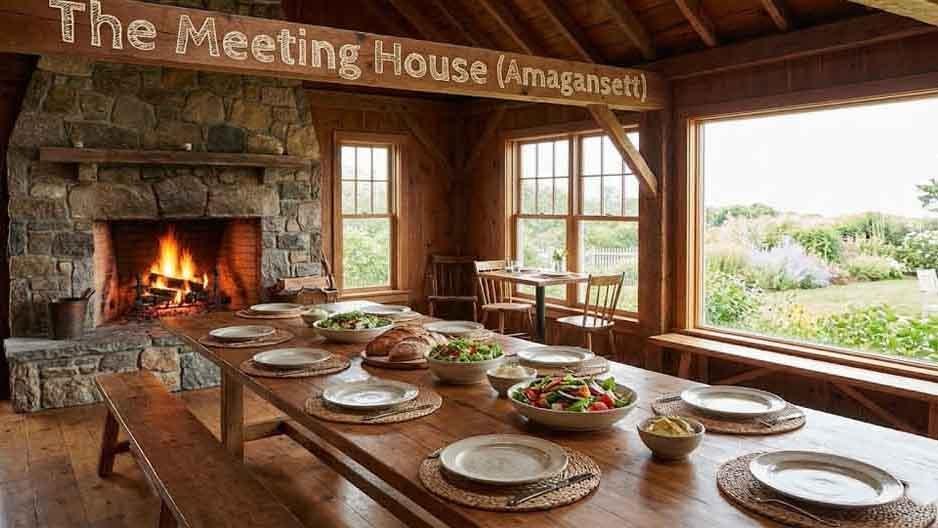
Walking into the Meeting House today, diners encounter a space that balances restraint with warmth. White walls keep the dining room airy and light, while dark marbled tabletops lend substance and weight. The 13-seat bar, positioned centrally, functions as the room’s social engine — a gathering point that blurs the line between those arriving for a full dinner and those stopping in for a cocktail and conversation.
The patio experience is equally deliberate. A small brick pathway leads to a half-dozen round bistro tables and dark blue wicker chairs arranged to overlook the central plaza of Amagansett Square. An adjacent enclosed porch adds additional seating for those who want the outdoors without full exposure. Frommer’s has described the interior as handsomely appointed, noting the substantial mahogany dining bar as a centerpiece that reinforces the gathering-room atmosphere (Frommer’s, 2025).
The art collection, curated with input from Dan Rizzie — a collage artist whose work resides in the collections of the Metropolitan Museum, MoMA, and the Dallas Museum of Art — elevates the space beyond typical restaurant décor. Rizzie, who resides in nearby Sag Harbor and has been a fixture of the East End art scene for decades, created the tree emblem that serves as the logo for the Reform Club, the Lerner family’s boutique hotel on Windmill Lane (Behind the Hedges, 2021). His presence in the Meeting House interior ties the restaurant to a broader cultural ecosystem that the Lerners have nurtured across their Amagansett properties.
The Reform Club Connection and the Lerner Ecosystem
The Meeting House does not exist in isolation. It functions as what the Reform Club’s website describes as the “culinary extension” of the family’s boutique hotel, a five-acre property on Windmill Lane where rooms range from suites to standalone cottages, breakfast arrives at your door, and the concierge will arrange everything from in-room spa treatments to surf lessons (Reform Club Amagansett, 2025). Hotel guests can order from the Meeting House menu directly to their rooms — select lunch offerings beginning at noon, the full dinner menu after 5 PM.
This symbiosis between hotel and restaurant reflects the Lerner family’s integrated vision for Amagansett. Max Lerner has been emphatic that the Square will never house a Gucci or a Chanel. Tenants are required to remain open year-round — a policy that distinguishes Amagansett Square from the seasonal ghost towns that East Hampton and Southampton become once Labor Day passes (Modern Luxury, 2025). The Meeting House, along with neighboring institutions like Cavaniola’s Cheese Shop, Vinnie & Nick’s Barber Shop (a 45-year Amagansett institution), and the boutique retailers that line the Square, creates a commercial village that prioritizes daily life over seasonal spectacle.
For those of us who operate year-round establishments — I’ve been behind the counter at The Heritage Diner in Mount Sinai for 25 years — this commitment to permanence resonates deeply. Restaurants that close for the winter are performing a kind of seasonal theater. Restaurants that stay open are making a promise to a community. The Lerners understand this distinction, and the Meeting House embodies it.
Practical Information for Diners
The Meeting House is located at 4 Amagansett Square Drive, Unit A, Amagansett, NY 11930. The restaurant operates seasonally adjusted hours. During the primary season, dinner is served Tuesday through Thursday and Sunday from 5:00 to 9:00 PM, and Friday and Saturday from 5:00 to 10:00 PM. Brunch is available Friday through Sunday from 11:00 AM to 2:00 PM. The restaurant is closed Mondays. During winter months, the Meeting House operates a Winter Supper Club with special weekly prix fixe menus on Friday and Saturday evenings — hours narrow, but the doors stay open.
Reservations are accepted and recommended, particularly during summer weekends when wait times can stretch significantly. The bar opens earlier than the dining room and stays open late, making it a viable option for those who prefer spontaneity over planning.
Phone: (631) 267-2764
Website: meetinghouseamg.com
Reservations: Available via Resy
Online Ordering: Toast
Instagram: @meetinghouseamagansett
Google Rating: 4.4 stars
Price Range: $$
Features: Takes reservations, offers takeout, offers delivery, full bar, outdoor patio seating, private event catering, in-room dining for Reform Club hotel guests.
A Restaurant That Earned Its Second Life
Not every restaurant deserves a resurrection. Most closures are final verdicts delivered by the market, and the parade of concepts that failed in the Meeting House’s absence — Wölffer Kitchen, Christian’s by Wölffer — confirmed that the space alone was not the magic. The magic was a specific alignment of ownership philosophy, culinary identity, and community purpose that only the original team could reproduce.
Peter from The Heritage Diner — a man who has spent a quarter century understanding that the difference between a restaurant that survives and one that becomes a landmark is measured in thousands of invisible decisions made when nobody is watching. At Marcellino NY, my bespoke leather workshop in Huntington, I call this the principle of the unseen stitch: the hand-saddle stitching on the inside of a briefcase that no client will ever inspect but that determines whether the piece lasts five years or fifty. The Meeting House operates on the same wavelength. The Gruyère in the mac and cheese. The court bouillon for the artichokes. The Ritz crackers flanking the dip platter — a deliberate callback to the original 2006 opening, not because anyone demanded it, but because Tim Bando remembers what made people feel at home.
As Paola and I prepare to launch Maison Pawli, our boutique real estate venture on the North Shore in 2026, I find myself returning to what the Lerners have built in Amagansett as a case study in how commercial spaces can nurture community rather than extract from it. Amagansett Square is not a shopping center. It is a philosophy expressed in brick, mortar, and mac and cheese. The Meeting House sits at its center because a family with the resources to do anything chose to do something worth doing twice.