
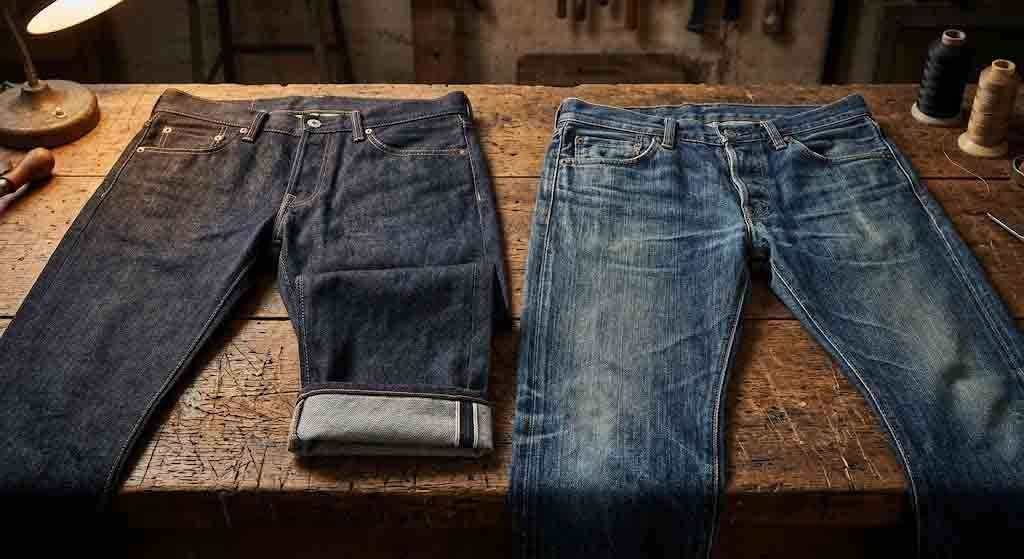
Raw denim has a mythology problem.
Walk into any heritage menswear forum and you’ll encounter a catechism that goes something like this: selvedge is superior because Japanese mills use vintage shuttle looms that produce a tighter, denser weave; the selvage edge prevents unraveling; and a pair of raw jeans that you wear for six months without washing will develop fades that are uniquely yours, a map of your own movement pressed into indigo. All of that sounds compelling. Some of it is even true. But the part about selvedge automatically meaning better, more durable, worth the $300 price tag — that’s the lie at the center of the whole enterprise.
I’ve been wearing jeans through hard use for a long time. Kitchen shifts, leatherwork that puts you on your knees, loading gear, moving through weather. The pants have to hold. So when the raw denim world started insisting that a $30 pair of Levi’s 501 STFs was somehow inferior to a $280 pair of Oni Secret Denim, I paid attention — and then I started pulling threads. Literally.
What Selvedge Actually Means
The word “selvedge” — sometimes spelled “selvage” — refers to one thing: the self-finished edge of a woven textile, produced when the weft thread loops back on itself on a traditional shuttle loom. It prevents the edge of the fabric from fraying. That’s it. That is the complete definition of the word. Selvedge is a loom characteristic, not a quality characteristic.
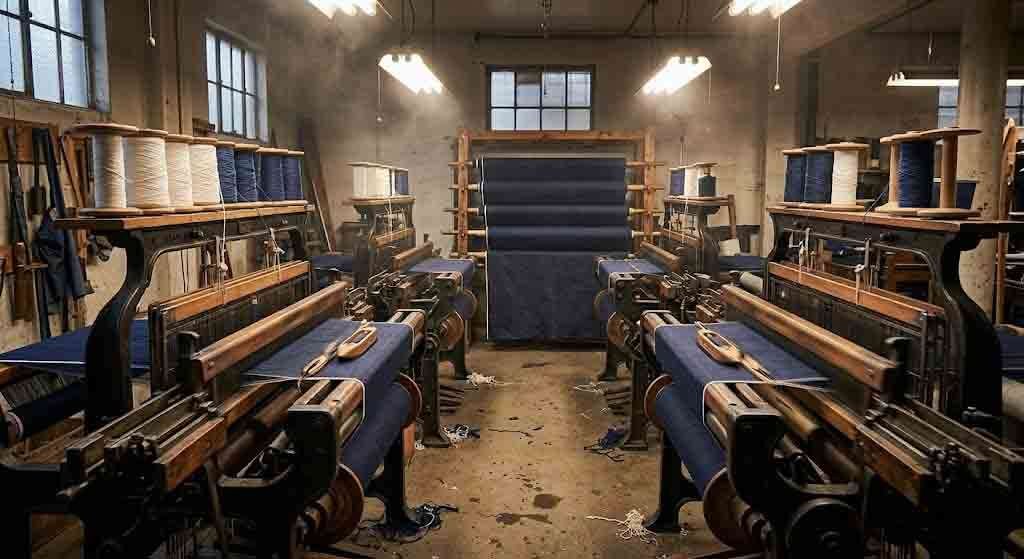
Modern projectile and rapier looms cut fabric at the edges and finish them differently. They’re faster, cheaper, and capable of producing fabric just as dense and durable as anything made on a shuttle loom. The raw denim industry — particularly the Japanese revival that emerged in the late 1980s — fetishized the shuttle loom and the selvedge edge partly because it was genuinely more labor-intensive and partly because it made excellent marketing. The red line on the cuff became a signal. It became the price tag.
Here’s the structural reality: what determines how a pair of jeans wears and lasts is fabric weight measured in ounces per square yard, warp and weft thread count, the quality of the cotton itself, and — critically — how the garment is constructed. A pair of 14.5 oz selvedge denim jeans with sloppy stitching and cheap copper rivets will fall apart faster than a 12 oz non-selvedge pair with flat-felled seams and a solid lockstitch construction. Selvedge tells you nothing about any of that.
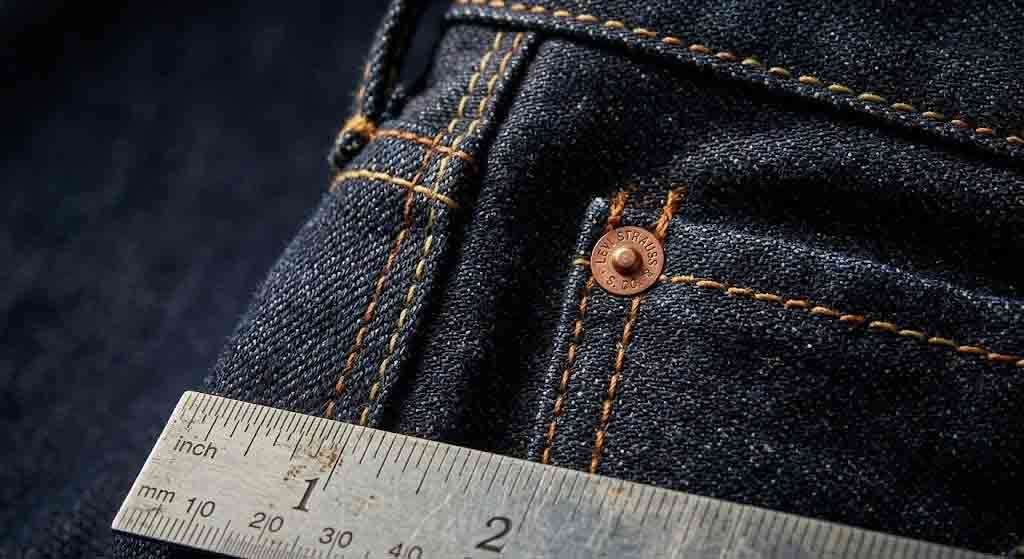
The Levi’s 501 STF Is a Masterclass in What Durability Actually Is
Levi’s Shrink-to-Fit 501s are made on modern looms. They are not selvedge. They cost around $70 at full retail, less on sale. They use ring-spun cotton in a denim weight that runs between 12 and 13 ounces, and they are built on a construction pattern that Levi’s has refined over 150 years. The bar tacks at the stress points — pocket corners, crotch seam, belt loops — are placed exactly where pants fail. The stitching uses the kind of stitch count that holds.
Workwear tests jeans in ways no forum can simulate. The constant friction of the edge of a prep table. Crouching in a delivery bay at 6 AM in January. Hours bent over a leather bench with your thighs pressed against a hard edge. I’ve watched $240 Japanese selvedge jeans develop stress tears at the inseam by month three. I’ve watched 501 STFs go two years of the same punishment before they asked for retirement — and they earned it.
The STF’s other advantage is fit. Because they’re sold unsanforized — meaning the cotton hasn’t been pre-shrunk — you size up, soak them in hot water, and wear them while they dry around your body. What you get is a pair of jeans that fits you, not a size chart. That is a craft approach. It’s just not marketed with the word “artisan.”
Where Japanese Selvedge Is Actually Better
I want to be fair here, because the raw denim community is not entirely wrong.
There are specific things that high-end Japanese selvedge denim does genuinely better. The fading. If you care about how indigo breaks down over time — the high-contrast “honeycombs” behind the knees, the whiskers at the hip, the combs at the thigh — a good Japanese selvedge jean fades more dramatically and more beautifully than a standard pair. The reason is the ring-spun yarn used in most Japanese selvedge, which leaves more irregular indigo coverage and therefore produces sharper contrast as the outer fibers wear. This matters if the artifact of the jean matters to you.
Some selvedge mills — Kaihara, Kurabo, Collect Mills — also produce fabric with genuinely unusual character. Slub denim, which has irregular texture built into the yarn, creates a textile that ages like old wood rather than like a uniform surface. That’s a legitimate aesthetic quality, not just marketing.
And there is something to the build quality at the top tier. Oni Secret Denim, Iron Heart, Samurai — these brands are using fabric that runs 18, 21, even 25 ounces. That is a different garment than a 12 oz Levi’s. Heavier fabric takes longer to break in, sits stiffer off the roll, and develops structure differently. If you want a pair of jeans that functions like light armor, those exist. But they cost $350 for a reason that is at least partially legitimate — and the weight, not the selvedge, is the key variable.
The Construction Question Nobody Asks at the Point of Sale
The thing most buyers never do before dropping $250 on a pair of raw jeans is inspect the construction. They look at the fabric. They check the edge for the selvedge ribbon. They ask about the mill. They rarely ask about the chain stitch versus lockstitch, about whether the outseam is flat-felled or serged, about the gauge of the copper on the rivets.
A flat-felled seam — where the allowance is folded under and double-stitched — is substantially more durable than a serged edge. It’s also more expensive to produce. A chain stitch, which produces the characteristic “roping” on the back leg when faded, is actually weaker than a lockstitch under direct pull but creates less seam rigidity, which is why some prefer it for comfort over years of wear. These are real distinctions that affect how a pant performs. They have nothing to do with whether the fabric has a selvedge edge.
The honest version of the selvedge conversation goes like this: if you buy a $280 pair of Samurai 710 jeans, you are buying a well-constructed garment made with heavy, interesting fabric that will develop exceptional character over years of wear. That’s a fair exchange. But you are not buying that because it’s selvedge. You’re buying it because Samurai knows how to build a pant. Put their expertise into a non-selvedge fabric and you’d still get a great result.
If you buy an $80 pair of American-made denim from Raleigh Denim Workshop or Tellason — both of which use domestic cone mills — you are buying something just as legitimate and probably more honest about what it is. The 15 American Leather Goods Makers You Should Know About in 2026 phenomenon that I’ve written about applies here too: American production at this price point is not about the price, it’s about the craft infrastructure being worth preserving.
The Marketing Mechanism Worth Understanding
The raw denim revival was not a spontaneous folk uprising. It emerged from a very specific set of cultural conditions: Japanese collectors in the late 1980s and 1990s who fetishized American workwear of the 1940s and 1950s and began reproducing it with even greater precision than the originals. They reverse-engineered Levi’s, Lee, and Wrangler patterns from vintage pairs, sourced cotton that approximated pre-war American cultivation, and rebuilt shuttle looms that had been mothballed for decades. The result was an authentic historical reproduction exercise that produced genuinely excellent jeans.
What happened next was predictable. The American market discovered these jeans around 2005–2010, and the marketing machine extracted the most legible quality signal — the selvedge edge — and made it the entire story. Everything else that made those Japanese jeans excellent got compressed into a single visible detail that consumers could check for before buying. The red line on the cuff became the shorthand for craft. And once that shorthand was established, any manufacturer could produce a selvedge-edged fabric of mediocre quality and charge the premium.
It’s the same mechanism that turned “grain-fed” into a marketing advantage over “grass-fed” before consumers wised up to what it actually meant. Or the way “handmade” on a leather good tells you almost nothing about the quality of the construction, the grade of the hide, or whether the maker knows what they’re doing. I know something about that particular lie having built leather goods by hand for years — full grain versus top grain versus genuine leather is the same conversation: the terminology signals quality but the execution is what delivers it or doesn’t.
What to Actually Look For
If you’re spending real money on denim, here is what actually matters:
Fabric weight. For everyday wear, 12–14 oz is the sweet spot — heavy enough to develop good fades, light enough to be comfortable in warm weather. For workwear or motorcycle use, 17–21 oz. Anything marketed as “heavy selvedge” at under 14 oz is mostly posturing.
Construction. Check the inseam and outseam. Flat-felled or single-needle means time and care. Serged edges on a $250 pair of jeans are a bad sign. Look at the rivets — brass or copper that is tightly set, not decorative chrome.
Fit before fade. No fade pattern — however beautiful — fixes a pair of jeans that fits wrong. The STF approach of soaking and sizing to your body is the most rational method. Buy your waist size, size up on length, soak in hot water, wear them dry.
Brand history. Older brands with a track record on the specific jean you’re buying — not a brand that made motorcycle boots and pivoted into denim because the margins looked good.
That’s it. Not which mill. Not which country. Not the color of the line on the cuff.
The selvedge edge is real. It’s a legitimate manufacturing characteristic. But it became a proxy for quality at some point in the past fifteen years, and the proxy is not the thing. The $300 pair of jeans may be worth it — but not because of the red thread. Know the difference before you reach for your wallet.
Sources:
– Heddels: Selvedge Denim 101 — What is Selvedge Denim? – Heddels: The Complete Guide to Denim Weight – Raleigh Denim Workshop: raleighworkshop.com – Tellason Denim: tellason.com – Levi Strauss & Co. 501 STF: levi.com – Kaihara Corporation: kaihara-denim.com
You Might Also Like: – Full Grain vs. Top Grain vs. Genuine Leather: What You’re Actually Buying – 15 American Leather Goods Makers You Should Know About in 2026 – Why American-Made Leather Goods Cost More (And Why It’s Worth It)