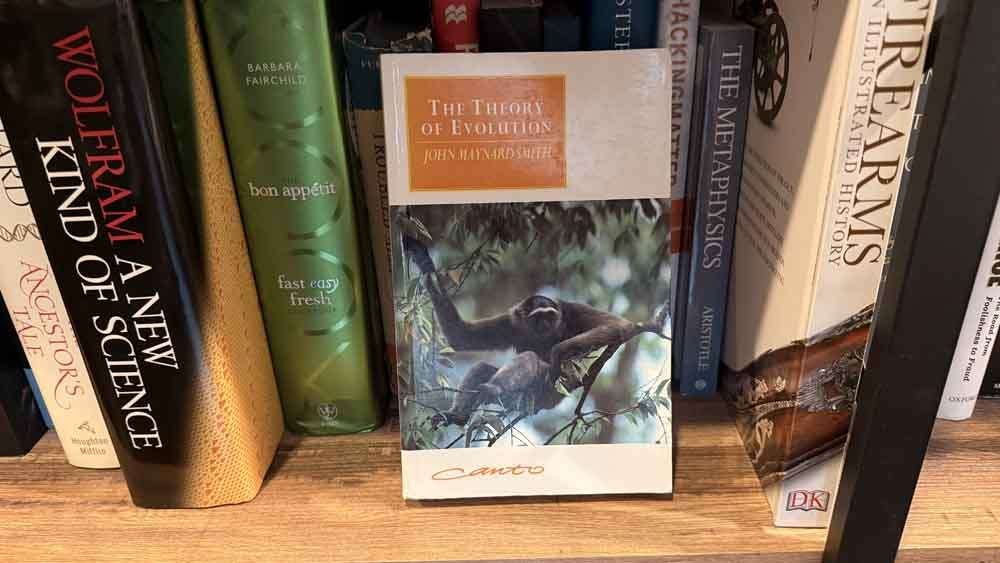
Darwin gave us the skeleton. What John Maynard Smith does in The Theory of Evolution is show how the flesh grew on it — the muscle, the nerves, the unexpected organs that nobody predicted from the original blueprint. First published in 1958, revised through the decades, and reissued in the Canto edition with a foreword by Richard Dawkins, this book is not a simple defense of Darwin. It is something more interesting than that: a demonstration that the theory, once given the tools of modern genetics and molecular biology, became something richer and stranger than Darwin himself could have imagined.
An Engineer Turned Biologist
Smith’s origin story matters here. He trained as an aeronautical engineer during the Second World War before taking a second degree in genetics under J.B.S. Haldane at University College London — a trajectory that should tell you something about how he thinks. He brings structural logic to living systems. He wants to know not just what happens in evolution but why the mechanism works, how the information flows, where the tolerances are. His writing has the clean patience of someone who has spent time around load-bearing calculations, and it shows on every page.
The Canto edition came with a foreword from Dawkins — whose own Selfish Gene sits on one end of the same long shelf Smith occupies — calling it the best general introduction to evolution available. That is not empty praise from a man not given to empty praise. Dawkins recognized what Smith had built: a book that could carry a general reader through population genetics, molecular biology, speciation, and development without dumbing any of it down while never becoming inaccessible. That balance is rare, and Smith achieves it by treating the reader as a fellow problem-solver rather than a student to be managed.
The Theory That Confirmed Itself
The central claim of the book is worth sitting with: Darwin’s theory of natural selection has been confirmed, but at the same time transformed, by what we have learned since. That word — transformed — is doing a lot of work, and Smith is honest about it. Darwin had no real theory of inheritance. He knew selection happened. He could observe it. But without genetics, he had no mechanism for how variation was stored, passed on, or constrained. The discovery of Mendelian genetics in the early twentieth century, and later the structure of DNA, did not simply support Darwin’s argument. They changed its terms entirely.
Smith walks through this transformation with the unhurried confidence of someone who watched it happen from inside the field. He explains how population genetics — the mathematics of allele frequencies, gene pools, and fitness landscapes — gave the theory its quantitative spine. He covers the work that came out of the Modern Synthesis of the 1930s and 40s, when Fisher, Haldane, and Wright fused Darwin with Mendel and showed mathematically how selection could drive populations toward adaptation across generations. This is foundational material, but Smith makes it feel alive rather than textbook-dry.
Genetics as a New Language for an Old Idea
What changes when you understand inheritance at the molecular level is not the fact of natural selection — it is the resolution at which you can see it. Smith takes the reader into the structure of chromosomes, the mechanics of meiosis, the role of mutation rates, and the way genetic recombination shuffles variation within populations. These are not decorative details. They are the substrate on which selection actually operates, and understanding them transforms evolution from a grand metaphor into a precision mechanism.
Particularly striking is Smith’s treatment of how development interacts with genetics — the proto-evo-devo insight that sits quietly in the book’s later chapters. Most genetic changes, he explains, are either developmentally neutral or developmentally catastrophic. The vast middle ground of useful variation is narrow. Natural selection has to work within architectural constraints set by the developmental program of the organism. A change that might be beneficial in isolation might be lethal in the context of a body plan built up over hundreds of millions of years of prior evolution. This is the bottleneck that makes evolution feel both inevitable and improbable at once — an insight that would later explode into the formal field of evolutionary developmental biology.
I have spent years thinking about how systems constrain their own change — it comes with the territory when you work with materials and processes that have their own logic, their own tolerances, their own points of failure. What Smith describes in the relationship between genetics and development maps onto something I recognize: the way a structure’s history limits and enables what it can become. You don’t escape your prior decisions. You work within them.
Speciation and the Problem of Divergence
One of the book’s most satisfying threads is its treatment of speciation — the mechanism by which one lineage becomes two. Smith is careful and precise here, working through geographical isolation, reproductive barriers, hybrid sterility, and the gradual accumulation of incompatibilities between diverging gene pools. He is also admirably honest about what remains genuinely hard: sympatric speciation, the origin of new body plans, the tempo of evolutionary change.
The debate over punctuated equilibrium — whether evolution moves at a steady pace or in bursts of rapid change punctuated by long stasis — was alive during Smith’s career, and he engages it without pretending the field had resolved it. That intellectual honesty is part of what makes the book hold up. He does not write a propaganda piece for evolutionary theory. He writes a map of what is known and where the edges of the map are still being drawn.
A Theory That Refuses to Sit Still
The deepest pleasure of this book is its sense of evolution not as a settled fact to be defended but as an ongoing system to be understood. Smith’s own later work — culminating in The Major Transitions in Evolution co-written with Eörs Szathmáry — pushed the theory further still, into questions about how entirely new levels of biological organization emerge: how replicating molecules became cells, how cells became organisms, how organisms became societies. Each transition, they argued, involves entities surrendering the ability to replicate independently in order to become components of a larger whole. The theory does not just explain life’s diversity. It explains life’s increasing complexity.
That arc from The Theory of Evolution to the major transitions work is one of the great intellectual trajectories in twentieth-century science. Smith was not defending Darwin. He was extending him, recasting him in a language Darwin never had access to, and in doing so showing that the original insight was not just correct but generative — the kind of idea that produces more ideas, that opens territory rather than closing it.
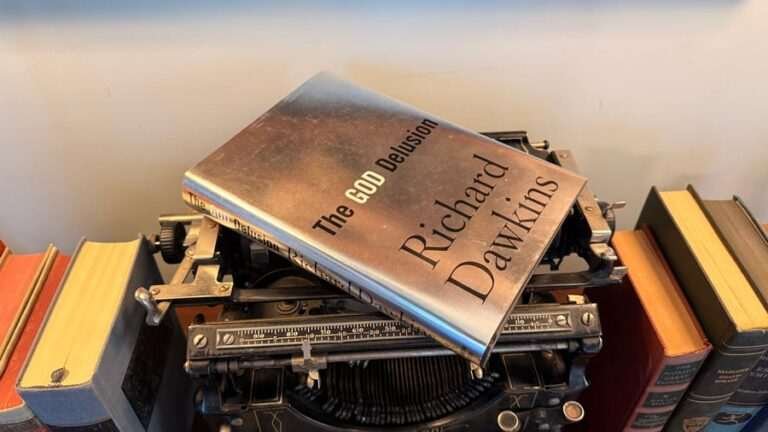
I had already spent time with Dawkins on one end of this tradition — my review of The God Delusion touches on some of the same evolutionary ground — and my review of The Darwin Wars by Andrew Brown covers the sociological combat that broke out among the people downstream of Smith and Dawkins. Smith sits upstream of all of it, quieter and more technically rigorous, the man who gave the whole generation their footing.
Who Should Read This
The Theory of Evolution is not a beach book. It asks for attention and rewards it. The passages on population genetics require slow reading, and the sections on genetics and molecular biology assume a reader willing to follow an argument rather than skim for conclusions. But Smith never loses sight of the human scale of the problem — what it means that all living things share a common descent, that the DNA in a fruit fly and the DNA in a diner cook are variations on the same ancient text.
If you have read Dawkins and want to go deeper. If you came to evolution through popular science and want to meet the engineering underneath it. If you are drawn to systems that work — that have been tested against reality for a hundred and fifty years and found not just intact but strengthened — this is the book. Darwin had the vision. Smith shows you how it works.
Sources
- The Theory of Evolution (Canto Edition) — Cambridge University Press
- The Theory of Evolution — Amazon
- John Maynard Smith — Wikipedia
- The Theory of Evolution — Wikipedia
- The Major Transitions in Evolution — Amazon
- John Maynard Smith — Annual Reviews, Genetics Vol. 39 (2005)
- John Maynard Smith obituary — PMC/NCBI
- The Theory of Evolution — Goodreads reader reviews