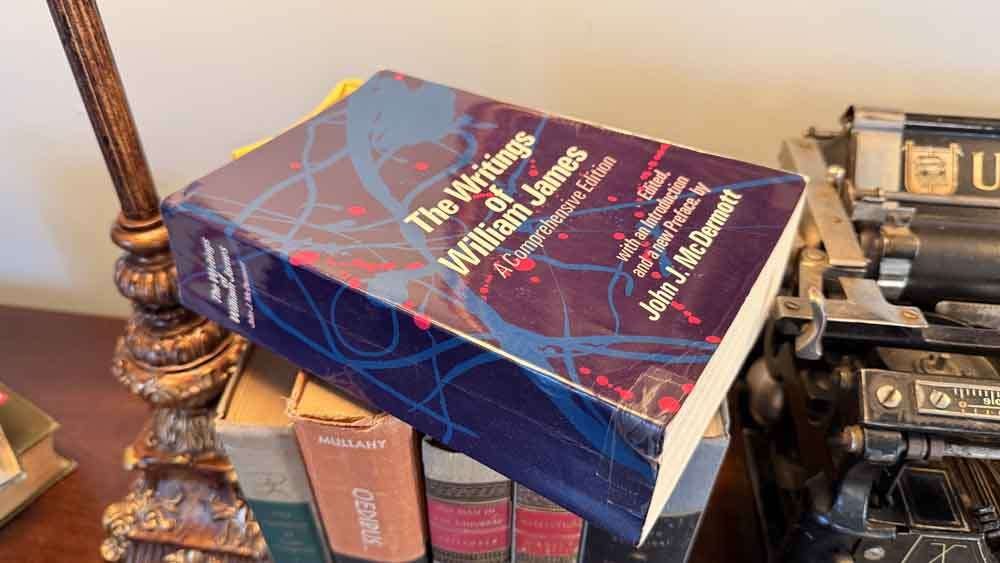
Edited by John J. McDermott, The Writings of William James is not a book you pick up and race through. It resists that. James himself — dense, associative, occasionally maddening in his digressions — demands a particular kind of reader: one willing to slow down, sit with an idea, and let it work on them before passing judgment. I was that reader. Mostly. There were moments when the prose felt like walking through wet concrete, and I will not pretend otherwise. But what emerged on the other side of that patience was one of the more genuinely useful intellectual encounters I have had in years.
William James is often called the father of American psychology, a title that feels at once accurate and insufficient. He was a psychologist, yes, but also a philosopher, a physician, a deeply restless thinker who refused to let any single discipline own him. His pragmatism — the philosophical framework for which he is most remembered — is not an academic artifact. It is a living argument that ideas should be judged by what they do, not by how elegant they sound in a lecture hall. An idea that produces no practical difference in the world is, for James, not an idea worth holding.
That conviction, arrived at over a century ago, reads today like a corrective to almost everything wrong with modern decision-making.
Pragmatism as a Business Philosophy Nobody Teaches
Walk into any business school, any boardroom, any serious strategy session, and you will encounter ideas presented with tremendous confidence. Theories, frameworks, models. What you will encounter far less often is the discipline of asking: does this actually work? Not in theory. Not on a whiteboard. In the world, where the friction is real and the outcomes are measurable.
James would have found this maddening. His central argument in Pragmatism — one of the key texts collected in McDermott’s volume — is that the truth of any idea is inseparable from its consequences. Truth is not a fixed property that ideas possess. It is something that happens to an idea as it is put to use. An idea becomes true insofar as it helps you navigate reality. When it stops doing that, you revise it or discard it.
This is the intellectual habit that separates operators from theorists, and it is, in my experience, precisely what distinguishes the people who build things that last from those who only talk about building them. I have watched people in every industry — restaurants, real estate, finance — fall in love with their own frameworks and then refuse to update them when the evidence turns against them. James diagnosed that failure in 1907. It has not improved.
The Theory of Emotions That Stopped Me Cold
Of all the ideas in this collection, the one that lodged deepest came from James’s early psychological writing — his work on emotion and the body. The common-sense assumption, which most people carry without examining, is that emotions cause physical reactions. You feel afraid, and then your heart races. You feel grief, and then the tears come.
James inverted this entirely.
His argument — developed in parallel with the Danish physiologist Carl Lange, which is why it became known as the James-Lange theory — is that the physical reaction is the emotion. You do not tremble because you are afraid. You are afraid because you tremble. You do not cry because you are sad. You are sad because you cry. Perception triggers a bodily change, and the mental experience of that change is what we call the emotion.
I found this genuinely arresting, not as an abstraction, but as a practical question. If James is right — and there is a significant body of modern neuroscience that suggests he was at least substantially right — then the implications for how we manage ourselves under pressure are considerable. The body is not the messenger. The body is the message. Change the physical state, and you change the emotional experience. This is not self-help language. It is a serious empirical claim, and James made it with the rigor of a scientist who had also read Kant.
The Difficulty Is Real, and It Is Worth It
I want to be fair about what kind of reading experience this is. McDermott’s editorial work is excellent — his introductions situate James historically and philosophically without condescending to the reader — but James himself is not an easy writer. He is layered, circuitous, and prone to pursuing an idea through five qualifications before arriving at the point. There were passages in the metaphysics sections, particularly in A Pluralistic Universe, where I felt the argument slip out from under me entirely.
But James earned his difficulty. He was not obscure for the sake of sounding profound. He was trying to describe things that resist clean description — the texture of consciousness, the continuity of experience, the way the present moment bleeds into the next — and he was doing it before the vocabulary for such things had been fully developed. That context makes the density more forgivable, and sometimes more impressive.
His concept of the “stream of consciousness” — the idea that experience is not a series of discrete states but a continuous, flowing whole — predates by decades the neuroscience that would later support it, and it would go on to reshape not only psychology but literature, film, and art. That is the kind of idea that justifies the difficulty of the writer who produced it.
What Pragmatism Gets Right That Most People Miss
There is a version of pragmatism that gets misread as pure utility — a philosophy that reduces everything to what works, full stop, without asking what it means to work or for whom. James did not hold that version. His pragmatism was pluralistic and humane. He believed that different frameworks could all be “true” in their respective domains, and that intellectual humility — the willingness to hold your current best understanding loosely — was not weakness but wisdom.
This connects to something I have long believed about the people and institutions that endure. They do not fall in love with their conclusions. They fall in love with the process of arriving at better ones. The diner that has survived twenty-five years on the North Shore did not do it by refusing to evolve. The craftsman who produces something genuinely lasting does it by treating each piece as an argument to be tested, not a statement to be defended.
James would have recognized that instinct. He spent his career arguing that the universe is still being made, that the future is genuinely open, and that ideas — including the ones we hold most confidently — are instruments, not monuments.
A Mind Worth the Effort
The Writings of William James, as assembled by McDermott, is not a casual read, and it is not trying to be. It is an encounter with one of the most original and consequential American thinkers of any era — a man who built the first psychology laboratory in the United States, wrote one of the most celebrated works of philosophy in the English language, and did it all while suffering from chronic depression and physical illness that would have silenced a lesser mind.
The ideas in this collection — pragmatism, radical empiricism, the James-Lange theory of emotion, the stream of consciousness — are not historical curiosities. They are active. They show up in cognitive behavioral therapy, in behavioral economics, in the philosophy of science, and in every honest conversation about how we know what we know and what we do with that knowledge.
If you are the kind of person who evaluates ideas by what they produce in the world — and I would argue that is the only rational way to evaluate them — then James is your philosopher. He arrived at that position before most of the world was ready for it, and it cost him some of the recognition he deserved. The recognition came eventually. The ideas were always there.
Read this book with patience and a pencil. It will return the effort.
You Might Also Like
- Horizontal Gene Transfer: Why Darwin’s Tree of Life Is Actually a Tangled Web
- Deserves Got Nothing to Do with It: Why Unforgiven Is the Greatest American Western Ever Made
Sources
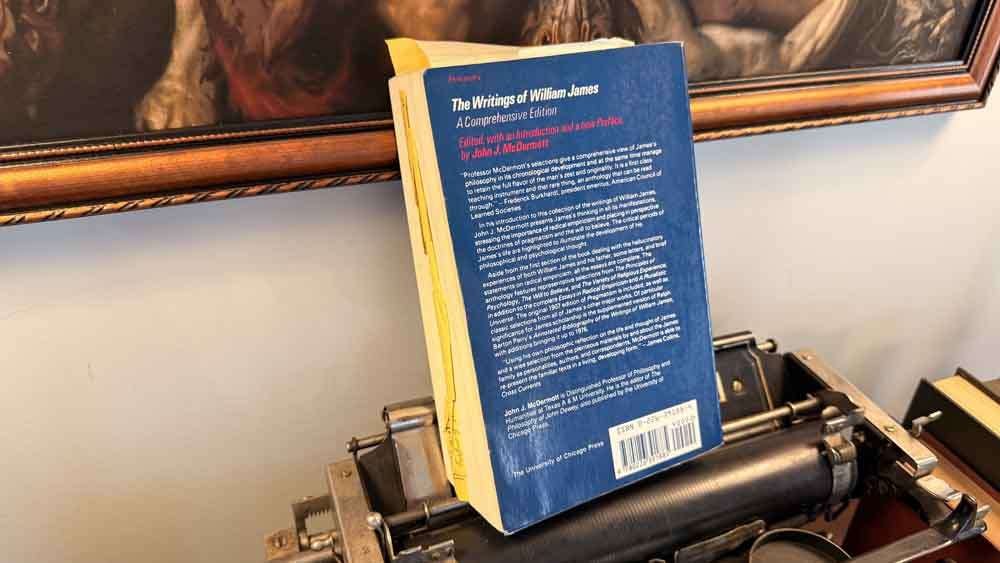
- James, William. The Writings of William James: A Comprehensive Edition, edited by John J. McDermott. University of Chicago Press, 1977. Available on Amazon
- James, William. Pragmatism: A New Name for Some Old Ways of Thinking. Longman Green and Co., 1907. Full text via Project Gutenberg
- Cannon, Walter B. “The James-Lange Theory of Emotions: A Critical Examination and an Alternative Theory.” The American Journal of Psychology, vol. 39, 1927.
- Richardson, Robert D. William James: In the Maelstrom of American Modernism. Houghton Mifflin, 2006. Available on Amazon