The question is not whether it was the right decision. It was the right decision. The question is what it costs a person to make a right decision that requires them to destroy something they love, and to do it deliberately, and to watch it happen, and to receive the last transmission, and to know that the silence afterward is permanent and was chosen.
On September 15, 2017, the Cassini spacecraft — which had been orbiting Saturn since 2004, which had traveled seven years to reach the ringed planet, which had spent thirteen years transmitting images and data of extraordinary beauty and scientific value, which had a name and a history and a team of engineers and scientists who knew its instruments the way a musician knows an instrument — entered Saturn’s upper atmosphere at a velocity of about 113,000 kilometers per hour and disintegrated. The disintegration was planned. The people who planned it knew exactly what would happen. Some of them wept.
The Moral Architecture of the Mission
To understand why Cassini had to die, you have to understand Enceladus.
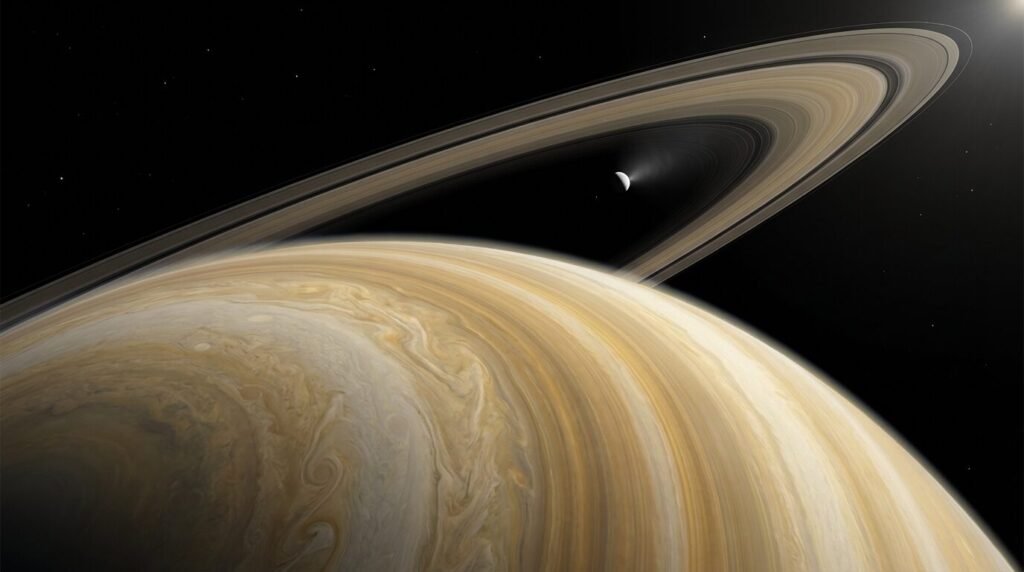
Enceladus is a small moon of Saturn, roughly 500 kilometers in diameter, and it is one of the most significant objects in the solar system from the standpoint of astrobiology — the study of life’s possibility beyond Earth. In 2005, Cassini flew through a plume of water vapor erupting from the moon’s south pole and detected evidence of a liquid water ocean beneath its icy surface. Subsequent analyses detected organic molecules in the plumes. In 2017, scientists reported the detection of molecular hydrogen in the plume material — a signature consistent with hydrothermal activity, the kind of chemistry that supports life around deep-sea vents on Earth.
Enceladus, in other words, might harbor life. The word “might” carries all the weight here — it is a hypothesis, not a confirmed observation. But the hypothesis is serious, supported by multiple independent lines of chemical evidence, and taken with full seriousness by the astrobiology community.
And here is the moral problem: Cassini was not sterile. It was built in the 1990s, before the full implications of Enceladus’s ocean were understood, in clean rooms but not to the planetary protection standards that would be required for a mission explicitly targeting a potentially inhabited world. Despite all precautions, Cassini almost certainly carried microbial stowaways — extremophile bacteria capable of surviving the vacuum and radiation of space, living dormant in microscopic niches in the spacecraft’s structure. These organisms were not the fault of the engineers or the scientists. They were an artifact of the limits of sterilization technology. They were, in the most literal sense, innocent contaminants.
If Cassini were allowed to run out of fuel and drift — as missions sometimes do, allowed to continue until contact is lost and the spacecraft remains in orbit indefinitely — it would eventually, over years or decades, be at risk of impacting Enceladus. Or Titan, another moon with a complex organic chemistry, perhaps also harboring conditions relevant to life. And if that impact carried living Earth organisms to an already living world, or to a world on the verge of life, the contamination would be irreversible. We could never know, afterward, whether the biology we found there was Enceladus’s biology or ours. We would have falsified the one experiment we most wanted to run cleanly.
The decision was therefore not a difficult one at the level of principle. It was simple: Cassini had to be destroyed in a way that ensured no impact with a potentially inhabited moon. The only clean solution was Saturn’s atmosphere. The planet would burn everything completely. Nothing would survive.
The decision was not difficult at the level of principle. At the level of feeling, it was something else entirely.
Twenty Years With a Machine
Linda Spilker joined the Cassini mission in 1988, six years before the spacecraft was launched, nine years before it left Earth, and sixteen years before it arrived at Saturn. She was Cassini’s project scientist for the Grand Finale — the mission’s last phase, a series of 22 daring orbits threading between Saturn’s atmosphere and its innermost ring, measuring gravitational and magnetic fields with unprecedented precision before the final plunge. She has spoken publicly, in interviews with Scientific American and elsewhere, about the texture of her relationship with the mission over those two decades.
The word “relationship” is worth examining rather than accepting too quickly. A spacecraft is not a person. It is a machine — an extraordinary machine, designed with deep intelligence and built with extreme care, but a machine. It cannot suffer. It does not know it exists. The grief that Spilker and her colleagues felt at the prospect of the Grand Finale was not, strictly speaking, grief for Cassini. It was something more like grief for what Cassini represented: the years of work, the decisions made at every juncture, the things seen and not otherwise seeable, the identity that had been partially constituted by participation in the mission.
When humans name their instruments — and they do, consistently: the rovers Spirit and Opportunity, the telescope Hubble, the probe Cassini-Huygens — they are doing something Dostoevsky would have understood. They are creating an object onto which consciousness can be projected, an artifact that can bear the weight of human feeling without collapsing under it. The naming is not sentimental weakness. It is a form of cognitive technology: a way of sustaining commitment to a project across years and decades by making the project feel like a relationship, feel like something with a face, feel like something that can be betrayed or honored or mourned.
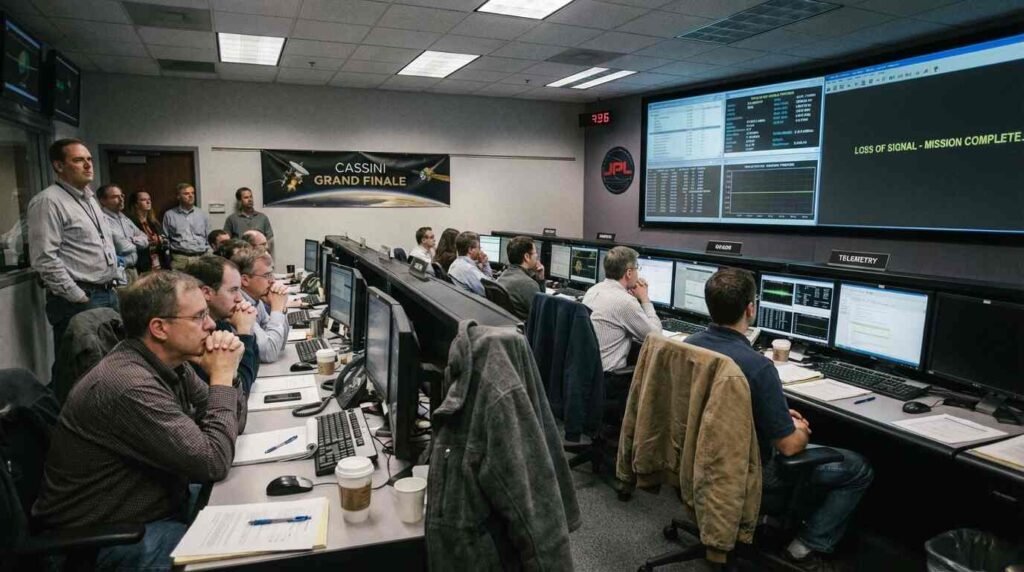
The engineers who stayed awake for Cassini’s launch in 1997. Who monitored the long transit through the solar system. Who celebrated arrival at Saturn in 2004 and who built the software for the Grand Finale and who received the final transmission — seventy seconds of last data, the signal reaching Earth at the speed of light from Saturn’s upper atmosphere — these people did not simply close a file. They buried something. They had to live with the knowledge that they had ordered the death of a thing they had made and loved and spoken to across a billion miles of space.
The Question of Moral Responsibility
Dostoevsky was preoccupied throughout his life with the question of responsibility — not legal responsibility, which is simple, but the deeper, stranger kind that attaches to persons who cause harm through negligence, through good intentions, through the complexity of a world that does not cooperate with clean ethical categories. Raskolnikov’s crime in Crime and Punishment is not murder in the ordinary sense; it is the assumption of the right to decide who may live, who must die, and on what grounds. The underground man’s crime is different — it is the crime of perfect inaction, of a consciousness so aware of its own contradictions that it cannot commit to anything.
The Cassini engineers occupy a different moral position from either. They did not assume the right to decide that Cassini’s life was worth less than the possibility of Enceladus’s life. They were given that responsibility, by the logic of the mission, by the ethics of planetary protection, by the simple fact that Cassini was their creation and therefore their responsibility. They accepted it. They built the timeline for the Grand Finale. They programmed the final maneuver. They sat in the control room in Pasadena and watched the telemetry flatline at 7:55 AM local time on September 15, 2017.
The moral question that lingers is not whether they were right. They were right. The question is the one that attaches to all responsible destruction: what is the shape of the obligation that remains afterward? When you destroy something you made, in order to protect something you cannot even confirm exists, on the grounds of a possibility — the possibility of microbial life on a moon a billion kilometers away — you have performed an act of extraordinary ethical seriousness. You have decided that the hypothetical interests of organisms you will never see outweigh the continued existence of the instrument to which you have given twenty years of your working life.
This is not heroism in the conventional sense. There is no enemy here, no danger, no rescue. It is something quieter and stranger: the subordination of the personal to the possible, of the certain to the probable, of the known value to the unknown one. Cassini was real. Its data was real. The life on Enceladus is not confirmed. The decision chose the unconfirmed over the real, and did so deliberately, and that is a form of moral seriousness that the culture does not have a very good vocabulary for.
What the Grand Finale Found
The scientific returns of the Grand Finale were extraordinary. In those final twenty-two orbits, Cassini dove between Saturn’s atmosphere and its D ring — a region no spacecraft had ever entered — and made measurements that resolved decades-old questions and opened new ones with characteristic scientific thoroughness.
The mass of Saturn’s rings was measured precisely for the first time: smaller than expected, suggesting the rings are geologically young — perhaps only 100 million years old, a cosmic blink — and being gradually destroyed, the material slowly spiraling into the planet. Saturn’s gravitational field, measured with high precision during the Grand Finale orbits, revealed unexpected asymmetries suggesting complex dynamics in the planet’s interior that existing models cannot fully account for. The magnetic field measurements confirmed an extraordinary result: Saturn’s magnetic field is almost perfectly aligned with its rotation axis, a symmetry that contradicts the prevailing dynamo theories for planetary magnetic fields and for which there is as yet no convincing explanation.
These are not minor scientific addenda. They are substantive discoveries that reframe understanding of giant planet formation and ring system evolution. Cassini’s death was productive. It went into the atmosphere transmitting data until the antenna could no longer maintain lock with Earth, giving science everything it had until the moment it could give no more.
That is, considered from the appropriate distance, exactly what one could wish for a life’s work: to be useful until the end, to give what it has to give, and then to stop cleanly, without leaving a mess.
The Silence After
The final transmission was received at the Jet Propulsion Laboratory at 7:55:46 AM Pacific Daylight Time on September 15, 2017. Seventy seconds after the transmission ended, Cassini itself disintegrated in Saturn’s atmosphere — the seventy-second gap being the time required for the signal to travel from Saturn to Earth at the speed of light. So the mission ended twice: once for the spacecraft, in fire and compression; and once for the engineers, in silence.
In the control room, people cried. Program manager Earl Maize was filmed wiping his eyes. Linda Spilker has described the days afterward as a kind of professional grief — not paralysis, not regret, but the particular blankness that follows any ending of consequence. The team had meetings. They wrote papers. The data analysis from the Grand Finale continues; publications based on Cassini data are still appearing years after the mission’s end.
The spacecraft is gone. The data lives. The images — and Cassini’s imaging team produced some of the most extraordinary photographs in the history of planetary science, images of Saturn’s hexagonal polar storm, of Enceladus’s plumes backlit against space, of Titan’s amber haze — remain. The grief and the work coexist, as they always must.
Dostoevsky understood that the highest human acts are usually also the most costly, and that cost is not a reason to avoid them but evidence of their seriousness. The engineers who killed Cassini to protect the possibility of life they had never seen, on a moon they could never visit, did something that required a specific kind of courage — not the courage of action in crisis, but the courage of deliberate, reasoned, irrevocable choice. They chose correctly. They paid for it. And then they went back to work.
For more on the intersection of science and moral weight, see the review of The Fabric of Reality by David Deutsch, and for the foundational physics underlying space exploration, the E=mc² biography by David Bodanis.
You Might Also Like
- Just Six Numbers by Martin Rees — A Review
- Relativity: The Special and the General Theory by Albert Einstein — A Review
Sources
- NASA JPL Cassini Mission Archives. “Cassini Grand Finale Mission Overview.” https://saturn.jpl.nasa.gov/mission/grand-finale/overview/
- Spilker, Linda. “Cassini-Huygens’ Exploration of the Saturn System: 13 Years of Discovery.” Science 364, no. 6445 (2019): 1046–1051.
- Waite, J.H. et al. “Cassini finds molecular hydrogen in the Enceladus plume: Evidence for hydrothermal processes.” Science 356, no. 6334 (2017): 155–159. https://www.science.org/doi/10.1126/science.aai8703
- ESA Cassini-Huygens Mission Documentation. https://www.esa.int/Science_Exploration/Space_Science/Cassini-Huygens
- Iess, L. et al. “Measurement and implications of Saturn’s gravity field and ring mass.” Science 364, no. 6445 (2019): eaat2965.
- Chang, Kenneth. “Cassini Spacecraft Ends Its Epic Trek by Diving Into Saturn.” The New York Times, September 15, 2017.