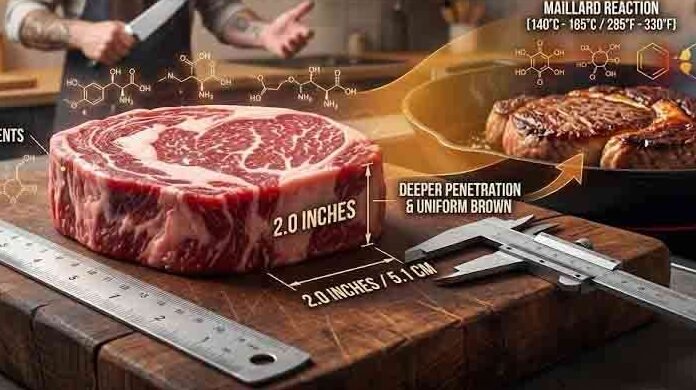
Every great butcher gives the same advice, and most home cooks hear it without truly understanding why: get the thick cut. Not 3/4 of an inch. Not one inch on sale. Two inches — the kind of cut that feels almost unreasonable in your hand, the kind that requires patience and a certain trust in fire and time. That recommendation isn’t aesthetic preference or upselling strategy. It is, at its core, a directive rooted in one of the most complex and consequential chemical reactions in all of culinary science — the Maillard reaction — and in the unforgiving physics of heat transfer through muscle tissue.
Understanding why thickness matters begins with understanding what the Maillard reaction actually is, and why the conditions required to achieve it are so difficult to satisfy on a thin piece of meat.
What the Maillard Reaction Actually Is (And What It Isn’t)
Named after French chemist Louis-Camille Maillard, who first described it in 1912 while attempting to reproduce biological protein synthesis, the Maillard reaction is a chemical interaction between amino acids and reducing sugars that produces melanoidins — the complex compounds responsible for the browned color, deep aroma, and savory flavor of seared meat. (Wikipedia, 2024)
It is not caramelization. That distinction matters. Caramelization is the pyrolysis of sugars under heat. The Maillard reaction involves both sugars and amino acids, and the resulting flavor compounds — pyrazines, furans, and thiophenes — are orders of magnitude more complex than simple caramelized sweetness. (The Flying Butcher, 2024) Where caramelization produces one note, the Maillard reaction produces a symphony.
As food scientist Kantha Shelke has noted, “the Maillard reaction produces complex, savory flavors, while caramelization yields a sweeter, caramel-like taste.” (Destination BBQ, 2025) This is the chemical architecture behind the difference between a steak that is merely cooked and one that is transformed.
The reaction begins at around 140°C (284°F) and accelerates rapidly in the range of 150–165°C (302–329°F). (BepBBQ, 2025) At temperatures above 218°C (425°F), the process shifts toward pyrolysis — actual burning — which produces bitter, acrid compounds rather than rich, savory ones. (Strata Cookware, 2025) The sweet spot, both literally and chemically, is narrow.
In beef specifically, the reaction is powered by glycogen — the form of stored energy found in muscle tissue, made of long chains of sugars. As Gabriel Keith Harris, Alumni Distinguished Undergraduate Professor of Food Science at NC State University, explains: “The thing that really makes a steak work in terms of Maillard is not just the protein, but the fact that it’s muscle, which contains glycogen… The heat of the grill splits the sugar chains in glycogen into individual sugars. Now you have these highly reactive amines on these proteins and you have sugars, and if the flame’s hot enough, you start splitting off amino acids from protein.” (NC State University, CALS)
The reaction also requires a dry surface. Water’s boiling point acts as a thermal ceiling — as long as moisture is present on the surface of the meat, the surface temperature cannot exceed 100°C (212°F), which is well below the Maillard threshold. A wet steak doesn’t sear; it steams. (Lone Mountain Wagyu, 2024) This is why every serious cook — from backyard grillers to Michelin-starred chefs — reaches for a paper towel before the cast iron ever heats up.
The Physics of Thickness: Why Two Inches Changes Everything
Here is where butcher wisdom and food science converge. The problem with cooking a thin steak is a problem of competing timelines. The surface needs to reach 150°C to initiate meaningful Maillard browning. The interior should not exceed roughly 54–57°C (130–135°F) for a proper medium-rare result. That is a 100°C gap between ideal surface and ideal center — and on a thin cut, the heat closes that gap faster than you can manage it.
Heat moves from the outside in. Always. When you place a steak on a ripping-hot cast iron pan, a steep temperature gradient forms immediately, with the exterior approaching sear temperatures while the interior begins its slower ascent. On a thin cut — 3/4 of an inch or less — there simply isn’t enough mass between the surface and the center to sustain that gradient long enough to develop a proper crust. By the time the surface achieves meaningful Maillard browning, the interior has already overcooked. The gray band — that ring of overdone, dry meat surrounding the desired rosy center — is the inevitable penalty. (The Science of Food, 2025)
A 2-inch cut changes the mathematics fundamentally. The greater thermal mass of a thick steak buffers the interior against rapid temperature rise, creating a crucial window — measured in minutes — during which the cook can develop a deep, complex crust on the exterior while the center remains in the target range. As the BBQ Report notes, the optimal thickness for most cooking methods is 1.75 to 2 inches: “thick enough to benefit from the technique, but not so thick that timing becomes challenging.” (BBQ Report, 2025)
Research from the Beef Research Council further supports this, noting that “Choice thick steaks cooked at low surface temperatures were shown to be juicier and more tender than Select thin steaks,” and that quality grade, thickness, and cooking temperature collectively determine the textural eating quality of the final result. (Beef Research Council, 2015)
The Role of Carryover Cooking and Thermal Mass
A concept that even experienced home cooks underestimate is carryover cooking — the continued rise in internal temperature after a steak is removed from the heat source. This occurs because the heat stored in the exterior of the meat continues propagating inward toward the thermal center, which is always the last point to reach temperature.
Thick steaks carry over significantly more than thin ones. As ThermoWorks explains: “Thick steaks like porterhouse or tomahawk have more thermal mass and more carryover.” (ThermoWorks, 2025) For a 2-inch cut finished over high heat, internal temperatures can continue rising 5–10°F after the steak leaves the pan. Understanding this means pulling the steak slightly earlier than the target doneness — a precision move that separates the merely competent from the genuinely skilled.
This physics is exactly why the reverse sear method has become the technique of choice among serious cooks for thick cuts. The process — low heat first (225–250°F oven or smoker) until the interior reaches within 10–15°F of target, followed by a violent sear on a preheated cast iron — exploits the thermal properties of thick meat rather than fighting them. The extended low-heat phase dries the surface, brings the interior to a precise temperature, and activates cathepsin enzymes that break down tough proteins. Then the final sear provides the burst of Maillard chemistry the surface needs. (Creekside BBQ, 2024)
On a thin steak, this technique is largely irrelevant. There isn’t enough mass to justify the two-phase approach. The steak cooks through before the surface can benefit from the extended low-heat phase. Thickness, in this context, is not a preference. It is a prerequisite.
Surface Preparation: The Science of the Dry Crust
Before the pan is ever heated, the preparation of the steak’s surface is itself a form of chemistry. Salt applied to the surface pulls moisture out via osmosis, and while that initial moisture is eventually reabsorbed into the meat (improving seasoning penetration), the surface-drying effect creates conditions more favorable to rapid Maillard browning. (Chemistry Is Life)
But the most direct method remains the simplest: a paper towel. Patting the surface dry before searing removes free moisture that would otherwise consume heat energy through evaporation rather than channeling it into the browning reaction. The “violent sizzling” when a steak hits a hot pan is the sound of surface moisture vaporizing — and if that sizzle persists too long, it signals that the cook is boiling the surface rather than searing it. (Medium / Wei Wang, 2024)
The ideal approach combines both: a generous salting at least an hour — ideally overnight — before cooking, followed by an uncovered rest in the refrigerator to dry the pellicle, and a final pat-dry immediately before the sear. On a 2-inch cut with sufficient thermal mass, this protocol produces a crust that is both deeply browned and structurally intact.
Pan Selection and Heat Management
The pan is not a neutral vessel. Its material properties directly influence the Maillard reaction. Cast iron’s value lies not in its thermal conductivity — which is actually lower than aluminum or carbon steel — but in its thermal mass: its ability to store large quantities of heat and release them slowly, without significant temperature drop when a cold piece of meat is introduced. (Strata Cookware, 2025)
When a steak hits a cast iron pan, the pan’s stored heat prevents the sharp temperature collapse that would occur in a thinner, less massive vessel. The surface of the steak stays dry and hot. The Maillard reaction proceeds without interruption. A thin aluminum pan, by contrast, drops temperature rapidly when cold meat is introduced, creating a window of steaming rather than searing before the heat can recover.
The optimal surface temperature for the sear is 350–400°F (177–204°C) — above the Maillard threshold, below the pyrolysis threshold. An infrared thermometer removes all guesswork from this calculation. (Live Science, 2014) A properly preheated cast iron skillet, allowed to heat dry for three to five minutes over high flame, will reliably land in this range.
Fat, Marbling, and the Flavor Architecture of the Sear
Thickness enables the Maillard reaction. But marbling — the intramuscular fat distributed throughout the muscle — determines the ceiling of that reaction’s flavor complexity. Fat is not merely a source of richness; it is a flavor carrier and a heat conductor. As marbled fat renders during the sear, it bastes the surface of the steak internally, distributing heat and contributing lipid-based aroma compounds that intertwine with the Maillard products to create the full sensory profile of a great sear.
This is why a well-marbled ribeye at 2 inches thick represents something close to the ideal searing candidate. The intramuscular fat renders rapidly under high heat, contributing to surface browning while simultaneously supplying the aromatics — aldehydes, lactones, and fatty acids — that define what we recognize as “beefy” flavor. A lean cut, however thick, will achieve the structural conditions for Maillard browning but lack the lipid complexity that makes the crust as much a flavor event as a textural one.
The Resting Phase: Why You Cannot Skip It
The final act of cooking a properly seared steak is the one most frequently skipped in impatience: the rest. After removal from heat, the muscle fibers of the steak — contracted and tightened by high temperature — begin to relax. The fluids that have migrated toward the exterior during cooking begin to redistribute toward the center. As The Science of Food explains, cooling “will thicken up the fluid left in the steak,” making the juices more viscous and less likely to flood the cutting board when the steak is sliced. (Science of Food, 2025)
For a 2-inch cut that has been properly seared, a rest of eight to ten minutes on a wire rack (not a cutting board, which traps steam and softens the crust) allows the internal temperature to stabilize, the crust to remain crisp, and the juices to set into a silkier, more cohesive texture. Cutting too soon is not simply a cosmetic failure — it is a flavor failure, pouring onto the plate the very complexity the Maillard reaction worked so hard to develop.
Thickness Is a Philosophy, Not Just a Measurement
What the butcher is really telling you, when they push the 2-inch cut across the counter, is something about the relationship between patience and outcome. Thin cuts are the domain of speed and convenience. They cook fast precisely because they can’t afford not to — the thermal window closes immediately, and the cook must act without hesitation or lose either the sear or the interior. There is skill in cooking thin, but there is no margin.
A 2-inch steak, by contrast, is the domain of deliberate craft. It demands proper surface preparation, a calibrated pan, a controlled sear, and the discipline to let the rest finish what the heat began. Every step matters because there are enough steps for mastery to reveal itself. The Maillard reaction doesn’t reward speed. It rewards precision — the same precision that separates a remarkable result from a merely adequate one in almost every discipline where heat, time, and raw material converge.
The chemistry was always there, waiting in the amino acids and the glycogen, in the cast iron and the flame. Thickness just gives it room to become what it was always capable of being.
Sources
- Wikipedia. Maillard reaction. https://en.wikipedia.org/wiki/Maillard_reaction
- Lone Mountain Wagyu. Cooking Wagyu Beef Using the Maillard Reaction. https://blogs.lonemountainwagyu.com/cooking-wagyu-beef-using-the-maillard-reaction
- Chemistry Is Life. The Chemistry of Steak. https://www.chemistryislife.com/the-chemistry-of-steak
- BepBBQ. What is the Maillard Reaction? How to achieve it when grilling meat or steak? https://bepbbq.com/en/what-is-the-maillard-reaction-how-to-achieve-it-when-grilling-meat-or-steak/
- The Flying Butcher. The Science of Meat: Understanding Maillard Reaction. https://www.theflyingbutcher.com/blog/understanding-maillard-reaction-for-better-grilling-and-roasting
- NC State University, College of Agriculture and Life Sciences. The Science of Steak on the Grill. https://cals.ncsu.edu/news/the-science-of-steak-on-the-grill/
- Destination BBQ. The Maillard Reaction. https://destination-bbq.com/glossary/maillard-reaction/
- PMC / National Institutes of Health. Effects of Searing Cooking on Sensory and Physicochemical Properties of Beef Steak. https://pmc.ncbi.nlm.nih.gov/articles/PMC6957442/
- ThermoWorks. Cooking Steaks Right: Thick vs Thin and Thermal Mass. https://blog.thermoworks.com/cooking-steaks-right-thick-vs-thin-and-thermal-mass/
- ThermoWorks. Steak Temperature Guide. https://blog.thermoworks.com/steak-temps-getting-it-right/
- ThermoWorks. Inside Temperature Gradients. https://blog.thermoworks.com/inside-temperature-gradients/
- BBQ Report. Reverse Sear Steak Guide. https://bbqreport.com/reverse-sear-steak-guide/
- Creekside BBQ. Mastering the Art of Reverse Sear. https://www.creeksidebbq.com/mastering-the-art-of-reverse-sear-juicy-tender-steaks-every-time/
- Strata Cookware. Debunking the Myth of the Blazing Hot Pan for a Great Sear. https://www.stratacookware.com/post/debunking-the-myth-of-the-blazing-hot-pan-for-a-great-sear
- Beef Research Council. Thermodynamics of Steaks. https://www.beefresearch.org/resources/product-quality/project-summaries/2011-2015/thermodynamics-of-steaks
- Live Science. How to Cook the Perfect Steak (with Science). https://www.livescience.com/44852-cook-perfect-steak-science.html
- The Science of Food. Anatomy, Heat and the Perfect Steak. https://scifood.blog/2025/01/04/the-science-behind-steak-achieve-steak-perfection-or-at-least-dont-suck/
- Medium / Wei Wang. The Science of Cooking Steaks. https://weiwang12.medium.com/the-science-of-cooking-steaks-cc140f825152