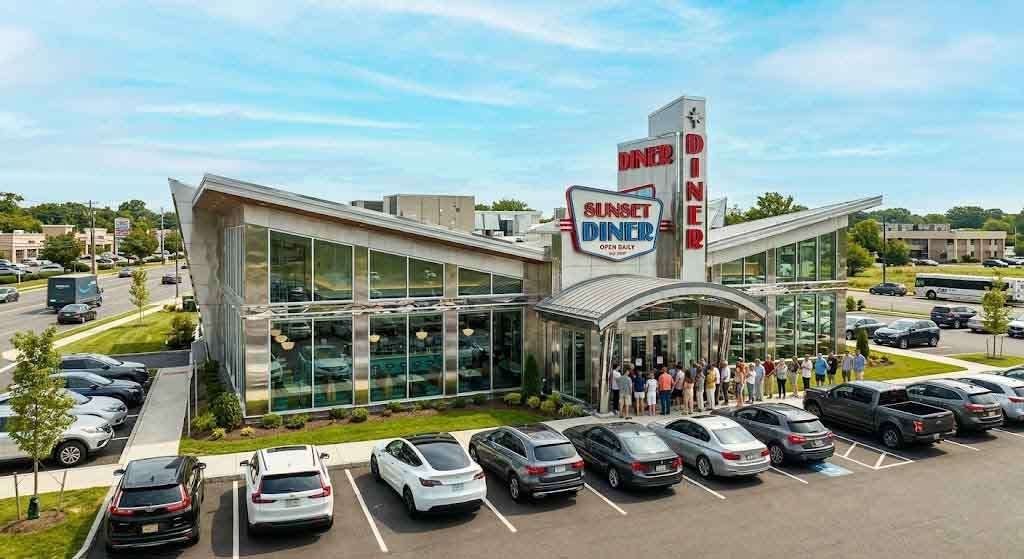
Tops Diner sits at 500 Passaic Avenue in East Newark, a small borough of roughly 2,600 people tucked between Newark and Harrison on the eastern bank of the Passaic River. Hudson County. Old industrial New Jersey. The building replaced itself in a $10 million renovation — four years of construction, the old Tops demolished, a 15,000-square-foot structure built in its place, an 18-stool counter topped with black marble, a terrazzo floor described by one reviewer as a work of art, a wraparound bar with a cocktail program, a vending machine stocked with actual Champagne for people celebrating things worth celebrating. None of that sounds like a diner. All of it still is one.
Time Out magazine called Tops the best diner in America in 2017. The claim is contested the way all such claims are contested — loudly, by people from other states, on the internet. But it points at something real. Tops is not a diner in the sense of a prefabricated O’Mahony unit from 1939. It is a diner in the sense of a specific American hospitality proposition: vast menu, generous portions, no pretense, open to everyone, operating seven days a week from eight in the morning to eleven at night, moving covers at a pace that would require a defibrillator at most fine-dining establishments.
The question worth asking is not whether Tops is the best diner in America. The question is how it actually works. Because the volume implied by the reputation — the two-hour waits on Sunday mornings, the 130 employees, the parking situation, the menu that runs to over 200 items — suggests a logistical operation that has more in common with a small manufacturing plant than with a grandmother’s kitchen.
The History Behind the Volume
Tops began in 1938 or 1942, depending on which source you trust, when a man named Jess P. Persson operated something called Tops Grill at the Passaic Avenue location. It is likely Persson had a mobile lunch wagon on or near the site before that. The Golemis family purchased the property in 1972 and has run it since — father George, then his sons — presiding over a series of expansions that culminated in the $10 million rebuild completed around 2021. Each expansion was a bet that more volume could be absorbed without the machine breaking down. Each bet has, apparently, paid off.
The history of the site is a compressed version of the history of the American diner generally: lunch wagon to fixed location to expanded fixed location to institution. What makes Tops unusual is that it completed this arc inside a single family’s tenure and reached the institutional phase without losing the essential diner identity — a feat that most places attempting similar volume accomplish only by becoming something else entirely.
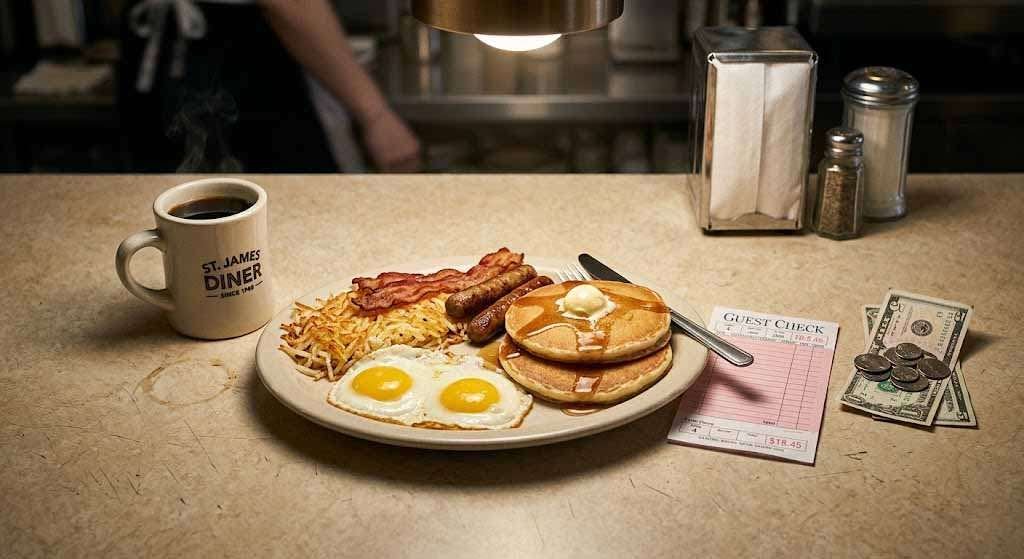
George’s Special is still on the menu: eggs, hash browns, bacon, sausage, two buttermilk pancakes. It easily feeds two people. It costs what it costs. It has been on the menu for decades because it is, in the language of the business, a vehicle. People who have never been to Tops before order it because it tells them what kind of place they’re in. People who have been fifty times order it because it’s what they order. The menu item is a contract.
The 200-Item Menu Problem
A normal high-functioning restaurant runs on discipline. The kitchen knows the menu. The line cooks have drilled the twenty or thirty dishes they produce until the execution is muscle memory. Prep lists are tight. Waste is minimized. The fewer the dishes, the cleaner the operation.
Tops has over 200 items on the menu.
This is, from an operational standpoint, either insane or a specific kind of genius, and the difference between those two things is whether you can actually execute it. The menu at Tops covers traditional diner territory — egg platters, pancakes, French toast, BLTs, burgers, club sandwiches, soups, salads, corned beef hash, disco fries — and then keeps going into territory that most diners would never attempt: lobster mac and cheese with Canadian hard-shell lobster in a cognac-laced sauce with Grana Padano, fontina, and sharp Vermont cheddar; ahi tuna tacos; grilled halibut with shrimp; shrimp and grits; Nutella French toast; a Caesar salad that gets ordered by people who came for eggs and ended up somewhere else.
The Food Network featured the lobster mac and cheese on Top 5 Restaurants. That a diner has a signature dish that requires cognac and three imported cheeses is either a category violation or a category expansion, depending on how firmly you believe categories matter.
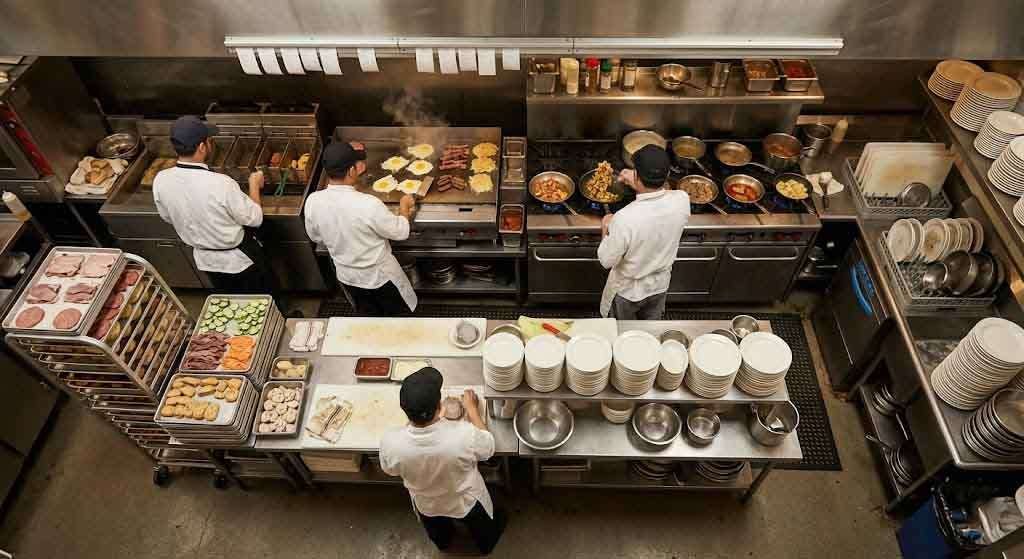
What the 200-item menu requires, practically speaking, is massive prep infrastructure. The cold storage alone for a menu with this range — multiple proteins, seasonal vegetables, specialty cheeses, fresh desserts and pastries made on premises — represents a capital investment and a daily labor cost that most diners never approach. The kitchen is not cooking to order in the sense of a small restaurant where the chef improvises from available ingredients. It is executing a highly systematized production schedule. Mise en place at Tops on a Friday morning is not mise en place at your local Greek diner. It is a logistics operation.
What Sunday Morning Actually Looks Like
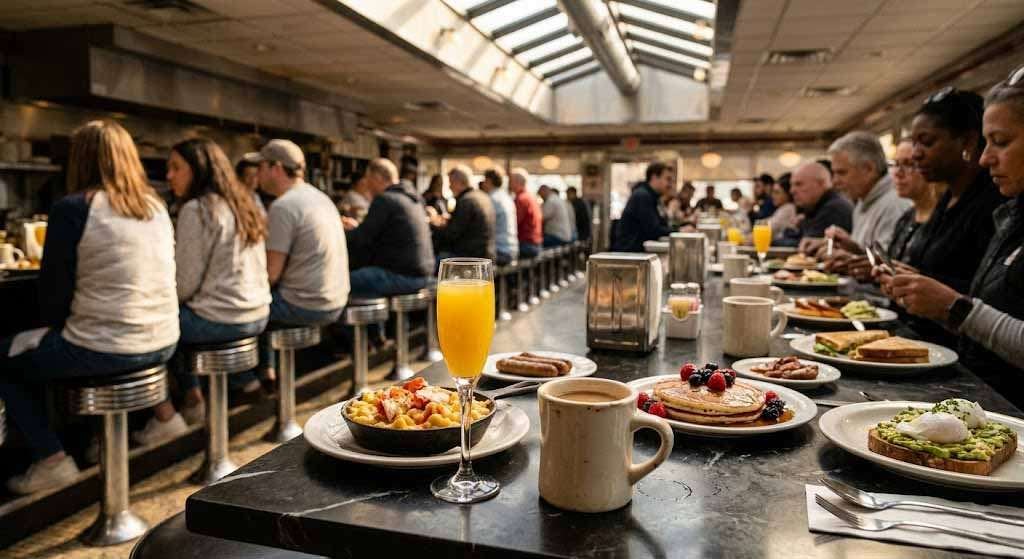
On weekends, Tops runs waits of up to two hours. They take reservations — unusual for a diner — and even with reservations, the flow of people requires active management. The 15,000-square-foot interior seats a substantial number, but the throughput required to generate the volume that Tops generates means table turns have to be efficient even when the food is abundant enough to slow people down.
Run the math backwards from a busy Sunday. If the dining room has, say, 200 seats — a rough figure for a 15,000-square-foot operation with a bar component — and the average check per head runs somewhere between $18 and $30 depending on whether you had a cocktail and dessert, and you turn the room three times over a brunch service that runs from eight a.m. to early afternoon: that is somewhere between $10,000 and $18,000 in a single service, before dinner. Seven days a week. Plus the bar revenue. Plus catering.
Nobody publishes Tops’s actual revenue figures. But the reputation, the staffing (130 employees is not a diner number — it is a hotel restaurant number), the renovation investment, and the sustained waits all point toward an operation generating well above what any ordinary diner produces. The machinery required to maintain that is invisible to anyone sitting in a booth eating a George’s Special, which is exactly the point.
The New Jersey Monthly observed that Tops may be one of the few diners that takes reservations. This is accurate and understated. Taking reservations at a diner is not a quirk. It is a signal that the volume of demand exceeds the capacity to serve it on a walk-in basis. Tops is so busy that it needs to pre-allocate its own seats.
The Menu Creep and What It Reveals
The lobster mac and cheese did not appear on the original Tops menu. Nothing did, because the original menu was a working lunch wagon’s menu. The evolution from fried eggs and coffee to lobster in cognac sauce represents something worth naming: menu creep, which is what happens when a restaurant builds enough volume to take creative risks and enough reputation to attract customers who will pay for those risks.
Menu creep is how diners lose themselves. The addition of the upscale item is not, in itself, the problem. The problem is when the upscale item becomes the identity and the patty melt becomes the afterthought. At Tops, this conversion has not happened — the traditional items remain central, the portions remain large, the prices remain accessible relative to what you’re getting. But the presence of Champagne in a vending machine and cognac in the mac and cheese signals something about who Tops is now competing with for the customer’s dollar and attention.
It is no longer competing only with other diners. It is competing with brunch restaurants in Hoboken, with hotel dining rooms in Newark, with any mid-priced full-service operation in the metropolitan area that has a decent cocktail program and table service. This competition changes the pressure on the kitchen, the training requirements for the staff, and the expectations management has to manage every morning when the doors open.
The Golemis family built something that outgrew the category it started in. That is not a criticism. It is a description of what ambition and longevity produce when the economics keep working.
The Factory Floor Below the Terrazzo
The terrazzo floor is beautiful. The black marble counter is beautiful. The cocktail bar is, by all accounts, genuinely good. Tops has a mimosa program. Tops has a vibe, in the current sense of that word, that extends well beyond the institutional fluorescence of a traditional working diner.
Below the terrazzo, figuratively, is a production operation that runs like a factory. A hundred and thirty people across all shifts. Prep that starts before the dining room opens. A pastry operation that produces all desserts in-house. A protein program that handles everything from the eggs (thousands of them, weekly) to the Canadian lobster. A reservation system. A catering division. A parking infrastructure that the $10 million renovation specifically addressed.
Most diners I know — and I have spent twenty-five years watching how they operate — run on controlled chaos. The cook who has been there fifteen years knows the shortcut. The waitress who has worked every shift for a decade knows which booth seats the regulars and which table wobbles. Institutional knowledge substitutes for systems. This works until the volume gets high enough that institutional knowledge cannot hold the operation together without some scaffold of actual process.
Tops is past the point where informal knowledge suffices. At 130 employees and 200 menu items and two-hour Sunday waits, you are running systems. You are managing labor scheduling with the rigor of a mid-size manufacturing operation. You are handling food cost at a scale where a percentage point of waste is real money. The romance of the diner — the short-order cook who knows every regular, the owner who walks the floor and knows the names of the dishwashers — is still there at Tops, visible in the reviews and the loyalty of the customer base. But it is supported, invisibly, by infrastructure that would not look out of place in a restaurant group running six locations.
This is the industrialization of the omelet. Not a pejorative. A description of what happens when a good thing scales without breaking.
You Might Also Like:
- Heritage Diner Disco Fries: New Jersey Classic with a Long Island Diner Finish
- How to Build the Perfect Diner Breakfast Platter — Step-by-Step Assembly Guide
- The Flour Beneath the Bread: What Goes Into a Proper Sourdough Loaf
Sources:
- Jersey Bites — Tops Diner: The Best, Made Better: https://jerseybites.com/2022/03/tops-diner-the-best-made-better/
- New Jersey Monthly — Tops Diner in East Newark Is a True Destination Diner: https://njmonthly.com/articles/restaurant-reviews/tops-diner-east-newark/
- Food Network — Tops Diner: https://www.foodnetwork.com/restaurants/nj/tops-diner-restaurant
- Yelp — Tops Diner: https://www.yelp.com/biz/tops-diner-east-newark
- OpenTable — Tops Diner: https://www.opentable.com/r/tops-diner-east-newark-2
- WOBM — New Jersey Gem Named One of America’s Best: https://wobm.com/tops-diner-new-jersey/