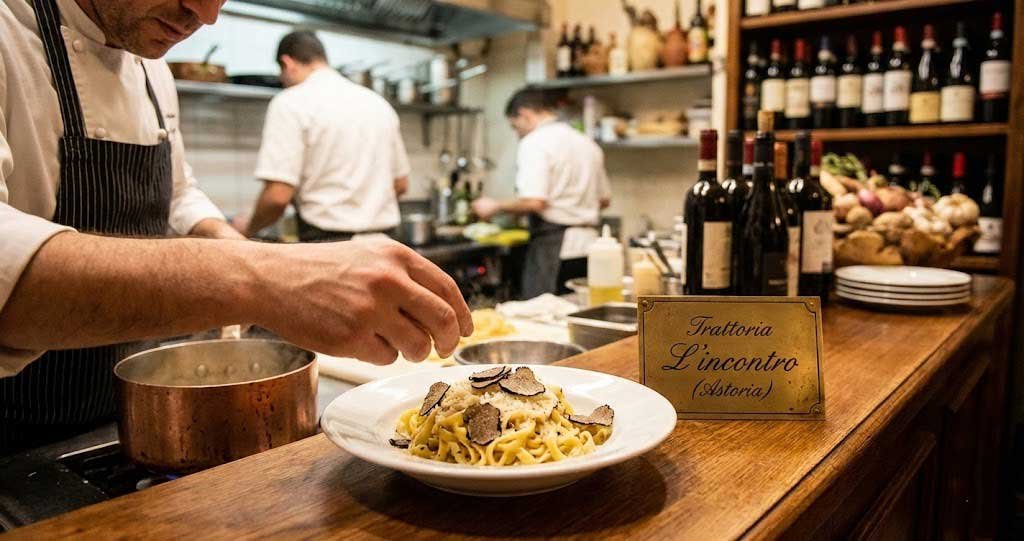
Somewhere between the hand-painted murals of Orsogna and the earpiece-wearing waitstaff reciting thirty daily specials from memory, Rocco Sacramone built something that transcended the word “restaurant.” For a quarter century on 31st Street in Astoria, Trattoria L’incontro operated less as an Italian eatery and more as a living thesis on what happens when an immigrant dishwasher’s obsession with his mother’s cooking collides with an entire borough’s hunger for authenticity. Now reborn on Manhattan’s Upper East Side as L’incontro by Rocco, the institution carries forward a legacy that Zagat once ranked third among every Italian restaurant in New York City — tying it with the Four Seasons and La Grenouille (Zagat Guide, 2004). That kind of company doesn’t come from marketing. It comes from decades of refusing to cut corners on a single plate of pasta.
I know something about that refusal. Twenty-five years behind the griddle at The Heritage Diner in Mount Sinai has taught me that the places which endure — whether a diner on Route 25A, a leather workshop in Huntington, or a trattoria in Queens — share an identical DNA: relentless attention to the details that most customers will never consciously notice but will always feel. Chef Rocco understood this from the moment he opened his doors in 1999, and it’s exactly why people wept over their rigatoni on his final night in Astoria.
From Orsogna to Astoria: The Making of a Chef
Rocco Sacramone was born in Orsogna, a small hilltop town in the Abruzzo region of central Italy, and came to the United States in 1970 (L’incontro by Rocco, 2024). His culinary education began not at a prestigious academy but at a sink — washing dishes in an Italian restaurant at age fourteen. His mother, Tina, became his first and most important teacher, passing down the recipes and techniques of their Abruzzese homeland with the seriousness of a master instructing an apprentice. That maternal transmission of knowledge — the understanding that food is not fuel but language, not product but inheritance — became the philosophical foundation of everything L’incontro would become.
Sacramone moved through the restaurant industry methodically, advancing from dishwasher to management, absorbing the operational complexity of front-of-house service, supply chain logistics, and kitchen brigade discipline. By the time he opened Trattoria L’incontro on Ditmars Boulevard in 1999, he possessed something that culinary school alone cannot provide: a complete understanding of the restaurant organism from the loading dock to the dessert course. His mother, Tina, joined him in the kitchen from day one, overseeing preparation work and ensuring that the traditional recipes survived their translation to a commercial kitchen. She also made the fresh pasta by hand — a detail that alone separated L’incontro from a hundred competitors (Queens Scene, 2019).
The name itself declared an intention. “L’incontro” translates to “the meeting” in Italian. Sacramone wasn’t opening a place to eat. He was opening a place to convene, to reconnect, to conduct the ancient Italian ritual of gathering around a table where the food matters as much as the conversation it inspires. In my own experience running The Heritage Diner, I’ve seen how that philosophy — the restaurant as Third Place, as the sociologist Ray Oldenburg would call it — is what separates businesses that last a generation from those that last a season.
The Astoria Institution: Twenty-Five Years on 31st Street
What Sacramone constructed inside a storefront off Ditmars Boulevard defied the modest expectations that the word “trattoria” might suggest. The dining room seated approximately two hundred, with high ceilings adorned with hand-painted murals depicting scenes from Orsogna, executed by local artists. An open brick oven anchored the space visually and functionally. A private dining room accommodated up to thirty-five guests, and a secondary room could handle sixty-five — making L’incontro a destination for christenings, anniversaries, business dinners, and the kind of multi-generational family gatherings that define Italian-American life in Queens (Trattoria L’incontro, 2022).
The operational sophistication was remarkable. Waitstaff wore earpieces — a detail that amused food critics but served a genuine purpose, allowing the kitchen to communicate real-time updates on the revolving roster of daily specials. On any given evening, a server might recite more than two dozen off-menu dishes from memory, each one a reflection of whatever Sacramone had sourced that morning from his network of purveyors. The signature Mezza Luna Ravioli — pillows of fresh pasta stuffed with mascarpone and pesto, finished with asparagus, brandy, and walnut sauce — became a permanent fixture. But it was the specials that turned first-time visitors into regulars, because they proved the kitchen was alive, improvising, responding to seasons and markets rather than running on autopilot.
Zagat recognized this with their highest food rating, a designation described as “extraordinary to perfection,” placing L’incontro third among all Italian restaurants in New York City — a ranking that put an Astoria trattoria in the company of Manhattan’s most storied dining rooms (Queens Scene, 2019). The Michelin Guide subsequently included L’incontro in its New York City selections, and the restaurant appeared on the cover of Queens Scene magazine more frequently than any other establishment in the neighborhood (Queens Scene, 2020).
The Pandemic, the Snowstorm, and the Barstool Fund
When COVID-19 shuttered indoor dining in New York City in late 2020, L’incontro was hit with the same existential crisis facing every full-service restaurant in the five boroughs. Sacramone’s staff shrank from over forty employees to five. Business plummeted by roughly seventy percent. The restaurant limped along on takeout, delivery, and the severely limited outdoor seating that the city’s regulations permitted during winter months (NY1, 2021).
Then came the snowstorm. In December 2020, Sacramone filmed himself and his remaining staff seated at an outdoor table on the sidewalk, eating dinner as snow piled around them. The video was not a stunt — it was a protest, a visceral demonstration of the absurdity of mandating outdoor dining in a New York winter while prohibiting the indoor service that restaurants like his were engineered to provide. The footage went viral almost immediately (Astoria Post, 2020).
Dave Portnoy, the founder of Barstool Sports, saw the video. The next day, he visited L’incontro, sat down with Sacramone for a curbside lunch, reviewed the restaurant’s brick-oven pizza — awarding it an 8.4 on his widely followed One Bite scale — and then mobilized his audience. Through The Barstool Fund, which was raising millions for pandemic-stricken small businesses across the country, Portnoy directed $100,000 to Trattoria L’incontro within days (Patch, 2020). Sacramone distributed $1,000 bonuses to each of his employees just before Christmas. He was subsequently featured on the Wendy Williams Show during NYC Restaurant Week, bringing national visibility to a story that resonated far beyond Astoria (Broadway Stages, 2021).
I followed that story closely from Mount Sinai, because the struggle was identical to what every independent restaurant operator was living through. The difference between Sacramone and the thousands who didn’t make it wasn’t luck — it was that his twenty-year investment in community had created the kind of loyalty that makes strangers rally to your cause. The Barstool Fund didn’t save L’incontro. The quarter-century of bear hugs, complimentary focaccia, and handmade pasta that preceded it did.
The Menu: Abruzzese Tradition Meets Modern Ambition
Sacramone’s culinary philosophy has always operated on a dual track: honoring the Abruzzese tradition he inherited from Tina while pushing into contemporary interpretations that keep the menu intellectually alive. His Pomodoro sauce, for instance, uses “tomato water” extracted from slow-cooked Campari tomatoes rather than a conventional thick tomato base — a technique that produces a lighter, more nuanced foundation for pasta dishes (New York Lifestyles Magazine, 2024).
The permanent menu reads like an education in Italian-American cooking at its highest register. Brick-oven pizza. Spaghetti with meatballs executed with the precision of a fine-dining kitchen. Chicken parmigiana and veal with lemon and capers. Grilled branzino, offered whole or as a filet. The Pasta Fagioli A Moddo Mio — Sacramone’s personal riff on the classic — replaces the typical heavy, soupy version with tubettini pasta in a silky purée of white kidney beans with fresh escarole, shrimp, and truffle oil. The Cenia All’Abruzzese — black sea bass topped with tomato sauce, capers, olives, and red peppers — is a direct transcription of a Sacramone family recipe that dates back to Orsogna (Aplez, 2022).
At the new Upper East Side location, the kitchen has expanded its repertoire with dishes like Polpette di Cinghiale — wild boar meatballs in a rich mushroom sauce finished with truffle oil — and Spaghettone Nduja, featuring house-made spaghetti with spicy nduja, burrata foam, and shrimp. The egg yolk ravioli with black truffle has emerged as a particular standout, and the ricotta gnocchi with Parmigiano and a whisper of truffle continues to draw devoted repeat visitors (Taste With Aron, 2025).
All pasta is made on premises. That single fact — which sounds unremarkable until you understand how few restaurants with two-hundred-seat capacities actually commit to it — explains more about L’incontro’s reputation than any critic’s paragraph ever could.
Community, Charity, and the Sacramone Standard
Sacramone’s impact on Astoria extended well beyond the dining room. He maintained an active partnership with Mount Sinai Queens, hosting free heart-healthy cooking classes alongside the hospital’s registered dietitians as part of their community health education outreach (QueensBuzz, 2013). These events weren’t promotional exercises — they were genuine educational programs where Sacramone demonstrated how to prepare nutritious meals using the same techniques and standards he applied in his professional kitchen.
Every year, Sacramone and his wife Debbie organized charitable donations, including hand-delivering thirty frozen turkeys to The Child Center of NY’s Early Childhood Center in Astoria before the holidays. Debbie also provided one hundred stuffed animals for the children (The Child Center of NY, 2022). The Queens Scene featured L’incontro on its cover more than any other establishment — a distinction earned not through advertising but through the kind of sustained community engagement that made Sacramone as much a neighborhood figure as a restaurateur.
This is something I recognize deeply from my own work. At The Heritage Diner, and in my craft at Marcellino NY, the businesses that survive aren’t the ones with the best marketing budgets — they’re the ones that have woven themselves into the social fabric of the community. Rocco Sacramone didn’t just feed Astoria. He belonged to it.
The Move to Manhattan: L’incontro by Rocco
In May 2024, after a rent increase made the economics of the massive Astoria space untenable, Sacramone made the bittersweet decision to close 31st Street and relocate to Manhattan. The final service on May 26, 2024, was an emotional affair — regulars who had been dining there for over two decades came to say goodbye, and more than a few tears were shed alongside the last plates of Mezza Luna Ravioli (Astoria Post, 2024).
L’incontro by Rocco opened on June 4, 2024, at 1572 Second Avenue on the Upper East Side, between 81st and 82nd Streets. The space — formerly occupied by Prime Butcher — has been transformed into something deliberately more intimate than the Astoria original. Where L’incontro once seated two hundred, the new room accommodates approximately eighty-five across thirty-four tables and bar seating. The design is sleek and modern: dark-countered bar, a striking bubble chandelier, blush banquettes set against dark metal wine racks, and a cozy VIP-style booth upholstered in velvety gray (East Side Feed, 2024).
Sacramone has described the new concept as “modern with a rustic twist,” and the reception has been overwhelmingly positive. OpenTable reviewers consistently praise the handmade pastas, the nightly specials, and the personal attention Sacramone still provides by making rounds to every table in the dining room — a habit that has followed him faithfully from Queens to Manhattan (OpenTable, 2025).
The Meaning of “The Meeting”
Rocco Sacramone once told a reporter that his success is measured by one metric: whether customers leave his restaurant with smiles (New York Lifestyles Magazine, 2024). It’s a deceptively simple statement from a man whose career has included Zagat’s highest food rating, Michelin recognition, a viral pandemic protest that became a national news story, and the construction of two entirely distinct restaurant concepts across two boroughs. But simplicity, when it’s earned through decades of uncompromising execution, is not the same as naivety. It’s wisdom.
“L’incontro” means “the meeting.” And what Sacramone has spent twenty-five years proving is that the most meaningful meetings in human life — the ones that mark births and mourn losses, that seal business deals and celebrate love, that reconnect old friends and welcome strangers into the fold — require a particular kind of space. Not a space that’s merely decorated well or stocked with expensive ingredients, but one where the person running it cares enough to emerge from the kitchen, embrace you, and make you feel like the most important guest in the room.
From the Heritage Diner’s counter to Marcellino NY’s stitching bench, I’ve built my own life around that same conviction: that the unseen details — the hand-stitched seam, the properly seasoned griddle, the tomato water reduced from Campari tomatoes — are what separate craft from commerce. Rocco Sacramone is a master of those details, and L’incontro, in any borough, remains one of the finest Italian restaurants in New York City.
L’incontro by Rocco 1572 Second Avenue (between 81st & 82nd Streets) New York, NY 10028 Phone: (718) 721-3532 Website: lincontrobyrocco.com Reservations: OpenTable Hours: Tuesday–Sunday, 4:30 PM – 10:30 PM | Monday Closed
Former Astoria Location (Closed May 2024) 21-76 31st Street, Astoria, Queens, NY 11105