 275 Route 25A, Mt Sinai, NY 11766


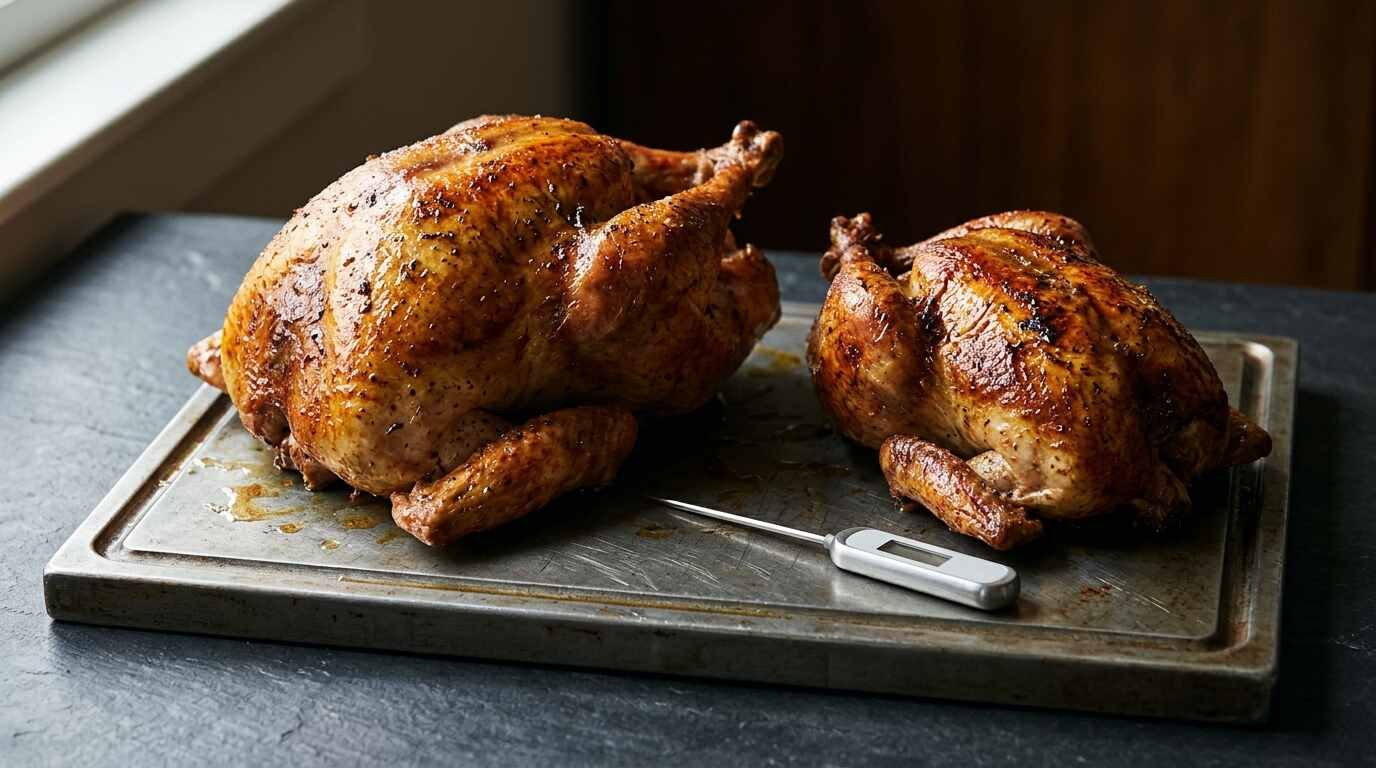
A 10-pound turkey in a 325 °F oven needs 2¾ to 3 hours, according to the roasting timetable from the USDA Food Safety and Inspection Service. Put a 20-pound bird in the same oven and the same table asks for roughly 4½. Twice the meat buys about half again the time. Set those two lines side by side on Thanksgiving morning and the arithmetic looks like a misprint.
It didn’t. The gap between those two numbers is geometry, and a particle physicist turned it into a one-line formula for his own holiday table. In 2021 the formula went through a heat-transfer model and into a peer-reviewed physics journal.
The physicist who refused 30 minutes a pound
A lab director, a stuffed bird, and a constant found by trial.
The formula belongs to W.K.H. “Pief” Panofsky, Director Emeritus of SLAC. His grandson, Nicholas Panofsky, told the story as a piece of family lore in a short item that first ran in SLAC Today and was reposted by Symmetry magazine in November 2008. The elder Panofsky had no patience for the old rule of 30 minutes per pound. As his grandson relayed it, he held that “the time a turkey should be cooked is not a linear equation.”
What he wrote down instead was this: t = W^(2/3) / 1.5. Time comes out in hours, weight goes in as pounds, and the rule was written for a stuffed turkey in a 325 °F oven. Symmetry reports that he built it from the ratio of the bird’s surface area to its mass, and that the 1.5 was settled empirically rather than derived.
Run the old linear rule on a 20-pound bird and it calls for ten hours. That is not a roast. That is a double shift.
Panofsky’s version gives about 4.9 hours for the same turkey. For a 10-pound bird it gives about 3.1. The ratio between them is 2 raised to the two-thirds power, which works out to 1.59. Doubling the weight multiplies the time by a little under 1.6, and that single exponent is the whole argument of this piece.
Heat walks in from the skin
Weight is counted in cubes. Cooking time is counted in the distance to the middle.
An oven does not heat a turkey all at once. It heats the outside, and the outside slowly hands that heat inward, layer by layer, the way warmth creeps along a cold iron pipe from the end held over a torch. Physicists call that conduction, and the equations for it are old. A 1999 column by the science writer Edward Willett traced turkey roasting back to H.S. Carslaw and J.C. Jaeger’s 1947 textbook Conduction of Heat in Solids, and pulled out the one result that matters at the counter: for an idealized spherical turkey, the time for heat to reach the center “is proportional to the square of the radius.”
That squared term is the engine. Greg Blonder, who writes about food science on his site Genuine Ideas, makes the same point about any solid food: a rule built on diffusion predicts that cooking time grows with the thickness of the food squared. Double the thickness of a steak and the heat needs about four times as long to reach the middle.
Now the second half. Weight tracks volume, and Willett’s column notes that the mass of a sphere goes up with the cube of its radius. Flip that around and the radius grows only as the cube root of the weight. Put the two together and the weight’s exponent becomes one third times two, which is two thirds. Out of a ball of meat and a heat equation falls Panofsky’s formula, exponent and all.
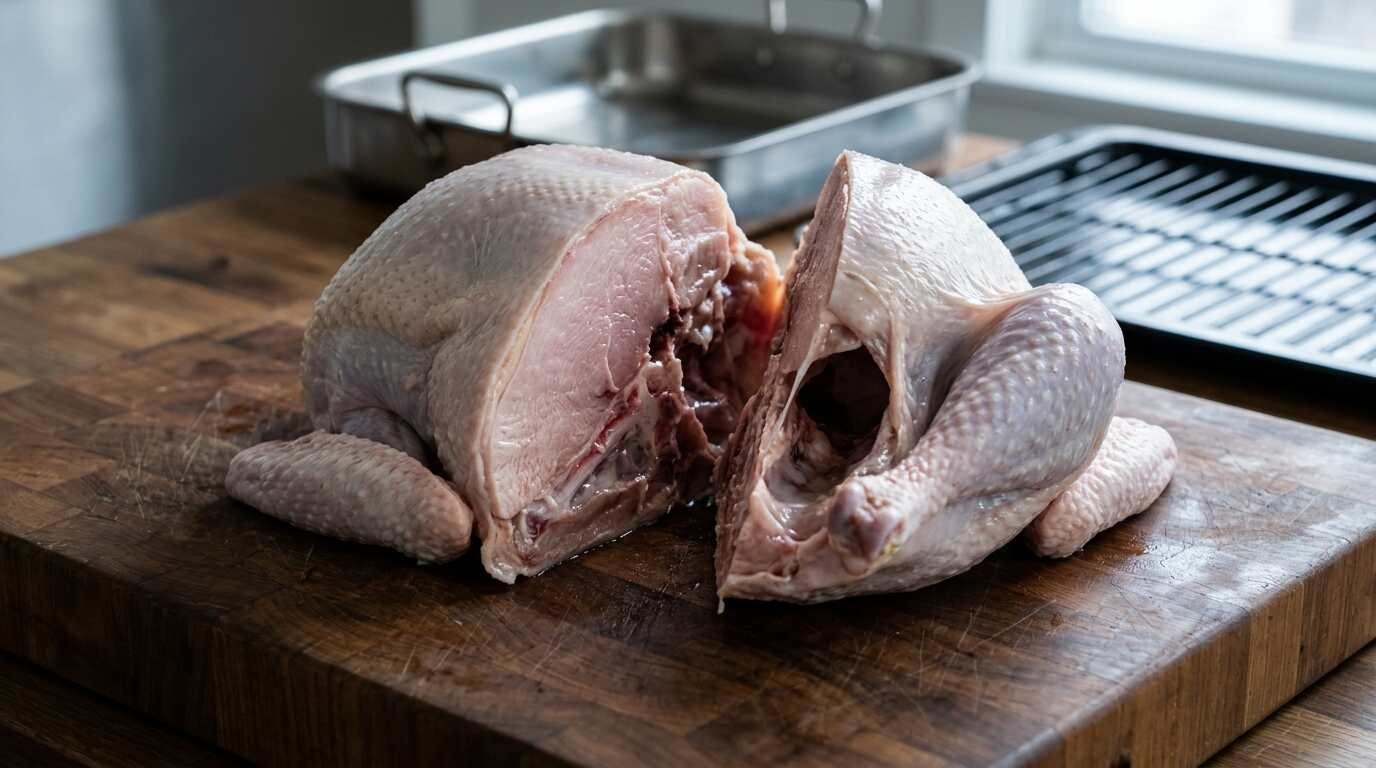
Symmetry’s surface-area framing is the same idea seen from the skin side. Surface area grows with the square of the radius, volume with the cube, so a bigger bird has less skin per pound to drink heat through. It also has less distance to cover than its weight suggests. Double a turkey’s weight and the center sits only about 26 percent farther from the skin, because the cube root of 2 is about 1.26. Square that 1.26 and the time comes to roughly 1.59 times as long. A 20-pound turkey is not two 10-pound turkeys welded together. It is one 10-pound turkey wearing a thicker coat.
The oven already knew
Five lines of Python against a federal chart.
Nothing about the USDA table presents itself as physics. It is a set of weight brackets and time ranges, the kind of thing taped inside a cabinet door. So the obvious test is to ask the chart what exponent it is hiding.
The FSIS page prints two timetables at 325 °F. The first runs from a 4-to-8-pound breast at 1½ to 3¼ hours up to 20-to-24-pound birds at 4½ to 5 hours. Taking the midpoint of every bracket (10 pounds and 2.875 hours for the 8-to-12 row, for instance) and fitting a power law, time = a × weight^b, on logarithmic axes gives a clean answer. Across the five whole-bird rows, 8 to 24 pounds, the exponent comes out at 0.649. Panofsky’s two thirds is 0.667.
A gap of 0.018. Nobody at the agency had to agree with a physicist for that to happen; the brackets fell into line on their own, the way a line cook who never sat through a chemistry class still knows when the oil is ready by the sound. The fit is tight too, with 99.5 percent of the variation in log time explained by log weight, and the fitted curve lands within about 2.5 percent of every midpoint.
Without any help, the chart also answers the question in the title. Its 8-to-12-pound row centers on 2.875 hours. At 20 pounds, where one bracket ends and the next begins, it reads 4½ hours. That is a ratio of about 1.57, against the 1.59 that the two-thirds rule predicts. The oven already knew.
Turkey time at the diner works on the same principle as everything else on a busy grill, and anyone who has read what a short-order cook knows about timing will recognize it: the thick thing goes on first, and it does not go on for twice as long just because it is twice as heavy.
Where Panofsky’s constant lands
The exponent holds. The 1.5 is where the arguing starts.
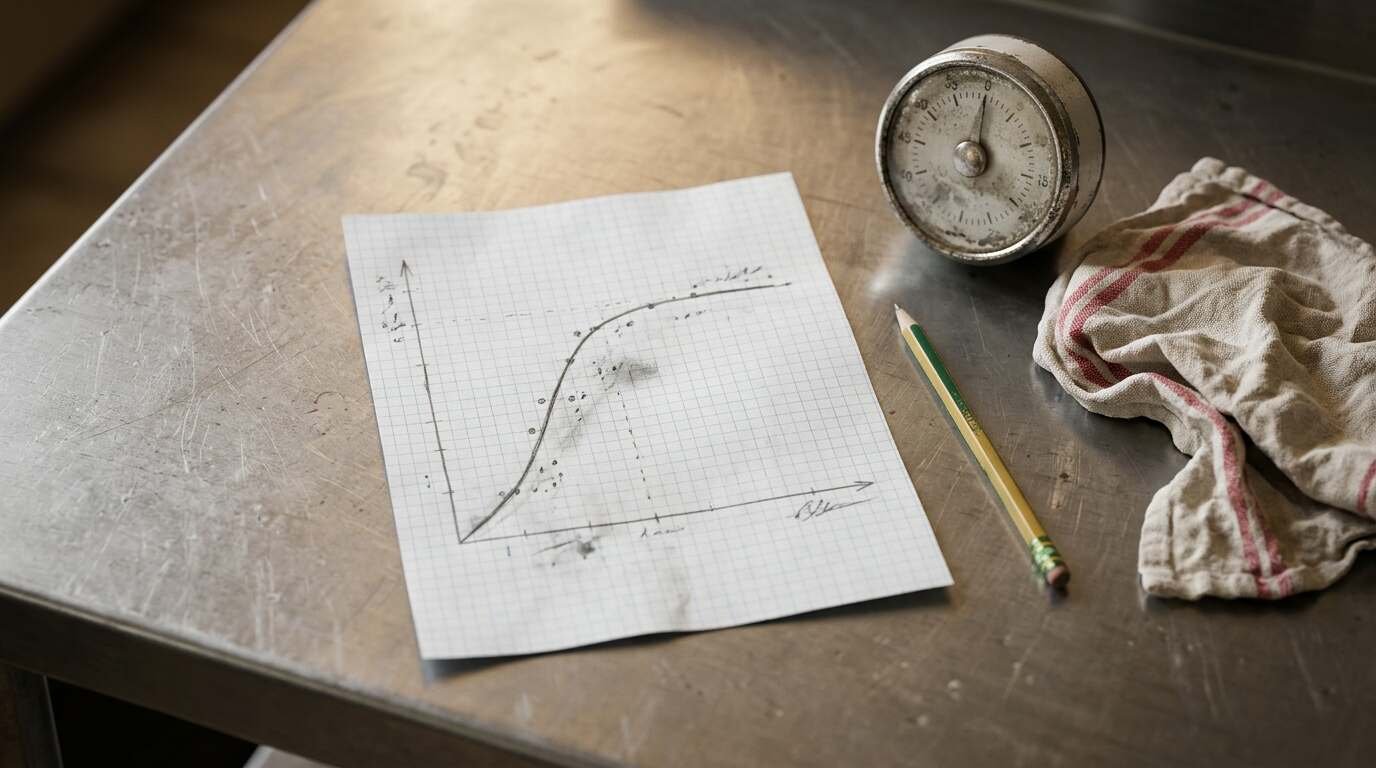
Plotted against the first USDA table, Panofsky’s formula runs high. At 16 pounds it predicts 4.23 hours where the chart’s 14-to-18 bracket centers on 4.0, and the overshoot grows to about 10 percent at 22 pounds. Against the second, longer table, his numbers sit within about 6 percent from 10 to 22 pounds. That fits his own conditions, since he wrote the rule for a stuffed bird, though the FSIS page as fetched for this piece did not label which of its two tables is which, so the match is an observation and not a verdict.
Taking the constant apart fell to the 2021 paper. Writing in AIP Advances, Yifei “Jenny” Jin, Lisa R. Wang and Jian Jim Wang derived Panofsky’s rule under a set of approximations and then generalized it to T = (1/P) × W^(2/3), naming P the “Panofsky constant.” In a related abstract for the American Physical Society’s March Meeting 2022, two of the authors, listed there with The Pennington School and Phillips Academy Andover, describe modeling the bird as a sphere and solving the heat-transfer equation numerically. They conclude that the generalized formula “can be perfectly applied to all turkey baking scenarios.”
A catch sits in the same paper. According to the journal abstract indexed by DOAJ, P is 1.5 in Panofsky’s original, but across thermal properties and baking conditions it can range from about 1.1 to about 1.9.
That range is not small. For a 16-pound turkey, W^(2/3) is about 6.35. Divide by 1.9 and the bird is done in about 3.3 hours. Divide by 1.1 and it needs about 5.8. The exponent is a law of geometry. The constant is a negotiation between the oven, the bird and whoever keeps opening the door.
The case against the spherical turkey
A bird is not a ball, and the breast row proves it.
There is a soft spot in the fit, and it shows up in the first row of the chart. Add the 4-to-8-pound breast to the whole birds and the fitted exponent drops from 0.649 to 0.552. Fit the second table, breast row excluded, and it comes out at 0.531. A boneless or bone-in breast is not a scaled-down turkey. It is a different shape, flatter, with no cavity and no legs sticking out into the hot air, and the two-thirds rule only works when the shape stays the same as the size changes. Willett’s spherical turkey and the paper’s spherical model are honest about this: they are approximations, and the actual animal is built more like a duffel bag with drumsticks.
Blonder adds a second complaint. On the same page where he lays out the thickness-squared rule, he warns that “in reality that rule breaks down below an inch or so in thickness,” and he walks through why real cooking times are hard to predict at all: evaporation cools the surface as moisture leaves it, and meat tends to stall at around 150 °F while that cooling fights the oven. None of that appears in a formula with one weight and one constant.
Then there is the argument that the whole bird is the problem. A Daily Mirror piece, republished on inkl, reports that University of Bristol physicist Peter Barham considers the ideal approach to be cutting the turkey up and cooking each part separately at the temperature that suits it, since white and dark meat want very different amounts of heat. The same article cites Panofsky’s surface-area formula and then muddles it, printing the division by 1.5 and describing a multiplication by 1.13 in the next breath.
So the physics wins the argument about the exponent and loses the argument about the table. The math explains why the 20-pound bird finishes at hour four and a half instead of hour six. It does not explain why one 16-pound bird is done at 3½ and the neighbor’s takes 5.
The thermometer gets the last word
165 °F, measured, not predicted.
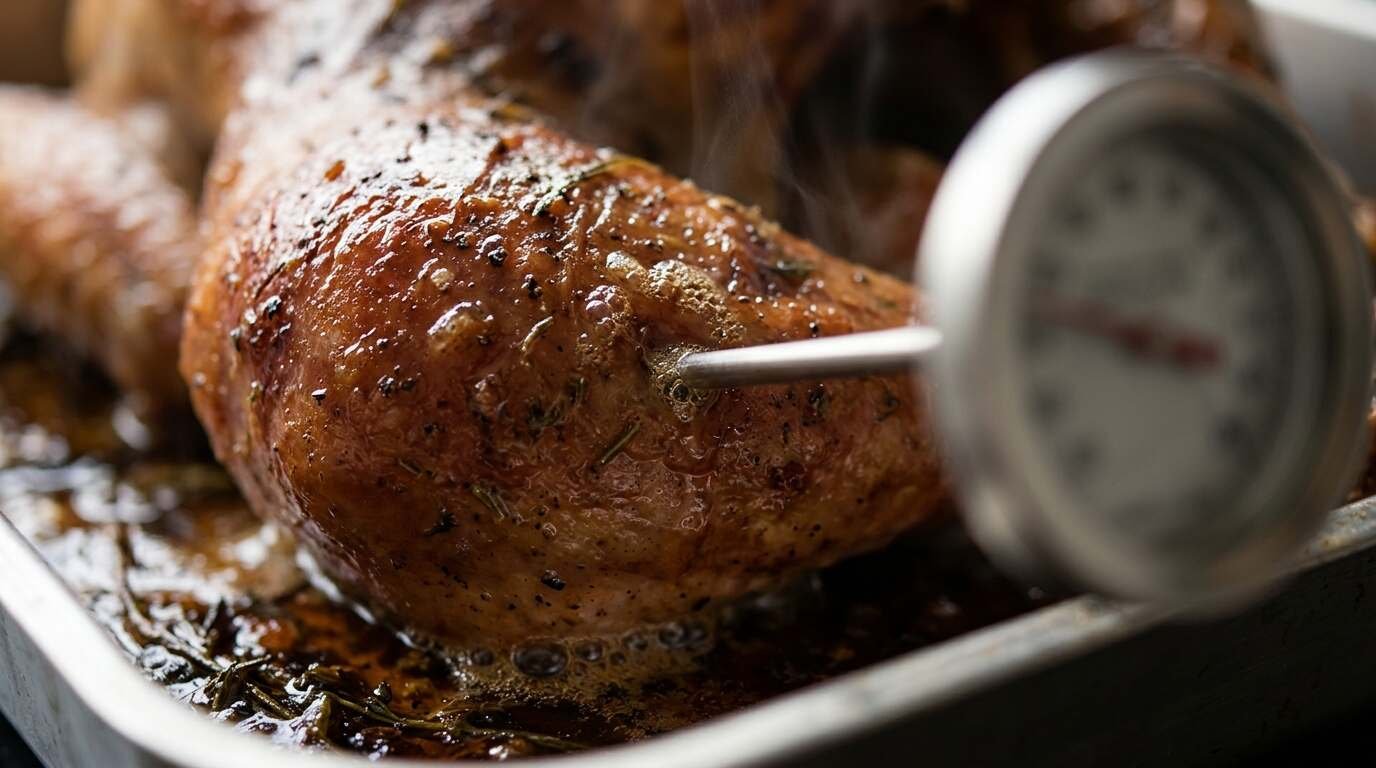
Every formula in this story is a forecast. The USDA’s own rule is a measurement: “A whole turkey is safe when cooked to a minimum internal temperature of 165 °F, as measured with a food thermometer.” The FSIS guide says to check the innermost part of the thigh and wing and the thickest part of the breast, to bring any stuffing to the same 165 °F, and to let the bird stand 20 minutes before carving so the juices set.
That makes the two-thirds rule a planning tool and nothing more. It tells a cook roughly when to start the oven so the turkey, the gravy and the sides arrive together. A probe tells the cook when to stop. An inexpensive instant-read thermometer, like the one in this site’s ThermoWorks ThermoPop 2 review, settles in seconds what Panofsky, two journal authors and a federal chart can only estimate in hours.
There is something stubborn about a number that a SLAC director arrived at with a stuffed bird and some trial and error, that a federal table matches to within two hundredths without ever mentioning it, and that a 2021 paper confirms while admitting the constant can swing by 70 percent. The exponent is settled. The bird on the counter is not.
How far off the chart did last year’s turkey land, and in which direction?
You Might Also Like
- Hot Turkey Sandwich
- After the Bird: Eight Ways to Use Leftover Turkey
- A Glass of Beer Is an Unsolved Engineering Problem
Sources
- USDA Food Safety and Inspection Service, “Let’s Talk Turkey—A Consumer Guide to Safely Roasting a Turkey”: https://www.fsis.usda.gov/es/node/3307
- Nicholas Panofsky, “The Panofsky turkey constant,” Symmetry magazine (originally SLAC Today), November 2008: https://www.symmetrymagazine.org/breaking/2008/11/26/the-panofsky-turkey-constant
- Yifei “Jenny” Jin, Lisa R. Wang, Jian Jim Wang, “Physics in turkey cooking: Revisit the Panofsky formula,” AIP Advances 11(11), 2021, DOI 10.1063/5.0067811, DOAJ record: https://doaj.org/article/2bd83d3d122c4a279e810187f2ea0df0
- Lisa R. Wang, Yifei Jenny Jin, “Physics in Turkey Cooking: Revisit the Panofsky Formula,” APS March Meeting 2022 abstract: https://archive.aps.org/mar/2022/t00/350
- Edward Willett, “The thermodynamics of turkey,” December 20, 1999: https://edwardwillett.com/1999/12/the-thermodynamics-of-turkey/
- Greg Blonder, “predicting cooking times,” Genuine Ideas, February 2016: https://genuineideas.com/ArticlesIndex/thumbs.html
- Emily Sleight, “Physicist claims key to perfect Christmas turkey is to chop it into bits before cooking,” Daily Mirror via inkl: https://www.inkl.com/news/physicist-claims-key-to-perfect-christmas-turkey-is-to-chop-it-into-bits-before-cooking
Suggested category: Technology & Science
Leave a Reply