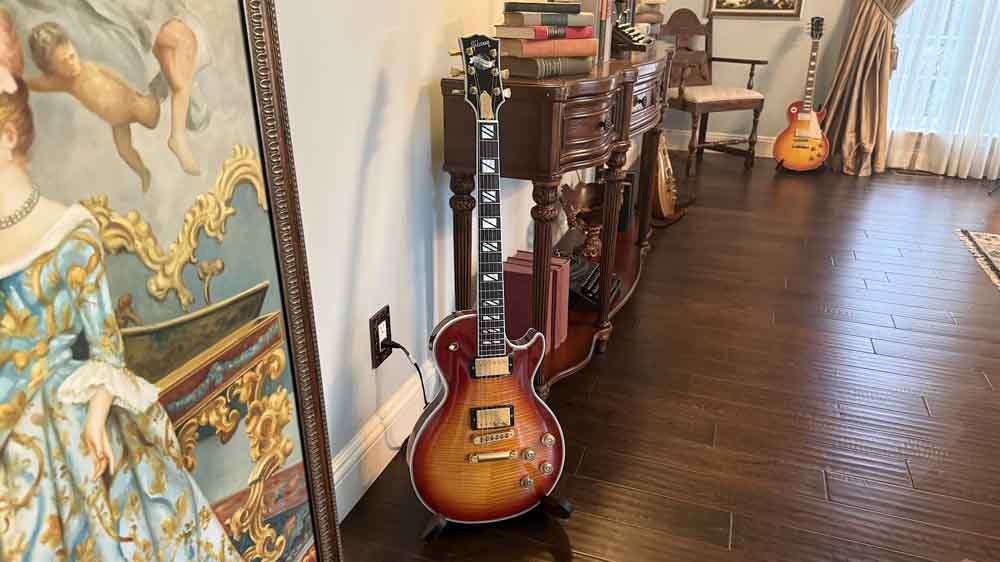
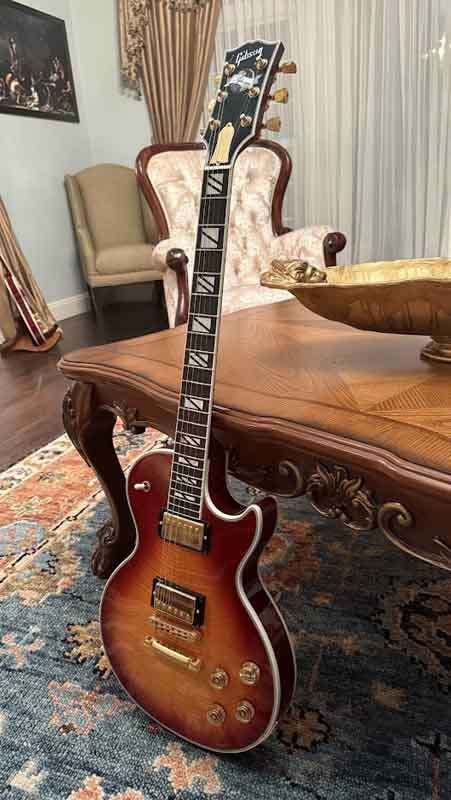
Five strings. That’s what it has right now. A 2008 Gibson Les Paul Supreme in Heritage Cherry Sunburst, AAAA flame maple on the front and back, gold frets, ebony fretboard, abalone globe on the headstock — and five strings. I haven’t played it in a long time. It sits in my gallery room on a wooden stand between a stack of old philosophy books and a painting that probably cost less than the guitar, and it stays there. A museum piece. The sixth string will get replaced eventually, or it won’t. That’s not really the point of this guitar anymore.
The Guitar That Started It
Years ago I had an old black Gibson. Nothing fancy. The kind of guitar you pick up because it feels right in your hands and the price doesn’t make you sick. I played it for a while, the way you play things when you’re young and time doesn’t feel like it has weight yet. Then my son started showing interest, the way kids do — not asking for lessons, just picking it up when I wasn’t looking. So I gave it to him. Figured he’d bang around on it for a few months and move on to something else. That’s what kids do with their father’s things. They take them, they forget them, they lose them. I was fine with that.
But he didn’t lose it. He kept it. Played it, put it away, kept it in his closet for years. I didn’t know this until much later, when we were talking about guitars one afternoon — the way we always did, trading opinions on tone and weight and what makes a Gibson a Gibson — and he came into the other room and came back holding that old black guitar of mine. Just pulled it out of the closet like it was nothing.
I didn’t expect that. You give a kid something and you assume it disappears into the chaos of growing up. But he held onto it. That moment told me more about him than most conversations ever did.
What a Supreme Actually Is
The Gibson Les Paul Supreme debuted at the January 2003 NAMM show and it was not a minor cosmetic update. Jeff Allen, Gibson USA’s General Manager at the time, said the team set out to create a genuinely new Les Paul at the high end — not another color change, not another limited run with a different headstock inlay. They wanted something that had never been done.
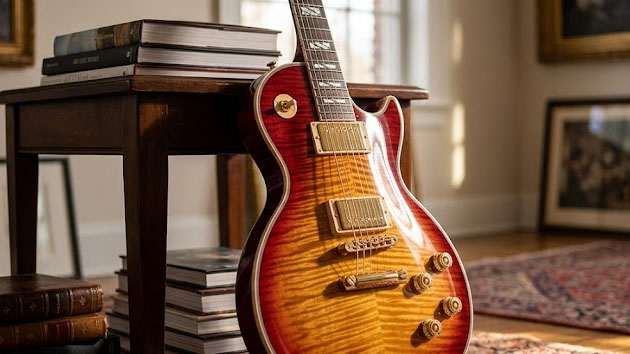
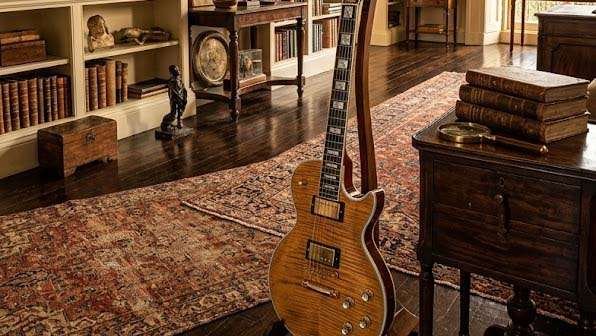
The breakthrough was the carved flame maple back. Every Les Paul before it had a plain mahogany back with plastic covers for the control cavity and switch. Allen challenged his engineer, Keith Medley, to eliminate every access pocket and cover on the back of the guitar so the figured maple could show uninterrupted. It took Medley weeks to figure out how to wire the entire electronics assembly through an oversized rectangular jack hole, sliding the pots in diagonally and routing the wiring through internal chambers. The result was a guitar with no back plates, no switchplate — just flame maple from headstock to endpin.
The body is chambered mahogany with AAAA figured maple on the top and back. The fretboard is ebony with Super Split Block mother-of-pearl inlays borrowed from Gibson’s Super 400, the company’s flagship archtop from the 1940s. The gold frets are a nickel-free alloy that runs about twenty percent harder than standard fret wire. The headstock carries an abalone globe with a pearloid “Supreme” banner — a small piece of inlay work that takes the guitar from instrument to artifact. The pickups are Gibson’s 490R in the neck and 498T in the bridge, both alnico humbuckers, both hotter than the vintage ’57 Classics found on most Les Pauls. They were designed for versatility — blues, classic rock, even some jazz if you roll the tone back.
Seven-ply binding on the top. Three-ply on the back. Gold Grover keystone tuners. An engraved brass truss rod cover. Everything about it says: we pulled out every stop we had.
Heritage Cherry Sunburst
The finish on this guitar is not just a color. It’s the color — the one that changed everything for Gibson in 1958.
By the mid-1950s, Les Paul Goldtop sales were collapsing. Shipping totals fell from 2,245 units in 1953 to 862 just two years later. Gibson needed something dramatic. In the summer of 1958, they dropped the gold paint and introduced a cherry-red sunburst over a translucent finish, exposing the figured maple top for the first time. The Les Paul Standard was born. Only about 1,700 were made between 1958 and 1960 before Gibson abandoned the design entirely in favor of the lighter SG body style. Those original Bursts — the ones Keith Richards started playing in 1964, the ones Jimmy Page built Led Zeppelin on, the ones Eric Clapton used to record the Bluesbreakers album they call “the Beano record” — now sell for prices that belong in real estate, not music stores.
Heritage Cherry Sunburst is Gibson’s faithful recreation of that original 1958 color. Deep cherry red bleeding into amber and honey at the center, designed to reveal the three-dimensional depth of the flame maple grain underneath. On a Supreme, where the maple quality is AAAA — the highest grade Gibson offers — the effect under good light is holographic. The flame shifts as you move around it. Every guitar is unique because every piece of maple is unique, the grain as individual as a fingerprint.
The Players
The Les Paul Supreme isn’t a stadium guitar the way a Standard or Custom is. You won’t see it in the hands of every classic rock guitarist on a greatest-hits tour. But it has its devotees. Neal Schon of Journey has played a custom Supreme on tour. Tim McIlrath of Rise Against used a 2004 Supreme in Alpine White through the entire Sufferer & the Witness era — he taped “Out of Step” on the back of the body, which is about as punk as a Supreme gets.
The broader Heritage Cherry Sunburst lineage, though, is the lineage. Page. Slash. Clapton. Duane Allman. Billy Gibbons’ “Pearly Gates,” a 1959 sunburst he’s used on every ZZ Top record since 1969. Peter Green’s famous ’59 that eventually passed to Gary Moore and then to Kirk Hammett. Paul Kossoff of Free. Ace Frehley of KISS. I wrote about Metallica’s Ride the Lightning a few weeks ago and Kirk Hammett is still touring with the Peter Green Les Paul — a sunburst guitar that has passed through three legendary players and is still on stage. Guitars carry lives.
Collector’s Piece
The original run of the Les Paul Supreme — 2003 through 2013 — is increasingly hard to find, especially in Heritage Cherry Sunburst. Gibson brought the model back in 2023 with updated specs, a compound radius fretboard, and Burstbucker Pro pickups, but the original versions with the ebony board, gold frets, and that specific chambering design are a different animal. Used examples from the first run trade between $3,000 and $5,500 depending on year and condition. A clean 2008 like this one, with its original pickups and hardware intact, sits comfortably in collector territory.
But collector value is an abstraction. Numbers on a screen. The value of this guitar has nothing to do with what someone on Reverb would pay for it.
What Stays
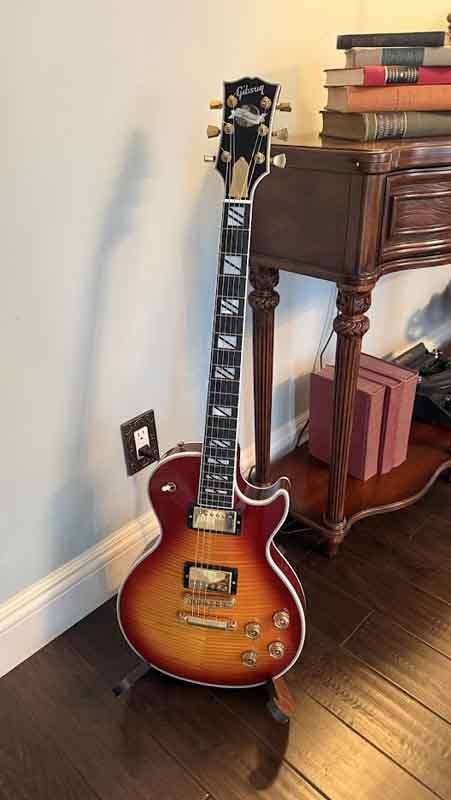
I have two Gibsons now. The old black one and the Supreme. One I gave away and got back. The other was always the favorite — his and mine both. We talked about guitars the way some fathers and sons talk about cars or baseball. It was the language that worked for us.
The Supreme sits in my gallery room with five strings and a layer of quiet. I could restring it tomorrow. I could plug it into the amp behind the door and let those 498T humbuckers shake the books off the shelf. But I don’t. Some things become more important standing still than they ever were in motion.
Two Gibsons. One old, one Supreme. Both of them holding something that doesn’t fit in a case.
You Might Also Like
- Ride the Lightning: Metallica, Fade Away
- The Sex Pistols — ‘Never Mind the Bollocks, Here’s the Sex Pistols’
- The Gay Science by Friedrich Nietzsche: God Is Dead, and Heavy Metal Has Known It Longest
Sources
- The Gibson Les Paul Supreme: Creative Origins of a New LP Model — Les Paul Forum
- What Makes the Gibson Les Paul Supreme an Evolving Work of Art? — Gibson Gazette
- The History of Gibson’s “Burst” by Year — Well Strung Guitars
- The History of the Les Paul “Burst” Finish — Nitorlack
- Gibson Les Paul — Wikipedia
- Gibson Les Paul Supreme — Equipboard
- Gibson Les Paul Supreme — Sweetwater Reviews
- First Gibson Les Paul Cherry Sunburst Acquired by Carter Vintage — Ink 19