The Meseta is where pilgrims quit. It is also where pilgrims are made. The difference is only a decision, repeated across forty flat kilometers.
This is a letter written to the self that arrived at Burgos cathedral on day eight of the Camino Francés, looked west at the plateau, and considered the bus. The bus was available. The bus is always available. That is the problem with the bus.
What the Meseta Is, Exactly
The Meseta — the high Castilian plateau — spans roughly 200 kilometers of the Camino Francés between Burgos and León. The Pilgrim’s Office in Santiago de Compostela processes more than 300,000 pilgrims annually who complete the final 100 kilometers required for the Compostela certificate. Of those who walk the full Camino Francés from Saint-Jean-Pied-de-Port, a significant portion skip the Meseta by bus, train, or taxi. The Confraternity of Saint James — the UK’s oldest Camino support organization — notes this openly in its preparation guidance, neither condemning nor endorsing the shortcut.
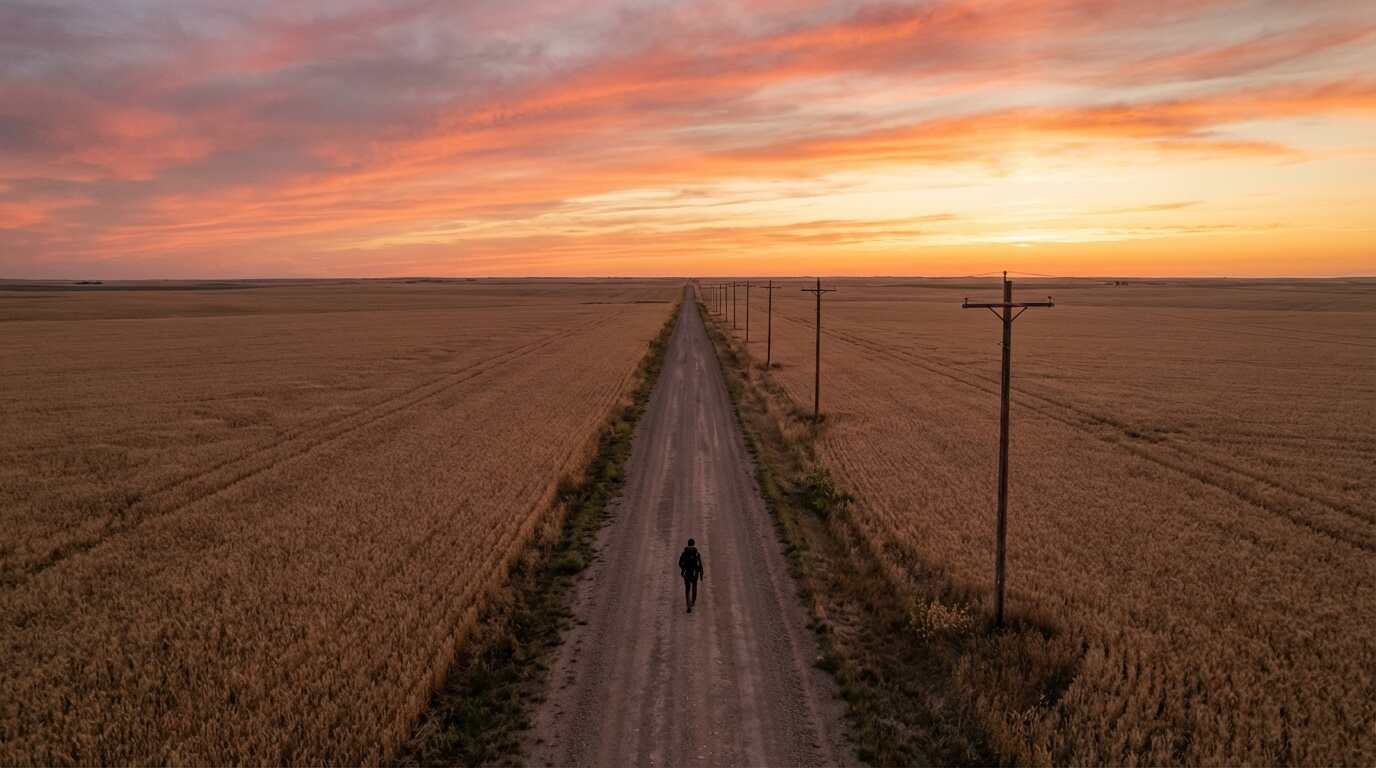
The Meseta is monotonous by design and by geology. The plateau runs at roughly 800 to 900 meters elevation, mostly treeless, mostly wheat fields, mostly sky. Villages appear at intervals of ten to fifteen kilometers and are often small enough to offer a bar, a hostel, and nothing else. The path is straight where other sections of the Camino Francés are winding. The horizon stays the same distance ahead of you for hours.
This is what you come for, if you come at all.

Why People Take the Bus
Sociologist Nancy Frey, in her fieldwork published as Pilgrim Stories: On and Off the Road to Santiago (University of California Press, 1998), documents the range of motivations pilgrims carry onto the Camino — grief, transition, physical challenge, spiritual search, simple curiosity. What most share, she finds, is some version of a hoped-for transformation: they expect the walking to do something to them.
The Meseta is where that expectation meets its stress test.
By day eight or nine of a full Camino, the body has absorbed the Pyrenees, the descent into Pamplona, the wine country of La Rioja, the rise and fall of the Castilian foothills. There is a temptation to believe, by Burgos, that the physically demanding part is complete and the remaining kilometers are formality. The Meseta corrects this belief. It corrects it by being flat, which turns out to be its own form of difficult.
On mountainous terrain, the body has problems to solve. The incline gives the mind something to be inside. On the Meseta, the body does not climb. It simply continues. For hours. With nothing to look at except the same horizon and the same path and the same slow reduction of the kilometer markers.
The bus is not irrationality. The bus is the reasonable response of a mind that has not yet discovered what the Meseta is for.
Day One on the Plateau
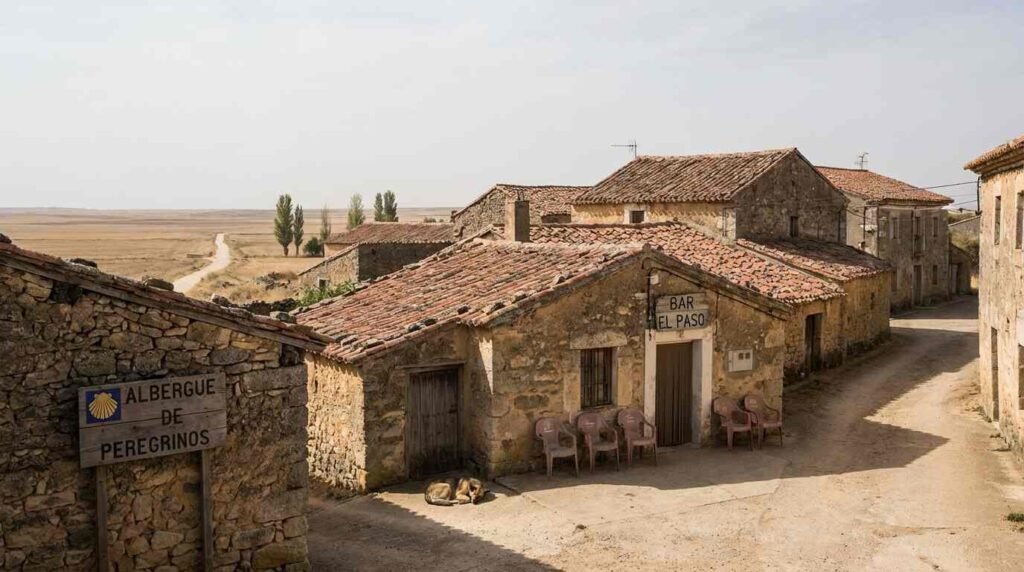
The first day west of Burgos is perhaps twenty-two kilometers to Hornillos del Camino, a village of roughly one hundred people that exists, functionally, because the Camino passes through it. The bar opens before seven. The beds in the municipal albergue are arranged in rows. There are no other attractions.
Marcus Aurelius, Meditations IV.3: Confine yourself to the present. This is easy to say in a study. On the Meseta, the present is a dirt path, a field, a horizon that does not change, and the specific thought pattern of a mind that has run out of novelty to process. What remains when novelty is exhausted is not peace. It is the mind itself, unoccupied.
The unoccupied mind, for most people, is not a comfortable place. It begins to fill itself. With grievances. With plans. With the replaying of old conversations. With the mental composition of arguments for decisions not yet made. None of this is pathological — it is the ordinary noise of a mind that has been given nothing to manage and therefore manages its own history.
This is why the Meseta is the proving ground.
What the Body Starts Teaching Around Day Two
The research published in the Journal of Humanistic Psychology on the Camino as transformative experience identifies a common pattern: pilgrims who persist through the Meseta report a qualitative shift in their inner experience around the second or third day on the plateau. The noise diminishes. Not because it is suppressed — suppression is a different operation — but because it has been walked through. The mind, given enough time without new stimulation, eventually stops reaching for what isn’t there.
What arrives in that space is less dramatic than the literature suggests and more useful.
On day two of the Meseta, somewhere between Burgos and León, the rhythm of walking had ceased to be an activity and had become a condition. The steps were no longer being counted or managed. The feet knew the path and the body followed and the mind was, for the first time since Saint-Jean-Pied-de-Port, simply present in the walk rather than thinking about the walk.
This is not enlightenment. It is the ordinary reward of sustained attention, available to anyone willing to stay.
Marcus Aurelius understood this through military discipline — the Roman legions’ capacity for long marches depended on exactly this kind of absorbed, sustainable rhythm, the mind emptied of complaint and returned to task. The body, under sustained exertion, teaches the mind the same thing the Stoics spent lifetimes trying to learn philosophically: that most of what you call necessary thought is not. Most of it is noise management. The walking reveals this by outlasting the noise.
The Seduction of the Shortcut
The bus from Burgos to León takes approximately one hour and forty-five minutes. The walk takes five to seven days. The Compostela certificate, which requires only the final 100 kilometers on foot, does not distinguish between pilgrims who walked the Meseta and pilgrims who bypassed it.
This is the philosophical problem in concentrated form.
If the goal is Santiago, the shortcut is entirely rational. If the goal is the Meseta — the specific thing the Meseta offers, which is the experience of persisting through discomfort until the discomfort stops being the primary experience — then the shortcut removes the point. But the Meseta does not announce what it offers. It simply appears, flat and uninviting, and waits.
Epictetus: Make the best use of what is in your power, and take the rest as it happens. The Meseta is squarely in the category of what happens. You did not design it and you cannot improve it and it will not accelerate because you would prefer it to. What is in your power is the decision to remain inside it or exit it. That decision, made each morning before the sun is fully up, is the practice.
The pilgrims who take the bus are not wrong. They are making a different choice for reasons that are their own. The Camino has no doctrine about correct walking. But something is lost when the challenge is bypassed before it has had time to do what it does, and what it does is specific to the challenge and not replicable elsewhere.
What the Letter Actually Says
The letter written to the self at Burgos — the self considering the bus — says this:
The scenery will not improve. The path will not become interesting in the way you are hoping. The kilometers will not accumulate faster if you find a better mental strategy. None of these things are the point, and understanding this is available only on the other side of deciding to walk.
The Meseta is not a proving ground for physical endurance, though your feet will log the proof. It is a proving ground for the mind’s relationship with absence — with a landscape that refuses to entertain you, with days that have no climax, with a body that simply continues doing what it is built to do once you stop interfering with it.
What you find on the far side of the plateau, walking into León with the cathedral emerging from the plain, is not triumph. It is something quieter — the particular quality of a mind that has been emptied by duration and walked through its own noise and arrived at the destination having spent five days in the company of itself.
That acquaintance is the document the Camino issues before the Compostela. It does not require any additional credential.
You Might Also Like:
- The Ghost Station Capital: How the World’s Lost Railway Architecture Continues to Define the Cities That Erased It
- Salt That Knew Its Place: The Stoic Doctrine of Natural Hierarchy and Why Every Diner Salt Shaker Is a Small Philosophical Argument About the Cosmos
Sources:
- Pilgrim’s Office, Santiago de Compostela: oficinadelperegrino.com
- Confraternity of Saint James: csj.org.uk
- Nancy Frey, Pilgrim Stories: On and Off the Road to Santiago (University of California Press, 1998)
- Research on transformative experience on the Camino: Journal of Humanistic Psychology (various issues)
- Marcus Aurelius, Meditations, trans. Gregory Hays (Modern Library, 2002)
- Epictetus, Enchiridion, trans. P.E. Matheson (Oxford University Press, 1916)