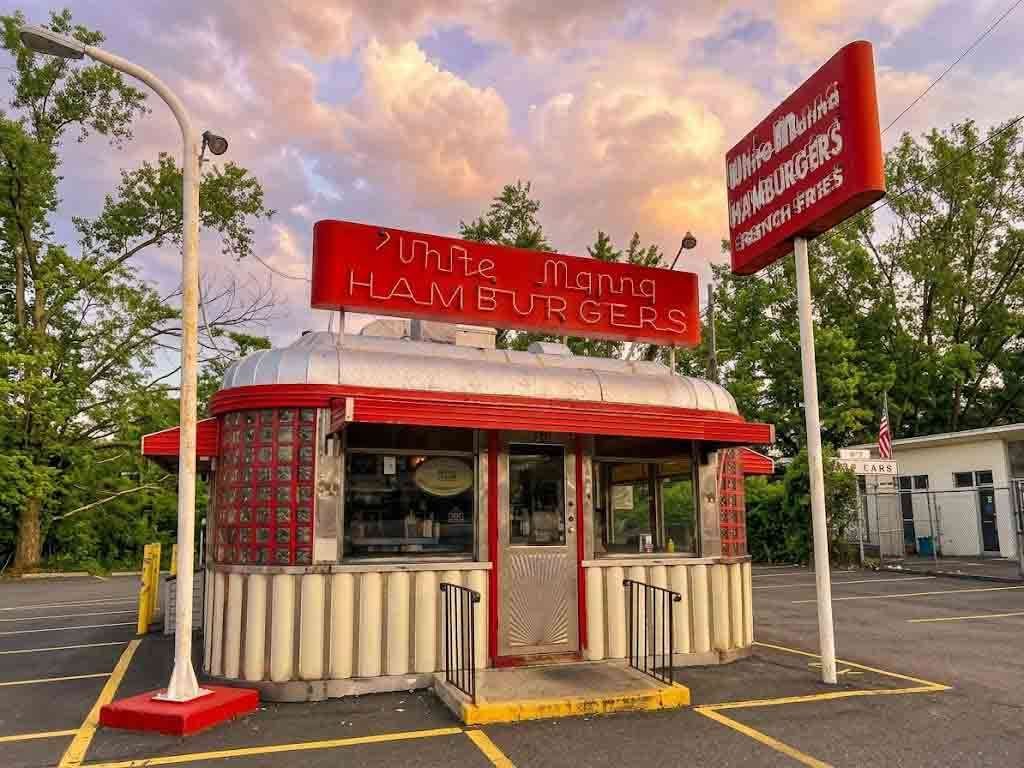
Before there was fast food, there was this: a circular counter, a central flat top, and a cook who never had to take more than three steps in any direction to reach the grill, the cash register, or the customer. The White Manna at 358 River Street in Hackensack, New Jersey, is not a charming place. It is an efficient one. There is a difference, and it matters.
The building was manufactured in 1939 by Paramount Dining Car Company of Oakland, New Jersey, and debuted that same year at the New York World’s Fair in Flushing Meadows, Queens, under the theme “The World of Tomorrow.” It was billed there as the “Diner of the Future” — an architectural demonstration that assembly-line production principles could be applied to ground beef. Louis Bridges purchased the prototype after the fair closed, relocated it to Jersey City, and eventually opened a second location in Hackensack in 1946. The Hackensack White Manna and the Jersey City White Mana are now separately owned and no longer affiliated, though both claim the same origin story and maintain a low-grade rivalry that once got adjudicated on the Food Network’s Food Feuds. Hackensack won. Jersey City’s owner disputed the result. Nobody changed anything.
That is American food history behaving like itself.
The Architecture of the Thing
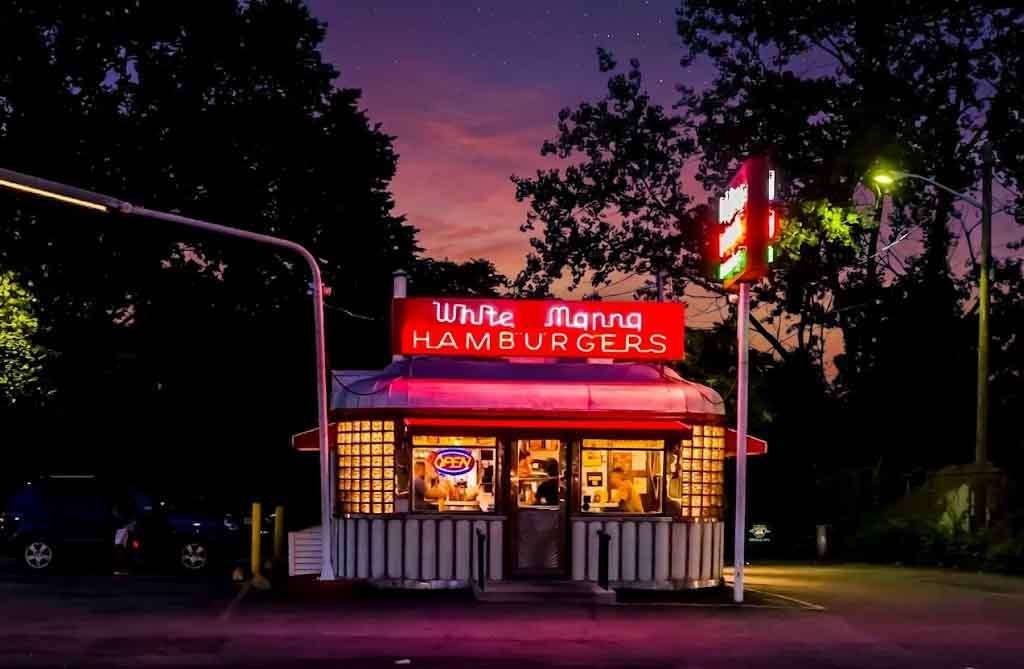
Architect Arthur E. Sieber filed the patent for the circular diner design in 1938, issued in 1941. The logic behind it was purely operational. At the fair, the structure attracted crowds not because of nostalgia — there was no nostalgia yet, the concept was brand new — but because the sight of rapid, systematic production was itself a spectacle. Fairgoers watched small patties land on the large central grill, onions distributed across the surface, patties pressed flat, flipped, assembled onto rolls, and slid across the counter to waiting hands, all within a continuous loop of motion that barely paused between orders.
The counter surrounds the grill. The grill is the center of the universe inside White Manna. Every movement in the kitchen radiates outward from that flat steel surface. There is no back-of-house to speak of — or very little of one. The cook works in full view of every person sitting at the counter. Whatever technique exists, it’s public. Whatever corners get cut, they’re cut in front of you. That accountability is structural, not philosophical. The building doesn’t give you a place to hide.
Ten feet. That’s the operational radius. Within ten feet, you can reach the grill, the buns, the cheese, the register, and the customer. The whole business model is built on minimizing the distance between those five things. When you remove distance from food service, you remove time. When you remove time, you increase volume. Volume is the whole game.
One Ounce of Beef, Extra-Lean, Never Frozen
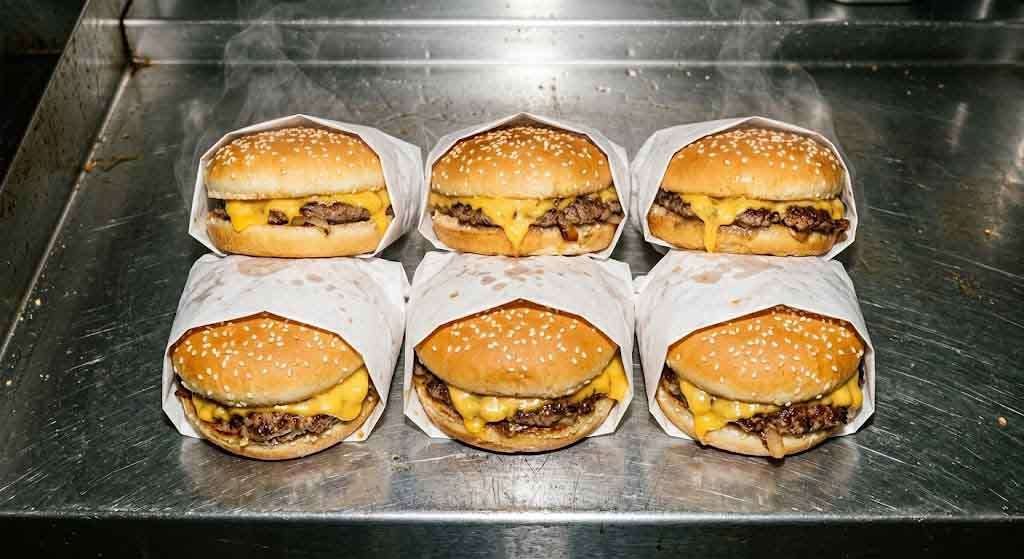
The slider at White Manna is approximately one ounce of fresh, extra-lean ground beef, delivered daily from a local supplier. It hits the flat top and gets pressed. Onions go down beside it — raw, thin-sliced — and the patty cooks in the onion steam as much as in direct heat. That steam is doing the work you don’t see. It carries the onion through the meat, saturating the interior before the exterior has finished its crust.
The bun is a Martin’s Potato Roll, soft and slightly sweet. It goes on top of the patty and onions while everything is still on the grill, so it takes on heat and moisture from below. The assembly happens fast. The slider comes off the grill and onto paper in one motion. If you ordered six, they’re wrapped in a stack before you’ve finished watching the cook start the next batch.
Three sliders is the standard recommendation. GQ put White Manna on its list of “20 Hamburgers You Must Eat Before You Die.” Thrillist named it the best burger in New Jersey. Anthony Bourdain featured it on No Reservations in 2010. The Daily Meal ranked it among the top 101 burgers in America. None of that has changed the price or the process in any meaningful way. The flat top is still the flat top. The onions are still the onions. The paper is still the paper. The accolades accumulate on the wall but they don’t touch the grill.
The Physical Toll of a Flat Top in a Box
Work a griddle in a space the size of a walk-in closet and your body keeps score. The heat radiates off a commercial flat top at close range — face, forearms, the inside of your wrists when you’re pressing patties or flipping fast. There is no position that isn’t adjacent to the grill. You learn to read the surface the way a carpenter reads grain: which zones run hot, which cool at the edges, where you stage patties to hold temperature and where you push them to finish fast.
Grease accumulates in patterns. The smell gets into your clothes, your hair, the pores on your hands, eventually your sense of what normal smells like. It stops being background and starts being ambient. You stop noticing it the way you stop noticing the sound of your own refrigerator at home.
The spatial constraint means you’re always in motion. There’s nowhere to stand still. Every position puts you between the grill and the counter, the counter and the register, the register and the supply shelf. The rotation is constant and unconscious after enough years — the body maps the space so completely that navigation stops requiring thought. That’s not comfort. That’s the opposite of comfort. That’s the point where you’ve surrendered enough personal space to the machine that the machine and you move together.
This is what efficiency actually costs. Not money. Body.
Surviving White Manna’s kitchen across a full shift is a function of tolerance for heat, tolerance for proximity, and the kind of low-level physical intelligence that doesn’t appear on any resume and doesn’t get talked about in food media because food media isn’t particularly interested in what a grill does to a forearm over the course of thirty years.
Volume Is the Business Model, Not the Menu
The menu at White Manna is short by design. Hamburgers. Cheeseburgers. Steak sandwich. Chicken steak sandwich. French fries. Cheese fries. Milkshakes, sodas. That’s approximately the whole of it. No seasonal specials. No rotating menu. No locally-sourced anything on a chalkboard. The menu doesn’t change because change introduces variables, and variables slow production. Slowness is the enemy of a volume business.
The line outside on a weekend stretches down the block. People wait in it knowing exactly what they’re going to order before they reach the front. The transaction at the counter is thirty seconds or less. You state the number of patties, you state cheese or no cheese, you tell them the roll preference, you pay, you move down the counter to wait. The next person steps up. The cook hasn’t stopped moving through any of this.
That is the system. It was demonstrated at a World’s Fair as the future of American eating. The future arrived and then stayed the same for eighty years, which is what successful futures usually do. They stop being futures and become foundations. Nobody calls White Manna innovative anymore. They call it a classic. The gap between those two words is exactly the length of time it takes for something to stop surprising people.
What the Slider Actually Is
The slider’s claim to invention is contested territory. White Castle opened in Wichita, Kansas, in 1921 and has its own claim to the small, steamed-onion hamburger format. The White Manna origin story says the name comes from the method — cooks sliding the finished patties across the grill surface to the customer — though food historians note the White Diamond chain was already advertising sliders in 1937 New Jersey newspapers, two years before the World’s Fair prototype. Louis Bridges and his family, farm boys out of Cordele, Georgia who built multiple New Jersey burger chains, created the White Diamond, the White Manna, and the Jersey City White Mana — which suggests the slider format was already in their operational vocabulary before Flushing Meadows.
What White Manna in Hackensack has done — and what distinguishes it from every claim and counter-claim in this argument — is survive. It has been at 358 River Street since 1946, serving from the same format, on roughly the same equipment philosophy, for the same working-class customer who didn’t need a seat reservation or a chef’s name on the wall to understand that the food was good. That’s not nostalgia. That’s accountability through repetition. You can’t run the same product eighty years in the same building unless the product is actually what you say it is.
Why Nothing Has Changed
The building is landmarked by Hudson County. The exterior is protected. The owners have no interest in changing the format. The customers who’ve been coming for thirty years have no interest in the format changing. The mechanism is locked — architecturally, culturally, economically — and the mechanism is what makes the slider the slider.
This is a thing worth understanding about small, long-running food institutions: they are not resistant to change because they’re sentimental. They’re resistant to change because any change to one variable — the beef supplier, the roll, the grill temperature, the spatial configuration of the counter — cascades through the entire system in ways that are impossible to predict and usually ruinous. A slider operation that’s been producing the same result for eighty years has built tolerances that nobody fully mapped because nobody needed to map them. The cooks know without knowing. The grill behaves as expected. The onions do what onions do in this specific heat on this specific surface.
Change the surface and everything changes. So nobody changes anything. The flat top runs the same. The one-ounce patties land the same. The Martin’s roll takes the same steam. The paper wraps the same. The line outside on Saturday morning is the same line that was there in 1956, with different people in it.
That’s not stasis. That’s precision. There’s a difference, and it matters too.
You Might Also Like:
Heritage Diner Disco Fries: New Jersey Classic with a Long Island Diner Finish | How to Build the Perfect Diner Breakfast Platter | The Classic Patty Melt: Griddled Rye Bread, Swiss Cheese, and Caramelized Onions
Sources
- White Manna official website: whitemanna.com
- White Manna — Wikipedia: en.wikipedia.org/wiki/White_Manna
- Roadtrippers, “Diner of the Future”: roadtrippers.com
- Mr. Local History Project: mrlocalhistory.org
- Scouting NY: scoutingny.com
- Anthony Bourdain, No Reservations, Travel Channel, 2010