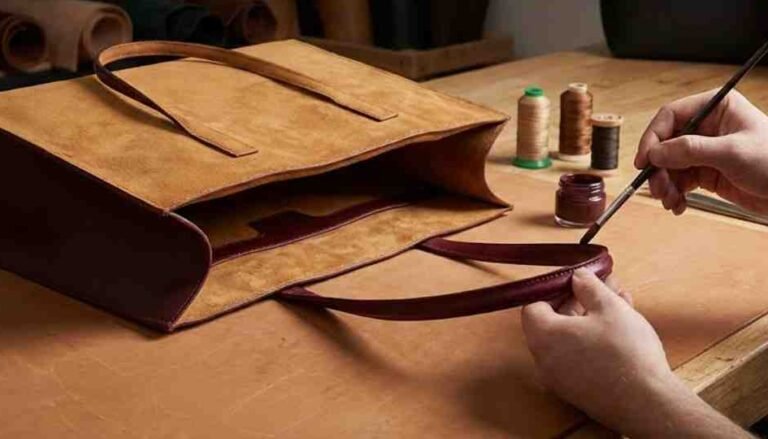
The briefcase sitting on my workbench at the Marcellino NY studio in Huntington weighs about four pounds. It is made from English bridle leather that was vegetable-tanned over the course of six weeks at a Pennsylvania tannery that has been operating since 1867. The thread is linen, waxed by hand. The edges have been burnished, sealed, and burnished again—a process I repeat until the cross-section of the leather gleams like old mahogany. The brass hardware was sourced from a domestic foundry. When the client picks it up next week, he will carry it into a Manhattan courtroom, and if his grandchildren inherit it, the leather will be richer, deeper, and more supple than the day it left my bench.
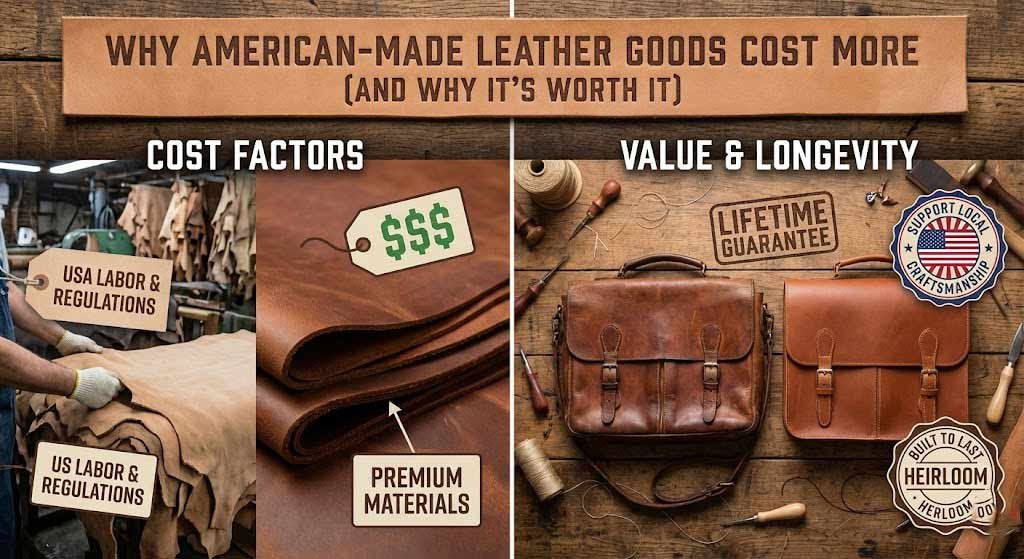
That briefcase costs significantly more than its imported counterpart. The sticker price makes some buyers hesitate—until they understand what that number actually represents. Not markup. Not branding mythology. But the compounding cost of doing everything the slow, difficult, American way: paying fair wages, sourcing materials that take weeks instead of hours to produce, and hand-finishing details that no factory in Guangzhou or Dhaka would consider profitable. This is the real economics of American-made leather goods—the kind of breakdown that matters if you are standing on the fence between a $150 bag that will crack in eighteen months and a $600 piece that will outlive you.
The Tanning Divide: Six Weeks Versus Six Hours
Every leather product begins with a decision at the tannery, and that decision determines everything that follows. Approximately ninety percent of the world’s leather is chrome-tanned, a process invented in 1858 that uses chromium sulfate to convert raw hide into finished leather in as little as a single day (Dalmases et al., Journal of Cleaner Production, 2020). The economics are straightforward: speed equals volume, volume equals lower unit cost, and lower unit cost equals the $49.99 messenger bag hanging from a hook at your local department store.
Vegetable tanning—the method used to produce the leather I build Marcellino briefcases from—operates on an entirely different clock. At Wickett & Craig in Curwensville, Pennsylvania, one of only two remaining specialty vegetable tanneries in the United States, the process from raw hide to finished leather takes roughly six weeks (Wickett & Craig, 2024). Hides sourced from North American cattle of European stock are rehydrated, dehaired, fleshed, split, and then moved through seventy-two vats filled with a proprietary blend of natural tannins extracted from Mimosa and Quebracho tree bark. After two weeks of soaking in progressively concentrated tanning liquor, the hides are split to thickness, drum-dyed, fat-liquored with oils and waxes, and—in the case of bridle leather—hot-stuffed with tallows that saturate the fibers to the core. The finished leather is then toggle-dried for three days in a climate-controlled facility before staking, spraying, ironing, and grading.
Every one of those steps requires skilled hands and institutional knowledge accumulated over more than 150 years. Wickett & Craig’s sixteen-acre facility produces approximately 4,500,000 square feet of leather annually—a figure that sounds enormous until you realize that a single chrome-tanning operation in South Asia can process comparable volume in a fraction of the time (Patina Project, 2025). The cost differential is not arbitrary. It is the arithmetic of patience.
Across the Atlantic, J & E Sedgwick in Walsall, England—a tannery I source from for certain Marcellino commissions—has been producing vegetable-tanned bridle leather since 1900. Their bridle butts are traditionally pit-tanned and hand-curried, the most labor-intensive product in their entire range. A master currier must ensure that every hide is as free of imperfection as possible while maintaining the integrity of the grain. This is not a job that can be automated. It is a job that requires years of apprenticeship and a tactile intelligence that no algorithm can replicate.
The distinction matters because it determines the life of everything made from the material. Chrome-tanned leather, while softer and more water-resistant out of the box, tends to crack, peel, and degrade within a few years—particularly when manufacturers in developing nations use cheap acrylic varnish to seal the edges (Von Baer, Chrome Tanned Leather Guide, 2025). Vegetable-tanned leather, by contrast, develops a patina—a deepening of color and luster that occurs as the natural tannins respond to sunlight, handling, and the oils of your hands. It does not die young. It improves.
Relevant Viewing: Search YouTube for “Ashland Leather Horween Tannery Tour” for a detailed behind-the-scenes look at one of America’s oldest continuously operating tanneries in Chicago, where Shell Cordovan undergoes a six-month tanning process still guided by a century-old proprietary formula.
The Labor Equation: What $17 an Hour Actually Means
In 2024, the median annual wage in the U.S. leather and allied product manufacturing sector was $35,160, with hourly wages averaging approximately $17 (U.S. Bureau of Labor Statistics, 2024). That figure includes the full spectrum of the domestic workforce—from entry-level material handlers to experienced tanners and skilled craftspeople. It does not, however, capture the complete cost picture. American manufacturers must also absorb employer-sponsored health insurance—which averages over $22,000 per year for family coverage—along with payroll taxes, workers’ compensation, OSHA compliance costs, paid leave, and retirement contributions (IVEMSA, U.S. and Mexico Labor Cost Comparison, 2025).
Now compare. In China, the hourly manufacturing wage can range from $2.30 to $3.70 depending on the region. In India, the national average is approximately $2.80 per hour. In Bangladesh, where a significant percentage of the world’s cheap leather goods are stitched, the figure drops to roughly $0.46 per hour (Aadmi, Global Expansion: Countries with Affordable Labor, 2025). Mexico, an increasingly popular nearshoring destination, offers manufacturing labor at approximately $1.07 per hour.
The gap is not subtle. An American leather worker earning $17 per hour, fully loaded with benefits and regulatory compliance, costs an employer somewhere between $25 and $35 per hour. An equivalent worker in Dhaka costs under $1. This is the fundamental arithmetic that has driven leather goods manufacturing offshore for decades, and it is the reason that fewer than 900 leather manufacturing companies remain in the United States, employing just 11,400 workers across all key occupations (Bureau of Labor Statistics, 2024).
But here is what the spreadsheet does not show: the quality of that labor. A 2024 KPMG study of manufacturing costs across seventeen countries found that while U.S. primary costs—wages, utilities, real estate—ranked fourteenth out of seventeen, the United States climbed to fifth when secondary factors like labor quality, workforce skill, and business environment were weighted appropriately (Cost of Manufacturing Operations Around the Globe, KPMG, 2024). The American leather worker is not merely cheaper or more expensive. The American leather worker is, on average, more productive, more reliable, and operating within a regulatory framework that ensures both workplace safety and product consistency.
At the Marcellino bench, this translates directly. When I hand-stitch a briefcase using a saddle stitch—two needles passing through each hole from opposite directions, creating a lock that will not unravel even if a single thread breaks—I am performing a technique that takes months to learn and years to master. The $150 imported briefcase is machine-stitched with a lock stitch, a single thread looped under tension. Cut one thread on a lock stitch and the entire seam can unzip like a cheap zipper.
Material Sourcing: The Hidden Supply Chain Premium
The U.S. leather goods market was valued at approximately $50.08 billion in 2023 and is projected to grow at a compound annual growth rate of 6.5 percent through 2030 (Grand View Research, 2024). Within that market, however, the materials that distinguish an heirloom-quality piece from a disposable one occupy an increasingly narrow and expensive niche.
Full-grain vegetable-tanned leather—the only material I will use for a Marcellino commission—starts with the hide itself. Not every cowhide qualifies. The animals must have had minimal exposure to barbed wire, insect bites, and branding—all of which leave scars visible on full-grain leather, where the entire outer surface of the hide is preserved without sanding or buffing. Wickett & Craig selects only full hides from North American cattle of European stock, a specification that eliminates the vast majority of available hides before the tanning process even begins.
Then there is the cost of the tannins themselves. Unlike chromium sulfate, which is an industrial chemical produced at massive scale, vegetable tannins are extracted from specific trees—Mimosa, Quebracho, chestnut, oak—that must be sustainably harvested and processed into concentrated form. The global investment in eco-friendly tanning technologies has increased by thirty-six percent in recent years, with bio-based tanning adoption rising forty-three percent and chrome-free alternatives growing thirty-eight percent (Customcy, Leather Industry Statistics, 2025). This is positive for the planet, but it also means that the already-scarce supply of premium vegetable tannins faces increasing demand from tanneries worldwide that are transitioning away from chrome.
Hardware adds another layer. A solid brass buckle or lock machined in the United States costs multiples more than a zinc-alloy equivalent stamped in a Chinese factory. Linen thread waxed for hand-stitching—the kind that does not rot, stretch, or degrade under UV exposure—is a specialty product with a limited number of global suppliers. Edge paint, dyes, conditioners, and finishing compounds sourced from reputable suppliers each add incremental cost that compounds across every component of the finished piece.
This is the supply chain that an American maker navigates daily. It is not a supply chain optimized for cost. It is a supply chain optimized for permanence.
The Environmental Calculus: What Chrome Really Costs
There is an environmental dimension to the price differential that rarely appears on the price tag but deserves honest accounting. Chrome tanning, while faster and cheaper, generates significant quantities of chromium-laden wastewater. In poorly regulated facilities—particularly in parts of South Asia—the handling of chromium III can lead to the formation of chromium VI, a carcinogenic compound that has been linked to respiratory damage, skin disorders, circulatory problems, and genetic harm among tannery workers (Stridewise, Leather Tanning Myths, 2023).
The vegetable tanning process, by contrast, uses materials that are biodegradable and non-toxic. Wickett & Craig has earned environmental certification from the Leather Working Group, an independent body that audits tanneries for water usage, waste management, and chemical handling. The tannins used—bark extracts, essentially—return to the earth without leaving a toxic signature. The wastewater from a vegetable tannery is orders of magnitude less hazardous than the effluent from a chrome operation.
This matters to the conscious buyer. When you purchase a chrome-tanned imported bag at a price point that seems too good to be true, part of the reason it is so cheap is that the environmental and human costs have been externalized—borne by communities downstream of unregulated tanneries in Dhaka, Kanpur, or Hazaribagh rather than factored into the retail price. The American-made vegetable-tanned product internalizes those costs. The maker pays for compliance. The tannery pays for certification. The consumer pays for a product that did not poison anyone in its creation.
At the Heritage Diner, where I have spent twenty-five years building a business on Route 25A in Mount Sinai, I understand this principle instinctively. You can buy cheaper ingredients. You can cut corners on sourcing. But the neighborhood knows. The regulars know. And eventually, the shortcuts reveal themselves—in a burger that does not taste right, in a leather bag that cracks at the seams, in a building that was renovated for appearance rather than structure. Paola and I are preparing to launch Maison Pawli, our boutique real estate venture on the North Shore, in 2026, and the same philosophy applies: the unseen details—the foundation, the framing, the materials behind the walls—are what determine whether something endures or merely persists for a season.
The Patina Principle: Cost-Per-Year Versus Cost-Per-Purchase
The most persuasive economic argument for American-made leather goods is not the upfront number. It is the cost-per-year calculation that the r/BuyItForLife community on Reddit has elevated to a purchasing philosophy.
Consider two briefcases. The imported chrome-tanned model costs $150 and, based on typical consumer reports, will show significant wear—cracking edges, peeling finish, broken stitching—within two to three years. Amortized over its useful life, that is $50 to $75 per year. The American-made vegetable-tanned briefcase costs $600 and, with minimal care, will serve its owner for twenty, thirty, or fifty years. At twenty years, the cost is $30 per year. At thirty, it is $20. At fifty, it is $12. And unlike the imported model, which depreciates to worthlessness, the American piece appreciates in character—the patina deepening, the leather softening, the brass hardware acquiring the kind of warm oxidation that cannot be faked.
This is what Heidegger meant when he wrote about the nature of a thing—the way a truly well-made object gathers the world around it, acquires the traces of its use, and becomes inseparable from the life of its owner. A briefcase carried into depositions, board meetings, and overseas flights for three decades is not merely an accessory. It is a record. It is evidence of a life lived with intention.
The premium segment of the leather goods market reflects this understanding. The global luxury leather goods market is projected to reach 397.2 million users by 2029, with the premium tier growing at 7.56 percent annually—significantly outpacing the mass market segment (Mordor Intelligence, 2025). Consumers are not merely paying for material. They are paying for time—the time invested in tanning, in stitching, in finishing—and for the time the product will give back in return.
The Maker’s Margin: What Artisanship Actually Pays
Here is a truth that rarely makes it into the marketing copy: the margins on handmade American leather goods are not extravagant. When you account for material costs—a single side of Wickett & Craig English bridle leather retails to craftspeople at approximately $269 to $319 depending on color and weight (Maker’s Leather Supply, 2025)—and recognize that a briefcase requires the better part of two full sides, plus hardware, thread, edge treatment, and lining, the material cost alone can approach $400 to $500 for a premium build.
Layer in the labor: twenty to forty hours of hand-cutting, skiving, stitching, edge-finishing, and assembly for a fully bespoke piece. At any reasonable American wage—even at the modest rates that independent artisans pay themselves—the labor component adds another several hundred dollars. Then add overhead: workshop rent, tools and equipment maintenance, insurance, shipping materials, and the invisible cost of years of training that preceded the ability to execute at this level.
The maker’s margin on a $900 bespoke briefcase is not the fifty or sixty percent that mass-market fashion brands enjoy on their overseas-manufactured goods. It is a working margin—enough to sustain a small studio, maintain quality, and continue practicing a craft that the global economy has tried very hard to make extinct.
At Marcellino NY, every piece carries this economic reality. The price is not an aspiration. It is a reflection. A reflection of the tanner in Curwensville who spent six weeks preparing the leather. Of the thread supplier who waxed linen by hand. Of the decades I have spent learning to read a hide the way a chef reads an ingredient—feeling for density, checking for consistency, knowing instinctively where to cut and where to avoid.
The Verdict: Investing in the Unseen
The global leather goods market reached $356.91 billion in 2024 and is projected to grow at seven percent annually through 2032 (Stellar Market Research, 2024). Within that enormous market, the American-made, vegetable-tanned, hand-stitched segment is a sliver—a correction to the dominant logic of disposability. It is also the segment that is growing fastest among informed consumers who have grown weary of replacing things.
The question is not whether American-made leather goods cost more. They do. The question is what you are paying for when you choose the alternative: chemical tanning that takes hours instead of weeks, labor conditions that would be illegal in the United States, machine stitching that cannot be repaired, synthetic edge treatments that peel within a year, and a product designed not for permanence but for planned obsolescence.
Marcus Aurelius wrote that the object of life is not to be on the side of the majority, but to escape finding yourself in the ranks of the insane. In an economy that produces 92 million tons of textile waste per year—much of it leather goods that cracked, split, and disintegrated before their owners had finished paying off the credit card—choosing the slower, more expensive, more deliberately crafted option is not extravagance. It is sanity.
The next time you hold an American-made leather bag and feel the weight of it, the density of the grain, the faint sweet smell of vegetable tannins rather than the chemical bite of chrome—you are holding six weeks of tanning, decades of craft knowledge, and a century-and-a-half of American tanning tradition. That is what the price tag represents. And it is, by any honest accounting, worth every cent.
Peter is the 25-year owner of The Heritage Diner in Mount Sinai, New York, founder of Marcellino NY bespoke leather goods, and co-founder of the forthcoming Maison Pawli boutique real estate venture. He writes from the intersection of craftsmanship, philosophy, and Long Island’s North Shore culture. For more, visit heritagediner.com and x9m8.com.