The scent of garlic-roasted plantains and slow-braised pork drifts through the humid summer air of western Smithtown, mingling with the faint percussion of Latin jazz spilling from behind a façade that could belong to a nightclub in Old Havana rather than a strip of Jericho Turnpike. Cafe Havana has occupied this particular stretch of Route 25 since roughly 2008, an establishment that has quietly become one of Suffolk County’s most enduring Cuban dining destinations—a place where the plantain reigns supreme, the mojitos flow with Caribbean generosity, and a downstairs lounge transforms the evening from dinner into an event. For anyone who has spent two and a half decades running a restaurant on Long Island, as I have at The Heritage Diner just a few miles east in Mount Sinai, there is an immediate recognition of what Cafe Havana has accomplished: the construction of atmosphere as architecture, the transformation of a meal into a sense of place.
A Caribbean Outpost on Jericho Turnpike
Long Island’s dining landscape is, by nature, a contradiction. We are a suburban sprawl of bagel shops and pizzerias overlaying a coastline that should, by all geographic logic, produce a culinary culture as vibrant as any coastal region in the world. The fact that it occasionally does—and that a restaurant serving Cuban-Caribbean cuisine can thrive for well over a decade in Smithtown—speaks to something deeper than demographic trends. It speaks to appetite in the truest sense: a hunger not just for flavor but for transport, for the feeling of being somewhere else while remaining firmly rooted in the community you know.
Cafe Havana opened its doors and quickly established itself as one of those rare suburban restaurants that refuses to play it safe. The interior is designed to evoke the tropics—palm trees, warm lighting, an indoor fireplace for the colder months, and a patio for outdoor dining when Long Island’s brief summer finally arrives. The restaurant underwent a significant renovation and grand reopening in May 2013, introducing a redesigned bar, an updated dining area, and an expanded menu that pushed deeper into the traditions of Cuban, Puerto Rican, and Spanish cuisine (Smithtown Patch, 2013). A second renovation around 2014 elevated the space further toward the upscale-casual register it occupies today, earning the “Casual Elegant” designation that appears across review platforms. More recently, the establishment has also been operating under the name Coco Bistro Kitchen & Lounge, reflecting an evolution in branding while maintaining the Cuban-Caribbean soul that built its reputation.
The Menu: Where the Plantain Is King
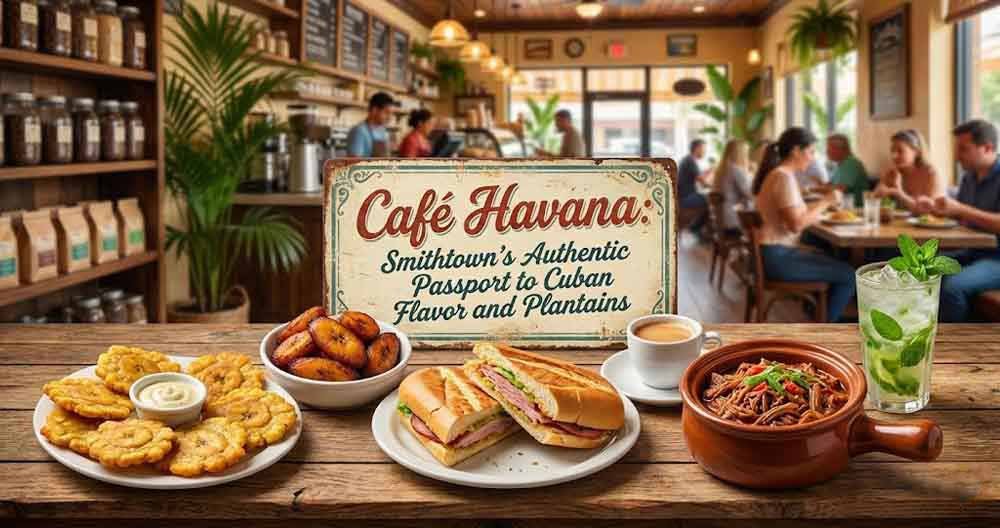
To understand Cafe Havana is to understand the plantain. This is not a garnish restaurant. The plantain here is the structural foundation of the menu, appearing in forms that range from the fried maduros tucked alongside an entrée to the towering mofongo that has become the establishment’s signature category.
Mofongo—that magnificent collision of West African technique and Caribbean ingredients—is the dish that separates a Cuban restaurant with real culinary ambition from one merely serving rice and beans. At Cafe Havana, all mofongo entrées are built on a base of green plantains, fried until golden and then smashed with garlic, olive oil, and chicharrón in the tradition that traces its roots through Puerto Rico, the Dominican Republic, and Cuba itself (Smithsonian Magazine, 2023). The origins of the dish stretch back centuries to the West African fufu—boiled and pounded starchy vegetables—that enslaved Africans adapted to Caribbean ingredients. The word “mofongo” itself derives from the Angolan Kikongo term mfwenge-mfwenge, meaning “a great amount of anything at all.” At Cafe Havana, mofongo is available with a rotating selection of proteins, and diners can substitute yuca for an additional charge—a nod to the dish’s broader Caribbean versatility.
The appetizer menu reads like a guided tour of the islands: coconut shrimp, chicken pineapple pinchos (marinated and grilled kabobs), empanadas with your choice of shrimp, chicken, or beef in a flaky pastry shell, yuca frita with garlic sauce, guava wings lacquered in house-marinated guava barbecue, coconut mussels steamed in garlic and herbs, and stuffed sweet plantains filled with seasoned beef and melted mozzarella. The Cuban Surf and Turf—pork tenderloins paired with shrimp, cayenne peppers, sweet paprika, and orange zest—is the kind of dish that announces its intentions before it arrives at the table.
For entrées, the churasco steak draws particular praise from regulars, many of whom describe it as among the best on Long Island. The marinated skirt steak sautéed with sizzling onions and house seasoning, served alongside rice, beans, and sweet plantains, represents the foundational comfort food of Cuban home cooking translated into restaurant form. The Havana Burger—a grass-fed beef patty topped with Swiss cheese, smoked ham, pickles, onions, tomatoes, and the full battery of condiments, served on either fried plantains or traditional buns—is the kind of creative hybrid that earns a place in the memory. The classic Cuban sandwich, that hot-pressed cathedral of roasted pork, smoked ham, Swiss cheese, pickles, and mustard, is executed with the reverence it deserves.
The Bar: Mojitos, Sangria, and the Art of the Caribbean Cocktail
A Cuban restaurant lives or dies by its mojito, and Cafe Havana has built a considerable reputation on the strength of its cocktail program. The mojito—that five-ingredient masterpiece of white rum, fresh lime, sugar, soda water, and mint—originated in Cuba, possibly as far back as the sixteenth century when a precursor called “El Draque” was reputedly concocted as a medicinal tonic. By the twentieth century, it had become the signature drink of La Bodeguita del Medio in Havana, the bar that Ernest Hemingway helped immortalize.
At Cafe Havana, the mojito is prepared in the traditional fashion—muddled, not blended—and available in variations that extend into coconut, passion fruit, and seasonal interpretations. The sangria program, offered in both red and white varieties, has earned its own devoted following, and the full bar extends into craft cocktails, Latin-inspired creations, and an inventory that rewards the curious drinker. Happy hour is a legitimate event here, drawing the after-work crowd from the surrounding Smithtown, St. James, and Nesconset communities.
The Lounge: When Dinner Becomes the Night
What distinguishes Cafe Havana from the majority of Long Island’s dining establishments is the downstairs lounge—a separate space with a DJ, a dance floor, and the kind of energy that transforms a Friday or Saturday night from a meal into an experience. This is not an afterthought bolted onto a restaurant concept; this is integral to the identity of the place.
The lounge hosts regular DJ nights on weekends, and the restaurant has historically offered salsa dancing lessons—a programming decision that speaks to a genuine understanding of the culture being represented. Live music appears on the calendar with regularity, and the overall atmosphere on weekend evenings has been described by patrons as closer to a Miami nightclub than a Smithtown dinner spot. Valet parking is available on weekends and for special events, a practical necessity given the energy the lounge generates.
This dual identity—refined dinner upstairs, vibrant nightlife below—is a model that has proven remarkably durable. It creates a reason to stay, a reason to return, and a reason to bring different groups of friends for different purposes. A quiet Tuesday dinner for two at 6:00 PM and a Saturday night out with a group of eight are both fully realized experiences under the same roof.
Reviews and Reputation
Across the major review platforms, Cafe Havana maintains the kind of consistent ratings that indicate genuine quality rather than hype. The restaurant holds a 4.3-star rating from over 848 OpenTable diners, a 4.5-star aggregate on Google, and strong marks on TripAdvisor where it has been ranked among the top restaurants in Smithtown. Foursquare users have given it an 8.0 out of 10 rating with consistent praise for the cocktails, the churasco, and the red snapper (TripAdvisor, 2024; OpenTable, 2025).
Recurring themes in the reviews paint a clear picture: the food is described as “always fantastic” by repeat visitors; the décor is praised as “beautiful”; the staff is noted for friendliness and professionalism; and the summer patio dining receives particular enthusiasm. The one consistent note—and this is worth mentioning for diners seeking a quiet, conversational evening—is volume. The atmosphere is lively, the music is present, and on weekend nights the energy level rises significantly. For some, this is exactly the point. For others seeking an intimate whisper-across-the-table evening, a Tuesday or Wednesday visit is the wiser choice.
As someone who has served hundreds of thousands of meals over twenty-five years at The Heritage Diner, I can tell you that consistency across nearly two decades of reviews is perhaps the most telling indicator of a restaurant’s character. Kitchens can produce a brilliant meal on any given night. Producing brilliant meals across thousands of nights, while maintaining an atmosphere that keeps people returning, requires something closer to institutional discipline—a quality that Cafe Havana clearly possesses.
Practical Information: Getting There, Getting In, Getting Fed
Address: 944 West Jericho Turnpike, Smithtown, NY 11787
Telephone: (631) 670-6277
Website: cafehavanali.com | Also operating as Coco Bistro Kitchen & Lounge
Hours:
- Sunday: 3:00 PM – 9:00 PM
- Monday: Closed
- Tuesday – Thursday: 5:00 PM – 10:00 PM
- Friday – Saturday: 5:00 PM – 11:00 PM
- Dinner only
Reservations: Available through the restaurant’s website at cafehavanali.com. Reservations are strongly recommended for Friday and Saturday evenings.
Delivery: Available through DoorDash and Uber Eats
Parking: Valet parking available on weekends and for special events. Standard lot parking available during the week.
Dress Code: Casual elegant. You will not feel out of place in a sport coat, and you will not feel overdressed either.
Private Events: The restaurant accommodates private parties, fundraising events, and special occasions. Custom cakes are available for events when pre-ordered. Outside food and beverages are not permitted.
Accessibility: Wheelchair accessible, with both indoor and outdoor seating options.
Price Range: $$–$$$ (entrées generally in the $29–$40 range per person)
Features: Full bar, happy hour, indoor fireplace, patio/outdoor dining, live music, DJ/lounge, Wi-Fi, non-smoking, outdoor smoking area
The Deeper Resonance: Why a Place Like This Matters
There is a philosophical dimension to a restaurant like Cafe Havana that extends beyond the menu and the Yelp rating. In an era when so much of Long Island’s dining culture has been flattened into the algorithmic sameness of franchise concepts and DoorDash optimization, the survival and continued vitality of an independently operated Cuban restaurant with a genuine cultural identity represents something worth celebrating.
At The Heritage Diner, I have watched this dynamic play out from the front lines for a quarter century. The restaurants that endure on Long Island are the ones that offer something you cannot replicate through a delivery app—atmosphere, identity, the irreplaceable quality of being somewhere. When Paola and I scout properties for our upcoming 2026 boutique real estate venture, Maison Pawli, one of the metrics we evaluate most carefully is the proximity of authentic, independent dining establishments. They are indicators of community health, of cultural vitality, of the kind of neighborhood character that appreciates the handmade over the mass-produced. In the same way that a Marcellino NY briefcase carries value because of the hand-stitching, the individually selected English bridle leather, and the decades of craft knowledge embedded in its construction, a restaurant like Cafe Havana carries value because every plate of mofongo and every muddled mojito represents a commitment to doing something specific and doing it well.
Cafe Havana is not trying to be everything to everyone. It is trying to be one thing—a Caribbean escape on Jericho Turnpike—and it succeeds at this with the kind of sustained excellence that only comes from genuine passion for the cuisine and the culture it represents. Whether you go for the mofongo, the churasco, the mojitos, or the Saturday night dance floor, you will leave knowing exactly where you have been. And on Long Island, that sense of place is worth more than any algorithm can calculate.
— Peter, The Heritage Diner, Mount Sinai, NY heritagediner.com/blog
Related Video: For a deeper exploration of mofongo’s rich cultural history and traditional preparation techniques, watch this excellent overview of how this iconic Caribbean plantain dish evolved from West African fufu into the culinary icon it is today: The History and Art of Mofongo – Dominican Cooking