Twenty-one years into its residency above Columbus Circle, Per Se remains the most consequential fine dining establishment operating in New York City—a restaurant that simultaneously defines and interrogates what American haute cuisine can become when filtered through classical French discipline and an almost pathological devotion to ingredient sourcing. Founded in February 2004 by Thomas Keller, the only American-born chef to hold simultaneous three-Michelin-star ratings at two restaurants, Per Se is not merely a place to eat. It is a philosophical statement rendered in pearl tapioca, sabayon, and Island Creek oysters—an argument that the act of nurturing people through food constitutes one of the highest callings available to a human being.
Peter, writing from behind the flat-top at The Heritage Diner in Mount Sinai, understands this argument viscerally. The scale differs—our griddle speaks a different language than Keller’s copper sauté pans—but the underlying grammar is identical. Excellence, as Heidegger might frame it, is not a destination. It is a mode of being. And Per Se, for all its stratospheric pricing and Columbus Circle glamour, operates within that same existential framework: every plate is an attempt to make today’s work surpass yesterday’s.
The Origins of a Culinary Monument
Thomas Aloysius Keller was born on October 14, 1955, in Oceanside, California, near Camp Pendleton, where his father served as a Marine drill sergeant (Britannica, 2025). The fifth of six siblings, raised by his mother Elizabeth after his parents’ divorce, Keller entered the restaurant world at fifteen as a dishwasher at the Palm Beach Yacht Club—too young, technically, to work the line. That dishwashing station taught him six principles he would carry through four decades: organization, efficiency, feedback, repetition, rituals, and teamwork (Academy of Achievement, 2024).
His mentor, Chef Roland Henin, posed the question that would become the foundational creed of the entire Thomas Keller Restaurant Group. In the summer of 1977, at the Dunes Club in Narragansett, Rhode Island, Henin asked the young cook: Why do cooks cook? Keller had no answer. Henin supplied one that would echo through Per Se’s dining room for the next two decades: to nurture people (W Magazine, 2025).
After training under masters at Guy Savoy, Taillevent, and Le Pré Catelan in Paris during the early 1980s, Keller opened Rakel in New York in 1986—a restaurant that showed promise but succumbed to the Wall Street crash. Years of consulting and itinerant chef positions followed before he discovered a converted French steam laundry in Yountville, California, in 1992. Nineteen months of fundraising yielded $1.2 million. The French Laundry opened in 1994 and within a decade had been named the best restaurant in the world twice by Restaurant Magazine (Wikipedia, 2025).
Per Se arrived in 2004 as the East Coast expression of that Yountville philosophy. Keller enlisted Jonathan Benno as his inaugural chef de cuisine and selected the fourth floor of what was then the Time Warner Center—now the Deutsche Bank Center—at Columbus Circle for its breathtaking views of Central Park. The restaurant’s name itself carries a quiet wit: when pressed about whether the New York venture would replicate The French Laundry, Keller kept answering, “Not per se.” The phrase stuck (The Splendid Table, 2013).
Design, Space, and the Language of Intentional Luxury
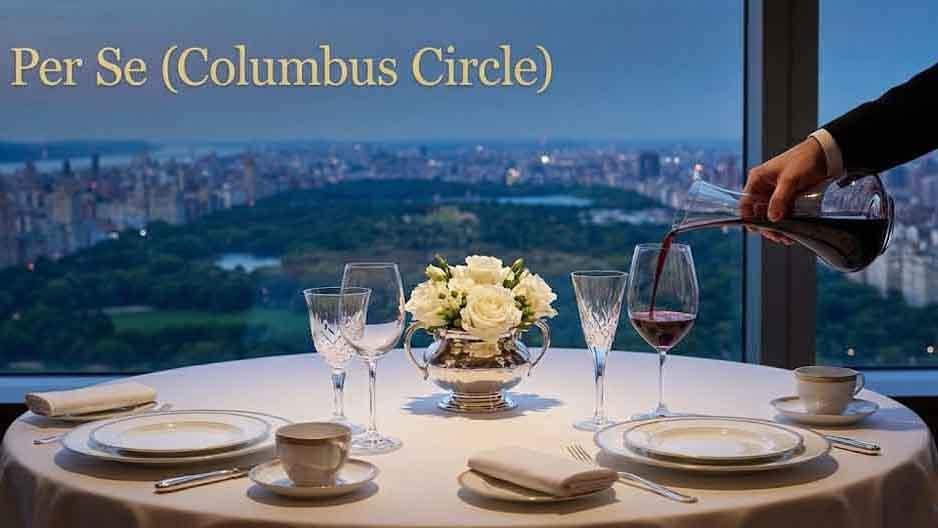
Keller commissioned restaurant and hotel designer Adam D. Tihany to translate The French Laundry’s sensibility into a Manhattan vocabulary. The result speaks in warm neutrals and natural elements—a dining room that the Michelin Guide describes as “impressively scaled, offering both stellar views of Central Park as well as precious privacy from table to table” (Michelin Guide, 2025).
The iconic blue door at Per Se’s entrance directly mirrors The French Laundry’s own blue door, though this one does not open—it functions as a symbolic threshold, a visual handshake between the two restaurants separated by three thousand miles. The wood-burning fireplace, an extraordinary engineering achievement in a modern Manhattan skyscraper, was something Keller fought to install despite the logistical complexity. Between the kitchen and the dining room lies what Keller calls “the breezeway”—a transitional corridor designed to allow service staff to decompress between what he describes as “a very violent environment” and “a very sensuous, luxurious, calm environment” (The Splendid Table, 2013).
The main dining room seats approximately sixty-two guests. Adjacent spaces include the Per Se Salon for a four-course tasting experience, the East Room for private parties of up to ten, and the WEST private dining room, which accommodates up to seventy-two seated guests or one hundred twenty for standing receptions. The wine cellar houses more than 2,000 bottles, curated to highlight both older vintages and limited-quantity releases from small producers. A bar and lounge complete the constellation of spaces (Thomas Keller Restaurant Group, 2025).
What strikes any craftsman—whether you hand-stitch English bridle leather briefcases at Marcellino NY or season a cast-iron griddle in a North Shore diner—is the relentlessness of the detail. Nothing at Per Se is accidental. The kitchen, sheathed in white tile with a French Laundry blue accent stripe running near the ceiling, was designed station by station to mirror the exact operational flow of Yountville. Each cooking position corresponds to a specific course in the tasting menu. The canapé chef alone produces twenty-five to thirty different preparations daily, only two of which appear on the printed menu.
The Menu: A Daily Act of Reinvention
Per Se offers two nine-course tasting menus daily: the Chef’s Tasting Menu and the Tasting of Vegetables. Both change every day. Keller’s cardinal rule—no single ingredient is ever repeated throughout the meal—forces the kitchen into a state of perpetual creative tension. The current Chef de Cuisine, Chad Palagi, a Napa Valley native who first joined Per Se as a commis in 2012, leads the brigade in developing these menus using classic French technique and what the restaurant describes as “the finest-quality ingredients available” (Thomas Keller Restaurant Group, 2025).
The main dining room tasting menus are priced at $425 per person, inclusive of service. Optional supplements—caviar, wagyu, white truffles, foie gras—can elevate that figure considerably. The extended “evolution” menus, introduced several years ago, reached $925 per person as of early 2025 (The Lo Times, 2025). A four-course tasting menu in the Per Se Salon offers a more accessible entry point, with a $150 per person deposit securing the reservation.
Certain dishes have achieved the status of culinary scripture. Oysters and Pearls—a sabayon of pearl tapioca with Island Creek oysters and White Sturgeon caviar—has been on the menu since the restaurant’s opening and remains what Michelin calls a “reliable, thrilling bookend.” The salmon cornet, a savory ice-cream-cone-shaped tuile filled with red onion crème fraîche and salmon tartare garnished with a single chive, traces its inspiration to a Baskin-Robbins visit where Keller conceived the idea of inverting the ice cream cone into something elegant. Coffee and Donuts—a cappuccino semifreddo paired with cinnamon-sugar beignets—closes the meal with the kind of highbrow-lowbrow playfulness that defines Keller’s entire career.
The wine program, overseen by trained sommeliers including General Manager Sandra Bohlsen (who holds a Level 3 certification from the American Sommelier Association), complements the food with what the restaurant calls “an award-winning wine list, boasting more than 2,000 bottles.” Pairings are available, or guests may navigate the list with guidance from the service team (The Shops at Columbus Circle, 2025).
The Kitchen Team and the Culture of Mentorship
Per Se’s kitchen operates as both a working restaurant and an academy. Keller’s philosophy of mentorship—codified through the Ment’or BKF Foundation, which he co-founded with Daniel Boulud and Jérôme Bocuse to support young American chefs and the U.S. Bocuse d’Or team—runs through every station. In 2017, Keller and Boulud led Team USA to its first-ever gold medal at the Bocuse d’Or, the competition widely regarded as the Olympics of the culinary world (Thomas Keller Restaurant Group, 2025).
Chad Palagi represents the fourth generation of chefs de cuisine at Per Se. His journey—commis to sous chef, a departure to serve as chef de cuisine at Michelin-starred Rich Table in San Francisco, then a return to Per Se in 2021—exemplifies the kind of career arc the restaurant was designed to foster. Elaine, the restaurant’s pastry leader, arrived in 2012 and has progressed through positions from Chef de Partie to Bread Baker to Sous Chef and Culinary Liaison. Sandra Bohlsen, originally from Germany, has risen from Captain to Maître d’ to General Manager since joining in 2013 (The Shops at Columbus Circle, 2025).
This institutional commitment to internal development mirrors something we practice at a much smaller scale on Route 25A. Whether you are training a new line cook at The Heritage Diner or apprenticing a stitching technique at the Marcellino NY workshop in Huntington, the principle holds: mastery is transmitted person to person, hand to hand, year over year.
Critical Reception: Triumphs, Trials, and the Resilience of Standards
Per Se’s critical history reads like a philosophical treatise on impermanence. In 2005, the restaurant earned three Michelin stars in the inaugural New York City Guide—a distinction it has maintained without interruption for two decades. The James Beard Foundation has honored Keller with both “Outstanding Chef” and “Outstanding Restaurateur” awards. In 2011, the Michelin Guide’s Mentor Chef Award recognized his role in developing the next generation of culinary talent.
Sam Sifton of The New York Times awarded Per Se four stars in 2011, calling it the best restaurant in New York City. Then came January 2016, when Sifton’s successor, Pete Wells, dropped the restaurant to two stars in a review that sent shockwaves through the industry. Wells described the experience as “respectably dull at best to disappointingly flat-footed at worst” and noted issues with both execution and value at the restaurant’s then-$325 price point (The New York Times, 2016).
Keller’s response revealed more about his character than any accolade ever could. Rather than attacking the critic or retreating into defensiveness, he issued a public statement of remarkable humility: “The fact that The New York Times restaurant critic Pete Wells’ dining experiences at Per Se did not live up to his expectations and to ours is greatly disappointing to me and to my team. We pride ourselves on maintaining the highest standards, but we make mistakes along the way. We are sorry we let you down” (Yahoo News, 2016).
Months later, speaking to The New Yorker, Keller offered an even more revealing reflection. He admitted the review was “devastating” but acknowledged: “Maybe we were complacent. I learned that, maybe, as a team we were a little bit too arrogant, our egos too exposed” (Gothamist, 2016). He visited each of his restaurants, reassuring a staff of over one thousand that the world was not ending, framing the critique as a “missed opportunity” rather than a final verdict.
The Michelin Guide never wavered. Per Se retained its three stars through the entire episode and continues to hold them in 2025. A late-2024 New York Times “Critic’s Notebook” column by interim co-critic Melissa Clark offered a more nuanced assessment, praising desserts and certain courses while questioning whether Keller’s food remained “exceptional in a dining landscape that he is largely responsible for creating” (The Lo Times, 2025). The restaurant also maintains membership in the French-based Relais & Châteaux, Relais Gourmands, and Traditions & Qualité organizations.
For anyone who has weathered a bad review, a slow Tuesday night, or a health inspection that exposed a blind spot, Keller’s response to Wells stands as a masterclass in professional accountability. As Marcus Aurelius wrote in Meditations: “The impediment to action advances action. What stands in the way becomes the way.”
Community, Philanthropy, and the First-Time Diners Program
Beyond the tasting menus and the critical discourse, Per Se maintains a commitment to culinary access that rarely receives the attention it deserves. The restaurant periodically hosts complimentary First Time Diners Lunches—seven-course experiences open to guests who have never dined at the restaurant. A companion Children’s First Time Diners Lunch introduces young people to the fine dining tradition. These programs, visible on the restaurant’s Tock booking platform, reflect Keller’s stated belief that the purpose of cooking is fundamentally to “make people happy” (Exploretock, 2025).
Keller’s philanthropic footprint extends through the Ment’or BKF Foundation, which supports emerging American chefs through grants, mentorship, and Bocuse d’Or competition training. His consultancy work on Pixar’s Ratatouille brought his philosophy of culinary excellence to an audience of millions, embedding the message that passion and skill can emerge from the most unlikely origins—a message as relevant to a fifteen-year-old dishwasher in Palm Beach as to a diner cook on Long Island’s North Shore.
The 2025 Netflix documentary Chef’s Table: Legends dedicated an episode to Keller, examining his trajectory from that Palm Beach Yacht Club dishpit to the summit of American gastronomy. The episode features Grant Achatz calling Keller “the president” and “the single person that everybody looks to as the best” (Wine Spectator, 2025). The film contextualizes Per Se not merely as a restaurant but as an institution that shaped the vocabulary of an entire profession.
The Experience: What to Know Before You Go
A meal at Per Se requires both financial preparation and logistical awareness. Reservations are made exclusively through the Tock platform at exploretock.com/perse. The restaurant operates daily for dinner service from 4:30 PM to 9:00 PM. The dress code, while not explicitly rigid, reflects the gravity of the setting—jackets are customary for men, and the general expectation aligns with what you would wear to any occasion where you are investing over $400 per person before wine.
The dining room’s floor-to-ceiling windows face Columbus Circle and Central Park, and sunset over the park provides what one reviewer called “the most dramatic urban view of any three-Michelin-starred restaurant in the world” (Travels for Stars, 2025). Guests with dietary restrictions, allergies, or preferences should communicate these at the time of booking; the kitchen has a documented history of creating custom courses—including spontaneous sorbets for guests with fruit allergies.
A gift bag of mignardises accompanies every departing guest, extending the experience beyond the restaurant’s walls. It is a gesture that echoes something Peter Joe, briefcase maker at Marcellino NY, understands in his bones: the final touch—the way a handle is turned, the way a closing stitch is set, the way a last chocolate is wrapped—tells the client everything about whether the craftsman cares about the work or merely about the transaction.
Contact Information:
Per Se 10 Columbus Circle, 4th Floor New York, NY 10019 (Deutsche Bank Center, The Shops at Columbus Circle)
Phone: (212) 823-9335 Website: thomaskeller.com/perseny Reservations: exploretock.com/perse Instagram: @perseny (324K+ followers) Hours: Dinner daily, 4:30 PM – 9:00 PM
Tasting Menu: $425 per person (service included) Salon Four-Course Menu: Available with $150 per person deposit Evolution Menu: $925 per person
Michelin Rating: ★★★ (Three Stars — Exceptional Cuisine, held continuously since 2006)
Accolades: Relais & Châteaux member; James Beard Foundation honoree; Netflix Chef’s Table: Legends (2025); La Liste Top Ten; Michelin Guide Mentor Chef Award (2021)
Private Dining: WEST accommodates up to 72 seated / 120 standing; East Room up to 10 guests
YouTube — Thomas Keller’s Signature Salmon Cornets (Recreation): https://www.youtube.com/watch?v=90VYTI8k87U
Written by Peter from The Heritage Diner — 25 years at 275 Route 25A, Mount Sinai, NY. Graduate degrees in Philosophy from Long Island University and The New School in NYC. Founder of Marcellino NY bespoke leather goods, Huntington, NY. Co-founder with broker Paola of Maison Pawli boutique real estate, launching 2026.