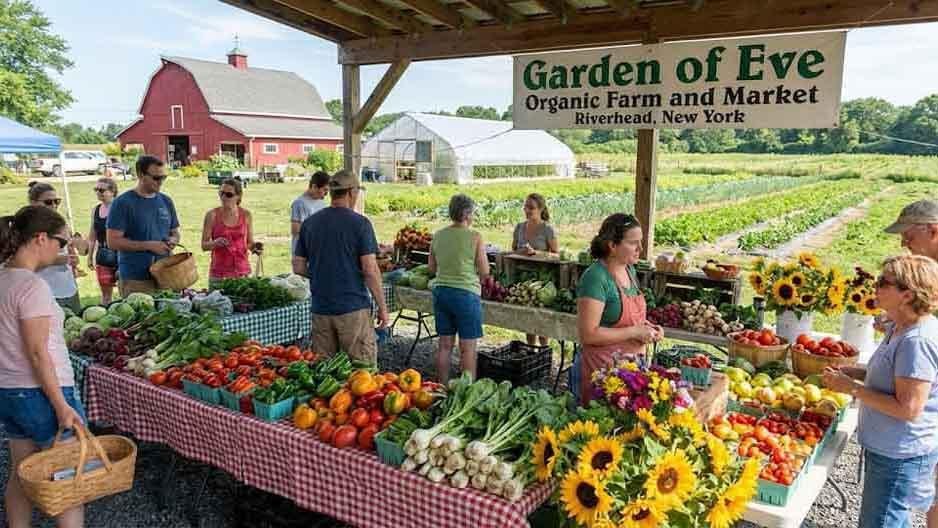
Forty dollars. That is what Chris and Eve Kaplan-Walbrecht earned the first time they hauled surplus zucchini from their quarter-acre backyard garden to a local farmers market in Riverhead. The year was 2001, and neither of them had any formal training in vegetable farming. He had spent a decade as a clean water organizer for the Citizens Campaign for the Environment, raised on a conventional dairy farm in upstate New York, where he learned early that the chemicals coursing through American agriculture left scars on the land and the people working it. She held degrees from Harvard in Environmental Science and from the University of Wisconsin–Madison in Conservation Biology, and had been mapping preservation corridors for the North Fork Environmental Council and serving as Principal Planner for the Town of Southampton. They met at a Save the Sound gathering in 2000, and within a year they had traded policy meetings for seed trays — convinced that the most honest form of environmental advocacy was growing food without poison and handing it to your neighbors (Garden of Eve Farm, About Us; FoodPrint, 2019).
Two and a half decades later, Garden of Eve Organic Farm stands as one of Long Island’s most significant agricultural institutions — a USDA-certified organic operation spanning roughly 85 acres along Sound Avenue at the gateway to North Fork wine country, producing over 70 varieties of vegetables, 20 varieties of herbs, and 30 varieties of flowers without a single synthetic pesticide or herbicide touching the soil (Garden of Eve Farm, 2025). Its story is one of radical persistence: a husband and wife who chose the harder path, proved that organic agriculture could thrive on one of the most expensive parcels of earth in the Northeast, and then made the even harder choice of knowing when to evolve.
From a Quarter-Acre Garden to an 85-Acre Proving Ground
The trajectory of Garden of Eve reads like an agricultural parable about stubbornness and soil. Chris Kaplan-Walbrecht graduated from SUNY Cobleskill with a degree in Geology, but it was the memory of chemical exposure on his family’s dairy operation that steered his conscience toward organic methods. As he told the Riverhead News-Review in a 2018 profile: he farmed 60 acres of certified organic vegetables and grew between 85 and 100 different crop varieties — a staggering level of diversification in an industry that rewards monocropping (Riverhead News-Review, 2018). Eve’s academic credentials were equally unconventional for a farmer. Her Harvard education in environmental science and her graduate research at Wisconsin gave her a rare fluency in both land-use policy and ecological systems thinking. While Chris was planting cover crops and rotating fields, Eve was navigating the bureaucratic architecture of municipal planning — skills that would prove essential as the farm grew into a complex agri-tourism destination drawing as many as 25,000 visitors annually (Suffolk Times, 2023).
Their initial expansion from weekend garden to commercial operation happened with remarkable speed. By the mid-2000s, the farm had grown to include pastured laying hens — eventually reaching a flock of over 1,000 birds — and a farm team that swelled to nearly 20 members. Two children arrived during this period: Forest in 2005 and Shira in 2007, both raised quite literally in the rows between the crops (Garden of Eve Farm, About Us). The farm stand, which began as a modest roadside operation, evolved into a full-scale market and garden center offering organic produce, eggs, flowers, birthday parties, school tours, a children’s play area, farm animals, and an on-site organic café that drew weekend crowds from across the Island and beyond.
The CSA Model and the Urban-Rural Bridge
One of Garden of Eve’s most consequential decisions was its early commitment to Community Supported Agriculture. The CSA model — in which customers purchase advance shares of a season’s harvest, providing farmers with upfront capital and predictable revenue — became the economic backbone of the operation. At its peak, the program served nearly 1,000 households across 20 pickup locations stretching from Long Island into Brooklyn, Queens, and Manhattan (Garden of Eve Farm, CSA; Just Food). For a small family-operated organic farm on the East End, running 18 CSA sites including 13 in New York City was an extraordinary logistical feat.
Eve Kaplan-Walbrecht articulated the philosophy behind their CSA model in a 2019 interview with FoodPrint, explaining that the subscription-based system offered both security for the farmer and connection for the consumer. Without CSA members, she noted, the farm could not exist — and without the farm, the land would inevitably face the same development pressures consuming agricultural parcels across the East End (FoodPrint, 2019). This was not theoretical concern. Property taxes on Long Island are among the highest in the nation. Electricity costs in Suffolk County outpace nearly every other jurisdiction in the country. Trucking supplies from Pennsylvania — the nearest hub for hay, straw, livestock, and tractor equipment — requires navigating the congestion of New York City, sometimes with oversize permits across the Throggs Neck Bridge. The economics of small-scale organic farming on Long Island are, by any rational measure, adversarial. That Garden of Eve thrived under these conditions for over two decades speaks to both the Kaplan-Walbrechts’ tenacity and the depth of demand for what they were producing.
Farmland Preservation and the $4.6 Million Commitment
In late 2022, Chris and Eve made one of the most significant land preservation decisions in recent Suffolk County history: they sold the development rights to 66 acres of their property for $4.6 million, permanently guaranteeing that the land cannot be converted to residential or commercial development (Riverhead News-Review, 2023; Newsday, 2022). The sale was executed through Suffolk County’s Farmland Development Rights Program — the first initiative of its kind in the United States, established in 1974 under then-County Executive John V.N. Klein.
The decision carried both financial and philosophical weight. Garden of Eve had already served as the backdrop for Suffolk County Executive Steve Bellone’s 2021 announcement of the “100 for 10 Farmland Preservation Initiative,” a $100 million, decade-long commitment to preserving the remaining 10,000 acres of at-risk farmland across the county (RiverheadLOCAL, 2021; Behind the Hedges, 2021). Standing at the edge of a field being prepared for planting, Bellone invoked the county’s agricultural heritage — 560 farms generating $226 million in annual sales, ranking Suffolk fourth statewide in total market value of agricultural goods, and employing more than 4,600 people. In April 2024, County Executive Ed Romaine returned to Garden of Eve to sign legislation increasing the annual farmland preservation appropriation from $10 million to $15 million, calling the fight against development pressure an existential one for the county’s character (RiverheadLOCAL, 2024).
Eve’s father originally purchased the land in 1977, saving it from an earlier development cycle. That her family would, a generation later, permanently protect the same acreage carries the kind of narrative weight that transcends agricultural policy and enters the territory of legacy. As Eve told reporters at the 2021 press conference: after twenty years of building something and putting your heart into it, the most important thing is ensuring it remains a farm (RiverheadLOCAL, 2021).
The Waterdrinker Transition and a Return to Roots
In May 2023, the Kaplan-Walbrechts announced that the public-facing portion of their operation — the farm stand, garden center, agri-tourism events, and seasonal festivals that had drawn tens of thousands of visitors annually — would be leased to the Weiss family, owners of Waterdrinker Family Farm & Garden in Manorville. Waterdrinker took over management of approximately 20 acres and the retail building on the east side of the property, while Garden of Eve continued organic farming operations on the remaining west side acreage (Suffolk Times, 2023; Riverhead News-Review, 2023).
The transition was not a retreat but a recalibration. Eve described the decision as a return to where they started — with farmers markets, the CSA program, and direct relationships between grower and consumer. The labor pressures, operational complexity, and physical toll of running a full-scale agri-tourism destination had accumulated over two decades, and the Kaplan-Walbrechts chose to simplify rather than burn out. They also expressed satisfaction that Waterdrinker pledged to farm their leased portion organically, preserving the integrity of the soil they had spent a quarter century building (Patch, 2023).
Waterdrinker opened their North Fork location on September 1, 2023, at 4560 Sound Avenue, bringing their signature family entertainment — barnyard animals, miniature golf, corn mazes, a beer garden operated by Long Island Farm Brewery, seasonal festivals, and the kind of agri-tainment programming that has become a staple of the East End autumn experience (Greater Long Island, 2023; Northforker, 2023). They also relocated the beloved annual Garlic Festival to their Manorville location, continuing a tradition Garden of Eve had hosted for 21 years.
Organic Advocacy and the Next Generation
Even as the farm stand chapter closed, Garden of Eve’s mission expanded in new directions. Eve Kaplan-Walbrecht turned her attention to an organic transition program aimed at teaching Long Island farmers how to convert their operations from conventional to certified organic methods — a direct response to the reality that only a handful of Long Island’s hundreds of farms operate without synthetic chemicals (Patch, 2023). The farm also partnered with community organizations to support the Young Farmers program, hosting fundraising events like the Rodney Anderson Memorial Cornhole Tournament at Riverhead Ciderhouse in January 2026, honoring the legacy of a program leader who championed agricultural education for a new generation (Garden of Eve Farm, 2026).
The CSA program continues operating with pickup locations across Long Island and throughout Brooklyn, Queens, and Manhattan, along with home delivery in Suffolk County. The farm’s 2025 summer/fall shares offered biweekly distributions of seasonal organic produce — a quieter, more focused version of what Garden of Eve has always done best: growing exceptional food in soil that has never known a synthetic molecule, and delivering it directly to the people willing to invest in that quality (Garden of Eve Farm, CSA, 2025).
Chris Kaplan-Walbrecht still farms 45 or more organic acres on Sound Avenue. Eve still runs the CSA logistics and consults on sustainable agriculture and food policy. Their operation remains certified by the Northeast Organic Farming Association and USDA, and they hold recognition from the Real Organic Project — a label reserved for farms committed to soil-grown and pasture-raised production standards that go beyond the minimum USDA organic requirements (Real Organic Project, 2023).
A Living Argument for What Endures
Peter from the Heritage Diner has spent 25 years watching businesses rise and fall along Long Island’s North Shore and East End corridors. The ones that survive share a common trait: they are built on conviction rather than convenience. Garden of Eve Organic Farm represents perhaps the purest expression of that principle in Suffolk County’s agricultural landscape. Chris and Eve Kaplan-Walbrecht did not become farmers because it was easy or lucrative. They became farmers because they believed that the way food is grown matters — to the soil, to the water, to the bodies of the people eating it, and to the future of the land itself.
The $4.6 million development rights sale ensures that 66 acres of Sound Avenue will never sprout condominiums or strip malls. The organic transition program plants seeds in a different kind of soil — the minds of younger farmers who might otherwise default to the chemical shortcuts that dominate American agriculture. And the CSA program, now entering its third decade, continues to prove that a direct relationship between farmer and eater is not a nostalgic relic but a viable economic model capable of sustaining a family, a community, and an ideal.
Garden of Eve does not have a DoorDash listing or a celebrity spokesperson. What it has is certified organic produce grown in soil that has been tended with care since 2001, a family that chose the hardest path available to them and walked it for a quarter century, and an 85-acre parcel at the edge of wine country that will remain farmland long after anyone reading this sentence is gone. That is a legacy worth driving 80 miles from the city to taste.
Contact Information:
Garden of Eve Organic Farm 4558 Sound Avenue Riverhead, NY 11901 Phone: (631) 722-8777 Email: farmer@gardenofevefarm.com Website: gardenofevefarm.com Instagram: @gardenofevefarm CSA Sign-Up: gardenofevefarm.com/csa
Note: The on-site Farm Market and Garden Center is no longer operated by Garden of Eve. That portion of the property is now managed by Waterdrinker Family Farm & Garden (Waterdrinker North Fork). Garden of Eve continues its organic farming operation and CSA program. Produce is available through CSA membership, farmers markets in Brooklyn and Long Island, and home delivery in Suffolk County.