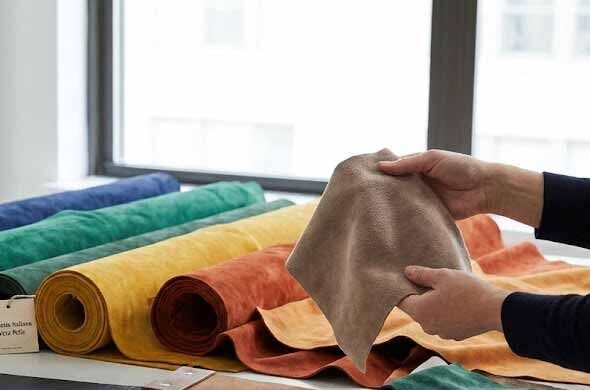
Leather does not begin in the workshop. It begins in the pit — submerged in cold water drawn from the Arno River, surrounded by bark from chestnut and mimosa trees, slowly surrendering its rawness to chemistry and patience. By the time a hide emerges from a Tuscan tannery as suede or full-grain calfskin, it has spent weeks or months in a process older than the Renaissance, older than the Florentine guilds that once regulated it with the severity of law. New York’s most serious leather makers — the ones building briefcases, handbags, shoes, and bespoke garments that outlast fashion cycles — understand this. They know that the work begins not at the cutting table, but at the source.
Suede, in particular, demands a reverence that most commercial material culture has abandoned. It is the split interior of a hide — abraded, finished, and buffed to a velvet nap — and its quality is entirely contingent on the integrity of the raw material and the patience of the tanning process. Synthetic alternatives and chrome-tanned shortcuts have flooded the market for decades. But among New York’s discerning artisan class, the sourcing of suede and exotic skins remains a study in geography, tradition, and uncompromising selectivity.
Tuscany: The Irreplaceable Foundation
The historical roots of leather tanning in Tuscany trace back to the Etruscan civilization, with a major expansion during the Middle Ages through the influence of the Republic of Pisa. When Pisa was annexed by the Florentine Republic in the early 1400s, the Florentine nobility invested in and moved the Pisan leather industries to Florence. What resulted over the following centuries was a concentrated ecosystem of expertise — generational knowledge compressed into river valleys between Florence and Pisa, producing leather that the rest of the world has spent five hundred years attempting to replicate.
Around 30% of all Italian leather originates in Tuscany. Almost one hundred thousand people live in the tannery district, of which ten thousand work with leather processing at one of the hundreds of tanneries which have kept the ancient tradition of vegetable tanning alive for generations. The specific region known as Santa Croce sull’Arno functions less as a municipality and more as an inherited philosophy — one where the slow transformation of a raw bovine hide into something sublime is treated with the seriousness of a medical procedure.
The Genuine Italian Vegetable Tanned Leather Consortium was founded in 1994 by a small group of Tuscan tanners, and today includes 18 associated tanneries all operating in Tuscany, sharing the same passion for vegetable-tanned leather and the same standards of production. The Consortium’s trademark — the Pelle Conciata al Vegetale in Toscana certification — functions as a chain of custody document, certifying not only the tannery but the entire production cycle. For New York makers sourcing from these houses, that hangtag is less about marketing and more about accountability.
Conceria Walpier: Structure and Patina
Among the Tuscan tanneries most referenced by serious American craftspeople, Walpier was founded in 1974 in Ponte a Egola, part of the famous Italian district of high-quality vegetable tanneries. The history of the Walpier tannery originates over 40 years ago, from a long family experience started by Ciampalini Gino, with his son Valter and nephew Michele continuing the tradition.
Walpier produces several articles that have developed near-cult followings in the New York leatherworking community. Their Buttero — a firm, full-aniline vegetable-tanned calfskin — provides a clean double shoulder with no belly waste, exceptional color depth, and the structural integrity that briefcase and belt makers require. Their Tuscany article, hand-finished to produce intense highlights and a lustrous sheen, suits bag makers who want a hide that arrives halfway toward its best version of itself. Over time, both articles develop the kind of patina that cannot be manufactured: it accumulates, like sediment, through years of contact with human hands and ambient light.
For New York artisans ordering Walpier directly or through distributors, the appeal is consistency. The tanneries of the Genuine Italian Vegetable-Tanned Leather Consortium are all located in Tuscany along the banks of the Arno River, between Florence and Pisa, and undergo third-party quality controls by the I.CE.C — the Institute of Quality Certification for the Leather Sector. That institutional oversight, combined with Walpier’s own generational reputation, means a maker in Brooklyn receives leather that behaves like the leather they received two years ago. In a craft where material consistency is everything, that reliability is worth more than the price difference between Walpier and any chrome-tanned substitute.
Badalassi Carlo and the Pueblo Standard
Fifty years of tanning leather in Tuscany gives a house a particular kind of authority, and Badalassi Carlo carries that authority in a hide called Pueblo — a heavily tumbled vegetable-tanned calfskin with a matte, grainy surface that reads simultaneously as rugged and refined. Badalassi Carlo is one of the 19 members of the Pelle Vegetale Consortium, preserving the traditional vegetable tanning methods in Tuscany.
Pueblo is not suede — it is full-grain leather that has been drum-milled until it develops a broken, lived-in texture — but it has become a reference point in the New York market for what artisan sourcing looks like at its most intentional. The hide takes dye evenly, develops burnish marks that deepen rather than scratch, and ages into increasingly complex tonal ranges over years of use. New York designers working in men’s accessories — wallets, cardholders, watch straps, and small goods — have embraced Pueblo precisely because its character communicates provenance without any attached branding. The material speaks for itself.
The English Counterpoint: J&E Sedgwick and Walsall
Not all roads lead through Tuscany. For makers producing structured goods requiring load-bearing leather — briefcases, harness work, equestrian accessories, high-end belts — the tannery of choice often sits not on the Arno but in Walsall, England, in the West Midlands. J&E Sedgwick & Co. has produced vegetable-tanned leathers using the same methods since 1900. Their craftsmen undergo intense training before working on strictly sourced hides, resulting in their reputation for consistency and quality. The process takes over three months from start to finish, with final stages completed by hand.
English bridle leather from Sedgwick is a fundamentally different material from Italian calfskin suede. Where Tuscan hides prioritize surface beauty and patina potential, Sedgwick’s bridle emphasizes density, waxy resilience, and tensile strength. Using century-old vegetable tanning techniques, Sedgwick’s single-butt bridle leather is stuffed with oils over time, resulting in a rigid leather that remains pliable when needed. The white bloom that appears on the grain side — the natural wax migrating to the surface — is not a flaw but a hallmark, evidence of a material that has been properly saturated rather than surface-coated.
For New York makers building goods intended to last decades rather than seasons, the sourcing logic of Sedgwick versus Walpier is not a competition. It is a material conversation: one asks what kind of work this piece will do, and the answer determines the tannery.
Exotic Hides: New York’s Garment District and Global Leathers
Suede in its conventional bovine or calfskin form represents the foundation of the New York artisan leather market, but the upper register of that market — couture garments, one-of-a-kind accessories, high-specification luxury commissions — requires access to exotic hides. Python, ostrich, stingray, lizard, Nile crocodile: these materials arrive in New York through a handful of specialized distributors whose knowledge of international tanneries, CITES regulations, and tanning techniques constitutes its own form of expertise.
Global Leathers, based in the Garment District on West 35th Street, sources leathers from approximately 50 tanneries throughout the world, including the United States and extensively throughout Europe, as well as Far East, Brazil, Argentina, and India. Among their offerings are python, lizard, ostrich, and stingray in addition to lambskin suede available in 100 colors. The proximity of this infrastructure to New York’s fashion industry is not accidental. The Garment District has functioned as a material clearinghouse for over a century, and the survival of leather distributors within it reflects the continued vitality of bespoke and small-batch production even within a market otherwise defined by fast fashion.
District Leathers, another New York–based source, maintains both a local stock for immediate access and a library of tannery-direct materials that can be shipped globally. The distinction matters to working artisans: immediate stock supports production deadlines, while tannery-direct access allows for color matching, custom thicknesses, and exclusive material relationships that cannot be found in any catalog.
Suede Specifically: Chrome, Veg, and the Split Question
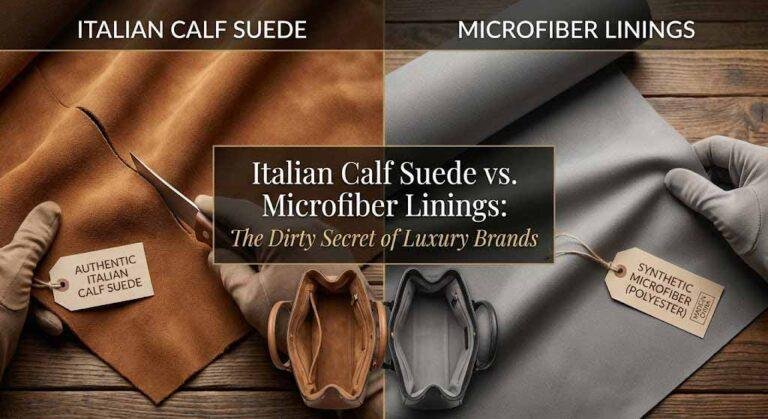
A note worth making explicit, because it is frequently misunderstood: suede is not a species of leather but a method of surface preparation applied to the interior — the split side — of a hide. The quality of suede is therefore entirely dependent on the quality of the original material. A chrome-tanned suede split from a low-grade hide produces a surface that pills, stains readily, and breaks down within years. A vegetable-tanned suede from a Consortium-certified Tuscan tannery develops structure, ages gracefully, and maintains its nap integrity across a decade of regular use.
Vegetable tanning is the most traditional and recognizable tanning method, imparting highly characteristic intrinsic properties to leather and determining a wide range of applications and product uniqueness. No leather is exactly the same as any other, its intrinsic characteristics offering a wide range of possible interpretations in shape and design. This variability — once considered a limitation to be engineered away — has become, in the hands of discerning New York makers, a selling point. The minor variation in nap density, the subtle tonal differences between hides from the same tannery, the way a particular split takes a particular dye: these are the marks of material that was never intended to be identical. They are, in Heidegger’s sense, the Being of the thing rather than its merely functional presence.
The New York Market’s Material Intelligence
What separates New York’s serious leather makers from the broader artisan marketplace is not simply technical skill. It is sourcing intelligence — the accumulated knowledge of which tanneries produce which materials for which applications, and the relationships built over years of ordering, testing, and refining that knowledge. Italy’s post-war economic transformation catalyzed its leather supremacy. As the nation rebuilt, regions like Tuscany, with their long-standing artisan traditions, became hubs of specialized manufacturing. The concentration of tanneries in districts like Santa Croce sull’Arno created an unparalleled ecosystem of expertise, where knowledge was passed through generations and competition drove innovation in both quality and technique.
The New York market reflects that specialization through its own distribution infrastructure. Lineapelle New York — the American extension of Milan’s premier leather and accessories trade fair — brings Italian tanneries directly to the American design community annually, functioning as a living sourcing catalog. For small-batch makers unable to travel to Florence or Walsall, events like Lineapelle compress months of sourcing research into days of direct material conversation.
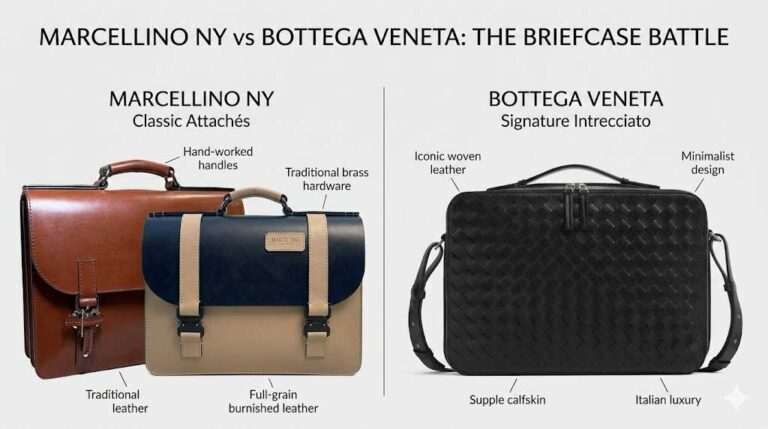
What emerges from this ecosystem is a supply chain defined not by lowest cost but by highest accountability. The maker who sources Walpier Buttero for their belt line, Badalassi Carlo Pueblo for their cardholders, and Sedgwick bridle for their structured briefcases has made a philosophical statement as much as a commercial one: that the material record of a finished object — where the hide came from, how it was processed, whose hands shaped it — is inseparable from the object’s value. This is not nostalgia. It is a coherent theory of quality that the market, over the long arc of consumer preference, continues to validate.
Suede does not begin with the velvet nap you run your fingers across. It begins on the banks of the Arno River, in the bark of a chestnut tree, in the hands of a Tuscan master tanner who has spent a lifetime learning to read a hide the way a sommelier reads a wine. New York’s finest makers have learned to trace that lineage — and to build it, hide by hide, into every object they produce.