Darkness is not simply an absence of light. It is a force. A thermodynamic condition. A selective pressure that shapes biochemistry, morphology, and the very architecture of mind over geological timescales. Adrian Tchaikovsky’s 2025 novel Shroud — published by Tor Books in February of that year — operates from this premise with such scientific rigor and imaginative ferocity that the moon at the center of its narrative functions less as a setting and more as a theorem. A proof, rendered in ammonia fog and crushing atmospheric weight, that life does not require our conditions. It only requires conditions.
For readers steeped in the conventions of science fiction, the first-contact narrative has grown comfortable in its anthropocentrism. Star Trek offered universal translators. Doctor Who offered sonic screwdrivers. Aliens, by and large, have tended to be humans in interesting costume — creatures whose biology falls just outside our own but whose cognition maps neatly onto ours. Tchaikovsky, who won the Arthur C. Clarke Award for Children of Time in 2016 and the Hugo Award for Best Series in 2023 for that trilogy, has spent the better part of a decade systematically dismantling this assumption. With Shroud, he has pushed further than anything he has attempted before — into the realm of genuine astrobiological speculation, into the hard physics of hypergravity environments, and into the thermodynamic logic of life evolving in a world where photosynthesis is simply not an option.
The result, as ESA astronaut Tim Peake wrote in his blurb for the novel, is “thrilling, terrifying and fascinating in equal measure.” Physicist and broadcaster Jim Al-Khalili described it more plainly: “Shroud is probably the most alien world anyone could possibly imagine.”
What they are responding to is not just imaginative ambition. They are responding to the underlying science — and it is worth examining that science in full, because it tells us something profound about what life actually requires, what survival actually demands, and what thermodynamic systems make possible in the darkness where stars are too distant to matter.
The Moon That Should Not Support Life
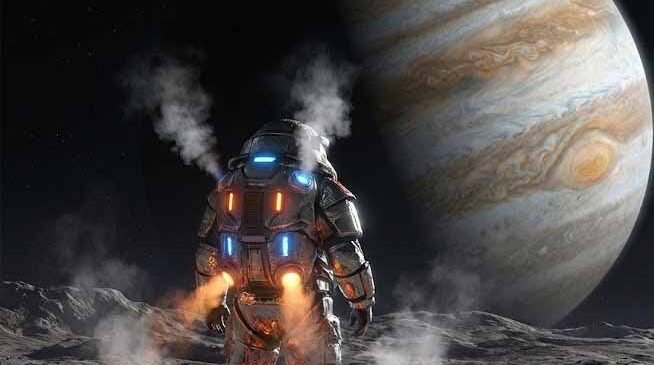
The moon Tchaikovsky calls Shroud orbits a gas giant in the Prospector413 star system, so far from its sun that stellar radiation is functionally irrelevant to its surface ecology. It is tidally locked to the gas giant, meaning one face perpetually points inward toward the planet — but this provides no warmth, no light. Its atmosphere is dense beyond reckoning: surface pressure runs at approximately twenty times Earth’s sea level. The composition is anoxic — no free oxygen — laced with methane and ammonia and hydrogen, the kind of atmospheric chemistry that predates Earth’s Great Oxidation Event of roughly 2.4 billion years ago by its biochemical logic, though not by its scale. Temperatures at the surface fall well below zero. There is no visible light. None.
And yet the moon screams.
It emits electromagnetic radiation across every observable band — a constant, all-frequencies storm of radio traffic that blazes on every instrument the crew of the Garveneer possesses. As Tchaikovsky writes in the novel, the moon “howled into space, shrieking its pain far out across the void in a thousand tongues.” To the human scientists studying it from orbit, this signal is indecipherable noise. To the native inhabitants — the hive intelligence the protagonist Juna Ceelander eventually names the Shrouded — it is the native language of thought itself.
The science behind Shroud’s habitability, such as it is, required Tchaikovsky to consult directly with real researchers. In an essay published in SciFiNow on the occasion of the novel’s release, he describes attending a talk at Eastercon — the UK’s national science fiction convention — given by William Bains, a Cambridge astrochemist and MIT researcher whose work focuses on exotic biochemistries and biosignature gases for exoplanet research. That conversation, which ran for several hours and during which Tchaikovsky “feverishly scribbled notes,” produced the foundational parameters of Shroud’s ecology. (Scifinow.co.uk, 2025)
What Bains helped Tchaikovsky understand is that life does not require photosynthesis. It requires thermodynamic disequilibrium — a difference between energy states that can be exploited to do chemical work. On Earth, the primary driver of that disequilibrium is stellar radiation arriving at roughly 6,000 Kelvin and interacting with a planetary surface at roughly 300 Kelvin. The gap between those temperatures is enormous, and photosynthetic life evolved to harvest it. But there are other energy gradients. Volcanic heat. Tidal flexing from gravitational interaction with a gas giant parent body, the same mechanism that keeps Jupiter’s moon Io volcanically active and that may sustain liquid water beneath Europa’s ice crust. Chemical gradients between different compounds in a dense, reactive atmosphere. On Shroud, as one reviewer described the novel’s internal ecology, life gets its energy from “planetary radiation, vulcanism, and a tiny greenhouse effect” — a combination not unlike what astrobiologists currently theorize sustains chemosynthetic ecosystems around deep-sea hydrothermal vents on Earth, where sunlight has never reached. (The Pinocchio Theory, 2025)
This is not fantasy biology. The Proceedings of the Royal Society of London published a foundational paper as early as 1975 — “Thermodynamics and the Recognition of Alien Biospheres” — establishing that the hallmark of a mature biosphere is not visible light activity but thermodynamic disequilibrium: the presence of chemical signatures in atmosphere and surface composition that diverge from what purely abiotic chemistry would produce. A biosphere changes its world. Shroud’s electromagnetic output is precisely this kind of signature, writ large and loud.
Gravity at 1.8 Times Earth Standard: What That Actually Does to a Human Body
The moon in Shroud is, according to multiple reviewers citing the novel’s internal parameters, larger and denser than Earth, producing surface gravity at approximately 1.8 times Earth standard. Locus Magazine’s Alexandra Pierce, in her review of the novel, cites “gravity at 1.8 Earth standard” as one of the moon’s defining environmental parameters. (Locus Online, 2025)
This figure is not a dramatic license. It is a physiological sentence.
The human body is calibrated for 1g — 9.81 meters per second squared — with extraordinary precision. Every system from cardiovascular fluid dynamics to skeletal load-bearing evolved over millions of years under this exact gravitational constant. Change that constant, and the cascade of consequences is immediate and compounding.
At 1.8g, the cardiovascular system faces a dramatically altered hydrostatic pressure gradient. Blood in the lower body experiences approximately 80% more gravitational pull than it does at 1g, meaning the heart must work correspondingly harder to return venous blood from the legs to the thoracic cavity. Research published in the American Journal of Physiology — Regulatory, Integrative and Comparative Physiology documents that hypergravity exposure induces significant arterial remodeling in the lower extremities: blood vessels stiffen to resist the elevated intravascular pressure, and this adaptation develops only after repeated prolonged exposures. Without it, orthostatic intolerance becomes acute. Blood pools in dependent vessels. Cerebral perfusion pressure falls. Vision narrows to tunnel, and loss of consciousness follows. (Journals.physiology.org, 2022)
Fighter pilots who sustain 4–6g briefly describe the progression: greyout, then blackout, then unconsciousness, in a matter of seconds. At 1.8g sustained — not the brief acceleration of an aerial maneuver, but continuous exposure across hours or days — the physiological effects are slower but no less destructive. Studies conducted at the Swedish Aerospace Physiology Centre show that even moderate hypergravity exposure increases plasma cortisol concentrations by 70%, adrenocorticotropic hormone (ACTH) levels threefold, and epinephrine by comparable margins. (Tandfonline.com, 2007) The neuroendocrine stress response activates as a survival mechanism — and if sustained, it degrades immune function, impairs cognitive clarity, and accelerates muscle catabolism.
The musculoskeletal system faces its own reckoning. Bone is a dynamic tissue: osteoblasts build it, osteoclasts resorb it, and the net balance between those two processes is driven largely by mechanical loading — the simple compressive force of gravity on the skeleton. At 1g, this system reaches homeostasis over the course of a lifetime, calibrated to the exact weight the skeleton must bear. At 1.8g, every structure from the lumbar vertebrae to the femoral heads suddenly bears 80% more load than the architecture was designed to sustain. The immediate consequence is not fracture — the skeleton is built with significant safety margins — but chronic compressive stress on joint cartilage, intervertebral discs, and the vascular supply to load-bearing bone.
In Shroud, Tchaikovsky captures this with clinical accuracy. Juna and Mai spend substantial portions of the narrative confined to their survival pod — not out of cowardice, but because standing upright and moving under 1.8g is metabolically catastrophic without the pharmaceutical support the novel describes them relying on heavily. The pressures on body and mind, on motivation and cognition, are not literary flourishes. They are the physics. As the SFFWorld review of the novel observed, Tchaikovsky has “drugged-up humans, filled full of pharmaceuticals in order to survive on a world where you cannot see around you” — and the challenge of sustaining coherent scientific thought under those conditions is one of the novel’s central dramatic engines.
Atmospheric Pressure Twenty Times Earth Normal: The Engineering of Suffocation
If hypergravity represents the gravitational sentence, the atmospheric pressure represents the sentence of the environment itself, compounding the gravitational load in ways that interact with human physiology in unexpected directions.
At twenty times Earth’s sea level pressure — roughly 2,000 kilopascals versus Earth’s standard 101 — the density of the atmosphere surrounding a survival pod becomes a significant mechanical and thermal factor. Dense atmospheres conduct and convect heat far more efficiently than thin ones. This is relevant because cold is Shroud’s other primary threat: the surface temperature falls well below the freezing point of water, and the atmosphere, despite its density, lacks the insulating properties of an oxygen-nitrogen mix at Earth-standard temperature and pressure. The thermal challenge, as Tchaikovsky frames it, is not simply keeping warm — it is preventing a pod and its occupants from functioning as efficient heat sinks into a cold, thermally conductive environment. The engineering constraints this places on the survival pod are severe.
The atmosphere’s composition adds further hazards. Methane and ammonia are not merely anoxic — they are chemically reactive with many organic compounds, meaning any breach of the pod’s integrity is not simply an exposure to cold vacuum but an acute chemical threat. As one detailed review noted, Shroud’s atmosphere is “fuelled by noxious substances such as methane and ammonia.” (FanFiAddict, 2025) For humans, ammonia gas at concentrations well below atmospheric saturation is acutely toxic: the Occupational Safety and Health Administration lists the immediately dangerous to life and health threshold for ammonia at 300 parts per million. The moon’s atmosphere would be immediately lethal at the surface on contact with an unprotected respiratory tract.
This is why the pod functions essentially as a deep-sea bathysphere — a pressure vessel designed not to hold atmosphere in but to hold it out. The engineering analogy is apt. Human beings have operated in high-pressure environments through deep-sea diving and submersible technology for decades, and the physiological consequences — nitrogen narcosis, oxygen toxicity, decompression sickness — are well documented. Shroud’s atmospheric chemistry would substitute different toxicological challenges but operate through similar structural logic: the goal is to create a survivable microenvironment inside a vessel that can resist the crushing weight of a column of dense gas pressing inward from all directions.
At twenty atmospheres of external pressure, the structural demands on the pod’s hull are significant. By comparison, a standard SCUBA tank is tested to approximately 3,000 psi (206 bar), and the hulls of military submarines are designed to withstand the equivalent of perhaps 60–70 atmospheres. Twenty atmospheres is well within the range of achievable engineering, but only with purpose-built equipment. The improvised nature of Juna and Mai’s emergency landing — in what was not designed as a long-duration surface habitat — means every mechanical failure becomes an existential threat. The pod, as multiple reviewers have noted, functions essentially as the entire plot’s structural constraint: it is the reason Juna and Mai cannot simply walk away, the reason they must manage resources with the precision of astronauts, the reason every interaction with the Shrouded takes place through hull cameras and electromagnetic emissions rather than through direct physical contact.
A World Without Photons: Life Built on Electromagnetic Architecture
The most radical element of Shroud’s worldbuilding is not its gravity or its pressure but its sensory epistemology — the question of how intelligence evolves in an environment where light is simply not available as an information medium.
On Earth, vision dominates the neurology of most complex animals. The human brain devotes roughly a third of its cortical processing to visual information. The optic nerves are the largest and most bandwidth-intensive sensory pathways in the body. Eyes evolved independently at least forty times in different animal lineages, which evolutionary biologists interpret as strong evidence that photon detection is so useful a capability that natural selection finds it reliably in environments where light is available. But what if light is not available? What then does evolution reach for?
Tchaikovsky’s answer, developed with Bains and grounded in real biophysics, is electromagnetic sensing and emission in the radio frequency range. The Shrouded — described in various reviews as “basketwork tardigrades” with exoskeletons they can modify and replace — do not see. They sense the world by emitting radio waves and detecting the returns, a biological radar. They communicate through electromagnetic signals. Their neural architecture, such as it is, runs on the same electromagnetic medium as their perception and their language. As the Fantasy-Hive review articulates, the Shrouded are “blind to visible light, but communicating across space in the same electromagnetic signals that course through our nervous system.” (Fantasy-Hive, 2025)
This is not pure invention. Weakly electric fish in the genus Apteronotus and related groups generate electric fields and detect distortions in those fields to navigate and communicate — a phenomenon called electrolocation, documented in detail in biological literature since the 1950s. Sharks and rays possess the Ampullae of Lorenzini, electroreceptive organs of considerable sensitivity. Bees detect and manipulate the electrostatic charge on flowers. The electromagnetic modality exists in Earth biology. Tchaikovsky and Bains simply extended it to its logical extreme: a world where electromagnetic sensing is not a supplementary tool but the primary axis of perception, scaled up to support a distributed hive intelligence.
The thermodynamic logic of this arrangement is compelling. In the absence of photons useful for biological work, the electromagnetic spectrum at radio frequencies still carries information about the environment — geological structure, thermal gradients, the presence and location of other organisms emitting their own fields. An organism that can generate and detect radio emissions possesses a complete sensory picture of its world, independent of visible light. It perceives its environment as a constant flux of electromagnetic signal, layered and dense, from which it extracts information the way a human visual cortex extracts shape and color and depth from photons.
The hive mind structure of the Shrouded follows from this architecture with a logic that feels almost inevitable once you accept the electromagnetic premise. If individual organisms emit and receive radio signals as their primary sensory and communicative medium, the distance over which they can remain in effective contact is limited only by signal strength and atmospheric interference. A distributed intelligence — one where individual bodies are nodes in a network rather than complete cognitive units — is a natural organizational solution. The Shrouded is not a metaphor for collective consciousness. It is a thermodynamic consequence of evolving radio-frequency cognition in a high-pressure, electromagnetically active environment.
What Tchaikovsky and Bains arrived at is a first-principles derivation of alien intelligence, working upward from atmospheric chemistry and energy availability to sensory modality to cognitive architecture. The result, as Locus Magazine described the novel, is simply “the best first-contact novel I’ve read in years.”
The Thermodynamics of Misunderstanding
Here is where the novel’s scientific scaffolding becomes something more than science. The Shrouded, upon encountering Juna and Mai’s survival pod, makes a catastrophically logical interpretive error: it assumes the pod is the intelligent entity, and that the biological organisms inside it are the pod’s organs — analogous to its own sub-units. This is not stupidity. It is Bayesian inference by a mind shaped entirely by different priors. In the Shrouded’s cognitive universe, intelligence is distributed across multiple bodies coordinated by electromagnetic signal. The pod emits electromagnetic signals — of course it does, it is full of electronics. The biological organisms inside it emit no signals legible to the Shrouded at all. Therefore, by the Shrouded’s own logic, the pod is the person.
As the Wikipedia synopsis of the novel notes, the Shrouded “does not truly understand humanity, since human bodies do not emit electromagnetic signals in the same way that Shroud life does.” (Wikipedia, 2025)
This is not simply a narrative device. It is a genuine epistemological statement about the nature of intelligence and communication. The philosopher Thomas Nagel asked, in his 1974 paper “What Is It Like to Be a Bat,” whether we can ever truly understand a form of consciousness organized around echolocation — whether the subjective experience of navigating via sound is accessible to creatures whose primary sense is vision. Tchaikovsky’s novel extends this question to a far more radical case: can a hive intelligence built on radio-frequency electromagnetic cognition ever truly comprehend individuated biological creatures who communicate through pressure waves in a medium — air — that the Shrouded’s environment renders largely irrelevant?
The answer the novel offers is partial, provisional, and hard-won. Communication is established through the most minimal of shared infrastructure: both humans and the Shrouded can detect radio emissions. A three-beat signal. A rhythm. Something below language but above noise. What emerges is not understanding but the beginning of a protocol — a way of establishing that each party is a sender and receiver, that intention exists on both sides. It is, as the review from The Fiction Fox describes it, “contact and cooperation” achieved through the recognition of reciprocal intentionality rather than shared meaning. (TheFictionFox, 2025)
This is also, incidentally, the actual scientific framework for proposed communication with extraterrestrial intelligence. SETI’s messaging protocols are built on exactly this logic: mathematical sequences, prime numbers, patterns that are unlikely to arise from purely physical processes and therefore signal intentionality, regardless of what language or sensory modality the recipient operates in. Tchaikovsky is not merely writing about science. He is writing science.
The Corporate Machine and the Long Failure of Curiosity
Shroud is not merely a survival narrative or an exobiology thought experiment. Tchaikovsky has constructed the moon’s hostile environment as an analogue for something human and contemporary: the way institutional and corporate frameworks systematically suppress the curiosity that makes genuine discovery possible.
The Garveneer is operated by an organization called the Concern — a future-tense extrapolation of corporate resource extraction taken to its logical end, where human beings are themselves rationalized as units of economic production and consumption. The crew cannot acknowledge the possibility of intelligent native life on Shroud because that acknowledgment would compromise the legal and commercial basis for mining the moon’s resources. As the SFRA Review analysis of the novel states, “per instructions, the crew cannot afford to admit that intelligent life exists simply because not acknowledging life legitimizes the destruction of the same.” (SFRA Review, 2025)
This is a pressure Juna Ceelander navigates throughout the novel — the institutional gravitational field of a corporate system every bit as crushing as the moon’s own 1.8g surface pull. The parallel is not accidental. Tchaikovsky is writing two survival narratives simultaneously: one about human bodies struggling to persist in a physically hostile environment, and one about human curiosity struggling to survive within an institutionally hostile one. The physics of the first shapes the drama of the second. Survival in hypergravity requires the precise management of finite resources — pharmaceuticals, power, time. Survival within the Concern requires the same calculus applied to professional risk, institutional favor, and the allocation of authority.
What the novel ultimately argues — and what the science underneath it supports — is that genuine understanding requires a tolerance for inefficiency. The Shrouded’s rapid learning curve, its ability to extrapolate from minimal data points to functional models of human technology, mirrors the pace of AI development, as the SFRA Review observed. (SFRA Review, 2025) But the Concern’s framework cannot accommodate the time required for that kind of mutual learning to occur. It has optimized for extraction and against discovery.
The thermodynamic analogy is exact. Discovery is an entropy-producing process: it increases the complexity of the system, introduces uncertainty, requires energy to sustain. Extraction is an entropy-reducing process, local and temporary: it imposes order, eliminates uncertainty, returns value in a legible form. The Concern has built an institution designed to minimize entropy — and in doing so has made itself constitutionally incapable of surviving contact with anything genuinely new.
What the Darkness Teaches
Working alongside a piece of English bridle leather in the workshop — watching the material respond to the pressure of a slicker, the oils slowly surfacing as the hide remembers the tanning it underwent years before — there is a specific kind of knowledge that only resistance teaches. The leather does not yield immediately. It takes time, repeated treatment, heat and moisture, before it reaches the state of suppleness that makes the final article worth carrying for decades. The Marcellino NY workshop operates on this principle: the material is not a canvas to be quickly covered but a system to be understood, slowly, through accumulated work.
Tchaikovsky’s Shroud operates on the same principle, applied to biology and physics and the philosophy of mind. The moon resists human understanding at every level simultaneously: gravitationally, atmospherically, biochemically, and epistemologically. The two scientists who survive its surface do so not by dominating it but by spending themselves, carefully, against its resistance — learning its language of electromagnetic signal by degrees, rationing pharmaceutical support, managing thermal load, finding in the Shrouded’s alien curiosity a counterpart to their own.
The question the novel poses is not whether life can exist in extreme conditions. The science has already answered that: life exists around hydrothermal vents where sunlight never reaches, in Antarctic ice sheets, in the acidic hot springs of Yellowstone, in the crushing pressures of the ocean’s abyssal zones. Life, as the researchers who study biosignature gases note, is fundamentally a thermodynamic phenomenon — an organized process for extracting useful work from energy gradients. Wherever gradients exist, life is at least theoretically possible. (MDPI Universe, 2020)
The question Shroud poses is whether understanding can exist in extreme conditions — whether minds shaped by entirely different thermodynamic regimes and sensory modalities can find, in the electromagnetic scream of a dark world, the minimal shared frequency that makes meaning possible.
Tchaikovsky’s answer is measured, provisional, and earned. The understanding that finally emerges between Juna and the Shrouded is not comprehensive. It is not comfortable. It is the beginning of a protocol — a three-beat rhythm in a shared bandwidth, the first syllables of a grammar that neither party yet has words for. But it is real, and it is hard-won, and the novel treats both of those qualities as worth the surviving.
In a genre full of worlds built for human habitation, Shroud stands as a rigorous reminder: the universe did not build itself to our specifications. It built itself to thermodynamics — to energy gradients, to pressure differentials, to the slow grind of selection across geological time. Understanding it, on its own terms, requires exactly the kind of patient, pharmaceutical-assisted, resource-conscious, electromagnetically-attentive survival that Juna Ceelander and Mai Ste Etienne practice in the darkness of that impossible moon.
They look into the darkness. The darkness, it turns out, was already looking back.
Shroud by Adrian Tchaikovsky is available now from Tor Books (US) and Pan Macmillan (UK). ISBN: 978-0-316-57902-5. Purchase at Amazon | Orbit/Tor listing