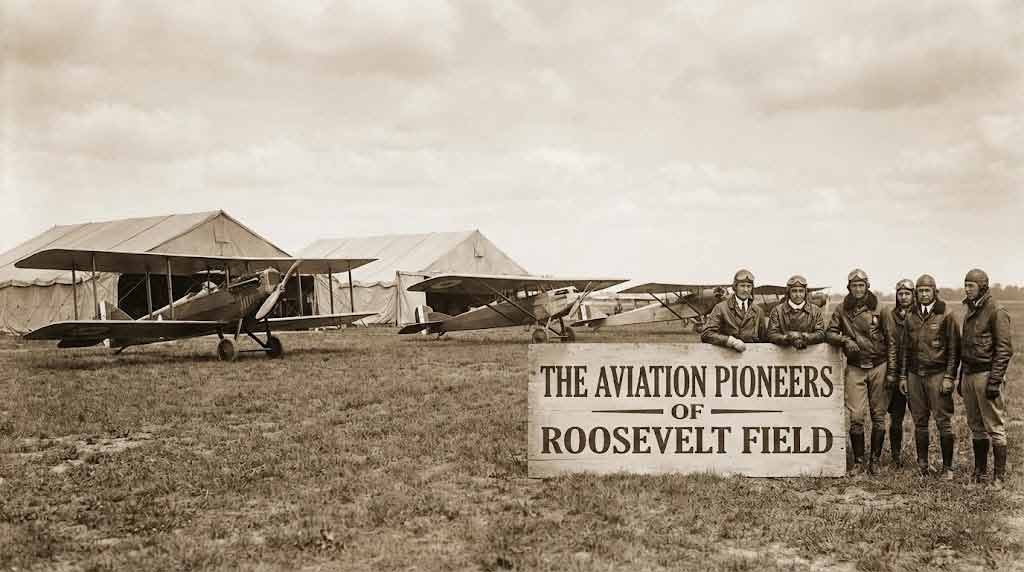
Before there was a shopping mall, before there was a parking garage stretching toward a suburban horizon, before the hum of HVAC units replaced the roar of radial engines — there was a muddy airstrip carved into the flat Hempstead Plains of Long Island, New York. Roosevelt Field was, by the standards of 1927, unremarkable. No towering terminals. No instrument landing systems. Just a bluff-divided plain of compacted earth and stubborn grass where men with too much courage and not enough certainty pointed machines at the sky and dared the sky to blink first.
On the morning of May 20, 1927, a lanky 25-year-old airmail pilot from Little Falls, Minnesota climbed into a cockpit the size of a phone booth, surrounded by nearly 450 gallons of aviation fuel, and aimed at Paris. His name was Charles Lindbergh. The plane was the Spirit of St. Louis. And what happened in the next 33 hours and 30 minutes did not just make aviation history — it rewired the world’s imagination about what a single human being, in a machine built in 60 days inside a converted fish cannery in San Diego, could accomplish alone.
This is that story. And it begins, as all great American stories should, right here on Long Island.
The Field That Built a Legend
Long Island had been sharpening aviators for nearly two decades before Lindbergh ever taxied down its runway. The flat, unobstructed Hempstead Plains — a rare geological gift of open terrain just miles from New York City — made the island a natural laboratory for early flight. By the mid-1920s, the cluster of airfields around Garden City and Mineola had already earned an informal designation: The Cradle of Aviation (Cradle of Aviation Museum, 2025).
Roosevelt Field itself bore the name of Quentin Roosevelt, President Theodore Roosevelt’s youngest son, killed in aerial combat over France in World War I. The field was not glamorous. A bluff 15 feet high divided the property awkwardly. The runway was uneven. Fonck’s catastrophic crash attempt in September 1926 — in which a Sikorsky S-35 overloaded with fuel cartwheeled off the end of the runway and killed two crew members — had exposed a literal sunken road embedded in the turf (Orteig Prize, Wikipedia, 2025). The competition for the $25,000 Orteig Prize had already drawn blood on this very ground.
That violence was not forgotten. When Lindbergh arrived at Roosevelt Field in May 1927, he did so with full knowledge of what failure looked like. French ace René Fonck had failed here. U.S. Naval aviators Noel Davis and Stanton Wooster had died at Langley Field testing their aircraft. Lindbergh’s chief French rivals, Charles Nungesser and François Coli, had departed Paris headed west on May 8th — and vanished somewhere over the Atlantic, never to be found (Wikipedia, Charles Lindbergh, 2025). Death had a seat at the table. And Lindbergh pulled up a chair anyway.
The Machine and the Obsession
The aircraft that would carry Lindbergh across 3,610 miles of open ocean was, to put it plainly, a flying fuel tank. <br>
Ryan Airlines of San Diego — operating out of a former fish cannery — built the Spirit of St. Louis in 60 days at a cost of $10,580 (Minnesota Historical Society, 2025). The plane’s chief engineer, Donald Hall, estimated the project required 850 engineering man-hours and 3,000 hours of construction labor (Smithsonian National Air and Space Museum, 2025). Powered by a 223-horsepower Wright Whirlwind J-5C radial engine and carrying a 46-foot wingspan specifically extended to accommodate the fuel load, the aircraft was a study in extreme prioritization.
There was no radio. No parachute. No forward visibility — the main fuel tank sat directly ahead of the cockpit for crash safety, so Lindbergh navigated with a periscope on his left side or by banking the plane and looking out the window. His leather pilot’s seat was removed and replaced with a wicker chair to save weight. He ditched sextant and fancy navigation instruments in favor of dead reckoning — compass, charts, and calculation (Space Center Houston, 2025).
When he told Ryan chief engineer Donald Hall, “I’d rather have extra gasoline than an extra man,” he wasn’t being poetic (Minnesota Historical Society, 2025). He was stating engineering philosophy. Lindbergh believed a single engine meant fewer failure points. Weight was the enemy. Everything not essential to flight was stripped. What remained was a man, a machine, and 450 gallons of aviation fuel weighing 2,750 pounds at takeoff — more than half the aircraft’s gross weight of 5,250 pounds (charleslindbergh.com, 2025).
May 19th: The Night Before
By the time Lindbergh positioned himself at Roosevelt Field in May 1927, the race had become claustrophobic with tension. Clarence Chamberlin and Charles Levine were preparing a rival Columbia aircraft nearby. Commander Richard Byrd — well-financed by department store heir Rodman Wanamaker — had a full crew, a trimotor Fokker called America, and a ramp constructed specifically to help his plane roll down into takeoff (Orteig Prize, Wikipedia, 2025). Byrd, to his considerable credit, had even offered Lindbergh use of the longer Roosevelt Field runway. The generosity said everything about the strange camaraderie of men who all knew they might die.
Rain had blanketed New York for days. A favorable weather report on the evening of May 19th changed everything. Lindbergh made his decision before midnight: he would fly in the morning.
He could not sleep. He later wrote that he had been “too busy the night before to lie down for more than a couple of hours” (Wikipedia, Charles Lindbergh, 2025). This was not nerves, exactly. It was the cost of total commitment — the mind that wouldn’t stop running calculations, plotting courses, weighing contingencies. He had been awake for the better part of two days before the wheels ever left the ground.
7:52 A.M. — Roosevelt Field, Long Island
The morning broke gray and damp. Rain had softened the runway. A crowd described variously as several hundred to nearly a thousand gathered in the mist to watch (Smithsonian, Pioneers of Flight, 2025). Ground crew pushed the Spirit of St. Louis — heavy enough to resist its own taxiing — into position on the runway. The plane, carrying its maximum fuel load for the very first time, had never flown this heavy before. No test flight had proven it could.
Lindbergh gunned the engine at approximately 7:52 A.M. Eastern time. The plane rolled. It gathered speed slowly — the field was soft, resistance high. Halfway down the runway, those watching began to breathe. By the end, they held their breath entirely. The Spirit of St. Louis cleared a tractor by fifteen feet, a telephone line by twenty, and dragged itself into the gray Long Island sky (charleslindbergh.com, 2025). Lindbergh later noted that on a hard, dry runway, the plane might have taken off with 500 additional pounds of fuel.
It was, by any measure, a knife-edge departure. And that was the easy part.
33 Hours, 30 Minutes: What Happened Over the Water
What followed over the next day and a half was as much a psychological battle as an aeronautical one. Lindbergh fought sleep from the fourth hour onward. He flew low over the Atlantic, nearly skimming the surface, hoping the cold spray would keep him conscious. He kept the windows open — increasing drag — because the cold air was the only thing standing between him and unconsciousness (History.com, 2025). At one point he considered turning back when sleet began to accumulate on the wings. He pressed forward.
Roughly halfway across, somewhere over the mid-Atlantic darkness, Lindbergh began to hallucinate. He described what he experienced in his 1953 Pulitzer Prize-winning memoir, The Spirit of St. Louis, as “vaguely outlined forms, transparent, moving, riding weightless with me in the plane” — apparitions that seemed to speak to him and offer navigation guidance (Fox News / History Channel, 2025). Sleep deprivation at that depth produces genuine waking hallucinations. Lindbergh had been awake for more than 50 hours.
He flew the Great Circle route northeast — Nova Scotia, Newfoundland, out over the open Atlantic, down toward Ireland. Twenty-seven hours after leaving Roosevelt Field, he spotted porpoises and fishing boats below. Then the southwestern coast of Ireland emerged through the mist. He was less than three miles off course after 2,000 miles of ocean (Minnesota Historical Society, 2025). The navigation, conducted entirely by dead reckoning and compass, was one of the most precise open-water crossings in aviation history.
He increased his airspeed over England. The sun was setting. By the time he crossed the French coast near Cherbourg, only 200 miles remained. He circled Le Bourget Aerodrome in confusion — he had expected darkness, but the field was blazing with headlights from 100,000 gathered spectators who had driven from Paris to witness something they weren’t sure was even possible (Smithsonian NASM, 2025). At 10:22 P.M. Paris time on May 21, 1927, the Spirit of St. Louis touched down. Charles Lindbergh had not slept in 55 hours.
The crowd broke the barriers and surged the plane. Lucky Lindy had to be physically lifted above the mob for his own safety.
What It Cost, and What It Changed
The Orteig Prize paid $25,000 — roughly $464,000 in today’s currency (Wikipedia, Orteig Prize, 2025). Lindbergh’s investment group had cobbled together $18,000 from a $15,000 bank loan, $2,000 of his own savings, and small donations — far less than his well-funded rivals (Wikipedia, Charles Lindbergh, 2025). The asymmetry between resource and result remains one of the most striking features of the story.
What followed was immediate and seismic. Applications for pilot’s licenses in the United States tripled within one year. The number of licensed aircraft quadrupled. Air mail volume grew 50 percent within six months. Aircraft industry stocks surged. The Spirit of St. Louis was viewed in person by 30 million Americans within a single year (HeroX, Orteig Prize, 2025). The “Lindbergh Boom” — as it came to be known — catalyzed commercial aviation in a way no government program or industry initiative had managed.
President Coolidge called it a “messenger of peace and goodwill” that had “broken down another barrier of time and space” (Smithsonian NASM, 2025). The language is presidential and careful. What actually happened was more primal: an entire civilization looked at a skinny guy in a wicker chair who had stayed awake for two and a half days and decided that maybe the future was going to be okay after all.
What Remains of Roosevelt Field
The field closed in 1951. Real estate developers acquired it, and by 1956 the Roosevelt Field Mall had risen where the runway had been — one of the first and largest enclosed shopping malls in the United States (Metro Airport News, 2022). The flat, open terrain that had drawn barnstormers and record-setters became parking lots and food courts. Quentin Roosevelt’s memorial airfield became an anchor for Macy’s.
A historical marker survives near the takeoff point. A young college student reportedly saved it from being relocated during mall construction (Aviation History Museums blog, 2022). It stands close to the spot where the Spirit of St. Louis left the earth on its second bounce down the runway.
The Cradle of Aviation Museum, located at Charles Lindbergh Boulevard in Garden City — just miles from the original field — preserves what the mall could not erase. The museum’s collection includes a reproduction Spirit of St. Louis from the 1957 Warner Bros. film, giving visitors the closest physical experience to standing beside Lindbergh’s machine that currently exists in the New York area. The Cradle of Aviation is also, as of February 2026, unveiling the Aline Rhonie Mural: The Pre-Lindbergh Era of American Aviation — a 100-foot work chronicling early American flight from 1909 to 1927, launching as part of the museum’s America 250 Celebration (Cradle of Aviation Museum, 2026).
Long Island did not just witness the flight that changed aviation. It launched it. And the flat, patient plains of the Hempstead plateau — those same unobstructed acres that once drew aviators the way a harbor draws sailors — still hold the memory of a May morning when a young man cleared a telephone line by twenty feet and changed everything.
📺 For Further Viewing: PBS American Experience produced a definitive interactive documentary on the flight, available at pbs.org — including a real-time flight tracker that steps through each leg of the journey hour by hour.
📚 Further Reading: The Spirit of St. Louis by Charles A. Lindbergh (Scribner, 1953) remains the definitive first-person account of the flight, and won the 1954 Pulitzer Prize for Biography or Autobiography. Atlantic Fever by Joe Jackson (Picador, 2012) provides the full competitive context of the Orteig Prize race.