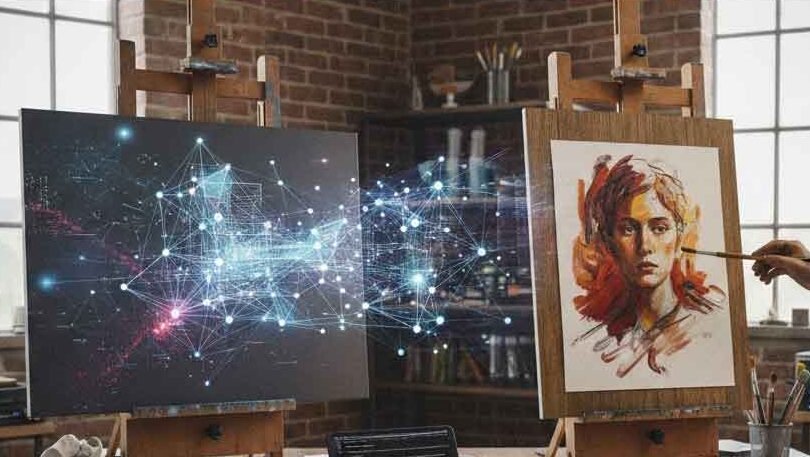
Somewhere in the contested territory between a Midjourney prompt and a Van Gogh brushstroke lies one of the most urgent philosophical arguments of our time — one that, depending on whom you ask, is either already settled or barely begun. The question is deceptively simple: Is A.I.-generated art real art?
The answer, as with most questions worth asking, is neither yes nor no. It is more interesting than that.
The Old Arguments Dressed in New Code
Every generation believes its technological disruption is unprecedented. It rarely is. When photography arrived in the 19th century, painters declared the end of painting. When cinema appeared, theater critics predicted the death of the stage. In each case, the old form did not die — it evolved, differentiated, and found new meaning precisely because a machine had taken over its most mechanical functions.
A.I. art is the latest chapter in that long argument, and the resistance follows a familiar script. Critics insist that generative tools like Midjourney, DALL-E, and Stable Diffusion are not creating — they are regurgitating, statistically averaging the visual output of millions of human artists without consent, intention, or lived experience. A key philosophical argument holds that mass A.I. art is not “art” properly so called because it lacks the degree of intentional control that most philosophers consider a necessary condition for arthood.
That is not a trivial objection. It is, in fact, the crux of the entire debate.
But before we accept it as final, it is worth asking whether we have been consistent in applying the standard of “intentional control” to the entire history of art-making. The photographer does not mix paint. The printmaker delegates to the press. The filmmaker surrenders vast swaths of the image to light, lens, and chance. We called all of those art. We gave them museum wings and Nobel Prizes and Pulitzers. The question is whether the human standing at the threshold of a generative model — curating, selecting, iterating, directing — is meaningfully different from the photographer standing at the threshold of a darkroom.
Walter Benjamin, the Algorithm, and the Question of Aura
In 1935, the German philosopher Walter Benjamin wrote an essay that now reads like prophecy. The Work of Art in the Age of Mechanical Reproduction argued that when art is reproduced at scale, it loses its aura — that ineffable quality of presence, of being rooted in a singular time and place, embedded in tradition and ritual. Benjamin proposed that “even the most perfect reproduction of a work of art is lacking in one element: its presence in time and space, its unique existence at the place where it happens to be.”
He was talking about photography and film. He could not have anticipated the generative algorithm. But the question his essay plants is precisely the one we now face: Does A.I.-generated imagery possess aura? Can something born of statistical pattern-matching carry the weight of authentic presence?
The answer that emerges from recent scholarship is provocative. From a Benjaminian perspective, A.I.-generated art is distinct from both traditional art and earlier forms of technological reproduction like photography. Rather than simply capturing the world as presented to a device, A.I.-generated art involves the identification and inventive representation of data patterns — a mode of generation that potentially reflects what scholars describe as a kind of collective unconscious of society.
This is a remarkable inversion. Where Benjamin worried that mechanical reproduction would strip art of its connection to tradition, some theorists now argue that A.I. art — trained on the entire corpus of human visual culture — is perhaps too connected to tradition, a mirror held up to everything we have ever made, simultaneously referencing and recombining it in ways no single human mind could achieve.
That is either a profound new kind of aura, or the final extinction of it. The argument is genuinely open.
The Market Has Already Decided — And the Market Is Not the Last Word
Let us be clear about one thing: the commercial world has not waited for the philosophers to finish their seminar. The A.I. art market surged to $3.2 billion in 2024 and is projected to reach $40.4 billion by 2033. Christie’s hosted its first all-A.I. art auction in February 2025, grossing nearly $730,000. Ai-Da, a humanoid robot artist, sold a portrait at Sotheby’s for over one million dollars.
None of that settles the philosophical question. Markets have a long history of valuing things that are not art and ignoring things that are. The fact that a collector paid seven figures for an algorithmic image no more proves it is art than the fact that mass-produced fast food exists proves it is cuisine. But it does tell us something important: the social function of A.I. art — the way it moves through galleries, auction houses, digital platforms, and conversations — is already operating exactly as art operates. It is generating meaning, provoking emotion, creating cultural discourse.
John Dewey defined art not as a category of objects, but as a living interaction between the audience, the artwork, and the creator. By that standard, A.I. art — whatever its ontological status — is functioning as art in the world, right now, whether or not it deserves the title.
The Intentionality Problem: Where the Hard Question Lives
The most sophisticated objection to A.I. art is not that machines cannot make beautiful things — they clearly can, and with alarming frequency. A 2025 study found that human participants could only distinguish A.I.-generated art from human-created work at rates hovering near 50 percent — essentially the accuracy of a coin flip.
The hard problem is intentionality. When a human artist paints, they carry into the canvas a specific life — memories, politics, grief, love, a particular Tuesday afternoon in winter. The brushstroke is a decision freighted with biography. The A.I. prompt is not. The system does not remember its childhood. It does not grieve. It does not, in the philosophical sense of the word, mean anything.
This is where Heidegger becomes useful. In his thinking about Dasein — Being-in-the-world — he argued that authentic existence requires dwelling, temporality, and thrownness: the condition of being thrown into a specific historical and biographical situation from which all meaning-making flows. An algorithm is not thrown. It is deployed. It has no before. It will have no after. Its output, however beautiful, emerges from a process that has never experienced the weight of existing.
And yet — the human who writes the prompt has experienced that weight. They bring their biography to the prompt as surely as the painter brings it to the brush. The question of where authorship lives in A.I. art is less about whether machines can feel and more about whether the human directing the machine is exercising genuine creative agency. As some scholars argue, prompt engineering — the deliberate craft of guiding a model toward a specific vision — is itself an art form, one that requires conceptual clarity, aesthetic judgment, and iterative refinement.
In my own work with A.I. image generation, there is nothing passive about the process. You arrive with a vision, pursue it across dozens of iterations, reject what does not serve it, and refine toward something that matches an internal image you carried before you ever opened the application. That is not so different from the sculptor who begins with stone and ends with what the stone always had inside it.
The Theft Question: Copyright, Training Data, and the Ethics of the Corpus
The debate cannot proceed honestly without confronting the ethical dimension. Many A.I. models are trained on billions of images scraped from the internet without the original artists’ consent or compensation, raising legitimate questions about intellectual property, originality, and whether the entire enterprise is built on a foundation of uncredited labor.
This is a real problem. It is also not, strictly speaking, an aesthetic problem — it is a legal and ethical one. The quality and legitimacy of the resulting image are questions that are separable from whether the training methodology was fair to the artists whose work fed the model. We can simultaneously believe that A.I. art is aesthetically valid and that the industry owes human artists far better protections and compensation than they currently receive.
History will likely force a resolution here. The EU’s Artificial Intelligence Act represents an early legislative attempt to establish frameworks, and ongoing litigation in the United States and United Kingdom will eventually produce precedents. The wild west phase of generative A.I. will not last indefinitely.
What Photography Tells Us About Where This Goes
When photography emerged in the 1840s, painters did not disappear. They stopped trying to compete with the camera on the camera’s own terms — meticulous visual documentation — and turned instead toward abstraction, expressionism, and the radical interior landscapes that would define modern art. The machine’s efficiency liberated the human hand to pursue what only the human hand could do.
The same displacement is underway now. The working photographers and designers who will be most affected are those doing the technically competent but conceptually routine work — the retouching, the stock imagery, the headshot sessions. The visionary, the director, the artist with a clear and irreducible point of view, will find that A.I. amplifies rather than replaces their essential capacities.
The briefcase analogy is apt here: there is a reason a bespoke English bridle leather case from Marcellino NY occupies a completely different category than a factory-produced bag, despite both performing the same functional role. The handmade object carries something the machine-made one cannot — the evidence of a specific human life applied over time to a specific material. A.I. art, whatever its merits, will never carry that particular kind of weight. But it may carry other kinds. And the human artist who learns to work alongside it, directing it with vision and intention, may produce things that neither the human alone nor the machine alone could achieve.
The Verdict Is Not Binary
The question “Is A.I. art real art?” is posed as a binary, but the honest answer refuses that structure. A.I. can produce images that are aesthetically powerful, culturally resonant, and emotionally affecting. It can also produce an industrial volume of visual noise that flattens and homogenizes everything it touches. The same is true of human artists. The medium is not the determining factor. The vision is.
The term “A.I. slop” — used to dismiss machine-generated work as inherently inferior — ignores the fact that society produced vast quantities of low-quality material long before algorithms arrived. The medium does not automatically determine the quality or the legitimacy of what it produces.
What separates art from decoration, from entertainment, from visual noise, has never been the tool. It has been the presence — or absence — of a genuinely directing human consciousness, asking a real question, pursuing a real vision, willing to be changed by what the making reveals. A.I. is a new kind of canvas. What you put on it still depends entirely on what you bring to it.
The conversation is not over. It has barely started. But the artists who will matter in the next century are almost certainly the ones who refuse to choose sides — who pick up the new tools with the same curiosity and rigor they brought to the old ones, and make something from them that could not have existed before.
That has always been what art does.
Sources:
- Artistic Turing Test: The Challenge of Differentiating Human and AI-Generated Art — ScienceDirect, September 2025. https://www.sciencedirect.com/science/article/pii/S2949882125000933
- The AI Art Debate: Is it Still Art if It Isn’t Expressed by a Human? — Ludo.ai. https://ludo.ai/blog/the-ai-art-debate
- AI Art in 2025: What’s Real, What’s Hype, and Why Everyone’s Arguing About It — GarageFarm. https://garagefarm.net/blog/ai-is-art-doomed
- Mass AI-Art: A Moderately Skeptical Perspective — Journal of Aesthetics and Art Criticism, Oxford Academic, October 2025. https://academic.oup.com/jaac/article/83/4/343/8203680
- In Defense of ‘De-Generated’ Art — The Philosophical Salon, May 2025. https://www.thephilosophicalsalon.com/in-defense-of-de-generated-art/
- The Work of Art in the Age of AI Reproducibility — AI & Society, Springer, July 2024. https://link.springer.com/article/10.1007/s00146-024-01991-3
- Work of Art in the Age of Its AI Reproduction — Ignas Kalpokas, SAGE Journals, 2025. https://journals.sagepub.com/doi/10.1177/01914537231184490
- The Aura in the Algorithm: Reimagining Walter Benjamin’s Aesthetic Theory in the Era of AI — SpringerLink. https://link.springer.com/chapter/10.1007/978-3-031-95469-6_8
- Where We Stand With AI-Generated Art in the Current Moment: 2025 Edition — Fstoppers, July 2025. https://fstoppers.com/business/where-stand-ai-generated-art-current-moment-2025-edition-706500
- Benjamin, Walter. The Work of Art in the Age of Mechanical Reproduction (1935). MIT Press PDF. https://web.mit.edu/allanmc/www/benjamin.pdf