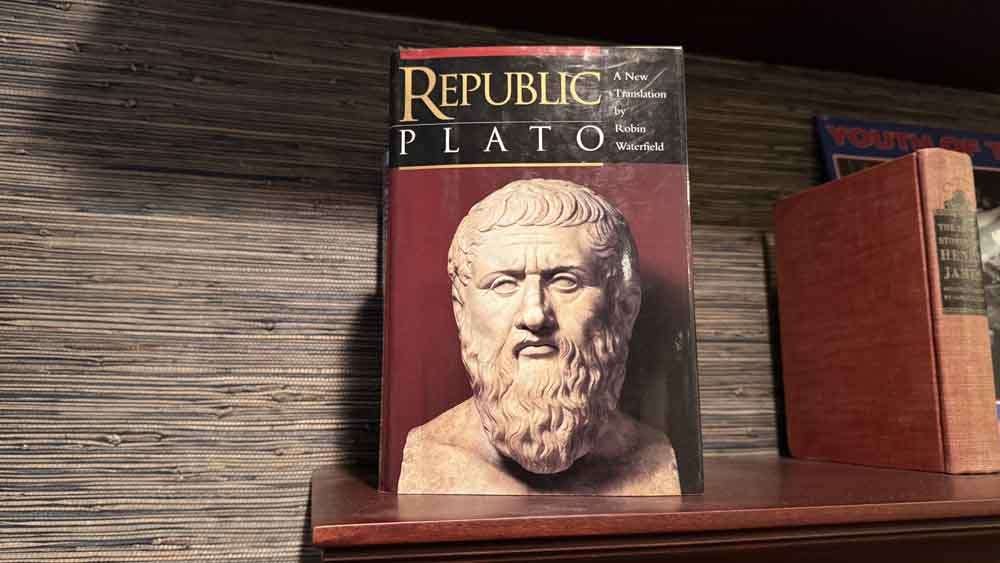
Plato did not write The Republic as a philosophy textbook. He wrote it as a provocation — a long, circling, sometimes infuriating conversation about what justice is, what the soul wants, and whether a good life is even possible in a world designed to reward the performance of goodness over its practice. That distinction — between appearing just and being just — is the engine that drives the entire work, and it is the reason The Republic has never gone stale in roughly 2,400 years of trying.
It is also the reason I have it tattooed on my body. Not a quote, not a symbol pulled from the aesthetic ether, but a mark that says: this text found me at a specific moment and changed what I was capable of thinking. That is what the best philosophy does. It does not decorate your mind — it restructures it.
What The Republic Actually Is
Most people who have heard of The Republic know it as the book with the Allegory of the Cave. That is true, but reductive — like saying the Iliad is the poem with the Trojan Horse. The Cave is the emotional center of the work, the image that concentrates everything Plato is arguing, but the book itself is much larger. Written as a Socratic dialogue, probably around 375 BCE, it runs across ten books and covers the nature of justice, the structure of the ideal city-state, the tripartite soul, the dangers of democracy, the corruption of poetry, the immortality of the soul, and the theory of Forms. It is, in other words, a complete philosophical system dressed in the clothes of a dinner party conversation.
Socrates — Plato’s mouthpiece throughout — does not lecture. He asks questions. He draws out contradictions. He gets people to admit, step by step, that what they thought they believed was either hollow or borrowed from someone else. The method is maddening and deeply effective. By the time you reach the Cave, you have already been softened up. You are ready to see what Plato is pointing at.
The Cave, Plainly Stated
The Allegory of the Cave appears in Book VII, and if you have never encountered it directly, here is the essential image. Prisoners are chained in an underground cave, facing a wall. Behind them, a fire burns. Between the fire and the prisoners, objects are carried past, casting shadows on the wall ahead. The prisoners have never seen anything else. They name the shadows. They debate which shadow will appear next. They become experts in the shadow world. When one prisoner is freed and dragged toward the light, he is blinded and in pain. The sunlit world outside the cave is overwhelming — too bright, too real, too much. But gradually his eyes adjust. He sees actual objects. He sees the sun itself. He understands, for the first time, what causes what.
Then he goes back down. He has to. But his eyes no longer work in the dark. The other prisoners think he is damaged. They want nothing to do with what he has seen. If he tries to free them, they might kill him.
Plato meant Socrates. He also meant every person who has ever returned from genuine understanding to a world that prefers the shadows.
The Cave as a Template for How Most People Live
What makes the Cave endure is not its elegance as a metaphor but its accuracy as a description. Strip away the ancient Greek staging and what you have is a portrait of default human cognition — the tendency to mistake familiarity for truth, to confuse the map for the territory, to call a thing real simply because everyone around you agrees to call it real.
The shadows on the cave wall are not ignorance in any simple sense. The prisoners are not stupid. They are attentive, sophisticated, expert at interpreting what they see. Their error is structural: they have no access to what is casting the shadows, so they cannot know that their expertise is built on a false foundation. This is the uncomfortable precision of the allegory. You can be very good at navigating a world that is fundamentally misrepresented to you. Intelligence applied to a flawed framework does not correct the framework — it deepens your investment in it.
The philosopher — Plato’s term for the person who climbs out — is not smarter in the IQ sense. What distinguishes the philosopher is the willingness to endure the discomfort of re-orientation. The blinding sunlight is not punishment; it is the sensation of encountering reality after a life of projections. That moment of blindness is necessary. You cannot skip it. Anyone who claims to have reached genuine understanding without passing through a period of total disorientation has probably just found a more sophisticated cave.
What the Return Costs
Plato is not romantic about what happens when you come back. The prisoner who returns sees poorly in the dark now. He cannot compete with those who never left, because his eyes have been recalibrated to a different standard of light. He will be laughed at. He will seem impractical, unmoored, possibly dangerous. The community of the cave has its own social order, its own hierarchy of expertise, its own rewards for those who best navigate the shadow world. The returned philosopher disrupts all of that without offering anything the cave-dwellers can immediately use.
This is the part of The Republic that has followed me longest. The tension between what you understand and what the world around you is prepared to hear. The gap between the level at which you can see a problem and the level at which the problem is being discussed. I have sat in enough conversations — about food, about craft, about what a neighborhood is becoming — to know that Plato was not writing mythology. He was writing sociology.
The hardest version of the return is not hostility. Hostility is clarifying. The hardest version is indifference — the discovery that most people are not chained against their will. They are comfortable. The shadows are warm. The conversation about which shadow comes next is genuinely engaging. Why would you want more than that?
Plato and the Examined Life
Running beneath the Cave allegory is the claim Plato inherited from Socrates and never let go: that the unexamined life is not worth living. The Republic is, at one level, a 400-page argument for why that is true. The just city, the just soul, the philosopher-king — all of it circles back to the same premise. You cannot be truly just, truly free, truly human, without the willingness to look at what you actually believe and ask whether it survives contact with reality.
That is not a comfortable ambition. Examination is not the same as self-improvement in the modern sense — it is not optimization or wellness or the refinement of existing habits. It is closer to what happens when you realize the habits themselves need to be questioned. When the furniture of your mind, accumulated over a lifetime, turns out to have been arranged by someone else’s hands.
This book has been covered with authority by scholars far more credentialed than I am. The classicist Julia Annas, whose An Introduction to Plato’s Republic remains one of the most rigorous guides to the text, argues that Plato’s central project is not political theory at all — it is moral psychology. She reads The Republic as a sustained argument about what it means to have a well-ordered soul. The political architecture — the tripartite class system, the philosopher-kings, the censored art — is scaffolding for the real inquiry: what kind of inner life makes a person genuinely happy rather than merely comfortable.
I find that reading more persuasive every year. The ideal city Plato builds is explicitly described as a metaphor for the soul writ large. He is not writing a city plan. He is drawing a map of the self.
The Translator Question
If you are coming to The Republic for the first time, translation matters more than it does for almost any other ancient text. The Allan Bloom translation — dense, literal, with extensive notes — is invaluable if you want to stay close to the Greek. The G.M.A. Grube translation revised by C.D.C. Reeve, published by Hackett, is more readable and widely used in university courses. For a more literary experience, Benjamin Jowett’s older translation is available free through Project Gutenberg and retains a Victorian elegance that, for some readers, suits the dialogue form well. Each one is a different conversation with the same text. Reading two of them, in sequence, is its own kind of philosophical exercise.
Why This Book Still Matters
Plato has been accused of everything: proto-totalitarianism for his censored ideal state, elitism for his philosopher-kings, misogyny despite the fact that he was among the first Greek thinkers to argue that women could be rulers. Some of those criticisms land. The Republic is not a perfect book. It is a deeply human one — contradictory, ambitious, occasionally wrong, and genuinely trying to answer the hardest questions a person can ask about how to live.
The Cave is not an argument you can refute and be done with. It is a mirror. Every generation looks into it and sees itself, because every generation inherits a world of shadows that someone else cast, and has to decide whether to name them faithfully or climb toward the light. That work is never finished. It was not finished in Athens in 375 BCE, and it is not finished now, on the North Shore of Long Island, or anywhere else where people gather to eat and argue and figure out what they believe.
I have read The Republic more times than I can count. I have read it as a student, as a business owner, as someone who has watched ideas spread and mutate through a community the way Dawkins described memes spreading through a culture — which, if you have read my review of The Selfish Gene, you know is not a small thing to me. I have read it alongside Nietzsche, whose Zarathustra was in some ways a reply to Plato across two millennia — a different answer to the same question about the philosopher’s relationship to the crowd. I wrote about that book here.
Each time, The Republic gives me something different. That is the mark of a living text rather than a dead monument. It is not a book you finish. It is a book you carry.
Some things you carry in your hands. Some in your memory. Some on your skin.
Sources
- Plato. The Republic. Trans. G.M.A. Grube, revised C.D.C. Reeve. Hackett Publishing. https://hackettpublishing.com/the-republic
- Plato. The Republic of Plato. Trans. Allan Bloom. Basic Books. https://www.basicbooks.com/titles/plato/the-republic-of-plato/9780465069347/
- Plato. The Republic. Trans. Benjamin Jowett. Project Gutenberg. https://www.gutenberg.org/ebooks/1497
- Annas, Julia. An Introduction to Plato’s Republic. Oxford University Press, 1981.
- Stanford Encyclopedia of Philosophy — Plato’s Republic. https://plato.stanford.edu/entries/plato-republic/
- The Heritage Diner — The Selfish Gene by Richard Dawkins. https://heritagediner.com/the-selfish-gene-by-richard-dawkins-the-book-that-unlocked-darwin-for-me/
- The Heritage Diner — Thus Spoke Zarathustra by Friedrich Nietzsche. https://heritagediner.com/thus-spoke-zarathustra-by-friedrich-nietzsche-the-book-that-rewired-my-understanding-of-everything/