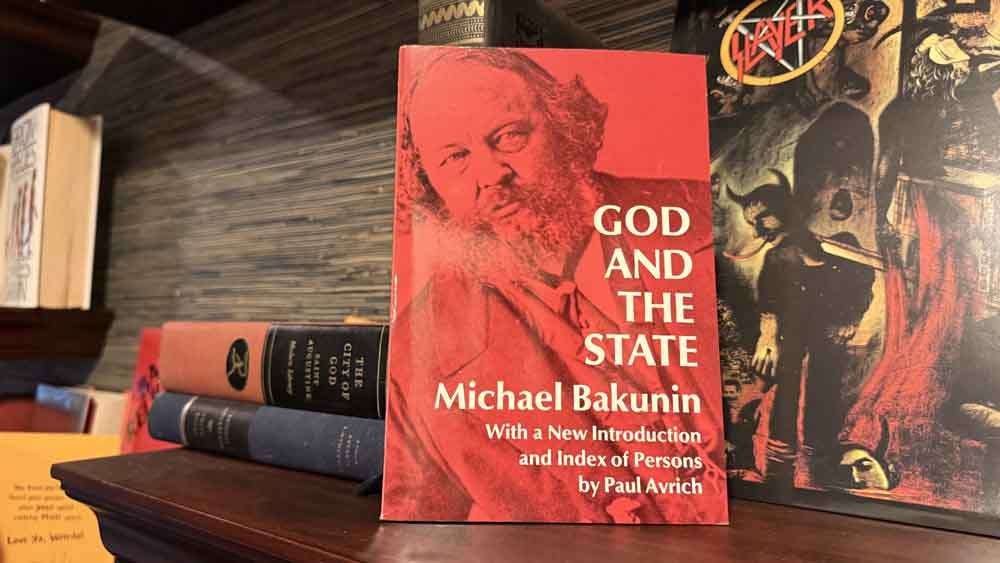
Bakunin never finished this book. He died in 1876 with the manuscript still in fragments, and his friends assembled and published it six years later from what he left behind. That incompleteness is not a flaw — it is, in a strange way, the most honest thing about it. God and the State reads like a man thinking at full speed, furious and brilliant and not yet done, and the urgency on every page feels less like a polished argument than like someone grabbing you by the collar and refusing to let go until you admit what you already suspect is true.
What Bakunin suspected — and argued with the kind of force that makes you uncomfortable even when you disagree — is that God and the State are not separate institutions. They are the same institution wearing different uniforms. One commands obedience in the name of heaven; the other commands it in the name of law. Both require you to surrender your reason to an authority you cannot question. Both promise protection in exchange for submission. And both, he argued, are built on a lie — that human beings need to be governed from above rather than liberated from within.
The Diagnosis Is Airtight
The strongest parts of God and the State are not the prescriptions — those come later and fall apart quickly — but the diagnosis, which holds up with almost uncomfortable precision. Bakunin’s central insight is that political and religious authority share a common psychological mechanism: they require the believer to accept something as true not because reason supports it but because the institution demands it. The priest and the legislator are both asking for the same thing, which is the suspension of your own judgment in favor of theirs.
He was writing in 1871, the year of the Paris Commune, when the relationship between church and state in Europe was nakedly transactional in ways that are easy to forget now. The Catholic Church was actively allied with conservative governments, blessing armies and monarchies and the suppression of labor movements. The divine right of kings had only recently become unfashionable as a formal doctrine, and its ghost lingered everywhere. Bakunin was not constructing a metaphor. He was describing a machine he could see operating in real time.
What makes this more than historical document is that the psychological architecture he identified — obedience without reason, authority without accountability, institutional self-perpetuation dressed as moral imperative — did not dissolve when church attendance declined or when monarchies gave way to parliaments. It migrated. If you have read my review of The God Delusion by Richard Dawkins, you’ll recognize a similar thread: Dawkins attacks the epistemological habits that religion installs, and Bakunin attacks the political structures that exploit those same habits. They are working the same problem from different directions, separated by a hundred and thirty years.
Where Darwin Comes In
Bakunin does something unexpected in the middle of the book: he invokes Darwin and the materialist science of his era as the only legitimate foundation for human freedom. His argument is that once you accept that human beings are the product of natural processes — that consciousness is not a divine gift but an evolved capacity — the entire justification for external moral authority collapses. If there is no God to have ordained the social order, then the social order is just an arrangement made by people, and arrangements made by people can be changed by people.
This is a cleaner version of the argument than it might sound. Bakunin is not simply saying that atheism leads to anarchism, though he does believe that. He is saying that the scientific worldview — specifically the Darwinian one, which was fresh and electric in 1871 — is fundamentally incompatible with the kind of deference that both church and state demand. Science asks you to follow the evidence. Authority asks you to follow the authority. You cannot fully do both, and Bakunin thinks most people sense this tension without being able to name it.
He is largely right. The institutions that have historically required the deepest obedience — religious, political, ideological — have also historically been the most hostile to the kind of empirical scrutiny that science requires. That is not a coincidence. It is a feature. An authority that can be questioned by evidence is an authority that can be replaced by evidence, and no institution wants to be replaceable.
The Point Where the Argument Breaks Down
Here is where honesty requires some pushback. Bakunin’s critique of authority is so powerful precisely because it is applied universally — he makes no exceptions for legitimate uses of power, no distinctions between coercive authority and voluntary coordination, no acknowledgment that some institutional constraints on individual behavior exist for reasons that have nothing to do with domination. His argument is essentially that all authority is illegitimate by definition, and that once you remove it, human beings will naturally organize themselves into free, cooperative, federated communities based on mutual aid and solidarity.
That second part — the prescription — has never survived contact with reality. Not because people are too corrupted by existing systems to live freely, which is what Bakunin might say, but because the problem of coordination at scale is genuinely hard and does not dissolve when you eliminate hierarchy. The question of how you make collective decisions when people disagree, how you handle those who defect from cooperation, how you maintain anything resembling shared infrastructure across a large population — these are not solved by Bakunin. They are waved away with a confidence that reads, in retrospect, as the single greatest weakness of the anarchist tradition.
Nietzsche, writing around the same period, was similarly devastating in his critique of received morality and similarly vague about what replaces it — though in Thus Spoke Zarathustra, you at least get the sense that Nietzsche knows he is offering a vision rather than a blueprint. Bakunin sometimes seems to think he has solved the problem of human social organization, and the certainty does not hold up.
What Survives
What survives, and what makes the book worth reading in 2026, is the diagnostic half. Bakunin understood something that remains underappreciated: that the habits of mind required for religious submission and the habits of mind required for political obedience are the same habits, cultivated by the same methods, and useful to the same class of people. He understood that institutions protect themselves by making their own questioning feel dangerous or impious — and that this mechanism functions just as well without God as with one.
He also understood, with a clarity that still lands, that education systems and religious institutions are not incidentally intertwined with political power but structurally intertwined with it. The question of who controls what children are taught, and toward what ends, was as live a controversy in 1871 as it is now. Bakunin’s answer — that education should produce critical, self-determining human beings rather than obedient subjects — is the right answer, even if his vision of what those human beings would build together afterward was hopelessly romantic.
A Short Book With a Long Shadow
God and the State is not long — you can read it in an afternoon — but it punches well above its length. The argument is occasionally repetitive, the prose sometimes overheated, and the optimism about human nature requires a generosity that history makes difficult to sustain. But the core of it is a serious philosophical claim, made by a serious thinker, that deserves to be engaged with on its own terms rather than dismissed because “anarchism” has become a word that functions more as an insult than a description.
Bakunin was right that authority without justification is just power. He was right that the institutions most invested in demanding obedience are also the ones most resistant to scrutiny. He was right that science and dogma make uneasy bedfellows, and that any worldview which requires you to stop asking questions at a certain point is worth examining very carefully.
He was wrong to think that removing the structures of authority would automatically produce something better. But being wrong about the cure does not make you wrong about the disease. Plenty of the best diagnosticians in history have had terrible bedside manner and worse treatment plans. You read them for the diagnosis, and you keep thinking from there.
You Might Also Like
- The God Delusion by Richard Dawkins — A Review
- Thus Spoke Zarathustra by Friedrich Nietzsche — The Book That Rewired My Understanding of Everything
- No Exit by Jean-Paul Sartre — The Play That Diagnosed Modern Life Before Modern Life Knew It Was Sick
Sources
- Bakunin, Mikhail. God and the State. Mother Earth Publishing Association, 1916 (first English edition). Originally published 1882.
- The full public domain text is also available via the Anarchist Library.
- Carr, E.H. Michael Bakunin. Macmillan, 1937. The standard English-language biography; valuable for situating the manuscript in the context of the First International.
- Dolgoff, Sam (ed.). Bakunin on Anarchy. Knopf, 1972. An excellent anthology with useful editorial context on Bakunin’s relationship with Marx and the broader socialist movement.
- Kelly, Aileen. Mikhail Bakunin: A Study in the Psychology and Politics of Utopianism. Oxford University Press, 1982. The most rigorous critical assessment of Bakunin’s thought available in English.