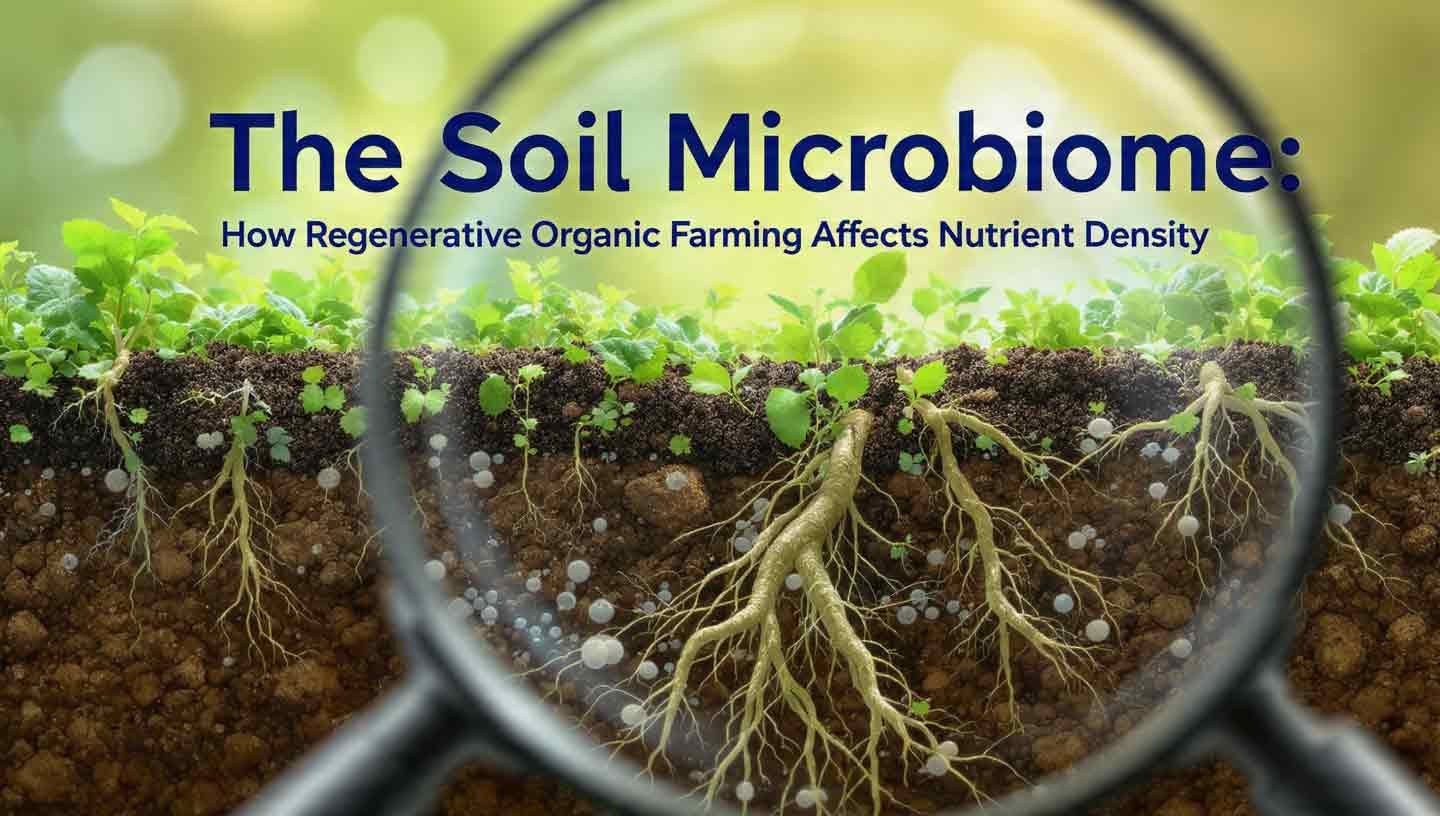
Sixty years of industrial agriculture have produced something that, on its surface, looks like abundance: perfect rows, uniform produce, year-round availability, and consistently low prices. But beneath that glossy surface — literally beneath it, in the soil — a quiet catastrophe has been unfolding. The food on your plate today is not nutritionally the same food your grandparents ate. And the reason why is written in the microbiology of the earth itself.
Understanding the soil microbiome — the dense, hyperactive community of bacteria, fungi, protozoa, and archaea living beneath every inch of farmland — is essential to understanding what regenerative organic farming actually does, and why it matters so profoundly to anyone who cooks, eats, or runs a kitchen committed to genuine quality.
The Silent Crisis Below Ground
The data on nutrient decline in modern food crops is, at this point, well-established and deeply unsettling. A 2024 review published in the journal Foods described the trend as “alarming” — the product of sixty years of synthetic fertilizers, intensive tillage, monoculture cropping, and the relentless breeding of high-yield varieties over high-nutrition ones (Bhardwaj et al., Foods, 2024). The USDA’s own historical records tell the same story: fruits, vegetables, and grains consistently carry lower levels of iron, calcium, zinc, protein, and vitamin C than they did in previous generations.
Research monitoring Australian food composition databases from 1991 to 2022 found that iron content in commonly consumed vegetables dropped by 20% over that thirty-year period, while iron in fruit fell by 48% (Institute for Functional Medicine, 2022 review). Zinc concentrations declined by 15% in fruit, and drops of 30 to 50 percent were documented in sweet corn, green beans, cauliflower, and chickpeas. A separate study in Scientific Reports found that protein content in wheat decreased by 23% between 1955 and 2016, alongside meaningful reductions in manganese, iron, zinc, and magnesium.
The cause of this collapse is not mysterious. It is the soil — or more precisely, what industrial farming has done to it.
What the Soil Microbiome Actually Does
A teaspoon of healthy, biologically active soil contains approximately one billion microorganisms and thousands of individual species. These are not passive bystanders. They are the engine of plant nutrition.
Soil microbes perform the fundamental processes that make nutrients available to crops: they cycle nitrogen, decompose organic matter, solubilize minerals, fix atmospheric gases, suppress pathogens, and define the very texture and water-retention capacity of the soil itself (Singh et al., Frontiers in Agronomy, 2023). Without them, plants are not merely disadvantaged — they are dependent on synthetic substitutes that can never fully replicate the complexity of biological nutrient cycling.
The relationship between a plant and its soil microbiome is not passive absorption. It is an active, co-evolved partnership. Most agricultural crops form symbiotic relationships with arbuscular mycorrhizal fungi (AMF) — a group of soil fungi that physically invade plant roots and extend hyphal networks deep into surrounding soil, searching for nutrients the roots could never reach on their own. These fungal networks can expand the effective nutrient-absorption area of a plant’s root system by a factor of 1,000 — extending from a cubic meter of accessible soil to a cubic kilometer of explored terrain (NC State University, Crop and Soil Sciences).
In exchange for liquid carbon siphoned from the plant, mycorrhizal fungi supply back a broad spectrum of nutrients: phosphorus, nitrogen, sulfur, potassium, calcium, magnesium, iron, zinc, copper, and manganese (Green Cover, 2023). A 2024 study in Frontiers in Plant Science confirmed that mycorrhizal inoculation produced significantly higher iron, zinc, phosphorus, and potassium content in foliar biomass compared to non-mycorrhizal control plants (Founoune-Mboup et al., Frontiers in Plant Science, 2024).
Think of it as Fred Provenza’s soccer team analogy, as described in Mongabay’s 2022 study coverage: a plant grown in healthy, microbe-rich soil has a massive recruitment pool and can field a full roster of beneficial organisms. A plant grown in depleted soil can only recruit locally — and may end up with a team of goalies.
How Conventional Farming Dismantles the System
The industrial farming model systematically destroys the very biological infrastructure that makes nutrient-dense food possible.
Tillage is the primary offender. When soil is plowed and broken apart, the hyphal networks of mycorrhizal fungi — networks that may span many hectares — are physically severed. Soil organic matter is exposed and consumed by microbes at an accelerated rate, releasing a burst of fertility in the short term, but depleting the long-term carbon reserves that sustain microbial diversity. As soil expert Dale Strickler explained in a 2021 interview: “You eventually run out and then you’re so much worse off than ever before… you’ve got dead soil” (Mongabay, 2022).
Synthetic fertilizers compound the damage. When high concentrations of inorganic nitrogen and water-soluble phosphorus are applied directly to the soil, they short-circuit the plant-fungi exchange. Why would a plant invest carbon in supporting mycorrhizal networks when nutrients are delivered directly to its roots? The symbiosis collapses, fungal populations decline, and the soil’s biological diversity contracts dramatically (NC State, Crop and Soil Sciences). Fertilizer, in this sense, is fast food — providing immediate gratification while degrading the system that produces genuine nourishment.
Monoculture cropping removes the botanical diversity that sustains diverse microbial communities. Research has consistently shown that diversified crop rotations improve soil microbial activity, increase organic carbon content, and produce measurable improvements in crop nutrient density. A January 2024 study in Nature Communications found that replacing wheat monoculture with diversified cash crops increased yields by 38%, improved the greenhouse gas balance by 88%, and stimulated microbial activity and diversity in the soil (Yang et al., Nature Communications, 2024).
What Regenerative Organic Farming Restores
Regenerative agriculture is not a single practice but a philosophy of soil stewardship — a set of principles that together work to restore the biological complexity that industrial farming has stripped away. Its core practices include no-till or reduced-till cultivation, cover cropping, crop rotation, composting, integration of livestock, and the elimination of synthetic inputs.
Regenerative practices such as planting a diversity of crops, rotating those crops, and using no-till methods foster diverse and healthy soil microbiomes. Each of these interventions addresses a different facet of the biological collapse that conventional farming produces. No-till preserves fungal networks and soil structure. Cover cropping maintains living roots in the ground year-round, continuously feeding the microbial community. Crop rotation introduces botanical diversity that supports a wider range of soil organisms. Compost builds organic matter and provides a continuous food source for bacteria and fungi alike.
The result, when these practices are applied consistently, is documented in the research. Regenerative agriculture has demonstrated advantages both for nutrient density of food through increased plant biodiversity as well as increased soil microbial diversity which benefits human microbiome health.
A landmark PeerJ study comparing regenerative and conventional paired farms across the United States found that regenerative practices produced crops with higher soil organic matter, better soil health scores, and measurably higher levels of certain vitamins, minerals, and phytochemicals (National Geographic, 2022, citing PeerJ 2022). A PMC-published comparison also reported that relative to conventional farming, regenerative practices based on Conservation Agriculture produced crops with higher phytochemicals, vitamins, and minerals — with soil health appearing to directly influence phytochemical levels, indicating that regenerative systems can enhance dietary compounds associated with reduced risk of chronic disease (PMC, 2022).
The numbers matter to a restaurant kitchen. When a tomato or a bunch of kale or a dozen eggs arrives from a regenerative organic farm, it carries a measurably different nutritional profile than the same product from a conventional source. That difference has a name: nutrient density. And nutrient density is, ultimately, what separates food that nourishes from food that merely fills.
The Farm-to-Table Imperative: Why Sourcing Is Nutrition Policy
For a restaurant serious about the health of its guests, the choice of farm partner is not an aesthetic decision or a marketing posture. It is a nutritional one.
The farm-to-table movement has always carried the intuition that fresher, local, and seasonally harvested food is better. The science of soil microbiology now provides the biological mechanism that explains why that intuition is correct. Produce harvested at peak ripeness from biologically active, regeneratively managed soil is not simply “fresher” — it is fundamentally more nourishing. It contains higher concentrations of the phytochemicals, vitamins, and minerals that human health depends on, because the soil ecosystem that produced it was intact, diverse, and functioning as nature designed.
Long Island’s North Shore and North Fork sit within an extraordinary agricultural corridor. Farms like Sang Lee Farms in Peconic have been certified organic by NOFA-NY for over fifteen years, practicing complex diversified cover cropping, limited-till methods, and water conservation — earning the Leopold Conservation Award in 2020 for their dedication to soil stewardship. 8 Hands Farm in Southold operates on a sustainable, grass-fed, and organically raised model across 28 acres of North Fork land. Deep Roots Farm on the North Fork sources biodynamic and organic produce for fine dining establishments sourcing from the Peconic Bay corridor.
The presence of these farms within reach of a working restaurant kitchen is an opportunity that goes beyond seasonality menus or chalkboard marketing. It is access to a food system that still has living soil in it — soil with the biological complexity to produce genuinely nutrient-dense food.
Over twenty-five years of operating in Mount Sinai, sourcing philosophy has always been part of the conversation here at The Heritage Diner. We have watched the broader food industry drift toward the cheapest, most consistent supply chain, and we have watched what that drift produces: uniform food, diminished flavor, and a quietly deteriorating nutritional return for the people eating it. When we incorporated fresh slow-fermented sourdough into our menu — using a genuine long-fermentation process rather than a commercial shortcut — the same principle was at work: the method matters because the biology matters. The soil that grows the wheat, the cultures that ferment the dough, the microbiome in the bread itself — these are not abstractions. They are the difference between food that sustains and food that merely satisfies.
The Gut Connection: Soil Microbiome to Human Microbiome
The implications of soil biology extend further than individual nutrient levels. There is a growing body of research suggesting that the diversity of the soil microbiome and the diversity of the human gut microbiome are not unrelated — that they are part of the same ecological continuum.
The management principles of regenerative agriculture endeavor to establish a diverse and functionally redundant soil microbiome resulting in greater nutrient cycling and reductions in pathogen occurrence. Similarly, human wellbeing is significantly influenced by human microbiome diversity and structure particularly in terms of physical and mental health.
The World Health Organization’s assessment is stark: today’s food systems are failing to deliver healthy diets for all (WHO, cited in Frontiers in Nutrition, 2025). Only nine plants account for 66% of all global crop production. This lack of diversity — both above and below the soil — has produced a nutritional monoculture that is measurably impacting human health. Diets high in ultra-processed foods are associated with micronutrient deficiencies, reduction of gut microbiome diversity, cardiometabolic disease, and mortality outcomes. The estimated healthcare costs associated with this nutritional failure approach $10 trillion globally.
Regenerative agriculture offers a different trajectory. By restoring biological diversity to the soil, it restores nutritional diversity to the food chain — and, ultimately, to the human body consuming that food.
What Chefs and Diners Can Actually Do
The science is clear. The practical implications are also clear, though they require more intentionality than simply buying food labeled “organic.”
Certified organic alone does not guarantee soil health. Large-scale organic operations often employ mechanical tillage and monoculture practices that degrade biological diversity even without synthetic chemicals. The label that actually signals soil health is regenerative certification — or, in the absence of formal certification, a direct relationship with a farmer who can describe their actual practices: cover cropping, no-till or reduced-till cultivation, compost application, and crop diversity.
For diners, choosing restaurants that name their farm sources — and that choose those farms for biological reasons, not just proximity or aesthetics — is the most direct route to consistently more nutrient-dense food. For chefs and restaurateurs, the questions to ask a farm supplier are direct: Do you till? What cover crops do you use? What is your rotation? Do you apply compost? These are not esoteric questions. They are questions about whether the soil growing the food is alive.
The farm-to-table movement has always been animated by something right — an instinct that the shortest distance between a living farm and a living plate preserves something essential. The soil microbiome is the scientific articulation of what that something is. It is the biological complexity that conventional agriculture traded for yield and consistency, and that regenerative agriculture is, farm by farm, working to restore.
The next time a tomato arrives in your kitchen, consider what it took to produce it: billions of organisms negotiating in the dark, trading carbon for minerals, extending networks through microscopic soil channels, making the insoluble soluble and the inaccessible available. That is not a metaphor for quality. It is quality — the original version, the one that was working long before the first synthetic fertilizer was ever applied to a field. Getting back to it is, in every sense, the point.
Sources
- Bhardwaj, R.L. et al. “An Alarming Decline in the Nutritional Quality of Foods.” Foods, 2024. https://www.mdpi.com/2304-8158/13/6/877
- Singh, I. et al. “Regenerative Agriculture Augments Bacterial Community Structure for a Healthier Soil and Agriculture.” Frontiers in Agronomy, 2023. https://www.frontiersin.org/journals/agronomy/articles/10.3389/fagro.2023.1134514/full
- Hermans, S.M. et al. “The Soil Microbiome: An Essential, but Neglected, Component of Regenerative Agroecosystems.” iScience, 2023. https://pmc.ncbi.nlm.nih.gov/articles/PMC9947323/
- Founoune-Mboup, H. et al. “Contribution of Arbuscular Mycorrhizal Fungi to the Bioavailability of Micronutrients (Iron and Zinc) in Millet Accessions.” Frontiers in Plant Science, 2024. https://www.frontiersin.org/journals/plant-science/articles/10.3389/fpls.2024.1364469/full
- Voisin, R. et al. “From Soil to Health: Advancing Regenerative Agriculture for Improved Food Quality and Nutrition Security.” Frontiers in Nutrition, 2025. https://www.frontiersin.org/journals/nutrition/articles/10.3389/fnut.2025.1638507/full
- Yang, X. et al. “Diversifying Crop Rotation Increases Food Production, Reduces Net Greenhouse Gas Emissions and Improves Soil Health.” Nature Communications, January 2024.
- “Study: Regenerative Farming Boosts Soil Health, Yielding More Nutritious Crops.” Mongabay, June 2022. https://news.mongabay.com/2022/06/study-regenerative-farming-boosts-soil-health-yielding-more-nutritious-crops/
- “Fruits and Vegetables Are Less Nutritious Than They Used to Be.” National Geographic, 2022/2025. https://www.nationalgeographic.com/magazine/article/fruits-and-vegetables-are-less-nutritious-than-they-used-to-be
- NC State University, Crop and Soil Sciences. “Fungi Fertilize the Future.” https://cals.ncsu.edu/crop-and-soil-sciences/news/fungi-fertilize-the-future/
- Institute for Functional Medicine. “Food for Health: Considering the Nutrient Density of Food Crops.” https://www.ifm.org/articles/food-for-health-nutrient-density-food-crops
- Jones, C. “Mycorrhizal Fungi — The Powerhouse of the Soil.” Green Cover, 2023. https://greencover.com/mycorrhizal-fungi-powerhouse/
- Sang Lee Farms. https://www.sangleefarms.com/
- 8 Hands Farm. https://www.8handsfarm.com/