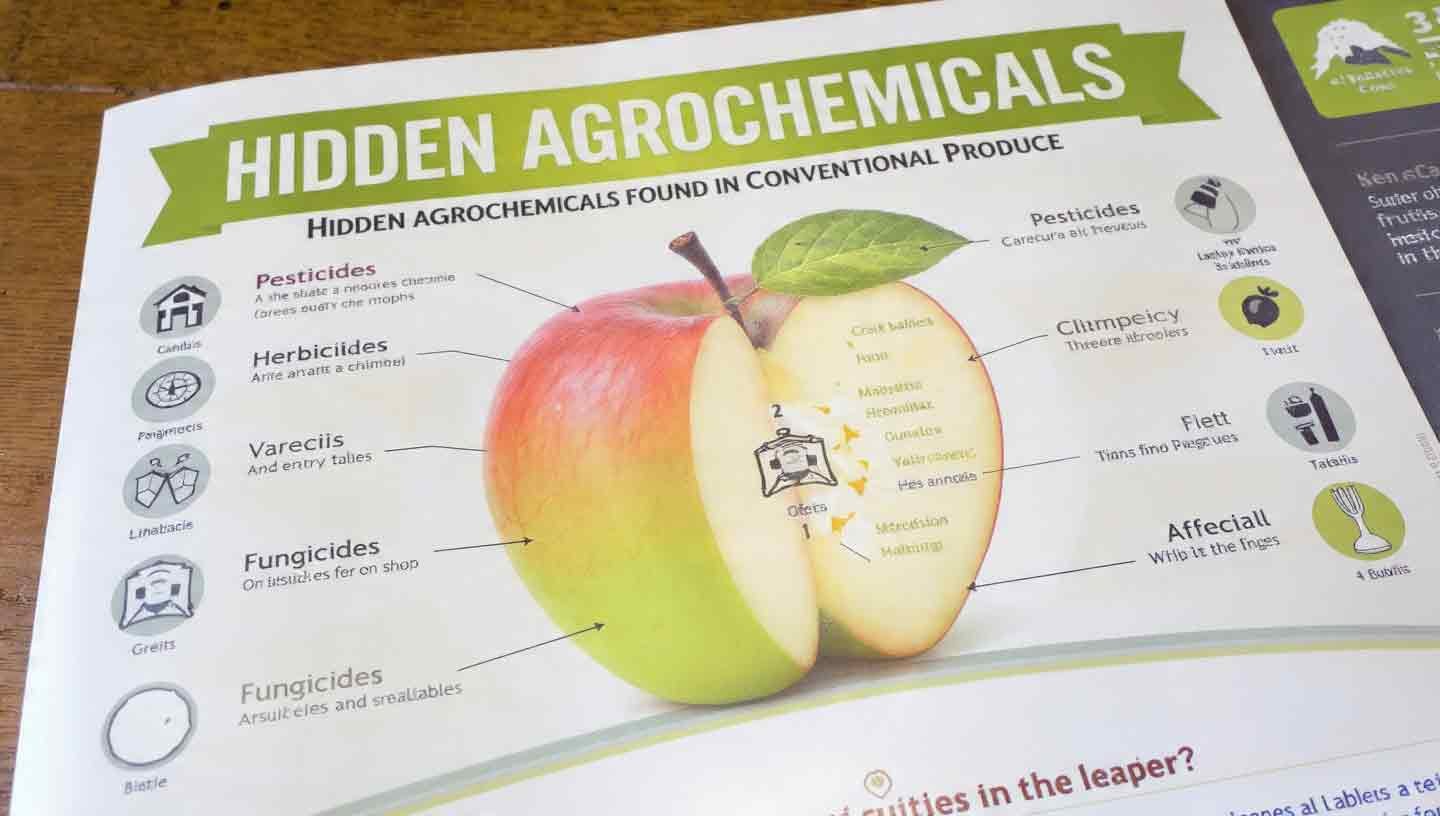
Wash your strawberries. That’s the conventional wisdom, repeated so often it has become culinary reflex — a small act of ritual cleanliness before the fruit hits the bowl. But what if washing isn’t nearly enough? What if the chemicals you’re concerned about are already inside the flesh, bonded at a molecular level, structurally invisible to the rinse cycle? The conversation around pesticides in produce has long been anchored to the Environmental Working Group’s annual Dirty Dozen — a genuinely useful guide, but one that, by design, tells only part of the story. The Dirty Dozen focuses on the produce with the highest pesticide residue. What it cannot fully capture are the post-harvest chemicals, the systemic insecticides that bind to plant tissue, the fungicidal coatings applied after the growing season ends, and the slow-burn endocrine disruptors lurking in the wax on your morning apple. This is the deeper layer — the one rarely discussed at the grocery store.
The Dirty Dozen Is a Floor, Not a Ceiling
The 2025 EWG Shopper’s Guide analyzed data from 53,692 samples of 47 fruits and vegetables tested by the USDA (Environmental Working Group, 2025). The findings were stark: more than 75 percent of all conventionally grown produce contained detectable pesticide residues, and for items on the Dirty Dozen — led by strawberries, spinach, and kale — that figure climbed to 95 percent (EWG, 2025). New 2025 entries include potatoes and blackberries, the latter joining after the USDA tested it for the first time in 2023.
These are sobering statistics, but the more unsettling truth is methodological: government regulators assess pesticide safety one chemical at a time, without accounting for the cumulative toxic burden of consuming multiple residues simultaneously (EWG, 2025). A single apple may test within legal limits for a dozen different compounds. Nobody is measuring what happens when those twelve compounds interact inside a developing child’s body over years of daily consumption.
That gap between “legal” and “safe” is where the real conversation begins.
Fungicides: The New Front Line of Contamination
For years, the pesticide conversation centered on insecticides — organophosphates, carbamates, the legacy chemicals of mid-20th-century agriculture. Fungicides were something of a regulatory afterthought. The 2024 EWG report changed that framing significantly, identifying fungicides as four of the five most frequently detected chemicals across Dirty Dozen produce: fludioxonil, pyraclostrobin, boscalid, and pyrimethanil (EWG, 2024).
Two of these — fludioxonil and pyrimethanil — not only appeared most frequently, but showed up in the highest average concentrations of any pesticides detected. Both are suspected endocrine disruptors with potential harm to the male reproductive system, according to EWG Senior Toxicologist Alexis Temkin, Ph.D. (EWG, 2024). The mechanism matters here: fungicides are often applied after harvest, during transit and storage, to prevent mold and decay on the way to market. That post-harvest application window places them on produce at the very moment the growing cycle’s natural processes — which might otherwise metabolize or diminish certain chemical residues — have ended. The fruit is static. The fungicide is not.
Blueberries, green beans, peaches, and pears showed particularly elevated fungicide levels in the 2024 analysis, the direct result of new USDA testing data becoming available for the first time (EWG, 2024). One outlier stood out for different reasons: acephate, an organophosphate insecticide banned for use on green beans in 2011, was still detected on them — with one sample testing positive at 500 times the EPA’s legal limit (Environmental Working Group, 2024; Common Dreams, 2024).
Neonicotinoids: The Systemic Problem You Can’t Wash Off
Here is the biological fact that renders the ritual rinse inadequate for a specific category of pesticides: neonicotinoids are systemic. They are absorbed by the plant itself during the growing process — through seed coating, soil application, or foliar spray — and become part of the plant’s internal chemistry. The fruit’s flesh contains them. Peeling helps with some residues; it does not help with these.
Neonicotinoids (commonly called “neonics”) are now the single most widely used class of insecticides in the United States, capturing roughly 25 percent of global insecticide sales as of 2014 and a global market value of approximately $3.7 billion (PMC, 2020). They work by permanently binding to insect nerve receptors, overstimulating and eventually destroying them — which is precisely why they are effective, and precisely why their impact on non-target organisms, including humans, warrants scrutiny.
EWG analysis of USDA data found that more than 15 percent of non-organic produce from 2002 to 2020 carried residues of at least one of three neonicotinoids — imidacloprid, clothianidin, and thiamethoxam — subsequently banned for outdoor use in the European Union in 2018 due to harm to pollinators (EWG). For specific crops, that exposure rate climbs dramatically: more than half of spinach, potato, and lettuce samples tested positive for at least one of these three neonics (EWG).
The human health picture is still forming, but the trajectory of evidence is concerning. A 2013 assessment by the European Food Safety Authority (EFSA) concluded there is substantive evidence that acetamiprid and imidacloprid can damage the developing human nervous system in ways that mirror the neurological effects of nicotine (PMC, 2020). A 2024 peer-reviewed paper published in Frontiers in Toxicology reviewed regulatory rodent studies and found that perinatal neonic exposure induces adverse, nicotine-like neurotoxic effects — including reduced brain dimensions, decreased motor activity, and impaired learning — and that current EPA exposure limits are either not protective or insufficiently supported by available neurotoxicity data (Frontiers in Toxicology, 2024).
Perhaps most striking: human biomonitoring studies have detected neonicotinoids in the bodies of roughly half the U.S. population on any given day, and in more than 95 percent of pregnant women tested, with levels rising over time (NRDC, 2025). The FDA reported that neonics were among the most frequently found pesticide residues in infant and toddler foods in its 2012 Total Diet Study, with occurrence ranging from 6 to 31 percent depending on the product (PMC, 2016).
Unlike contact pesticides, neonics cannot be washed, rinsed, or peeled away. They are, in the most literal sense, food.
Chlorpropham and the Invisible Potato Treatment
Most people who worry about pesticide exposure focus on what they can see — the shiny skin of an apple, the visible film on a grape. What receives almost no public attention is the post-harvest chemistry applied inside the supply chain, particularly to potatoes.
Chlorpropham (CIPC) is a sprout suppressant applied to stored potatoes as a thermal fog during long-term storage — sometimes months before those potatoes reach a grocery shelf. It works by inhibiting cell division, preventing sprouting and extending commercial viability. It has been used in the potato industry since the 1950s. Japan sets a permitted residue level of 50 ppm for potatoes; the U.S. EPA reduced its allowable limit from 50 ppm to 30 ppm in 1996 following Food Quality Protection Act mandates (ScienceDirect; EPA).
The concern is not primarily CIPC itself, but its metabolites. Research shows that CIPC breaks down into compounds including 3-chloroaniline (3CA), a minor but documented metabolite with mutagenic potential (PubMed, 2004). Subchronic exposure studies in rats demonstrated dose-dependent hematological changes including decreased red blood cell counts, suppressed hemoglobin, and altered platelet counts (ScienceDirect, 1999). The European Union subsequently declined to renew the authorization of CIPC, prompting the EU’s potato processing sector to find alternatives — a significant regulatory signal that hasn’t fully translated into American consumer awareness.
Certified organic potatoes are never treated with CIPC or synthetic mold and sprout inhibitors. The practical tradeoff: they may require more storage care and won’t last as long as their conventionally treated counterparts. For families making this swap, buying in smaller quantities is the adjustment (Organic Eye, 2025).
What’s on the Wax: The Post-Harvest Coating Problem
Walk through any produce section and you’ll notice the almost architectural shine on certain apples, cucumbers, peppers, and citrus fruits. That gloss is not natural. It is applied during the packing process after harvest — an edible coating designed to reduce moisture loss, extend shelf life, and improve cosmetic appeal for retail display. The wax itself is not the central concern; most formulations use carnauba (from palm leaves), shellac (from lac beetles), or beeswax. The issue is what the wax contains and what it seals in.
Conventional wax formulations can include morpholine as a solvent and emulsifier, used to ensure thin, even application. Morpholine by itself, at the doses present on treated produce, is not considered an acute health risk. However, research indicates it undergoes nitrosation during digestion in the presence of excess nitrites — which are common in the diet — to form N-nitrosomorpholine (NMOR), a genotoxic carcinogen (International Journal of Medical Research and Health Sciences). Health Canada’s Health Hazard Assessment set a safe daily dose of morpholine at 4.3 nanograms per kilogram of body weight — a figure that underscores how little margin exists (IJMRHS). The European Union has moved to restrict morpholine in produce coatings in response to these concerns; U.S. regulations have not followed.
Beyond morpholine, the wax layer creates a second problem: it physically traps pesticide residues against the fruit’s surface, making them significantly harder to remove through washing alone. Systemic pesticides are already in the flesh; contact pesticides and fungicides applied post-harvest are now sealed under a polymer barrier. The result is a double layer of exposure that routine washing under tap water cannot adequately address.
For consumers who peel their fruit, this concern is largely mitigated — though nutrient loss in the peel is a genuine tradeoff. For those who eat the skin (where much of the fiber and polyphenol content resides), a baking soda wash — one teaspoon in two cups of water, scrubbed gently and rinsed — has been shown in peer-reviewed research to remove more surface residues than water alone (Journal of Agricultural and Food Chemistry, 2017).
The Cocktail Effect: Why Single-Chemical Safety Standards Fall Short
Regulatory agencies in the United States assess the safety of pesticides one at a time. The EPA establishes tolerances — maximum residue limits — for individual compounds based on animal toxicity data. What this framework does not account for is the combined exposure that happens at every meal.
A serving of conventional spinach may legally carry residues of eight, ten, or more distinct pesticides, each within its individual legal tolerance. The science of what happens when those compounds interact — whether they amplify one another’s toxicity, compete for the same metabolic pathways, or create entirely new compounds during digestion — remains deeply underdeveloped. This is the “cocktail effect,” and it is the central blind spot in how produce safety is regulated and communicated to consumers.
As EWG’s 2025 analysis noted, the presence of so many different pesticides across the food supply “is concerning from a public health standpoint” precisely because government risk assessments consider them individually and cannot model what they mean collectively (EWG, 2025). Children are particularly vulnerable: their developing nervous and endocrine systems are far more sensitive to chemical disruption than adult bodies, and they consume more food relative to body weight — meaning their proportional exposure to any given residue is higher.
This is not a call to abandon produce. Every credible toxicologist, including those at EWG, emphasizes the same foundational point: the health benefits of eating fruits and vegetables, even conventionally grown ones, outweigh the risks of pesticide exposure for the overwhelming majority of people. The goal is informed choice, not fear.
Practical Intelligence at the Grocery Store
The 2025 Clean Fifteen — the produce items with very low or no detectable pesticide residues — includes avocados, sweet corn, pineapple, onions, papaya, frozen sweet peas, asparagus, honeydew melon, kiwi, cabbage, mushrooms, mangoes, sweet potatoes, watermelon, and carrots. Nearly 60 percent of samples across these items showed no detectable pesticide residues (EWG, 2025).
For the Dirty Dozen categories — strawberries, spinach, kale and collard greens, peaches, pears, nectarines, apples, grapes, bell and hot peppers, cherries, blueberries, and now potatoes and blackberries — buying organic where accessible and affordable is the most direct way to reduce chemical load. Frozen organic versions of berries and leafy greens, when available, are often more economical than fresh and retain their nutritional value.
For conventionally grown produce where organic isn’t available: wash with a baking soda solution rather than plain water, peel when the skin is not essential to the dish, and be especially attentive with the foods most likely to carry systemic chemistry — spinach, leafy greens, and berries. Store potatoes bought conventionally and use them relatively quickly, since the longer they sit, the more CIPC has potentially degraded into its metabolites.
None of this requires perfection. It requires awareness.
The Quiet Revolution Already Underway
It would be misleading to close without acknowledging the regulatory movement happening at the margins. The EU’s decision to ban the three major neonicotinoids for outdoor use in 2018 was a watershed moment that permanently shifted how European agriculture approaches insect management. Canada has moved to significantly restrict some of its most widespread neonic uses. In 2024, the U.S. EPA canceled all uses of the herbicide DCPA (Dacthal) after the manufacturer’s own data — submitted a decade late — showed that even low levels of exposure altered thyroid hormone levels in developing fetuses (EWG, 2025).
These are not small developments. They suggest that the regulatory floor beneath American produce safety is not static — it is, slowly, being raised by science that keeps arriving faster than the policy apparatus can absorb it.
The Dirty Dozen remains an essential consumer tool. But it is a starting point, not a destination. The hidden agrochemicals — the fungicidal cocktail sealed under the wax, the systemic neonicotinoids woven into the plant’s own tissue, the post-harvest fog applied to your potatoes in a climate-controlled warehouse months before you see them — these are the next chapter of a conversation that is long overdue.
Sources:
- EWG’s 2025 Shopper’s Guide to Pesticides in Produce
- EWG’s 2024 Dirty Dozen Press Release
- EWG: Neonic Pesticides on U.S. Produce
- Frontiers in Toxicology: Neonicotinoid Developmental Neurotoxicity (2024)
- PMC: Critical Review of Neonicotinoid Impacts on Human Health (2020)
- PMC: Effects of Neonicotinoids on Human Health — Systematic Review (2016)
- NRDC: Neonicotinoids 101
- ScienceDirect: Chlorpropham Overview
- PubMed: Hemotoxicity of CIPC in F344 Rats
- IJMRHS: Health Effects of Morpholine-Based Coatings
- EPA: Chlorpropham Reregistration Fact Sheet
- Common Dreams: 2024 Dirty Dozen Coverage