Cold water moves fast through Long Island Sound. Somewhere between the sandy bottom of Great South Bay and the swift tidal currents off Norwalk, Connecticut, a bivalve is doing what it has done for two centuries — filtering, growing, becoming something quietly extraordinary. The Blue Point oyster doesn’t announce itself. It doesn’t need to. It has sat at the center of American oyster culture since a man named Humphret Avery first planted seed off the shore of Blue Point, New York, in 1815, and it spent most of the nineteenth century as the single most prestigious oyster on the Eastern Seaboard — the only one to grace the table of Buckingham Palace at Queen Victoria’s personal request.
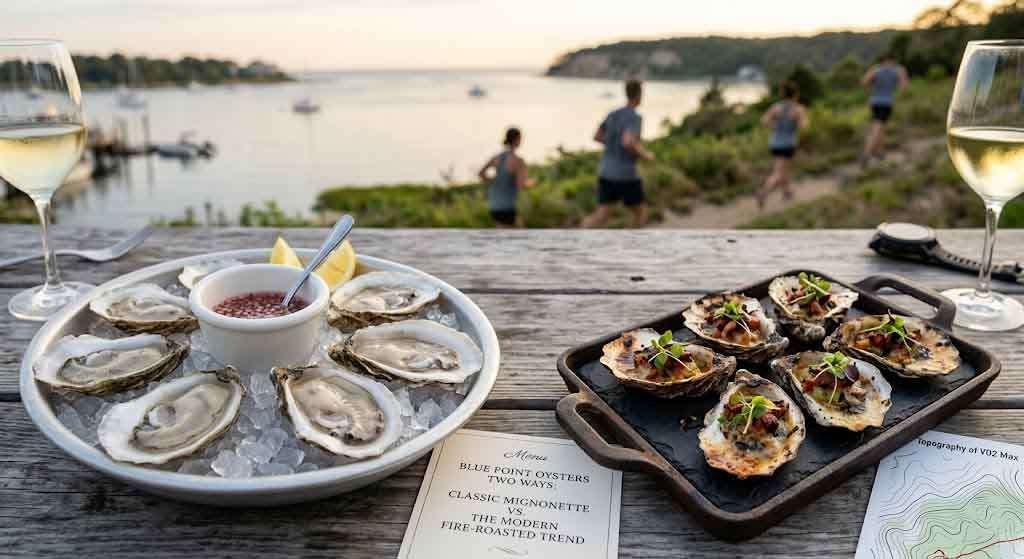
Two hundred years of merroir, of mineral-laced cold water and sandy substrate, produce an oyster with medium salinity, a springy and meaty bite, and a clean finish with just enough mineral edge to tell you where it came from. Not the briniest oyster in the water. Not the creamiest. But one with a kind of honest, balanced character that has made it both an icon and, at times, a victim of its own fame — its name eventually diluted into a catch-all term for virtually any Crassostrea virginica pulled from Long Island Sound. That tension between heritage and commercialization is its own story. But this piece is about something more immediate: what you do with a Blue Point once it’s in front of you. Specifically, the two preparations that define the ongoing conversation in serious oyster culture right now — the unflinching restraint of a classic French mignonette, and the primal, theater-driven heat of the modern fire-roasted preparation.
The Anatomy of a Blue Point
Before discussing how to eat them, it’s worth understanding what you’re working with. Blue Points are bottom-planted oysters, seeded and grown-out in the cold, nutrient-rich, shallow waters of Long Island Sound, then harvested typically between September and April when the cold suppresses spawning and keeps the meat firm and full. The dual-location cultivation system — seed from Great South Bay, grow-out in Long Island Sound or Connecticut beds — creates the particular combination of flavor compounds that defines the variety. The salinity registers in the mid-range, neither aggressively oceanic like a Wellfleet nor as mild and sweet as a Pacific Kumamotos. There’s a slight coppery mineral note on the finish that lingers, and the texture is firm enough to hold up to a small spoonful of acid without disintegrating.
This last quality matters enormously in how you choose to serve them. A delicate oyster can be overwhelmed. A Blue Point is sturdy enough to carry a conversation with its accompaniment rather than surrender to it. Which is precisely why it became, two centuries ago, the default oyster of New York’s raw bars — and why it remains relevant today as chefs reach for fire and smoke and butter where their predecessors reached for lemon and vinegar.
The Classic Mignonette: Restraint as an Artform
The word mignonette comes from the French mignon — dainty, small, delicate. It was originally a term for a sachet of peppercorns and spices used to flavor cooking liquids; over time it migrated to refer specifically to cracked pepper, and eventually to the sharp, shallot-heavy vinegar sauce that became standard issue at every serious raw bar in New York. Three ingredients — red wine vinegar, finely minced shallots, freshly cracked black pepper — and nothing else. No oil. No sugar. No distractions.
The philosophy behind a proper mignonette is the same philosophy behind restraint in any serious craft: remove everything unnecessary, and what remains becomes more itself. The acid in the vinegar does several things simultaneously. It lifts the brine of the oyster without masking it, creates a gentle pickled softness in the shallot, and frames the mineral finish in a way that raw lemon juice alone — too sharp, too one-note — cannot. The pepper provides just enough aromatic warmth to suggest complexity without introducing heat. Made correctly, a mignonette rests in the refrigerator for at least two hours before service so the shallots can soften and mellow in the vinegar, their sharp edge becoming something more nuanced, almost sweet.
The ratio matters. Finely hand-minced shallots — never processed, which creates mush — combined with a quality red wine vinegar or champagne vinegar at roughly two parts vinegar to one part shallot by volume. Freshly cracked black peppercorns, not pre-ground. A pinch of fleur de sel if you want, though purists omit it. The resulting sauce is pink, clean, almost translucent — and the effect on a properly shucked Blue Point is revelatory. A half-teaspoon spooned into the shell, the oyster lifted on a fork and the liquor tilted back with it — and what you experience is the oyster amplified, not transformed. Its own salinity made more vivid, its mineral finish given a frame.
This is the preparation that respects the oyster’s integrity absolutely. It is, in the vocabulary of craft, the equivalent of allowing an excellent material to speak for itself. At the Heritage Diner, where we’ve built twenty-five years around the conviction that quality ingredients don’t need interference so much as proper context, this philosophy feels deeply familiar. The best thing a kitchen can often do is get out of the way.
The Fire-Roasted Turn: When Theater Meets Flavor Science
The move toward live fire has been the defining culinary shift of the past decade — from the wood-burning hearths of fine dining establishments to backyard grills — and oysters have not been exempt. The chargrilled oyster has deep American roots, rooted most prominently in New Orleans, where Drago’s Seafood Restaurant in Metairie is widely credited with popularizing the charbroiled preparation in the 1990s: oysters in their half shell hit a screaming-hot grill, basted with roasted garlic butter, finished with Parmesan and Romano, served still bubbling while the edges curl and char. It is the opposite of restraint. It is full-volume, generous, unapologetically theatrical.
What fire does to an oyster is worth understanding at a biochemical level, because it isn’t simply about adding flavor — it’s about transforming the texture and chemistry of the oyster meat itself. When a raw oyster meets high heat, several things happen quickly. The proteins denature and contract, firming the texture from silky and slippery to something closer to a plump, seared scallop. The natural glycogen — the compound responsible for that faint sweetness in a cold raw oyster — undergoes Maillard reactions at the surface where it contacts the hot shell or grill grate, producing complex caramelized and roasted flavor compounds that have no analog in the raw state. The liquor steams inside the shell, cooking the oyster from below as the flame works from above. The result, when executed properly, is something entirely different from the raw oyster — not better or worse, but genuinely other.
The modern fire-roasted preparation has evolved well beyond the classic New Orleans version. Contemporary chefs are working with compound butters built on brown butter bases rather than straight garlic, introducing herbs like tarragon and thyme, finishing with fresh citrus zest rather than just Parmesan, smoking the butter itself before incorporating it into the shell. Some approaches skip the cheese entirely and instead work with a smoked chili oil, a miso butter, a fermented black bean paste — preparations that honor the fire-driven transformation of the oyster while reaching for more nuanced flavor profiles. The throughline in all of them is that the heat is the point: the char, the steam, the sizzle when the shell hits the fire.
Mignonette or Fire? The Case for Context
The question of which preparation is superior is the wrong question. Both are correct — in the right context, for the right moment, with the right bottle on the table. The mignonette preparation belongs to cold weather, to contemplative eating, to the kind of meal where the point is precision and the diner’s attention is being directed to the oyster’s own identity. It belongs at a raw bar, on ice, with a glass of Muscadet or a dry Blanc de Blancs — wines without fruit distraction, wines that function as acid and minerality and little else.
The fire-roasted preparation belongs to summer, to the grill, to shared plates and warm evenings and meals that are meant to be experienced rather than analyzed. It belongs with crusty bread to soak up the butter pooling in the shell, with cold lager or a slightly smoky, oxidative Sherry, with the particular pleasure of eating something that is piping hot and briny and rich all at once. Both require excellent oysters. The mignonette approach will expose every flaw in a mediocre oyster; a bad oyster under mignonette has nowhere to hide. The fire will forgive slightly more — the char and butter can carry a softer specimen further — but truly excellent oysters still make the fire-roasted version transcendent rather than merely good.
Serving Blue Points Right: The Practical Details
For the classic mignonette, execution is about freshness and cold. Oysters shucked to order, served on crushed ice with the shell cupped deep side down to retain the liquor. Mignonette made at minimum two hours ahead, ideally the night before, served in a small ramekin with a tiny spoon alongside fresh lemon wedges and a bottle of clean hot sauce for those who want it. The shucking itself matters — a clean cut at the hinge, the adductor muscle severed from the top shell cleanly to leave the oyster and its liquor undisturbed. Any fragments of shell in the cup are unforgivable.
For the fire-roasted version, you need either an extremely hot charcoal or gas grill — or a cast iron pan preheated to near-smoking — and oysters shucked but left in the deep half shell, the top shell removed. Your compound butter — softened, blended with roasted garlic, fresh parsley, lemon zest, cracked pepper — goes directly into the shell before the heat. The oyster hits the grill cup-side down, the butter melts and bubbles and mingles with the oyster’s own liquor, and the edges of the meat should just begin to curl before you pull them. Thirty seconds too long and you’ve overcooked them into something rubbery and robbed. Watch them carefully. The moment the oyster is cooked through but still plump, the butter is bubbling at the edges, finish with a grating of Pecorino Romano and serve immediately on a platter. The window between perfect and overdone is narrow.
The Deeper Argument: Why Both Matter
At the core of this comparison sits a broader question about what we want from food — specifically from a food as singular as the oyster, which carries with it two centuries of American history and a specific geography that no other ingredient can replicate. The classic mignonette is an act of listening: to the oyster, to the water it came from, to the subtle interplay between acid and brine and mineral. The fire-roasted preparation is an act of interpretation: the cook bringing something of their own to the conversation, using heat and fat and char to create a new thing that could not exist without both the oyster and the hand behind it.
Neither approach is more legitimate. The best cooks I’ve known understand instinctively when to listen and when to interpret — and they understand that the choice isn’t about preference so much as about reading what the moment requires. A two-hundred-year-old oyster from the waters of Long Island Sound deserves both kinds of respect: the silence of a well-made mignonette on a cold evening, and the fire and noise of a hot grill on a summer night. Give it both. You won’t be wrong.
Sources
- Pangea Shellfish Company, Blue Point Oysters — Oysterology Online: https://www.pangeashellfish.com/oysterology/blue-point-oyster
- Pangea Shellfish Company, Blue Points: The Most Bastardized Name in Seafood: https://www.pangeashellfish.com/blog/blue-points-the-most-bastardized-name-in-seafood
- William G. Pomeroy Foundation, Blue Point Oysters: https://www.wgpfoundation.org/historic-markers/blue-point-oysters/
- The Gotham Center for New York City History, Dutch Baymen, Blue Points, and Oyster-Crazed New Yorkers: https://www.gothamcenter.org/blog/dutch-baymen-blue-points-and-oyster-crazed-new-yorkers
- In A Half Shell, Bluepoint Oysters: Then and Now: https://www.inahalfshell.com/journal/bluepoint-oysters
- WebstaurantStore, What Is Mignonette Sauce: https://www.webstaurantstore.com/blog/4418/what-is-mignonette.html
- Rowan Jacobsen, A Geography of Oysters (Bloomsbury, 2007)
- Original Oyster House, Fire-Grilled Oysters: https://www.originaloysterhouse.com/chargrilled-oysters-near-me/