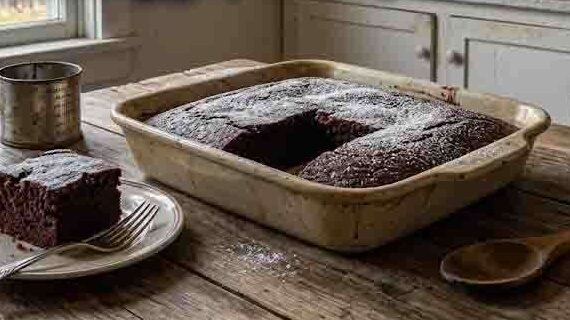
Flour, sugar, cocoa, vinegar, oil, and water. No eggs cracked over a mixing bowl. No stick of butter softened on the counter. No splash of milk. Seven ingredients — most of them already sitting in a kitchen cabinet — and yet the result is a moist, deeply chocolatey cake that has outlasted the era of scarcity that invented it. Depression Cake, more widely known as Wacky Cake, has a biography unlike any other dessert in the American kitchen: born of hardship, refined through rationing, and now quietly experiencing a third act as a vegan pantry staple and budget-forward baking option in an age when grocery bills have become their own kind of burden.
To understand why this cake endures, you have to go back to the world that made it necessary — and to the Long Island communities that lived through the same collapse that sparked it.
When Scarcity Became the Recipe
By 1932, unemployment had soared to approximately 25 percent of the workforce, affecting over 12 million Americans and leading to acute food insecurity for many families. The Dust Bowl compounded matters: a series of severe dust storms beginning in 1930 eroded topsoil across the Great Plains, resulting in farm foreclosures and shortages of dairy products like milk and butter, as well as eggs and sugar from disrupted supply chains and reduced livestock yields. Some families fed themselves on as little as five dollars a week. Dessert became a privilege, not a ritual.
And yet American home cooks — largely women managing household budgets with extraordinary ingenuity — refused to abandon the table. Depression cake emerged as an inventive solution, relying on inexpensive pantry staples to produce a moist cake without eggs, butter, or milk. Shortening replaced butter. Water replaced milk. And in one of the more remarkable tricks in domestic food science, the chemical reaction between vinegar and baking soda replaced the leavening power of eggs entirely.
Radio shows and women’s periodicals played a large role in circulating the recipe during the Great Depression. Betty Crocker’s Cooking Hour on the radio provided budget-friendly alternatives. Loring Schuler’s Ladies’ Home Journal offered tips on replacing eggs with baking powder and substituting inexpensive grains. M.F.K. Fisher — perhaps America’s most literary food writer — published a version called “War Cake” in her book How to Cook a Wolf, declaring it the most practical cake ever made.
The recipe predates the Depression by at least a decade. It has been referred to as “War Cake” by texts dating back to World War I, and is listed under “Recipes for Conservation Sweets” in a pamphlet distributed by the United States Food Administration in 1918 entitled “War Economy in Food.” Boiled raisin cakes sharing similar logic trace back to the Civil War era. The Depression simply gave the concept its most famous chapter.
When the United States entered World War II in December 1941, wartime rationing intensified matters. Sugar rationing commenced in May 1942, limiting civilians to half a pound per person per week. Butter and fats were rationed from March 1943. The eggless, dairy-free cake didn’t fade — it surged again. It was touted as a “favorite recipe” of the U.S. armed forces. And during the 1940s, it picked up a name that has stuck ever since: Wacky Cake — so named because making a respectable cake without eggs or butter seemed, by the standards of conventional baking, frankly unhinged.
The East End of Long Island: A Community That Understood Scarcity
The Depression wasn’t an abstraction in Suffolk County. It was the family farm that couldn’t meet the bank note. The load of potatoes that wouldn’t sell at market.
World War I had opened up more markets for Long Island farmers, but prices went down during the 1920s, followed by the stock market crash and the Great Depression. Farmers were forced to borrow cash for seed and equipment and suffered alongside the rest of the country. Suffolk County in the 1930s was still predominantly agricultural — potatoes, cauliflower, and duck farms stretched from Riverhead east to Montauk, and north shore communities like Mount Sinai sat amid that same working landscape. The soil was productive, but the markets were punishing.
Driving out east along the North Shore along New York State Route 25A, houses and buildings start to spread out, turning back to the potato and sod farms that once were east of and including towns such as Mount Sinai. Those farms — the ones still faintly visible between the developments that followed the postwar housing boom — were the context in which East End families baked Depression-era cakes. They may have had eggs from their own chickens or butter from a neighbor’s dairy cow, but cash was short, and the Depression-era habit of substituting what you had for what a recipe called for was less an ideological choice than a survival skill.
Suffolk County today is the fourth most valuable agricultural area in the country, a fact that feels improbable given how thoroughly the region has been associated with wealth and leisure. But those farm roots are real, and Depression Cake is a direct artifact of that history — a recipe that lived in the handwritten card files of farm wives from Yaphank to Southold, passed quietly from one generation to the next long after the rationing books were gone.
The Science Behind a Cake Without Eggs
That this cake works at all is, on its face, remarkable. Eggs in conventional baking carry enormous structural responsibility: they provide moisture, emulsification, leavening, and protein structure. Butter contributes fat for tenderness and flavor. Milk adds liquid and richness. Strip all three and you would expect a dense, gummy brick.
Depression Cake produces the opposite. The secret is chemistry.
When you mix baking soda — a base with a pH above 7 — with vinegar, an acid with a pH below 7, you get a chemical reaction that produces an eruption of carbon dioxide bubbles. Those bubbles, trapped in the wet batter before it sets in the oven, provide lift. The result is a crumb that is light, open, and moist despite the total absence of eggs.
Baking soda needs an acidic component to react with. When the basic properties of baking soda mix with the acidic properties of another ingredient, it works to neutralize the acid — and this is what causes the air bubbles that leaven the baked good. In the Wacky Cake formula, white vinegar serves as that acid. It is fast-acting, flavorless once baked, and — critically during the Depression — cheap and shelf-stable.
Butter and eggs usually do heavy lifting in cake recipes. Butter keeps cakes tender by coating the flour and slowing down gluten development, while eggs help with both leavening and structure. In Depression Cake, vegetable oil replaces the fat function of butter — oil is liquid, meaning it coats flour proteins at the molecular level without the need for creaming, resulting in a cake with a notably tender, moist crumb. The absence of eggs means less protein coagulation during baking, which further softens the texture.
Before baking soda became available, achieving lightness in cakes required either maintaining a yeast culture for days or whipping egg whites by hand with enormous effort. The invention of baking soda truly was revolutionary — it allowed cooks to spend far less time and still produce light, airy results. Depression Cake represents the logical end of that revolution: a cake that needs no bowl, no mixer, no eggs, no dairy, and no advance planning — just pantry staples and a chemical reaction that behaves the same way it did in every kitchen science demonstration ever made.
The Method: Three Holes, One Pan, Thirty Minutes
The preparation of Wacky Cake is distinctive enough to deserve its own attention. The process begins by sifting the dry ingredients — flour, cocoa, sugar, baking soda, and salt — directly into an ungreased 8×8-inch baking pan. Three depressions are then formed in the dry mixture: one for the vinegar, another for the oil, and a third for the water and vanilla extract. The wet ingredients are poured into their respective depressions, followed by gently stirring the mixture with a fork until smooth — no separate mixing bowls or electric mixers required.
The three wells are not theatrical. They matter. Because baking soda reacts the moment it contacts acid, keeping the vinegar separate from the baking soda until the last possible second preserves the leavening power. Baking soda becomes reactive when exposed to acids and must be used right away — otherwise the carbon dioxide-producing bubbles will begin to pop, resulting in a flat and dense product rather than something light and airy. Getting the batter into a preheated oven immediately after mixing isn’t a suggestion — it is the difference between success and a flat disc.
The result bakes in roughly 30 minutes at 350°F. No stand mixer. No separate bowls. No softening of butter, no tempering of eggs, no resting of batter. A cake, start to oven, in under ten minutes of active effort.
A Name That Undersells a Legacy
Wacky Cake has always suffered from its own branding. Baking expert and CEO at Dragonfly Cakes, Odette D’Aniello, has noted that the name doesn’t exactly signal elegance or occasion — something many people now associate with home baking, especially around celebrations. It doesn’t always match the aesthetics of today’s ultra-decorated cakes or the rich textures people expect from more ingredient-heavy recipes.
This is a fair critique of the marketing. It is not a fair critique of the cake.
Women could bring the luxury of dessert — the joy, celebration, and sweetness — to American tables even in the darkest of times. That is the purpose this cake served for nearly a century, and it served it with complete reliability. It appeared in 4-H competitions in the 1940s, school cafeteria menus through the 1970s, and community cookbooks across several generations. In the 1970s, it gained renewed popularity among younger generations experimenting with their parents’ wartime recipes, appearing in community cookbooks and family gatherings as a nod to mid-20th-century simplicity.
The current moment has brought it back again — this time for different reasons. Amid the inflation spikes of the 2020s, particularly from 2022 onward, Depression Cake has resurfaced as a budget-friendly dessert, appealing to home bakers seeking affordable indulgences during rising food costs. The egg shortage that hit U.S. grocery stores in 2024 and into 2025 sent searches for eggless cake recipes spiking. Wacky Cake — a recipe that solved that exact problem ninety years ago — appeared across food media once more, as relevant as ever.
The Accidental Vegan Classic
Long before plant-based eating became a lifestyle category, Depression Cake was already doing what contemporary vegan baking labors to achieve: producing a rich, moist, chocolatey dessert without a single animal product.
Long before plant-based baking became a trend, people were already doing it out of necessity. Depression Cake is naturally egg- and dairy-free, proving that delicious baking doesn’t need to be complicated.
What makes this Depression-era cake so timeless is its elimination of dairy and eggs. Those with special dietary needs due to allergies can enjoy this vegan sweet treat without worry of triggering symptoms. Food allergy prevalence has increased significantly in recent decades, and egg and dairy allergies remain among the most common. A cake that requires no substitutions, no specialty flours, no flax eggs, and no coconut cream — that simply works as written for anyone who can’t or won’t eat animal products — is a genuinely useful thing to know how to make.
The modern variations have expanded well beyond the original chocolate version. Lemon, vanilla, spiced apple, and coffee iterations have all found their footing. Toppings have evolved too: cocoa glazes, peanut butter frosting, dairy-free chocolate ganache, and simple dustings of powdered sugar all work within the spirit of the original. The base formula — acid plus baking soda, oil for tenderness, water for liquid — turns out to be remarkably adaptable.
What the Pantry Remembers
There is a category of recipe that functions as compressed cultural memory — dishes that encode an entire era’s relationship with resources, community, and improvisation. Depression Cake is one of those recipes. It tells you something about 1932 that no economic chart can fully convey: that even at the bottom of the worst financial collapse in American history, a home cook could find a way to put something sweet on the table, could make something celebratory out of flour and vinegar, could turn scarcity into ingenuity rather than surrender.
The East End of Long Island — for all its current associations with vineyard weekends and Hamptons real estate — carried those farm-community values through the Depression and into the postwar suburbs that followed. Recipes like this one moved with the families who held them, from Shelter Island farmhouses to the split-levels of Brookhaven and beyond, eventually disappearing into the back of the card box, surfacing again whenever the world reminded people that having less does not have to mean eating worse.
Wacky Cake is proof that the pantry, properly understood, has never required a trip to the specialty grocery store. It requires attention, a little chemistry, and the understanding that constraints have always been one of the more reliable mothers of invention.
Sources
- Wikipedia: Depression Cake
- Wikipedia: History of Long Island
- Contingent Magazine: Personal Pan Histories: Wacky Cake
- Food Republic: The Depression-Era Cake We Don’t See People Eat Anymore
- Tasting Table: Depression-Era Wacky Cake Recipe
- Chowhound: Wacky Cake Is The Depression-Era Cake That Still Holds Up
- Sally’s Baking Addiction: Baking Powder vs. Baking Soda
- FoodCrumbles: How Baking Powder & Baking Soda Work
- Forest Hills Tuv Ha’Aretz CSA: From Ducks and Potatoes to Wine and CSAs: A History of Farming on Long Island
- Budget Bytes: Chocolate Depression Cake
- Natural Rooted Home: Depression Era Chocolate Cake
- K-State Research & Extension: 3 Key Chemical Leavening Agents in Baking