Desperation has always been the mother of culinary invention. Long before “farm-to-table” became a restaurant marketing buzzword, American home cooks were performing something far more impressive in their modest Depression-era kitchens — turning a sleeve of crackers, a cup of sugar, and a squeeze of lemon into a pie that smelled, looked, and tasted unmistakably of apple. No orchard required. No fruit at all. Just ingenuity, chemistry, and a willingness to believe that the mind could be persuaded to complete what the pantry could not provide.
Mock Apple Pie is one of the most remarkable culinary artifacts in American history — not because it is exotic or technically complex, but precisely because it is neither. It is, at its core, a story about perception, scarcity, and the deep human need for comfort even when the table is nearly bare.
A History Longer Than the Depression
The popular narrative places Mock Apple Pie squarely in the 1930s, a Depression-era invention born of hardship and Nabisco’s marketing genius. The truth is considerably older and more layered.
The first recorded recipe for the pie dates back to 1857, when The Saturday Evening Post published a recipe for “cracker pie.” The February 14 issue of that year carried the following note, preserved in the archives: “As apples are very scarce in many sections of the country, I think the housewife will find the following recipe for making an apple pie out of crackers very acceptable.” The ingredients were elemental — crackers, sugar, tartaric acid, and water — but the intent was clear. The scarcity of fresh fruit in frontier and rural America made substitution not a novelty, but a necessity.
New York Times food writer Florence Fabricant noted that mock apple pies were popular among pioneer families crossing the Great Plains, where orchards were distant memories and supply lines were nonexistent. Civil War soldiers, too, knew the pie in cruder form — some would crush hardtack with the butt of a rifle and reconstitute it into something resembling a fruit filling, longing for a taste of home between campaigns. One documented account from the Civil War era involves a South Carolina woman named Margaret Hunter who sent her recipe for mock apple pie to her brother serving in Mississippi (Burkhalter, Raised on Old-Time Country Cooking, 2012). The pie traveled by letter across battle lines. That is how deeply comfort food runs in the human psyche.
By the time Ritz crackers arrived in 1934, the underlying recipe was already seventy years old. What Nabisco did was not invent the dish — it industrialized the myth.
The Ritz Arrives: Affordable Luxury in the Darkest Decade
Ritz Crackers made their debut on November 21, 1934. They were very well received and ended up being popular during this time period because of their unique buttery flavor and their low selling cost — just 19 cents for a one-pound box, making them accessible to a population living through the worst economic contraction in American history.
The name itself was a stroke of psychological brilliance. “Ritz” conjured the glamour of luxury hotels in an era when luxury had all but vanished. Unlike plain saltines, Ritz had a buttery, rich flavor that felt indulgent — marketed as an affordable luxury, giving people a sense of treating themselves during a time when treats were few and far between. The branding gave permission to feel civilized again.
Within three years, Ritz crackers had become the bestselling cracker in the world. By 1935, the National Biscuit Company had sold 5 billion units. Shortly after, the mock apple pie recipe began appearing on the back of the box — though, notably, it wasn’t until the Second World War that the company formally began printing the Ritz Mock Apple Pie recipe on the packages, further evidence that the recipe’s rise to national prominence was a gradual process, not a single marketing moment.
The broader economic context matters here. Between 1929 and 1932, worldwide GDP fell by an estimated 15%; in the United States, the Depression resulted in a 30% contraction in GDP, with unemployment in some countries rising as high as 33% and crop prices falling by up to 60%. The Dust Bowl ravaged the Great Plains throughout the 1930s, with prolonged drought and destructive agricultural practices leading to massive dust storms that destroyed crops and livestock, further limiting the availability of already scarce fresh produce. Against this backdrop, a buttery cracker that could masquerade as an apple was not a parlor trick — it was a lifeline.
The Chemistry of Deception: How It Actually Works
The more fascinating question is not why this pie was made, but how it works. How does a cracker become an apple?
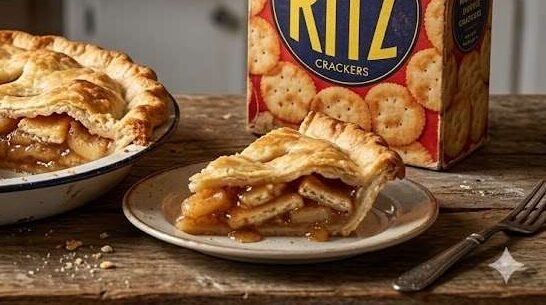
The answer lies in a precise combination of texture manipulation, acid chemistry, and olfactory suggestion. The recipe calls for boiling Ritz crackers in a syrup of water, sugar, cream of tartar, and lemon juice for several minutes before pouring the mixture into an unbaked crust. Boiling the crackers with sugar and lemon juice softens them, causing them to take on a more apple-like texture — the sugar and lemon give the filling the necessary sweetness and a bit of tang, while cinnamon brings out the primary flavor note of apple pie.
The key to the pie’s success may be its most humble ingredient: cream of tartar, a white powdery acidic compound. It serves two purposes — adding an acidic, fruit-like note to the filling and preventing sugar crystallization as the crackers are boiled, resulting in a filling that is perfectly smooth in texture and zingy in taste.
The cinnamon is not decorative. It is essential misdirection. The human brain associates the aroma of cinnamon-sugar with apple pie so deeply and automatically that it effectively overwrites the absence of the fruit itself. As sensory scientist Jeannine Delwiche explained in research covered by The Seattle Times: “Your brain is effectively filling in the missing part, the apple aroma.”
This is not simply a quaint observation. It reflects decades of research in sensory neuroscience. Dr. Charles Spence, professor of experimental psychology at Oxford University and author of Gastrophysics, has argued that the brain operates as a “prediction engine, generating internal models of the world” — and that far more important to our flavor experience than what is on the tongue is the context that surrounds the eating: the smell, the visual cues, the expectations already formed before the first bite. When you see a golden double-crust pie cooling on a counter and smell cinnamon in the air, you have already tasted it in your mind.
Research published in Frontiers in Neuroscience and related journals confirms that flavor perception results from multisensory integration of multiple sensory signals in the human brain, with taste, smell, oral texture, and visual appearance all combining in regions including the orbitofrontal cortex — a process sometimes called “neurogastronomy.” Mock Apple Pie is, in this sense, a Depression-era experiment in applied neurogastronomy conducted by home cooks who had never heard the word.
Nabisco’s Marketing Masterstroke — and Its Limits
It would be uncharitable — and historically inaccurate — to reduce the Mock Apple Pie story to a cynical marketing play. Nabisco did not invent the recipe, and the company’s decision to print it on the back of the Ritz box was, at least in part, a genuine response to the moment. What Nabisco did was tell families: “You can still enjoy the traditions you love, and Ritz crackers will help you get there.”
Still, the commercial dimension is real. Printing the recipe on the packaging turned every box into an advertisement. The recipe was not only a service — it was a use case. And it was extraordinarily effective. The recipe appeared on Ritz boxes from approximately 1935 until the late 1980s. After Nabisco removed it, the company received more than 1,500 letters in the first year alone requesting its return, prompting them to resurrect the practice in 1991. Even today, it remains Nabisco’s most requested recipe.
The genius of the strategy was its authenticity. Nabisco was not selling false hope — the pie genuinely worked. The Oxford Encyclopedia of Food and Drink in America confirms that “crackers have a history of approximating apple pie in both texture and taste,” a statement that in any other context would sound absurd, but in the context of this pie’s 170-year history feels almost understated.
The Depression Kitchen and the Ritual of Normalcy
To understand why Mock Apple Pie mattered beyond its caloric function, you have to understand what food meant to an American family in the 1930s. The most lasting legacy of the 1930s for most Americans was their diligence in eating every last bite on their plate. Nothing was discarded. Bread crusts became croutons. Vegetable scraps became stock. Bacon fat was stored in a can beside the stove and used to cook everything.
But food was not only fuel. It was ritual. A Sunday pie — any pie — meant that the week had not defeated you. It meant the kitchen still smelled like home, that the table was still set, that the family still gathered. Families were forced to rely even more heavily on government assistance and whatever they could grow themselves in small backyard gardens, but home canning and preservation became essential skills that kept households nourished and connected to seasonal rhythms. Within that culture of radical thrift, Mock Apple Pie was not just food. It was a small, edible act of resistance — a refusal to let want erase the rituals of plenty.
This is why food writers Jane and Michael Stern, writing in 1988, offered three reasons to make Mock Apple Pie: crackers are cheaper than apples; apples are not always in season; and — perhaps most memorably — you should make it to astonish the people you love when you finally reveal what they have been eating (Stern, Ocala Star-Banner, 1988). That third reason is not practical. It is theatrical. It is about delight, about the pleasure of the reveal, about joy in a recipe’s cleverness. That a Depression-era dish could inspire that kind of mischief says something profound about human resilience.
The Science of “Good Enough” and the Deeper Lesson
Mock Apple Pie raises a philosophical question that extends well beyond the kitchen: what makes a thing what it appears to be? If a pie looks like apple pie, smells like apple pie, has the texture of apple pie, and triggers the neurological response associated with eating apple pie — is the distinction between “real” and “mock” meaningful?
Sensory research suggests the answer is complex. According to the assimilation model — the most influential model in sensory psychology — taste and flavor experiences are modified toward what one expects. Neuroimaging studies confirm that these effects are not superficial response biases but reflect truly changed perception, with cortical representations of flavor genuinely modulated by prior expectation. In other words, if you expect apple pie, you are neurologically primed to experience apple pie. The crackers are not a trick your tongue tolerates — they become, in the brain’s processing, something genuinely apple-adjacent.
This is a lesson that extends to every domain of craft, hospitality, and experience design. The context in which something is delivered shapes how it is received. The plating of a dish, the smell of a room, the weight of a tool in the hand — all of these set expectations that become, for the person experiencing them, a form of truth. Skilled makers understand this instinctively. The Depression-era cook who slid a Ritz cracker pie out of the oven on a Sunday afternoon and watched her children reach for a second slice understood something essential about the human relationship with expectation, comfort, and meaning.
A Pie That Still Astonishes
Mock Apple Pie never fully disappeared. It enjoyed a resurgence of nostalgia in the 1960s as the children of the Depression became parents themselves. In recent years, the pie has found renewed interest among vintage food enthusiasts, who love it for its easy assembly, surprising verisimilitude, and nostalgic appeal. Today it lives on food history blogs, in family recipe boxes, and in the occasional brave home baker who wants to test the credulity of their dinner guests.
To make it today is to connect with something larger than a recipe — a lineage of American resourcefulness that runs from the Civil War through the Great Plains prairie kitchens to the Depression breadlines to the yellow Formica countertops of the 1960s. Every time a batch of Ritz crackers is lowered into simmering lemon syrup and emerges, somehow, smelling of autumn and spice, that lineage is renewed.
The brain fills in what the pantry cannot provide. It always has. That is not a limitation — it is one of the most distinctly human things about us.
Sources
- The Saturday Evening Post, “Cracker Pie,” February 14, 1857
- Chowhound, “This Depression-Era ‘Apple’ Pie Didn’t Contain An Ounce Of Fruit,” April 2025 — https://www.chowhound.com/1841607/depression-era-apple-pie-no-fruit/
- CulinaryLore, “Did Nabisco Invent Mock Apple Pie to Sell Ritz Crackers?” — https://culinarylore.com/food-history:did-nabisco-invent-mock-apple-pie/
- Dr Pepper Museum, “Cooking with Collections: Mock Apple Pie” — https://drpeppermuseum.com/cooking-with-collections-mock-apple-pie/
- West Virginia University Libraries, “Mock Apple Pie,” August 2020 — https://news.lib.wvu.edu/2020/08/18/mock-apple-pie/
- Eats History, “Mock Apple Pie: A Great Depression Recipe,” September 2025 — https://eatshistory.com/mock-apple-pie-a-great-depression-recipe/
- The Takeout, “Puttin’ On The Ritz: All About Mock Apple Pie,” October 2020 — https://www.thetakeout.com/what-is-mock-apple-pie-a-ritz-crackers-recipe-for-the-1845280261/
- Grub Americana, “Desperation Pies,” September 2024 — https://grubamericana.com/2024/09/27/desperation-pies/
- Quaint Cooking, “History of Mock Apple Pie,” November 2022 — https://quaintcooking.com/2019/07/17/history-of-mock-apple-pie/
- The Seattle Times, “Recipe: Ritz Mock Apple Pie — An Old Time Favorite” — https://www.seattletimes.com/life/food-drink/recipe-ritz-mock-apple-pie-8212-an-old-time-favorite/
- Spence, Charles. Gastrophysics: The New Science of Eating. Penguin, 2017.
- Burkhalter, Bettye B. Raised on Old-Time Country Cooking: A Companion to the Trilogy. AuthorHouse, 2012.
- Stern, Jane and Michael Stern. “A Phenomenon that Borders on Miraculous — Mock Apple Pie.” Ocala Star-Banner, September 8, 1988.
- Oxford Encyclopedia of Food and Drink in America. “Mock Foods.” Oxford University Press, 2004.
- Wikipedia, “Great Depression” — https://en.wikipedia.org/wiki/Great_Depression
- EatingMeals.com, “The Great Depression Diet: A Look at 1930s Foodways” — https://eatingmeals.com/what-was-the-diet-in-the-1930s/
- Brain World Magazine, “The Neuroscience of Taste: A Q&A With Psychologist Charles Spence” — https://brainworldmagazine.com/the-neuroscience-of-taste-a-qa-with-psychologist-charles-spence/
- ScienceDirect, “Extrinsic Information Influences Taste and Flavor Perception” — https://www.sciencedirect.com/science/article/abs/pii/S1084952112002030