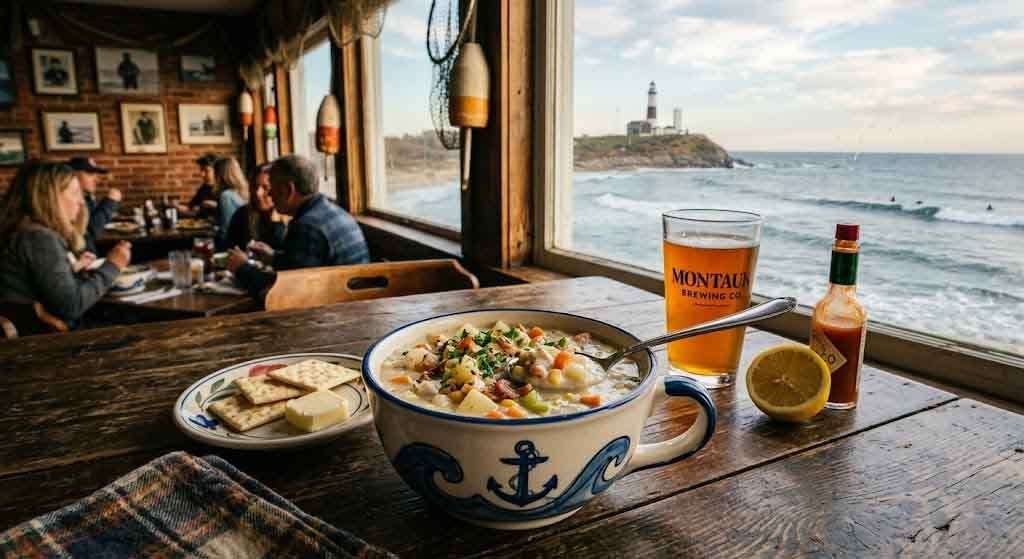
Weathered boards. Lantern smoke. The Atlantic hammering the bluffs at Hither Plain while a man in a cork life vest stood watch through a February gale. This was Montauk before the restaurants, before the surf shops, before Carl Fisher tried to build a second Miami at the end of Long Island. Long before any of that, there were the surfmen — federal employees of the U.S. Life-Saving Service, stationed in austere wooden outposts along the most treacherous stretch of the New York coastline — and in the cast-iron pot boiling on their woodstove, there was a chowder that history has largely forgotten.
It was seasoned by the ocean itself.
The Men and the Stations They Kept
The U.S. Life-Saving Service was formally organized by an Act of Congress on June 18, 1878, though federal support for coastal rescue operations on Long Island’s south shore had begun earlier, in 1871, when the Secretary of the Treasury was first authorized to pay professional surfmen up to $40 per month — ending the unreliable volunteer system that had allowed too many ships and too many lives to disappear into the Atlantic without aid (Greater Westhampton Historical Museum).
By 1914, thirty stations stretched from Rockaway Point to Montauk Point, spaced three to five miles apart, each housing a keeper and a rotating crew of surfmen drawn from local fishing and whaling families who knew how to handle a self-bailing rowboat in open surf (Montauk Library). Montauk’s own Hither Plain Life-Saving Station was erected in 1872 — just half a mile southwest of Fort Pond — with its first keeper, George H. Osborne, appointed on December 9 of that year. The Ditch Plain station followed in 1885 (Montauk Historical Society).
These were not comfortable postings. The U.S. Life-Saving Service Heritage Association’s documentation of daily station life describes a regimen of almost military discipline: surfmen were on duty twenty-four hours a day, with a single day off every eight days. Nights were spent walking beach patrols, men from adjacent stations meeting in the dark midway between their posts to exchange stamped metal tokens called “chits” as proof of patrol. Lookout tower duty ran from sunrise to sunset on clear days; on foggy days and at night, it was all patrols, all weather, no exceptions (USLSS Heritage Association).
The unofficial motto of the surfmen was plain and unsparing: You have to go out. You don’t have to come back.
A Station Kitchen at the Edge of the World
Inside the station itself, as documented by the National Park Service’s records of typical Life-Saving Service station layouts, the crew’s side of the building contained a kitchen, a dining room, a lounging area, and above it all, an unheated sleeping room where iron beds and numbered closets waited for men who might be called out into the surf at any hour. They read, played cards, told stories, and they cooked (NPS Maritime Museum).
Cooking at these stations was fundamentally a function of scarcity and isolation. The men were fishermen and whalers by background, not trained cooks. The provisions they worked with were the standard rations of the era — salt pork, hardtack, dried beans, potatoes, coffee, and whatever the sea and the local landscape chose to offer. There were no grocery deliveries to Hither Plain in the 1870s. There was a shallow water well, a wood stove, and the Atlantic, vast and indifferent, directly outside the door.
What the Atlantic offered, consistently and in abundance, were clams. Hard-shell quahogs, surf clams, and soft-shell steamers lay in the shallows and mudflats just off the Montauk shores, requiring nothing more than a bucket and some patience to harvest. And the ocean offered something else: water, already salted, mineral-rich, carrying within it a depth of flavor that straight table salt — when table salt was even reliably available — could never quite replicate.
Cooking with Seawater: An Old Practice, Not a Strange One
The use of seawater as a cooking medium is older than recorded history and appears across maritime cultures from the ancient Romans to the fishermen of coastal Maine. The classicist Alexis Soyer documented in his 1853 work The Pantropheon a Roman preparation calling for wild boar cooked in seawater with bay leaves — a technique valued not just for its salinity but for the mineral character the ocean water imparted to the meat (The Old Foodie).
Along the New England coast, cooking lobsters in vats of seawater over wood-fired stoves was a common practice — not as a novelty, but as the preferred method, one that produced a flavor that fresh water with added salt simply could not match. Modern culinary science supports what these coastal cooks understood intuitively: seawater averages around 3.5% salinity, lower than most commercial brines, but it carries trace minerals, iodine, and a layered oceanic quality that alters the taste of food cooked within it in ways that dissolved table salt cannot replicate (Edible Monterey Bay).
For the Montauk surfman standing at his kitchen stove after a night patrol along the Ditch Plains bluffs, reaching for a pail of Atlantic water to start a chowder pot was not an act of desperation. It was the obvious choice. The water was there. The clams were there. The potatoes and salt pork were in the pantry. And the knowledge of how to bring these elements together into something nourishing and real — that lived in the hands and the memory of men who had been fishing these same waters since before they wore federal uniforms.
The Chowder Itself: What They Were Actually Making
Early American chowder — particularly the style that would have appeared in a working coastal station in the 1870s and 1880s — bore little resemblance to the thick, cream-heavy New England version that now dominates the tourist restaurant menus of the Northeast. The first published clam chowder recipe, which appeared in the Boston Evening Post on September 23, 1751, was a thinner, broth-based preparation thickened with ship’s biscuit rather than flour or cream (Health Craft).
Herman Melville’s 1851 description in Moby-Dick of chowder served at the Try Pots on Nantucket — “small juicy clams, scarcely bigger than hazel nuts, mixed with pounded ship biscuits and salted pork cut up into little flakes, the whole enriched with butter” — gives a more accurate picture of what a surfman’s chowder might have looked like than any modern restaurant bowl does. Potatoes had largely replaced hardtack as the primary starch by the second half of the 19th century, which would have placed the Montauk stations squarely in the era of the potato-thickened, clear or lightly creamed chowder, built on clam liquor and seawater, salt pork rendered in the pan first, onions cooked in the fat (Lobsteranywhere.com).
Long Island’s own chowder tradition occupies a particular and genuinely intermediate position. As food historians have noted, Long Island clam chowder developed as a hybrid of the cream-based New England style and the tomato-enriched Manhattan style — a product of the island’s literal position between the two culinary worlds, as much a geographical fact as a culinary one. The surfmen at Hither Plain and Ditch Plains were cooking at the moment when this regional identity was still forming, working with ingredients that predate the Long Island “combination” style that would later become codified.
What they made was elemental. Seawater into the pot first, to a boil. Quahogs opened over the heat, their liquor joining the pot. Salt pork sliced and fried in a separate pan, the fat clarified and used to soften onions. Potatoes cut rough and simmered until just yielding. Everything combined, the pot pulled back from the direct heat to steep, flavors deepening. Perhaps a small pour of cream if the station had it. Hardtack crumbled in as a thickener, or left whole on the side for dipping.
It was not refined. It was not supposed to be. It was the food of men who had just come off a beach patrol in a January nor’easter and needed something hot and sustaining before the next watch.
The Legacy No One Documented
What makes the surfman’s chowder genuinely poignant as a piece of culinary history is precisely that no one wrote it down. The Life-Saving Service’s meticulous records documented rescue techniques, equipment inventories, patrol logs, and training schedules with bureaucratic thoroughness. The kitchen was another matter. The cooking existed in the same category as the weather itself — constant, essential, and too obvious to need recording.
The Hither Plain station remained in operation until 1933, when it was decommissioned as the U.S. Coast Guard absorbed the Life-Saving Service’s functions. By 1948, it was formally decommissioned. The Ditch Plain station served until prohibition-era reactivation in 1924 — Montauk had become a significant center for rum-running, and the federal government briefly pressed its coastal watchers back into service to monitor the traffic — before closing again with the end of Prohibition in 1933 (Montauk Historical Society). The buildings were eventually razed. The men scattered back into the fishing communities and local families from which they had come.
What they ate at those stations went with them, absorbed into household cooking that never needed to advertise its origins, never needed to become a menu item or a tourist attraction, never needed to call itself anything at all.
Why This Matters Now
There is a conversation happening across the American culinary landscape about provenance — about understanding where food comes from, what shaped it, and what was lost when that shaping happened in poverty or isolation rather than in celebrated kitchens. The surfman’s chowder belongs to that conversation.
It is also a reminder that the most sophisticated ingredient a cook can reach for is sometimes the one directly at hand. Seawater at 3.5% salinity, drawn from the Atlantic off the Montauk bluffs, carries within it a mineral complexity that no amount of kosher salt dissolved in tap water will replicate. The modern chefs experimenting with filtered and sanitized seawater as a cooking medium in restaurants in Greece, Scotland, and Maine are not discovering something new — they are recovering something that working-class coastal cooks understood as a matter of practical common sense for centuries (Edible Monterey Bay).
The surfmen of Hither Plain and Ditch Plains did not think of themselves as custodians of a culinary tradition. They thought of themselves as men who needed to eat before the next watch, who had clams and a cast-iron pot and an ocean full of the only salt they needed. The chowder they made was not an artifact of Long Island food culture — it was Long Island food culture, at its oldest and most honest, simmering on a woodstove while the Atlantic beat itself against the bluffs outside and a man in a lookout tower counted the lights of passing ships.
That is a recipe worth recovering.
Sources
- U.S. Life-Saving Service Heritage Association — Daily Station Life: uslife-savingservice.org
- Greater Westhampton Historical Museum — Potunk Life Saving Station History: whbhistorical.org
- Montauk Library — Life-Saving Heritage on Display: montauklibrary.org
- Montauk Historical Society — Lost Montauk: montaukhistoricalsociety.org
- National Park Service — Maritime Museum (Station Life Documentation): nps.gov
- Edible Monterey Bay — Out to Sea: Cooking with Ocean Water: ediblemontereybay.com
- The Old Foodie — Cooking with Seawater: theoldfoodie.com
- Lobster Anywhere — Seafood Chowder 101: History and Types: lobsteranywhere.com
- Health Craft — New England Clam Chowder: The Original Recipe and History: healthcraft.com
- Herman Melville, Moby-Dick (1851)