Food has always followed war. Not in the romanticized sense of soldiers sharing rations around a fire — but in the harder, more consequential sense of entire civilian populations reorganizing their kitchens, their shopping lists, and their understanding of nutrition around the logistics of a conflict they would never see firsthand. When the United States entered the First World War in April 1917, it entered not just with soldiers but with its pantries.
What followed was one of the most dramatic redirections of American eating habits in the country’s history — and some of the most inventive cooking this side of the Great Depression. At the center of it was Herbert Hoover, appointed by President Woodrow Wilson as head of the newly formed U.S. Food Administration, and a walnut-sized nutritional truth that American kitchens were slow to recognize: protein does not require meat to exist.
That truth had everything to do with the ground beneath Long Island’s North Fork.
Hoover’s Kitchen Revolution
On August 10, 1917, Wilson signed Executive Order 2679-A, creating the U.S. Food Administration (USFA). Hoover — who had already distinguished himself running humanitarian food relief operations in Belgium under German occupation — took the position on the condition that the program remain strictly voluntary. No federal rationing. No government enforcement. Just persuasion, propaganda, and a deep faith that American housewives, if given both the moral argument and the practical tools, would cooperate.
He was right. By 1918, the USFA claimed more than 10 million homes had submitted formal pledges to modify their diets. Domestic food consumption fell roughly 15 percent — without a single mandatory restriction (U.S. Food Administration Records, National Archives, 1918). The word “Hooverizing” entered the American vernacular, meaning to economize. “Meatless Tuesdays,” “Wheatless Wednesdays,” and “Porkless Thursdays” became household mantras in millions of American homes.
The administration’s genius was in its framing. It did not ask people to eat less — it asked them to eat differently. Its pamphlets insisted that the word “save” had been overemphasized in the public mind, and that “substitute” was the more honest, more useful concept. The USFA’s Educational Division published menus, distributed recipes through women’s magazines, and trained home economists nationwide to develop palatable alternatives. The propaganda posters were striking: “Food Is Ammunition — Don’t Waste It.” The message was patriotic, urgent, and concrete.
Alternative proteins that the USFA promoted explicitly included fish, beans, peanuts, and other nuts. It was this last category — nuts — that would prove to be the most elegant, the most dense, and the most underappreciated substitution of the entire war effort.
The Meatless Loaf as a Form of Ingenuity
The “meat loaf” was not new in 1917. It was already a Depression-era ancestor of itself, a working-class utility dish that stretched protein through breadcrumbs, eggs, and binding agents. What the wartime kitchen did was strip out the meat entirely and rebuild the loaf’s structural and nutritional logic from scratch.
The results were more sophisticated than the average American expected. Archival recipes recovered by NC State University’s Special Collections from the Progressive Farmer — a widely circulated agricultural weekly during the war years — show a range of wartime loaves built on legumes and nuts. A “Potato Peanut Loaf” from the March 23, 1918 issue called for a cup of ground peanuts or peanut butter, bound with mashed potato, milk, fat, and two eggs. A “Soy Bean Loaf” from February 2, 1918 combined cold boiled soybeans with bread crumbs, tomato catsup, onion, egg, and seasoning — rolled and baked, served with a savory sauce.
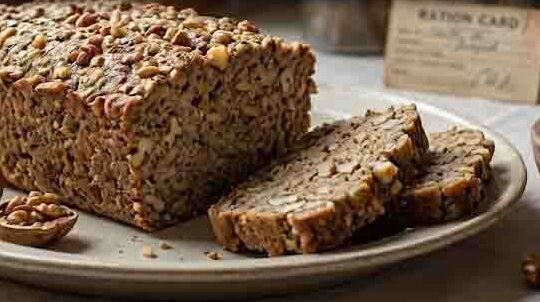
Walnut appeared in multiple wartime recipes both as a primary protein source and as a textural anchor — its fat content and density giving the loaf the structural integrity that ground beef would otherwise provide. The sweet-astringent depth of the walnut also brought a complexity to the flavor profile that beans and peanuts, for all their value, couldn’t quite replicate. This wasn’t accidental. The wartime home economist understood intuitively what food scientists have since confirmed in peer-reviewed research: the walnut is, nutritionally, one of the most complete plant foods available.
The Walnut’s Nutritional Case
To understand why the walnut earned its place in the wartime kitchen — and why it deserves serious consideration in the contemporary one — requires a brief look at the numbers.
A 100-gram serving of English walnuts contains approximately 15.5 grams of protein, 7 grams of dietary fiber, and a fat profile dominated by polyunsaturated fatty acids, including significant quantities of alpha-linolenic acid (ALA), the plant-based omega-3 fatty acid (USDA National Nutrient Database). Black walnuts, Juglans nigra, which grow natively across New York State and have been documented throughout Suffolk County’s landscape since the early settlement period, carry an even more impressive protein load — research published in Frontiers in Nutrition (2022) found black walnut kernels contain 24.06 grams of protein per 100 grams, substantially higher than the Persian walnut commonly found in American grocery stores.
The essential amino acid profile of walnuts is broad and functional: leucine, isoleucine, valine, phenylalanine, threonine, and particularly high concentrations of arginine and glutamic acid (PMC, National Center for Biotechnology Information, 2023). The one structural limitation — relatively low lysine content — is precisely what made wartime combination recipes so nutritionally intelligent. Pair walnut with a legume or grain, and you cover the full amino acid spectrum.
The wartime kitchen, working without modern nutritional science vocabulary but with centuries of folk wisdom and a crash course in protein chemistry, arrived at this conclusion through necessity. The combination of walnut and potato — both abundant, both shelf-stable, both cheap — produced a loaf that could genuinely sustain a working family through a meatless day without the particular hollowness of a meal that feels like an apology for what it isn’t.
The North Fork as Larder
Sixty miles east of midtown Manhattan, where the Long Island Sound narrows and the potato fields of the North Fork begin their slow march toward Orient Point, there has been continuous cultivation since at least 1640 — when early European settlers first purchased land from the Corchaug people of what is now Cutchogue (Peconic Land Trust historical records). That makes the North Fork’s agricultural soil among the oldest continually worked farmland in the United States.
By 1917, the North Fork was already a diverse agricultural engine. Farms in the towns of Southold, Riverhead, and Greenport grew potatoes, vegetables, and grain. Wickham’s Fruit Farm in Cutchogue — still operating today across 200 acres under Suffolk County’s Farmland Preservation program — traces its continuous cultivation to 1661. The region’s climate, moderated by both the Long Island Sound to the north and the Peconic Bay to the south, sits squarely in USDA hardiness zones 6 and 7. This is precisely the zone in which English walnuts thrive and in which black walnut — a tree native to the northeastern United States — grows without effort.
Black walnut (Juglans nigra) is not a cultivated specialty crop on the North Fork. It is a native species, a tree that grows along fence lines, at the edges of old farm lots, and in the margins of the North Fork’s many preserved natural areas. During the years of the First World War, a housewife in Mattituck or Jamesport would not have had to purchase walnuts. She would have had to gather them — from the same tree her grandmother may have known — hull them on the back steps, and fold them into a wartime loaf alongside mashed potato and egg.
This is local sourcing at its most elemental. Not farm-to-table as a marketing concept, but farm-to-table as a fact of survival.
Reconstructing the Wartime Walnut Loaf
The recipe below is a reconstruction, built from wartime-era USFA source materials and the nut-and-potato loaf traditions documented in the Progressive Farmer archives. It is not a facsimile of a single dish but a synthesis of the logic that governed meatless cooking in 1917 and 1918. Measurements have been adapted for the modern kitchen.
Ingredients (serves 4–6)
- 2 cups ground or finely chopped walnuts (black walnuts preferred for depth of flavor; English walnuts acceptable)
- 2 cups riced or well-mashed potato (approximately 2 medium Russets)
- 1 medium onion, finely minced and sautéed until soft
- 2 eggs, beaten
- ½ cup whole milk or the liquid from cooked beans for a deeper, earthier note
- 1 cup breadcrumbs (wartime cooks used day-old cornbread or rye; either works beautifully)
- 1½ teaspoons salt
- ½ teaspoon sage, dried
- ½ teaspoon black pepper
- 1 tablespoon rendered fat or butter for oiling the pan and brushing the top
Method
Preheat the oven to 350°F. Combine the ground walnuts, mashed potato, sautéed onion, breadcrumbs, eggs, milk, and all seasoning in a large bowl. Mix thoroughly — the texture should be dense and cohesive, holding its shape when pressed. If the mixture feels slack, add breadcrumbs by the tablespoon until it firms. Transfer to a well-oiled 9×5 loaf pan, pressing the mixture firmly and evenly. Brush the top surface with fat. Bake uncovered for 50–55 minutes until the top is deeply browned and the internal structure has set firm. Rest for 10 minutes before slicing.
Serve with a sharp tomato sauce — the acid cuts the richness of the walnut fat — or with a drizzle of good gravy if your pantry allows. A side of pickled vegetables, which wartime cooks produced from their liberty gardens in abundance, brings the necessary brightness.
What the Wartime Kitchen Understood That We Forgot
Somewhere between the end of the First World War and the post-war prosperity of the 1920s, the extraordinary ingenuity of the American meatless kitchen got filed away. Meat returned to the table in quantity, and the nut loaf retreated to the fringes of American cooking — preserved mainly in vegetarian cookbooks and the occasional Thanksgiving side dish, where it sits today with a reputation undeserving of its history.
The wartime kitchen understood something that the contemporary farm-to-table movement has only recently rediscovered: that protein is not the exclusive province of animals, that flavor can be built from the fats and sugars of nuts and the earthiness of well-cooked starch, and that a dish made from what the land around you actually grows is almost always more interesting than one made from what a supply chain delivers.
The North Fork of Long Island — with its native black walnut trees, its centuries of continuous cultivation, and its proximity to some of the most productive small-farm acreage in the Northeast — was precisely the kind of place where a dish like this could have originated organically, grown from need and local knowledge rather than from any recipe card.
It still can.
The wartime meatless loaf was never really about the absence of meat. It was about the presence of imagination. About taking what the landscape offers — a handful of walnuts from the tree at the edge of the field, two Russets from the cellar, an egg, a heel of old bread — and building something that sustains.
That kind of cooking is never really out of season.
Sources
- U.S. Food Administration Records, National Archives and Records Administration (NARA), Record Group 4, 1917–1918. archives.gov
- NC State University Special Collections, Recipes from World War I (Part 1) — Meatless, 2019. lib.ncsu.edu
- Ponder, Stephen. “Popular Propaganda: The Food Administration in World War I.” Journalism and Mass Communication Quarterly 72:3 (1995): 539–550.
- Herbert Hoover Presidential Library and Museum, “Years of Compassion 1914–1923.” hoover.archives.gov
- Saturday Evening Post, “Herbert Hoover’s Meatless Wheatless World War I Diet,” 2018. saturdayeveningpost.com
- Frontiers in Nutrition, “Quantification of Vitamins, Minerals, and Amino Acids in Black Walnut (Juglans nigra),” 2022. frontiersin.org
- PMC / National Center for Biotechnology Information, “Advanced Insights into Walnut Protein: Structure, Physiochemical Properties and Applications,” 2023. pmc.ncbi.nlm.nih.gov
- Peconic Land Trust, North Fork agricultural history. peconiclandtrust.org
- Atlas Obscura, “The Meatless, Wheatless Meals of World War I America,” 2025. atlasobscura.com