Autumn on Long Island’s North Shore arrives like a slow exhalation — the last heat of summer releasing its grip on Sound Avenue, the farm stands filling up with crates of Honeycrisp and Empire, and the air turning sharp enough to make the idea of a warm kitchen feel like an act of mercy. It is the season of apples. And if you know where to look — at Lewin Farms in Calverton, at Harbes Family Farm across 78 acres of Riverhead, at Wickham’s Fruit Farm in Cutchogue with its presses running since the 1600s — you will find that the North Fork still holds an agricultural memory older than most of the country’s suburbs.
This is the season when a Depression-era recipe I have been thinking about for years comes back into full clarity: baked apples finished in rendered bacon fat. Simple. Austere. Startlingly good. A dish that never required a cookbook or a culinary school to understand — only a coal stove, a jar of saved drippings, and an apple from whatever tree was standing in the yard.
The Grammar of Scarcity
The Great Depression reshaped the American kitchen with the logic of a hard frost: everything tender died, and what survived was built for endurance. After the stock market collapse of October 1929, families across the country learned to cook with what they had rather than what they wanted. Butter was expensive. Eggs were rationed by necessity. Meat was a luxury dressed up as a weekday staple — which meant what remained after the bacon was gone, the fat rendered into the pan, was among the most valuable things in the house.
Bacon was prized more for its fat — its drippings — than for the meat itself during the Depression years. A family might fry a few strips of side pork and stretch the resulting grease across three or four additional meals. Families stretched every ingredient to its limit, learning to make do with what they had and redefining what it meant to be resourceful in the kitchen. That resourcefulness was not a reduction of cooking — it was a different kind of mastery, one that understood the full value of what a single ingredient could give.
Into this context, the baked apple made perfect sense. Apples were abundant and cheap, especially in the Northeast. They required no refrigeration. Cored and filled with cinnamon sugar and a tablespoon of rendered fat, they baked into something that approximated the comfort of a full pie without its flour, butter, or pastry labor. Homemakers had to keep their families fed, whether or not they enjoyed everything they were eating — but this particular recipe was one they genuinely could.
The bacon fat was the stroke of genius. Not because it was all that was left, though sometimes it was, but because it worked. The smoked pork fat caramelized at the edges of the cored cavity, the sugars deepening into something complex and savory-sweet, the apple’s own pectin thickening the pan juices into a lacquered glaze. It was, by accident and necessity, elegant.
The Science of the Fat
Understanding why bacon fat works in a baked apple requires a brief detour into the chemistry of the pan. Bacon grease is about 40% saturated fat and has a smoke point of around 325 degrees — lower than avocado oil, higher than butter. In a slow oven at 350°F, it stays just below that threshold, melting rather than burning, basting the interior of the apple as it renders further in the heat.
Bacon grease is a rich source of flavor compounds, including umami taste, which is responsible for its distinctive savory flavor. That umami note — the same quality that makes a great stock or a well-aged cheese feel complete — acts as a flavor bridge in a sweet preparation. It suppresses bitterness, amplifies sweetness, and gives the finished dish a rounded depth that butter alone cannot provide. The smokiness from the curing process penetrates the apple’s flesh as steam carries it upward through the cored channel, acting as a gentle marinade from the inside out.
The distinction between lard and bacon fat matters here. Bacon fat is specifically fat from the belly of the pig that comes from bacon. This distinction is important because bacon is often smoked, so with bacon, you’ll get that smoky flavor, and with most lard, you won’t. A plain lard baked apple would be richer, softer, more neutral. A bacon fat baked apple carries a whisper of the smokehouse — an undercurrent that reads as sophistication when you’re not expecting it.
As chef and author Samin Nosrat writes in Salt, Fat, Acid, Heat, food can only ever be as delicious as the fat with which it’s cooked. The Depression-era cook who first spooned drippings into a cored apple may not have been thinking in those terms, but she arrived at the same conclusion through the unforgiving precision of necessity.
The North Shore Apple
Long Island is not the first place that comes to mind when people think of apple country — the Hudson Valley gets that distinction, as does New England. But the North Fork has been growing tree fruit longer than most American institutions have existed. Wickham’s Fruit Farm dates back to the 1600s and offers more than 40 apple varieties, a living agricultural continuity that predates the Revolution. Harbes Family Orchard spans 15 acres and features over 27 apple varieties, including Gala, Sansa, Honeycrisp, and Golden Delicious. Lewin Farms is Long Island’s first you-pick farm, offering a variety of crops throughout the year, including apples.
For a recipe like this, apple selection matters more than people realize. The baked apple lives or dies on texture: you need a variety that softens fully in the oven without collapsing into mash, one with enough natural acidity to hold its own against the fat and sugar. Tart apples that hold their shape during cooking are ideal — Cortland, Granny Smith, Jonathan, Northern Spy, or Pink Lady all work well. A Honeycrisp will go too soft. A Red Delicious — which has almost no acid to speak of — will taste of nothing. Cortland and Empire, the workhorses of the North Fork harvest season, are the right choice: firm, tart, full of that clean autumnal sweetness that no other season can replicate.
If you can pull a bag from Lewin’s in Calverton or work through a row of Northern Spy at Breeze Hill Farm in Peconic, you are starting with an apple that was picked within the week, which means the pectin is at full strength and the skin will hold its shape in the oven. That matters.
The Recipe Itself
The Depression-era version of this dish is aggressively simple, and that simplicity is not a concession — it is the point.
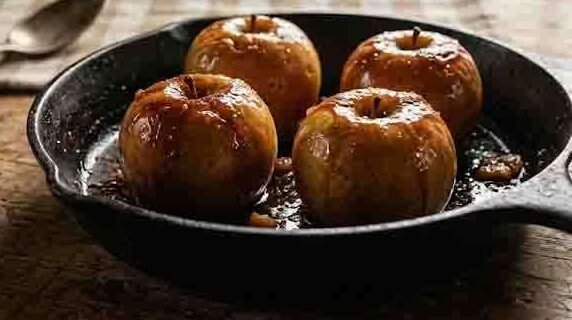
Core three or four large apples without piercing through the bottom, leaving a floor of flesh to contain the filling. Combine brown sugar — not white, which tastes thin in comparison — with ground cinnamon in roughly a three-to-one ratio. Pack the cavity tightly with the mixture. Into the bottom of each cored channel, set a full tablespoon of bacon fat, not just a smear. Set another half-tablespoon on the crown. Place the apples in a heavy baking dish — cast iron if you have it — and pour enough water into the base of the pan to cover the bottom by a quarter inch, which prevents the caramelizing sugars from scorching and creates the steam that helps the flesh cook evenly from the outside in.
Bake at 350°F. The timing varies by apple size and oven, but the range sits between 45 minutes and an hour. You are looking for a fork to pass through the thickest part of the flesh without resistance, for the skin to have taken on a burnished, slightly wrinkled look, and for the pan juices to have reduced into a dark, fragrant glaze. Pull them from the oven and let them rest for five minutes before serving — they are better warm than hot, when the flavors have had a moment to settle.
There is no ice cream in the original recipe. But if you are serving this in a contemporary context, a scoop of vanilla alongside cuts through the richness in a way that would have made Depression-era cooks weep with envy.
The Modern Return
In the wake of recent economic hardship, we have seen a great return to the recipes of the Great Depression and World War II eras. People are getting creative in the kitchen, finding new ways to use the same ingredients in several recipes. This is not nostalgia for poverty — it is something more useful. It is the rediscovery that constraints often produce better cooking than abundance, that a kitchen organized around full use of every ingredient tends to produce food with more complexity and intention than one organized around convenience.
The bacon fat baked apple fits neatly into several contemporary food conversations: the growing interest in nose-to-tail cooking and zero-waste kitchens, the revival of rendered animal fats as an alternative to industrial seed oils, the renewed appreciation for fermentation and slow food that has reshaped how serious home cooks stock their pantries. Before the era of readily available vegetable oils, animal fats were a dietary staple and vital cooking ingredient. Saving bacon fat wasn’t just about flavor; it was about resourcefulness and minimizing waste. Today, with a renewed appreciation for traditional cooking methods and a growing awareness of healthy fats, rendered bacon fat is experiencing a renaissance.
Restaurants serving American heritage food have quietly put baked apples back on menus, usually dressed up with calvados or crème fraîche and a candied walnut or two. The bones of the dish remain unchanged. What the Depression cook stumbled into by necessity, the contemporary chef arrives at by research.
What Survives
There is something worth sitting with in this recipe that goes beyond flavor and technique. The apple, the fat, the cinnamon, the fire — these are ancient cooking elements assembled without any pretension toward sophistication. And yet what comes out of the oven has a quality that expensive ingredients and elaborate technique often fail to achieve: it tastes like someone cared about it.
The Long Island orchards that are still standing — Wickham’s, Harbes, Lewin’s, Breeze Hill — are themselves versions of this same economy. They have survived because they produce something real, something rooted in specific soil and specific seasons, something that does not exist in the same form anywhere else. The apple you pick from a tree in Calverton or Cutchogue in late September is not the same apple that arrives in a grocery store in February. The fat from a good rasher of smoked bacon is not a neutral cooking medium — it is a carrier of flavor, a record of everything that went into the pig’s rearing and the smokehouse’s particular cure.
When you bake these two things together, you are participating in a tradition of making something remarkable from what the season and the pantry provide. That is all cooking has ever been. The Depression-era homemaker knew this instinctively, because she had no choice. We have every choice, which is precisely why it is worth choosing this one.
Sources
- Great Depression Cooking With Clara — heritagediner.com reference to Clara’s Depression Cooking series
- Eats History — What Did People Eat During the Great Depression? (eatshistory.com)
- Eat Healthy 365 — Great Depression Era Breakfasts: What People Really Ate (eathealthy365.com)
- Sidney Museum — Baked Apples: Edible Artefacts (sidneymuseum.ca)
- AmazingRibs.com — The Science of Oils and Fats (amazingribs.com)
- ShiftyChevre — What Is Rendered Bacon Fat? (shiftychevre.com)
- Grassland Beef / Discover — Bacon Grease Uses: A Home Cook’s Guide (grasslandbeef.com)
- EatingMeals — What Kind of Fat Is Bacon Grease? (eatingmeals.com)
- The Reader’s Kitchen — Fried Apples and Onions (thereaderskitchen.com)
- Going Local Long Island — The Best Spots for Apple Picking on Long Island (goinglocal.li)
- Arbor View House — Apple Picking on the North Fork of Long Island (arborviewhouse.com)
- Food Hero — Depression-Era Desserts Are Making a Comeback (foodhero.com)
- Samin Nosrat — Salt, Fat, Acid, Heat (Simon & Schuster, 2017)