Custard has always been a test of patience. Long before the New York cheesecake claimed its throne in the dessert canon, bakers across Europe understood that eggs, fat, and heat required a certain kind of respect — slow, deliberate, and forgiving of nothing. What makes New York cheesecake both iconic and technically demanding is that it pushes that understanding to its limit: a high-fat, egg-heavy filling baked to a razor’s edge between silky and seized.
Getting it right is not a matter of luck. It’s a matter of understanding what’s actually happening inside that springform pan.
The Origins of a Culinary Standard
Arnold Reuben, a German-Jewish immigrant who owned a succession of Manhattan restaurants, is generally credited with creating the New York style cheesecake after sampling a cheese pie at a dinner party in 1929 — acquiring the recipe from the hostess and substituting cream cheese for the original curds. The timing was not accidental. Essential to the rise of cream cheese-based cheesecake was the addition by producers in the late 1920s of stabilizers — without them, the cheese would break up during baking and produce a grainy texture.
Cream cheese itself was invented in 1872 by American dairyman William Lawrence of Chester, New York, who accidentally created it while trying to reproduce French Neufchâtel — a denser, creamier result that enabled a completely different texture in baked goods. Once stabilizers solved the baking problem, the New York style cheesecake spread fast. In 1950, Junior’s opened in Brooklyn and has been a king among New York cheesecake makers ever since — and remains the benchmark by which most serious home bakers measure their results.
What sets the New York version apart from its softer cousins is density. The ratio of cream cheese to liquid is high, the eggs are present in force, and the result is a filling that walks the line between a firm custard and a yielding, dense cake. That balance is everything — and it’s chemistry, not guesswork.
The Emulsion at the Core
Before a cheesecake ever touches heat, the battle is already underway in the bowl. Cream cheese is itself a stabilized dairy emulsion — fat, protein, and water held together in suspension. When you begin mixing it with eggs and sour cream, you’re building a second-order emulsion on top of an existing one.
Eggs act as emulsifiers in cheesecake, helping to create a smooth and creamy texture. The egg yolks contain lecithin, a natural emulsifier that helps blend the fats from ingredients like cream cheese with water-based components like lemon juice or sour cream — producing a homogenous mixture that contributes to the cheesecake’s velvety mouthfeel.
This is why room temperature ingredients are non-negotiable. Using room temperature ingredients, especially cream cheese and eggs, is crucial for proper emulsification. Everything blends smoothly and quickly, ensuring you don’t overmix and incorporate too much air into the batter. Cold cream cheese doesn’t blend — it lumps. And lumps in an emulsion become fault lines in a finished cheesecake.
Overmixing is the opposite problem. Eggs hold air inside the batter, which could rise up and cause cracks. Mix the eggs as little as possible once they’re added. The pre-egg mixture can take a beating, but once the eggs go in, restraint is the rule. You are no longer trying to create structure — you are trying to preserve it.
Some bakers add a tablespoon of flour or cornstarch to the batter as insurance. Starch stabilizes the proteins in the eggs, helping to stop them from shrinking and causing cracks to form. It’s a small addition, nearly imperceptible in the final texture, but it gives the protein network a scaffold to hold onto during the thermal stress of baking.
Why the Water Bath Works
The bain-marie — water bath — is the single most argued technique in cheesecake baking. Some bakers skip it entirely, finding workarounds in lower temperatures and slower cooling. But the physics of why it works are worth understanding, because they reveal exactly what you’re trying to protect.
Water boils at 212°F at sea level. While the oven temperature may be set to 325°F or 350°F, the temperature immediately surrounding the cheesecake in a water bath cannot exceed 212°F. This thermal ceiling is what provides the insulation — the sides of the cheesecake don’t cook and dry out before the center has a chance to set.
A water bath creates a moist atmosphere that keeps the cake from drying out and cracking, while the hot water surrounding the pan bakes the filling gently and evenly. This addresses two separate failure modes at once: direct overcooking of the outer edge, and surface dehydration that leaves the top brittle and prone to tearing.
A water bath paired with low heat safeguards against rapid temperature fluctuations during the critical phase of egg coagulation, where proteins undergo structural changes. A gentle approach minimizes the risk of curdling, where the protein structure contracts and expels moisture — leading to a porous, tough texture rather than a smooth, creamy one.
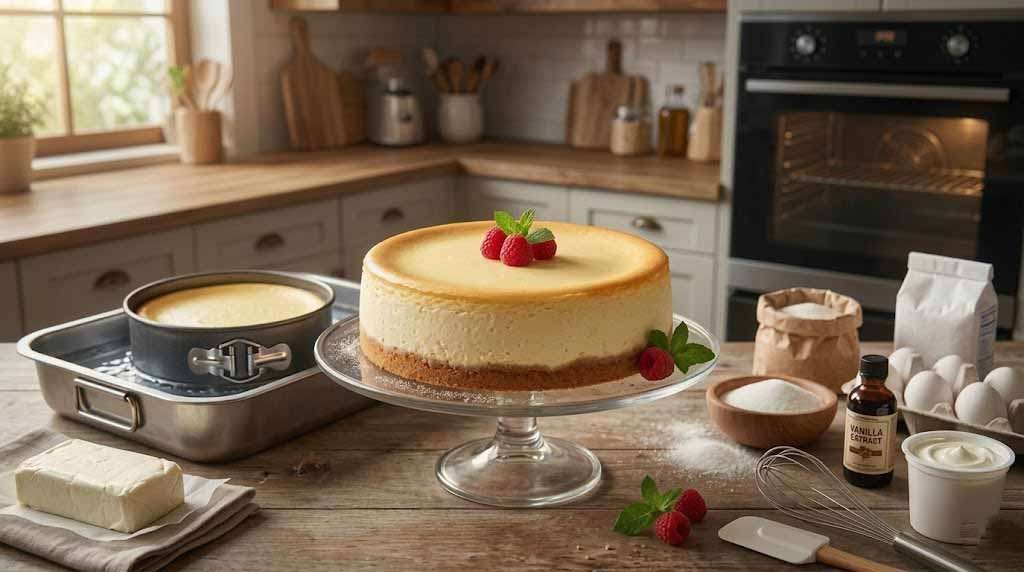
The practical setup matters. Wrap the outside of the springform pan in two tight layers of heavy-duty aluminum foil, up and over the sides, before setting it in the roasting pan. Fill the outer pan with hot tap water to about halfway up the cheesecake pan’s sides. The foil keeps the crust dry. The water keeps the oven air humid and the outer walls of the filling cool. Both do essential work.
For bakers who worry about water infiltrating through the foil — a reasonable concern with older pans — an alternative works well: place a roasting pan filled with an inch of boiling water on the bottom rack of the oven, and bake the cheesecake on the rack above it. The steam from the hot water below creates a humid oven environment that prevents the cheesecake from developing a surface crust or film, which is more prone to cracking upon cooling. It’s a softer version of the full bain-marie, and while it doesn’t provide the same thermal insulation at the pan’s sides, it handles the surface-dehydration problem effectively.
Reading Doneness Correctly
This is where most cheesecakes go wrong. The visual cues for a done cheesecake are counterintuitive, and bakers trained on standard cakes often pull them out too early or — worse — too late.
Cheesecake that’s baked correctly will register a maximum of 175°F about one inch in from the outer edge, and at least 150°F in the very center when measured with a digital thermometer inserted halfway through the filling. Temperature is far more reliable than appearance. The center should still wobble when you nudge the pan — not slosh like liquid, but move with the slow, loose roll of barely-set gelatin. That wobble is residual heat doing the rest of the work.
Overbaking is the chief cause of cracked cheesecake. An overcooked cheesecake has protein networks that have contracted too tightly, expelled moisture, and stiffened — and when that stiff outer ring meets a still-cooling, still-contracting center, the surface tears. The crack you see is structural failure caused by differential contraction.
Do not open the oven door during baking. Big cracks are often caused by drafts and sudden temperature changes. Every time the oven door opens, a wave of cool air hits the cheesecake’s surface and accelerates the formation of that surface film you’re trying to avoid.
The Cooling Protocol: Where Cracks Are Born or Prevented
Getting the bake right is half the battle. The other half happens after the oven turns off.
Cheesecakes typically crack when the center and edges cool at drastically different rates. When the hot, airy center is exposed to cool room air, it rapidly shrinks while the set edges remain rigid — tearing the surface.
The solution is a gradual thermal descent. Turn the oven off when the cheesecake reads the right internal temperature, and leave it inside with the door cracked — propped with a wooden spoon — for at least one hour. Turning the oven off and leaving the cheesecake inside for one full hour creates a temperature transition so gradual it eliminates thermal shock entirely. After that, move it to a wire rack at room temperature for another hour before refrigerating.
Transfer the loosely covered cake to the refrigerator and chill for a minimum of six hours, ideally overnight — this non-negotiable step allows the texture and flavors to fully develop. Cheesecake sliced before it has fully set will look soft, taste dense in the wrong way, and lose its clean line on the plate. Overnight refrigeration transforms the texture entirely. The proteins firm up, the emulsion stabilizes, and the subtle tang of the sour cream rounds out fully.
One additional trick before baking: run a thin, flexible knife around the edge where the batter meets the pan before putting the cheesecake in the oven. This minor scoring prevents the edges from sticking tightly to the pan as the cheesecake shrinks slightly while baking — reducing the tension that causes cracks.
Ingredient Choices That Determine the Outcome
The classic New York formulation relies on full-fat Philadelphia brick cream cheese — not the spreadable tub variety, which contains more water and less fat, and will not produce the same density or set. Sour cream is the traditional acidic dairy addition, contributing tang and a slightly looser texture than heavy cream, which builds more body. A cheesecake made with only cream cheese and eggs will be dry and will likely develop surface cracks; sour cream or heavy cream adds moisture and creaminess that the bake needs.
The graham cracker crust requires its own attention. Press it firmly and evenly — thin spots will crack, thick spots won’t bake through. Pre-bake it at 350°F for eight to ten minutes before adding the filling. This sets the butter, which prevents the crust from absorbing moisture from the batter and turning into a wet, flavorless layer.
Vanilla and lemon zest are standard additions, both serving to cut through the fat with brightness. Some purists use only one. The point is balance — nothing should announce itself above the cream cheese, which is the ingredient the entire dessert exists to celebrate.
What the Surface Crack Is Actually Telling You
When a cheesecake cracks, most bakers respond with frustration. A better response is curiosity. A crack is a structural record of what happened inside the filling during the bake and the cool — a kind of topographic map of thermal events.
A large central crack usually means the cheesecake was overbaked or cooled too fast. A ring of small cracks near the edge means the outer wall set before the center did, likely from too much direct heat or an oven running hot. A fine web of surface cracks across the top often indicates the surface dried out during baking — the water bath or steam wasn’t doing its job.
None of these outcomes are irreversible in the aesthetic sense. A spoonful of sour cream spread over the surface and five minutes back in a warm oven will seal most cracks visibly. A fruit topping will cover the rest. But understanding the cause means the next cheesecake comes out better — and eventually, the surface stays smooth from oven to refrigerator to plate.
That’s the standard worth chasing: a cheesecake so well executed it needs nothing on top. Dense, pale gold at the edge, ivory at the center, the surface unbroken. A slice that holds its edge cleanly and yields to a fork with the weight of something that took patience to produce.
It always does.